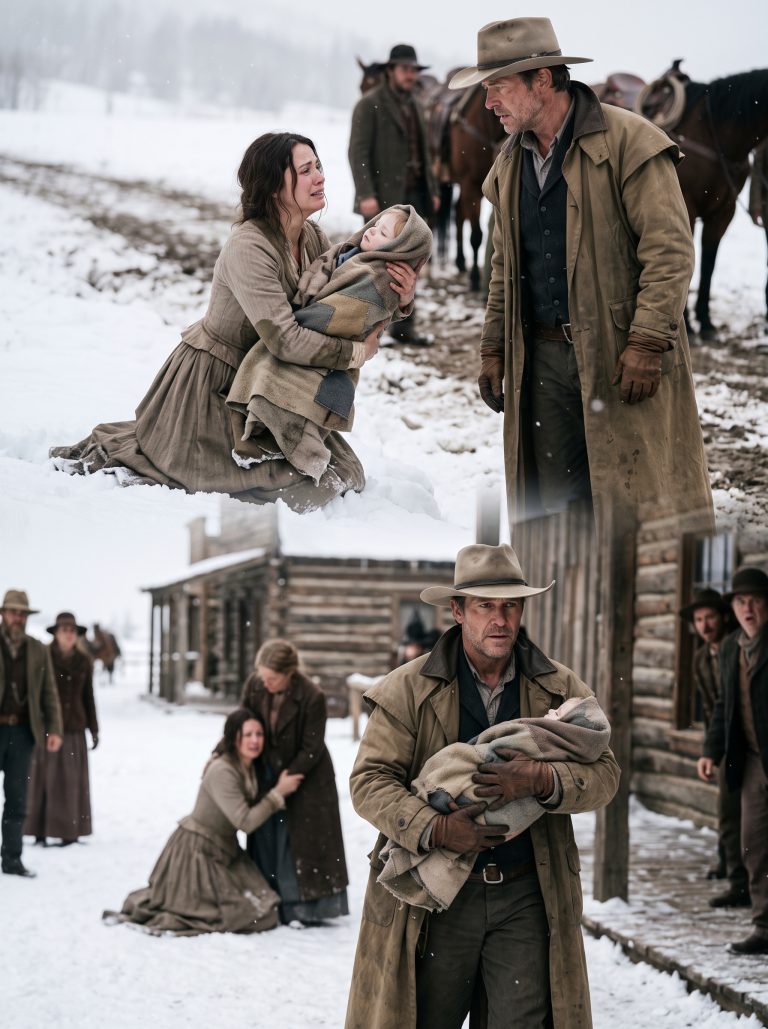
She Married a Rich Colorado Cowboy Just to Escape the Streets—But When His Sons Called Her “Mom,” His Sister-In-Law Declared War*

Part 1
The knock came just after sundown, hard enough to rattle the thin door of Mrs. Hobb’s boarding house and stop Emily Hart mid-motion, one hand still folded around a stocking she was packing into her trunk.
In Larkspur Hollow, nobody knocked that way unless they meant to take something from you.
That afternoon the town council had shut the schoolhouse. The Blackwood Mining Company had cut wages at the stamp mill, and half the families with school-age children had already pulled up stakes for Butte. Six pupils did not justify a teacher’s salary, the council said, hats in hand, eyes on the floor. Emily had thanked them for their trouble and walked home with her spine straight, because pride was sometimes the only wage a woman got to keep.
She opened the door to find Mrs. Hobb’s husband on the other side, twisting his hat.
“I’m sorry, Miss Hart. The missus needs the room let to someone who can pay. You’ve got till Sunday.”
Emily said she understood. She did not say that Sunday felt like the edge of a cliff.
When he left, a second knock came, deeper and unhurried. She opened the door on a man the whole county knew by reputation before they knew him by face: Nathaniel Cross, owner of Cross Creek Ranch, a spread that ran clear to the foothills. A widower. Father to two boys no housekeeper had lasted more than a season with.
“Miss Hart,” he said. “I’d like a word.”
He did not offer comfort when his eyes found her packed trunk, and she was grateful for it. Pity would have broken something in her that pride was still holding together.
“I need someone to raise my sons,” he said, once she’d let him in. “And you need a roof. I’m not asking you to love me. I’m asking you to marry me.”
The word hit the small room like a dropped plate.
“You don’t love me,” she said.
“No.”
“And I don’t love you.”
“I know. That’s not what I came to buy.”
It should have insulted her. Instead, his bluntness steadied her, the way a fence post steadies a man walking a dark field. He laid it out plain: her own room, authority in his house, his name, and in return, his sons — Caleb, ten, and Jonah, seven — who had chased off three housekeepers and a tutor since their mother drowned two winters back, when the old mill dam above the ranch let go in a spring flood.
“Why me?” she asked.
“Because you made Tom Reed mend the window he broke instead of shaming him for breaking it. Because you kept teaching children whose folks paid you in eggs. My boys don’t need obedience, Miss Hart. They need mercy with a backbone.”
Thunder walked low over the hills. Emily looked at her trunk, at the three days between her and homelessness, and understood that some doors only opened once.
“If I do this,” she said, “I won’t be decoration. I will discipline them and comfort them and love them whether they want it or not.”
Something that looked almost like respect crossed his hard face. “I’d expect nothing less.”
“Then I’ll do it.”
Cross Creek Ranch rose out of the rain like a fortress built against loneliness — lantern-lit windows, a porch that ran the length of the house, dark barns crouched beyond. Two boys waited in the hall. Caleb had his father’s set jaw and eyes gone flat with old grief. Jonah hid half behind his brother, pale, small.
“Boys,” Nathaniel said. “This is Miss Hart.”
Caleb’s gaze raked over her single trunk. “She ain’t our teacher.”
“No,” his father said. “She’s come to live with us. She’ll be part of this family.”
Jonah looked at her sideways. Caleb’s mouth twisted into something too old for a ten-year-old.
Emily knelt anyway, ignoring the wet hem dragging at her ankles. “I’m not here to replace anyone,” she told him gently. “Your mother is yours. Always. I’m only here.”
Caleb studied her the way a man studies a stranger’s horse before deciding whether to trust it near his own.
“You won’t last,” he said.
They were married two mornings later, before the boys ever had the chance to test that prediction. The territorial justice of the peace read the vows in his own parlor in under ten minutes, Nathaniel’s foreman and his wife standing as witnesses. Emily wore her one good gray dress. Nathaniel slid a plain band onto her finger with hands that were careful, not tender — the hands of a man keeping a promise, not making love. When the justice pronounced them married, Nathaniel said, “Thank you, Emily,” quiet and formal, and she answered, “Thank you for giving me a place,” and that was the whole of their wedding.
It was enough to make it real. A signature in a ledger in the county seat. A ring that meant something different to each of them and nothing at all to the town, which would spend months deciding whether to call it scandal or good sense.
That evening, back at the ranch, Nathaniel gathered the boys in the hall and said the word plainly for the first time. “She’s your mother now. By law and by my word.” Jonah flinched backward at the weight of it. Caleb only watched Emily’s face, as if waiting to catch her in a lie.
And as rain hammered the roof that first night home, and Nathaniel Cross stood silent behind her in the hall, Emily understood that shelter had been the smallest part of what she’d just agreed to survive.
Part 2
Caleb meant to drive her out before breakfast. He knocked over his chair, refused his eggs, and watched her the way a man watches weather he doesn’t trust. Jonah spilled his milk on purpose to see if she’d shout. She only handed him a cloth. “A gentleman cleans what he spills.”
“I ain’t a gentleman,” Jonah whispered.
“Not yet,” she said. “But I have hopes.”
The days that followed tested every ounce of dignity she owned — a frog dropped in her sewing basket, her hairpins buried in the flour barrel, lessons abandoned mid-sentence. She never once raised her voice.
On the fifth evening she found Caleb alone at the fence line, rain misting the pasture gray.
“You’ll catch cold,” she said.
“Mama used to stand here,” he answered, not turning. “She said the land looked endless.” His voice thinned. “She used to sing when storms came.”
He hummed a few broken notes before he could stop himself, and Emily listened as if he’d handed her something sacred.
That night thunder woke Jonah screaming. She sang him the tune Caleb had given her. In the doorway, unseen, Caleb watched with his face gone pale and hungry.
The house didn’t soften all at once. But Caleb started lingering near the schoolroom door instead of storming past it. Jonah trailed her through the kitchen like a shy shadow. And Nathaniel began watching her not like a hired solution to a problem, but like a woman he could not quite figure out.
Then the spring runoff came hard and fast off the mountains, swelling Larkspur Creek toward the company dam above the ranch. It had failed once before, two winters back, and been rebuilt afterward under the county’s watch — sturdier timber, a new spillway gate — but the men still muttered uneasily every time the water ran high.
Nathaniel rode out at dusk with half his hands to check the earthworks. Near midnight, a rider came back alone, mud-white and shaking.
“The spillway’s groaning,” he told Emily. “Mr. Cross stayed to move the herd off the low pasture.”
Caleb was already reaching for his coat. “I’m going.”
“No,” Emily said, and put herself between him and the door.
“You’re not my real mother!”
“Real mothers protect their children,” she said, voice trembling only once. “Tonight, that’s exactly what I’m doing.”
Outside, the creek roared somewhere in the dark, and no lantern came down the road.
Part 3
Emily did not move from the door until Caleb’s hand fell from the latch.
“You can hate me tomorrow,” she told him. “Tonight you’ll stay alive.”
Jonah’s small voice came from the stairs. “Caleb. Don’t go.”
The fight went out of him. They spent the night lighting every lantern, laying towels by the door, warming water for a man who might come home half-drowned. Near dawn a horse screamed in the yard. Nathaniel staggered in on foot leading it, blood dark along his temple, and went down in the mud before he reached the porch.
He’d cracked two ribs and split his scalp on a rock when the bank gave way beneath him. The doctor called him lucky in the grim way frontier doctors used the word. For three days Emily fought him harder than she’d ever fought the boys, keeping him in bed by will alone.
It was during that convalescence that Eleanor Wade arrived — Margaret’s older sister, in a hired carriage with two trunks and a face arranged in mourning so practiced it might have been rehearsed before a mirror.
“So,” Eleanor said, looking Emily over on the porch steps. “You’re the schoolteacher who married into a dead woman’s place.”
“I’m Emily Cross,” Emily answered evenly. “Welcome to Cross Creek. Your nephews are inside.”
Eleanor did not soften. Over the following days she wielded grief like a blade — sighing at Emily’s corrections, murmuring prayers over Margaret’s portrait loud enough for the boys to hear, reminding Jonah that “memory is a duty.” At supper, when Jonah reached under the table for Emily’s hand during a rumble of thunder, Eleanor’s voice cut in soft and cruel: “You must try harder to remember your mother’s hand instead, darling.”
Nathaniel’s jaw went tight as wire. “He is seven.”
“And old enough to honor her.”
“He honors her by living,” Nathaniel said, and the table went silent.
What Emily did not yet understand was why Eleanor’s grief had curdled into something so sharp, so desperate to control. She found a piece of it three nights later, in the hallway outside the boys’ room, when she overheard Eleanor whispering to Caleb about letters — about blood, about courts, about how Emily meant to erase Margaret entirely.
“Do you think I don’t know what you are?” Eleanor hissed at Emily, cornered. “A dismissed teacher with an empty purse, married before the dirt settled on my sister’s grave.”
“Margaret has been gone two years,” Emily said quietly. “You have made certain no one else has.”
Eleanor’s composure cracked — and what spilled out was not simple cruelty, but terror. “You don’t understand what’s coming for this ranch,” she said. “You don’t know what killed her.”
Emily went cold. “The dam broke. It was an accident.”
“Was it?” Eleanor’s laugh had no humor in it at all. “The Blackwood Mining Company owns the water rights above this valley. Two years ago they widened the spillway cut to feed their stamp mill without filing a single permit. I have the surveyor’s letter. I have the inspection report they buried. My sister drowned because Silas Blackwood wanted more water than the old dam could hold, and no one in this territory would take my word for it — a grieving sister, they called me, seeing conspiracies in an accident. A judge won’t order Blackwood to open its books for a grieving sister with a dead man’s letter. But if I petitioned for the boys’ guardianship, the ranch itself became part of the case — and once that happened, the court could demand records touching anything the boys stood to inherit. It was the only door in this territory that would open for me.”
The truth landed strangely in Emily’s chest — not forgiveness, not yet, but understanding. Eleanor’s cruelty had a shape now. Fear, twisted by two years of being disbelieved, had curdled into something that hurt the very children she meant to protect.
“You could have simply told Nathaniel,” Emily said.
“Would he have believed a grieving woman over a company that pays half this county’s wages, with nothing but a dead surveyor’s letter to back her?” Eleanor’s eyes were wet and furious. “I told myself the petition was the only way to force a judge to even look at the evidence — even if it cost me my nephews’ trust to do it.”
Before Emily could answer, a floorboard groaned. Caleb stood in the shadows, white-faced, having heard every word.
“The dam,” he said slowly, “is doing it again. I heard the hands talking. It’s groaning just like before Mama—”
He didn’t finish. He didn’t need to.
Within the hour, lanterns bobbed across the yard as Nathaniel — against the doctor’s strict orders, every movement making him wince, a hand pressed to his bandaged ribs — rode out with every hand he had, Emily and Eleanor both refusing to be left behind. What they found at the spillway confirmed Eleanor’s worst fear: fresh blasting marks along the rock face, widened just that week under cover of the spring melt, Blackwood’s crew nowhere in sight and the gate valve wedged deliberately open. The company meant to gut the dam for a second, larger cut before anyone downstream could object.
“They didn’t even wait two years to try it again,” Nathaniel said, low and lethal.
Confronted at the spillway with fresh blasting scars and a wedged-open gate valve staring back at him, the company’s own foreman lost his nerve. He was a family man himself, and he had no wish to be the one standing trial if the dam let go a second time. Under Nathaniel’s questioning — and the plain fact that half the valley now knew what he’d been ordered to do — he agreed to swear a statement and hand over his site log, which recorded the second cut in his own handwriting, dated and initialed, along with the written order from the company office authorizing it before any county inspector could be scheduled to look. Paired with the surveyor’s letter and the buried inspection report Eleanor had carried for two years, it was enough for a judge to act on.
The hearing that followed in Larkspur Hollow was not the custody battle Eleanor had once threatened. It became something larger. Blackwood’s lawyer tried to frame Eleanor’s guardianship petition — filed weeks earlier, before she’d found her nerve — as proof of a family in disarray, unfit and quarreling. He painted Emily precisely as the town once had: a penniless teacher who’d married for shelter within hours of losing her post.
“Did you love him, when you agreed to marry?” Blackwood’s lawyer asked her, certain he already had his answer.
“No,” Emily said, and let the murmur roll through the room before she continued. “But I respected a man honest enough not to dress up need as romance. And I love him now — not because he sheltered me, but because he never once tried to make me smaller to keep me.”
Then Eleanor rose, unbidden, and laid the foreman’s site log and her own long-buried documents before the judge — along with a signed statement admitting her guardianship petition had been born of fear and grief rather than any genuine complaint about the boys’ welfare. “I was wrong to use my nephews as leverage,” she said, voice shaking. “I will regret it as long as I live. But I was right about what killed my sister, and I finally have the proof to say so without anyone calling me a hysterical woman.”
The judge dismissed the guardianship petition. The evidence against Blackwood Mining went to the territorial marshal within the week; by summer, the company’s operating permits and water rights were placed under formal review, and the dam was placed under territorial supervision for the first time in a decade.
Caleb testified last, small and steady at the front of the courtroom. “Aunt Eleanor scared me,” he said. “But she wasn’t lying about the dam. And Emily wasn’t lying about anything.” He looked at his father. “I think two people can tell the truth and still get it wrong about each other.”
It was, Emily thought later, the wisest thing anyone said all day.
Eleanor did not vanish from their lives afterward, as Emily had once expected — and dreaded. She came back that autumn with no trunks, no lawyer, only a plain traveling bag and a request to visit under whatever terms Nathaniel set. He set careful ones. She kept them. Slowly, awkwardly, she became something closer to what she’d always claimed to want to be: an aunt, rather than a rival.
By Christmas, Cross Creek’s old bunkhouse had been whitewashed into a schoolroom with twenty pupils and a bell Nathaniel insisted on ordering from Denver over Emily’s objections that it was too grand. Caleb had become her fiercest, most reluctant helper. Jonah rang the bell with far more enthusiasm than accuracy.
On Christmas Eve, the boys stood before the hearth with a folded paper between them, and Caleb read it aloud in a voice that kept threatening to crack: a request, carefully worded, that Emily be their mother in full — not instead of Margaret, but alongside her, because she had stayed, because she sang during storms, because she had told the truth even when the truth cost her something in a room full of strangers.
“You can answer now,” Caleb said.
Emily opened her arms instead, and both boys came into them at once.
Later, when the house had quieted, Nathaniel found her by the window. He did not carry a bargain this time — only a small ring, plainer than any courtroom exhibit, finer than anything either of them had owned when they’d first stood in a rain-soaked boarding-house room and agreed to a marriage built on nothing but need.
“We’re married already,” she reminded him, half-laughing, half-undone. “The justice signed the paper himself.”
“I know it,” Nathaniel said. “I’m not asking you to marry me again. I’m asking you to let me say the vows properly this time — the ones I skipped over in that parlor because I was too proud to mean them yet. The first time I asked, I offered you shelter and called it a contract. Now I’m asking you to choose this life beside me. No debt between us. No storm at your back forcing your hand.”
“And what are you renewing it with?” she asked, though she already knew.
“I offer you every rough edge I’ve got. My stubbornness. My sons. My mornings and my nights, for however many storms come — the same vow, meant all the way through this time.”
Outside, snow was already softening the scars the flood had left along the low fields. Somewhere down the hall, two boys were pretending very badly not to be listening at the door.
Emily held out her hand.
“Freely,” she said, and meant every part of it — the shelter that had become a home, the strangers who had become her sons, the vow that had once been a bargain and was, at last, entirely true.
Home, she had learned, was never a thing that could be taken by whoever held the most money or the loudest claim. It was simply whoever stood beside you when someone tried.
The End