They Left Her in a Sack to Die — But the Cowboy’s Daughter Said, “She Belongs With Us ”

Part 1
The morning the sky over western Wyoming burned the color of old copper, Jonas McCord was not thinking about miracles. He was thinking about fence posts.
He rode the property line the way he did every dawn, his four-year-old daughter Clara tucked in front of him on the saddle, her small hands wrapped around the horn like she’d been born holding it. Clara was a quiet child — too quiet, the ranchers’ wives in Red Willow liked to whisper, too dreamy for a girl who’d never known her mother’s face. Martha had died bringing her into the world. For four years it had been just the two of them, a man and a little girl who talked to the wind.
“Papa,” Clara said that morning, tilting her head like she was straining to catch a sound only she could hear. “The wind is singing about someone who’s very tired.”
Jonas didn’t answer. He’d learned not to dismiss the things his daughter said. It was maybe a quarter mile later, under the old sycamore tree where Martha used to paint during their courting days, that he saw it.
A shape. Large, dark, crumpled against the trunk. Moving.
It was a burlap sack, tied at the top with rope knotted again and again, like whoever had done the tying wanted to be very sure nothing inside could get out. Jonas told Clara to stay on the horse. She didn’t listen. By the time he’d sawed through the rope and pulled the sack open, his daughter was standing right behind him.
What was inside stopped his heart.
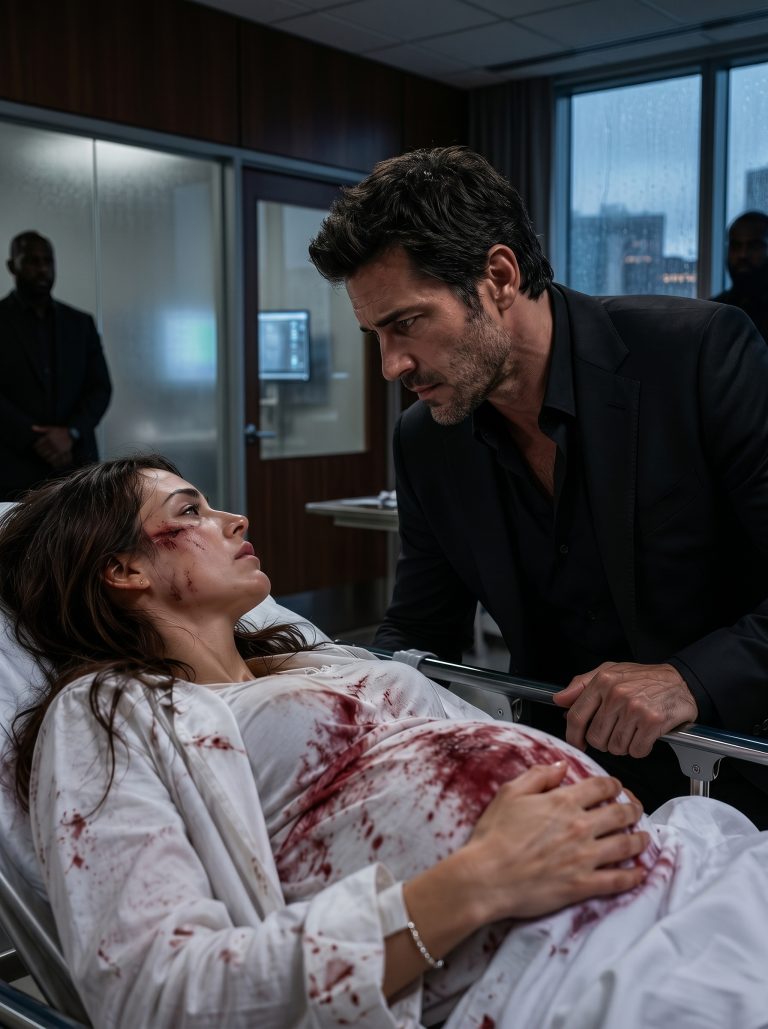
A young woman. Maybe twenty. Her face was a landscape of bruises, one eye swollen fully shut, her wrists bound so tight behind her back the rope had rubbed the skin raw. When Jonas pulled the gag from her mouth, she made a sound that wasn’t quite a sob and wasn’t quite a scream — the sound of someone who had stopped believing anyone was coming.
Clara didn’t say *Mama*. Not then.
She just knelt in the dirt, very still, and studied the woman’s ruined face the way she studied storm clouds before they broke.
“She’s warm,” Clara said finally, quiet and strange. “Warm like the wind before rain. Papa, we can’t leave her.”
That was all. Jonas would think about that sentence for weeks afterward — how careful his daughter had been with it, how she hadn’t claimed the stranger as anything at all. Just something to be protected. Something the wind had asked her to notice.
He carried the woman into the house. Laid her in his own bed, on the quilt Martha had stitched square by square during her pregnancy. She couldn’t remember her own name. She could remember fire. Smoke. Hands grabbing her in the dark.
He gave her a name to use until her real one came back: Rosie.
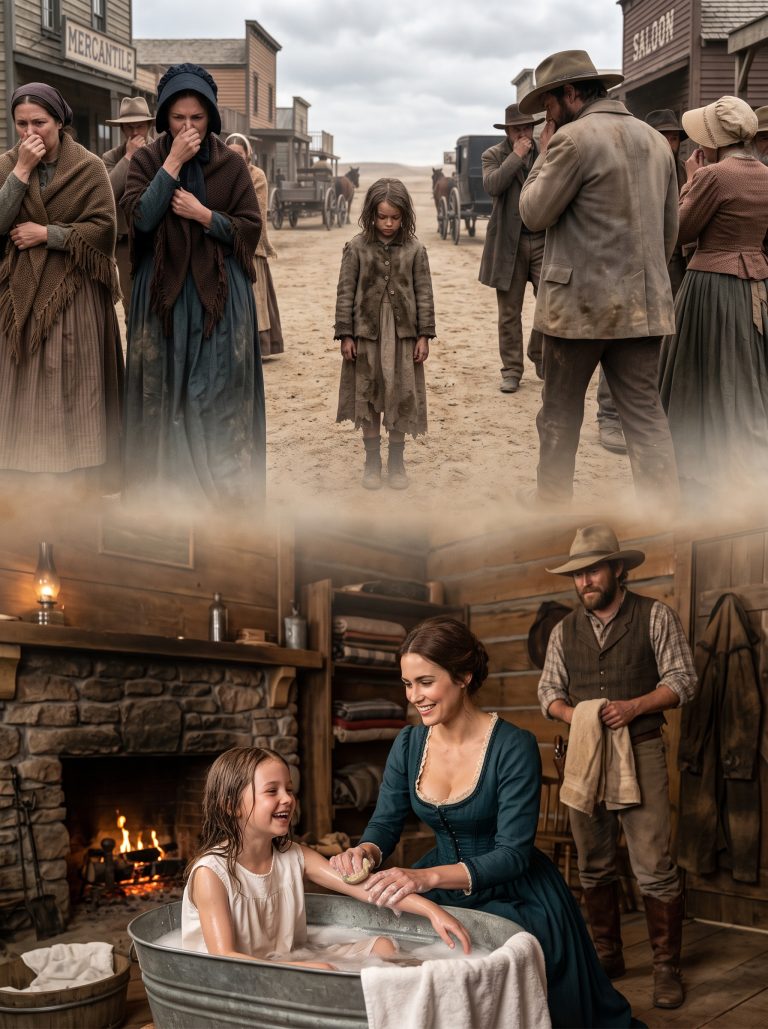
For the first two days, Clara kept her distance the way a cat does with something new in the house — circling, watching, bringing small offerings of wildflowers and leaving them just inside the bedroom door without a word. It was on the third morning, when Rosie woke from a nightmare gasping for air, that Clara climbed onto the bed uninvited and simply put her small hand flat against the woman’s chest, the way Martha used to be described to her — *to help you remember how to breathe.*
“Is it all right,” Clara asked, very seriously, looking at her father in the doorway, “if I call her something? Just for now. Until she remembers her real one.”
Jonas didn’t answer right away. He didn’t know what to say to that — how much of this was a lonely child reaching for something she’d never had, and how much was the strange, unsettling clarity Clara sometimes carried, the same clarity Martha used to have.
“That’s up to Rosie,” he said finally. “Not up to me. Not up to the wind, either.”
And Rosie — bruised, nameless, terrified of her own shadow — looked at the little girl for a long moment before she nodded, just once, like the word cost her something and she was willing to pay it anyway.
It would be weeks before it stopped feeling strange in anyone’s mouth.
By then, word had already gotten out. It always did in a town like Red Willow. Some neighbors rode out with casseroles and curiosity in equal measure. Others rode out with warrants.
Because within the week, a man would arrive at Jonas McCord’s gate — silver eye-badge pinned to his coat, hired not by the territory but by men whose names never appeared on any warrant — asking after a woman named **Rosie Bellamy**, wanted for arson and manslaughter in a fire that had killed two people at a place called Hollow Creek.
He had no idea that his ranch had just become the last place on earth those men wanted her found alive.
He had no idea what Hollow Creek really was, or who had paid to keep it quiet, or how far up the territory that money went.
He just knew one thing, sitting there in the lamplight, watching a stranger’s chest rise and fall.
Whatever she was running from wasn’t finished with her yet.
Part 2
By the second month, Rosie could stand without Jonas’s arm to hold her up, though her legs still trembled like a newborn colt’s.
The first time Clara truly called her Mama happened on a quiet morning after a storm. Rosie had been sitting on the porch, watching the clouds clear, when Clara came running from the garden with muddy hands and a broken flower she had tried to save.
“Mama,” Clara said without thinking, “can you help me fix it?”
The little girl froze after the word left her mouth. She looked toward Jonas, then back at Rosie, suddenly afraid she had crossed a line.
Rosie didn’t answer right away. She simply opened her arms.
Clara climbed into them, and for the first time since she had arrived at the ranch, Rosie cried without fear.
After that morning, the word came slowly but naturally. Clara didn’t use it because she needed someone to replace the mother she had lost. She used it because Rosie had become the person who stayed.
Jonas watched Rosie’s face do something complicated every time he heard it — surprise, tenderness, and a quiet grief for everything she had survived before finding them. Nobody rushed it.
She still didn’t believe she’d earned it.
Then the hoofbeats came up the road that didn’t belong to well-meaning gossips.
Sheriff Dawson rode at the front, looking like a man who already regretted the company he was keeping. Beside him, a stranger in a coat too fine for Red Willow — clean-shaven, unreadable, a small silver badge pinned above his heart shaped like an open eye. Not a territorial star. Not a marshal’s shield.
“Agent Marcus Webb,” he said, dismounting slow, in a voice with no particular home region left in it — the voice of a man who’d worked too many towns to sound like any of them. “Pinkerton National Detective Agency. I’ve been retained to investigate a fire at the Hollow Creek Orphanage.”
“Retained by who?” Jonas asked.
Webb smiled, and it was the smile of a man who got paid whether or not he answered that question honestly. “By parties with an interest in seeing the matter closed quietly. Two people died in that fire. We’re looking for a woman seen fleeing the scene — matching the description of the one you’re harboring.”
“How does a man out of Cheyenne end up at my gate?” Jonas asked. “This ranch isn’t on any road you’d ride past by accident.”
“A woman badly burned and beaten doesn’t stay a secret long in a town this size, Mr. McCord. Not when a doctor’s wife starts buying salve and bandages she can’t explain, and the man who sells them has a memory for faces and a habit of writing letters.” Webb’s gaze drifted, deliberate, toward the road that led into Red Willow — toward Henderson’s feed store, though he never said the name. “Someone always talks. It’s usually the last person you’d suspect of caring enough to notice.”
“He’s not law,” Dawson said under his breath, close enough only for Jonas to hear. “Pinkertons answer to whoever’s paying them. I can’t make him leave and I can’t make him stay. That’s the trouble with hired eyes, Jonas — they don’t blink for anybody but the client.”
It was Clara’s shout that broke the standoff — *”Papa! The mean hen got Mama!”* — and Jonas came around the side of the house to find Rosie on the ground, laughing despite the rooster’s fury, blood beading on her hand. The laughter died the instant she looked up and saw the man on horseback.
Her whole body went rigid.
“You,” she whispered. Her hand went to her throat. “I know you.”
Webb’s expression didn’t so much as flicker.
“Do you? What’s your name, girl?”
“I — I don’t—”
“Don’t remember,” Webb finished for her, almost gently, almost cruel. “Convenient. Because the woman my clients are looking for — Rosie Bellamy — kept records. Records of names. Dates. Money. Records that would be very inconvenient for certain men if they ever surfaced. A woman like that would have every reason in the world to forget her own face.”
*Certain men.* Not the territory. Not the law. *Clients.*
Jonas heard it and understood, in a cold rush, that this had nothing to do with justice and never had. Pinkertons didn’t work for the public good. They worked for whoever cut the check — local businessmen who cared more about money and reputation than the children they were supposed to protect.
“Get off my land,” Jonas said.
Webb rode away smiling, promising he’d be back with enough men that Jonas’s rifle wouldn’t matter. And that night, sitting by the window with the gun across his lap, Jonas finally asked the question he’d been circling for two weeks.
*”Rosie. What was Hollow Creek, really? Not the fire. Before that.”*
She was quiet a long time before she answered, and when she did, her voice had the flat, careful sound of someone finally saying a thing she’d been afraid was true.
“I don’t think it was an orphanage that happened to go bad, Jonas. I think it was built to go bad. I think someone very rich needed a place children could disappear into — and out of — without anyone ever counting them.”
She stopped, her brow furrowing the way it did when a memory surfaced only halfway. “There’s a name I keep almost seeing. Not a name — letters. Gold-stamped, on the corner of an envelope I wasn’t supposed to touch, in Crowley’s desk drawer. Three letters. I can’t get past the first one. It starts with a *T*.”
Part 3
Jonas didn’t sleep after that. He sat with the rifle across his knees and let Rosie talk, because the pieces had finally started arranging themselves into something with a shape, and shapes, once seen, could not be unseen.
“It wasn’t Mrs. Crowley’s money,” Rosie said. “That’s the part I didn’t understand until now. She never had money of her own — she had *backers*. I used to see the same names in her private ledger, over and over, quarterly payments coming in that had nothing to do with the state stipend for orphan care. A rancher named Calhoun down south. A man who ran freight contracts out of Cheyenne. And one name that only ever appeared as initials — *T.R.W.* — who sent the largest sums of anyone.”
“Why would ranchers and freight men fund an orphanage?”
“Because it wasn’t funding an orphanage,” Rosie said. “It was funding a supply line. Boys old enough to work went to ranches and mines that needed labor no one asked questions about — cheaper than paying a grown man, and no family to come looking when one of them got hurt or worked to death. Girls went to households that wanted servants nobody would ever call servants. And some — ” her voice caught, and she made herself finish it, ” — some went to men whose interest in children wasn’t labor at all. Crowley kept a separate column for those. Higher prices. No names, just letters.”
“And Webb?”
“Webb doesn’t work for the law, Jonas. You said it yourself, or Dawson did. Pinkertons work for clients. Somebody with enough money to hire a national agency wanted this quiet, and wanted it quiet badly enough to burn a building down with people locked inside it. That’s not the profile of a rancher protecting cheap labor. That’s the profile of someone with a great deal more to lose — his reputation, his business, and the respect he had spent years building in the county.”
Jonas sat with that a long moment, the fury in his chest cold and very still.
“Then it isn’t over when Webb leaves,” he said. “It’s over when we know whose money paid for that fire.”
—
**Webb came back eleven days later**, not with a warrant this time but with twenty riders, some carrying torches despite the daylight — hired men, Jonas understood now, men on someone’s payroll rather than deputized by anyone’s law. At their head, Webb. Beside him, Henderson from the feed store, righteous and red-faced, the kind of small-town man who mistook proximity to power for possession of it. Trailing reluctantly at the back, Sheriff Dawson, caught between two authorities and answering, technically, to neither.
“I have a writ for the arrest of Rosie Bellamy,” Webb called out, holding up a paper like a man holding a winning hand.
“A writ from who?” Jonas called back. “Show me the judge who signed it, not the client who paid for it.”
The pause before Webb answered told the whole crowd everything it needed to know.
Rosie stepped onto the porch anyway, and let every man on that road see the marks Webb’s employers had left on her throat.
“You want me?” she called out. “Then look at me first. Does this look like the work of justice, or does it look like someone tried to silence a witness who saw where the money went?”
It was Dawson, in the end, who kept the night from turning into a lynching — insisting that if Rosie could lead them to proof, real proof, then she’d go into town under *his* protection, sheriff’s protection, not a hired agent’s, and the whole territory could see it done properly or not at all.
That night, Jonas found Rosie at the kitchen window, exactly as he had that first night — arms wrapped around herself, holding her own pieces together.
“You’ve never once asked me to stay,” she said quietly, without turning around.
“I figured you’d earned the right to decide that for yourself,” Jonas said. He didn’t move closer. There was a careful distance he’d been keeping for weeks now, one he didn’t entirely understand himself — some mix of respect for what she’d survived, and a fear that anything closer would be one more thing taken from her before she’d chosen it. “Whatever happens tomorrow, though — you don’t leave my side.”
“Understood.”
Neither of them said anything else. It would be a long while yet before either of them was ready to.
—
**The ride to Hollow Creek** took two hours through hills of sage and scrub pine. Webb kept glancing back at Rosie with an expression that mixed calculation and something closer to nerves — a hired man watching a job come apart. When the orphanage finally rose out of the hills, three stories of grey stone, one wing blackened and half-collapsed, Rosie went silent in a way that told Jonas everything about what this place had cost her.
At the base of the courtyard sycamore, third stone from the left, they found the box exactly where she’d buried it.
Inside: three leather-bound ledgers and a diary.
“Forty-seven children,” Rosie said, scanning page after page, her voice breaking on the number. “Sold in three years.” She turned to a column she’d clearly been dreading. “And here — the backers. Calhoun. A freight contractor. And T.R.W., paying more than both of them combined.”
Dawson took the ledger and went pale reading it. “T.R.W.,” he said slowly. “Thaddeus R. Whitfield. A wealthy cattle rancher who owns the Whitfield Cattle Company south of Red Willow. He is one of the most respected men in the county, the kind of man whose name opens doors and makes people hesitate before speaking.”
The silence in that courtyard had weight.
“He’s why nobody local could ever touch this,” Dawson said. “Whitfield has influence in Red Willow because many families depend on his ranch and his business. That influence made it easier for him to hide what happened at Hollow Creek and convince people not to ask questions. Hiring Webb was not about protecting the law. It was about protecting his reputation and keeping a quiet town from learning the truth.”
Webb’s hand drifted toward his holster. “Those ledgers die with you,” he said, low. “Should have made sure of that the first time.”
Dawson was faster. His shot caught Webb in the shoulder and spun him half off his feet, and in the chaos that followed, the hired men who’d ridden out with him — men paid by the day, not the cause — put their hands up without much persuading. Henderson was tackled into the mud by Jonas himself, sobbing about *the economy the town needed* until Dawson ordered him hauled up before Jonas did something a court wouldn’t forgive.
“It’s over,” Dawson said, though there was no triumph in it — just a man staring down the barrel of how far up this actually went.
“It’s not over,” Rosie said quietly, still holding the ledger. “Not until Whitfield answers for it too.”
—
**The trial that followed** stretched into weeks rather than days, because a man who owned half the county did not go down in an afternoon. Judge Arthur Blackwood, brought in from Cheyenne specifically because he owed nothing to anyone named Whitfield, presided over hearing after hearing while Marshal Clayton’s investigators worked outward from the ledgers — tracing sums, tracing letters, tracing children.
Rosie testified for the better part of a full day. The defense pressed her hard on the amnesia, on her own childhood, on whether trauma could simply be inventing a conspiracy where there was only a badly run orphanage. She didn’t flinch.
“I know the difference,” she said, “between a badly run orphanage and a business. A business keeps books. Mrs. Crowley kept books. And the man who signed the largest checks in those books is sitting comfortably in Cheyenne while two people who tried to stop him are dead.”
It took another month before Whitfield’s own bank drafts, subpoenaed at Blackwood’s order, matched the ledger sums exactly. By then Webb — facing a shoulder wound gone septic and no client left willing to pay for his silence — had confessed to everything: the bribes, the fire, the order to make Rosie disappear rather than risk her memory returning at all.
The jury took less than two hours.
*Guilty on all counts* — for Webb, for Henderson, for the buyer named Patterson who’d worked three purchased children nearly to death, and, in a verdict nobody in Red Willow had ever truly expected to see, for Thaddeus Whitfield himself, sentenced alongside the men his money had put to work.
Outside the courthouse, Marshal Clayton told Rosie that a handful of new warrants had gone out — men on Whitfield’s own payroll, mostly, foremen and buyers who’d known exactly what they were doing. Children were already being recovered from ranches not two days’ ride from Red Willow.
“What happens to them,” Rosie asked, “the ones with nowhere to go?”
“There’s talk of building a proper home,” Clayton said. “Well-funded. Well-regulated.”
“Name it after Daniel,” Rosie said. “He died trying to save them.”
—
**The hangings came on a bright, cold morning**, winter’s first honest warning in the wind. Rosie insisted on watching. Clara stayed home with Mrs. Johnson — some things weren’t meant for a five-year-old’s eyes, no matter what the wind told her.
Webb’s last words to Rosie, before the trapdoor dropped, were flat and unrepentant. “You should have stayed in that sack.”
“The world would have been simpler,” she agreed. “Never better.”
Afterward, Rosie buried her face in Jonas’s chest and let herself shake without apologizing for it.
“It’s done,” she whispered. “Why don’t I feel better?”
“Because punishment isn’t the same as healing,” Jonas said. “That part takes longer. But we’ve got time now.”
He didn’t kiss her. He hadn’t yet, in all these months — not the night of the confrontation, not the night of the verdict, not the morning the men who’d hurt her finally hanged. Some part of him understood, without either of them saying it, that whatever grew between them needed to grow on ground she’d chosen freely, not ground carved out by danger and adrenaline. So he held her while she shook, and let that be enough, and waited.
—
In between, there were months made of nothing more dramatic than ordinary days, and Jonas came to understand that those were the ones that mattered most.
There was the afternoon the wagon wheel split on the north road, and Rosie held the jack steady in the mud while he swore at a stuck bolt, and by the time it was fixed they were both laughing so hard neither of them could remember what had been so funny in the first place. There was the evening Thomas burned the biscuits so badly the whole kitchen filled with smoke, and Rosie flung open every window while Jonas fanned the doorway with his hat, and Clara declared, solemnly, that the black lumps still counted as supper if you were hungry enough — and everyone ate them anyway, laughing around a table thick with smoke and flour dust, because it turned out a ruined meal could still be the best one of the year.
Neither moment asked anything of either of them. That, Jonas came to think, was exactly why they mattered — two people learning each other in the unremarkable hours, with no danger left to explain what they were feeling and no excuse left to hide behind.
**It was nearly a year later**, on an ordinary evening with nothing at stake at all, that things finally shifted.
Rosie had been living at the ranch the whole time — helping with the animals, teaching the children who’d started arriving one and two at a time as word spread that the McCord place took in the ones nobody else would. Emily Hartman, seven, who hadn’t sung a note since the fire. Thomas, ten and furious at the world, who arrived expecting labor and instead found Jonas beside him at the fence line teaching him the difference between work and slavery. Clara had long since stopped asking permission to call Rosie *Mama* — it had simply become true somewhere in the space of those months, the way ice becomes water without anyone marking the exact moment.
But Jonas and Rosie themselves had stayed, deliberately, careful — two people circling something neither wanted to rush into breaking.
It was an ordinary evening, weeding the garden Martha had once planted, when Rosie sat back on her heels and said, without any particular ceremony, “I think I’m ready. If you are.”
“Ready for what?”
“For this not to be careful anymore.”
Jonas set down his trowel. “You don’t have to be certain today. I’m not asking you to be.”
“I know,” Rosie said. “That’s exactly why I am.”
He crossed the small distance between them slowly, the way he’d have approached anything that mattered too much to get wrong, and when he finally kissed her, it wasn’t the kiss of two people surviving a crisis together. It was the kiss of two people who had waited long enough to be sure.
—
**They married that following spring**, under the sycamore at Hollow Creek — the orphanage itself long since torn down, replaced with gardens and a small memorial bearing the names of every child who’d been sold, and the two, Daniel and Grace, who’d died trying to save them.
*”Marriage,”* the preacher told the gathered crowd, *”is the courage to stay when the world says run.”*
Clara, older now, no longer needed the wind to tell her what she already knew. She served as flower girl and scattered petals with an enthusiasm that made the whole crowd laugh through their tears.
—
**Years later**, the ranch had grown into something that looked, from a distance, almost like a small village — more than a hundred children sheltered under that roof across the decades that followed, a legacy built not from blood but from the choice, made slowly and carefully by two people who had every reason not to trust each other, to stop, to look, and to stay.
On Clara’s tenth birthday, gathered with fifteen children under the tree that had witnessed both the worst and the best of what had happened to their family, someone asked Rosie to tell the story again.
She told it the way she always did now — carefully, honestly, without skipping the parts that had taken time. About a girl left for dead because she’d kept records that powerful men wanted burned. About a cowboy who hadn’t rushed anything, who’d waited for her to be ready before he ever called it love. About a little girl who hadn’t claimed a stranger as her mother in a single breathless moment, but had earned that word slowly, the way anything worth keeping has to be earned.
“And then,” Clara said, finishing it the way she always insisted on finishing it, “we built a family. Not all at once. But we built it.”
Every child gathered under that tree raised a hand and promised, together, to be brave — and if you believed the way Clara still believed, the wind carried every word of it out across the prairie, patient, the way the best things always are.