“Get In My Wagon,” The Cowboy Growled — Seeing The Pregnant Widow Struggling With Her Wagon

Part 1
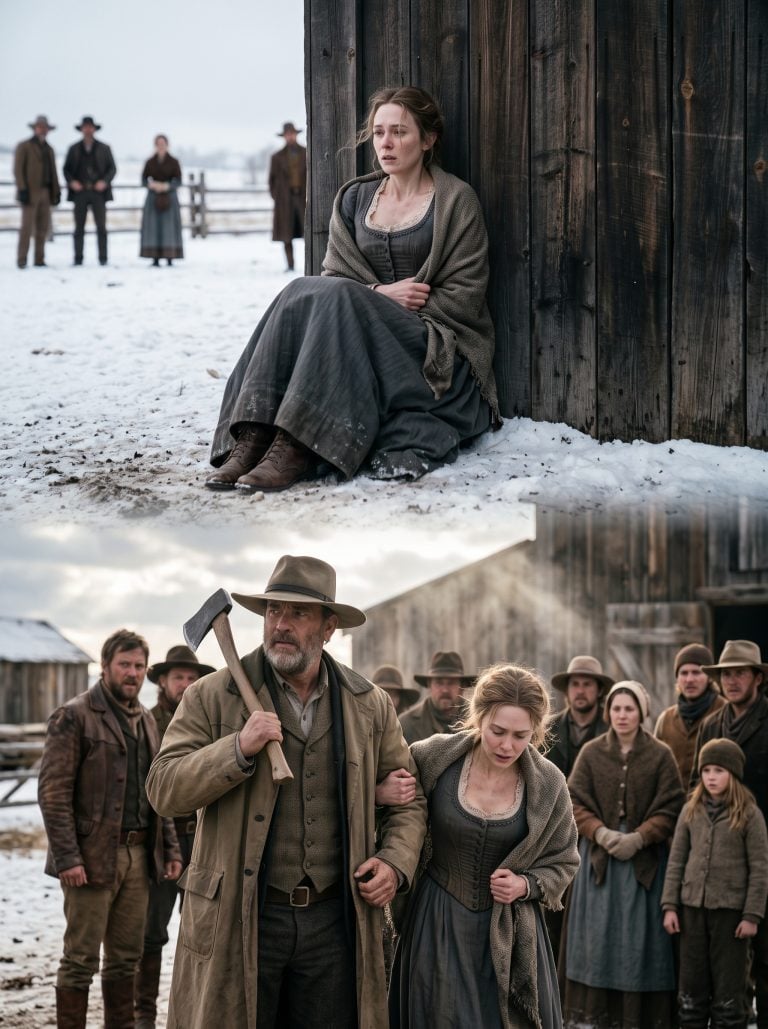
The first time Jacob Colton saw Eleanor Hayes, she was standing beside a wagon buried to its axle in snow, one hand braced against a splintered wheel, the other pressed beneath the swell of a child not yet born.
Wind off the Montana foothills tore at her skirts and pulled loose strands of red hair from under her bonnet. Two children crouched beneath torn canvas. A third — a small, quiet girl with dark eyes and a carved wooden bird clutched in one fist — stood apart from the others, watching everything and saying nothing.
Jacob reined in his horse.
He had spent four years teaching himself not to stop for anyone. Not for a lamed mule, not for a coughing miner, not for a widow woman fighting a wheel that would not hold. Stopping meant questions, and questions meant a man had to explain himself, and Jacob Colton had long since run out of explanations he was willing to give.
Then the wheel gave a final groan and the wagon lurched sideways. Eleanor threw her weight against it to keep it from tipping and cried out as the strain caught her low in the belly.
Jacob was off his horse before he’d decided to be.
“That axle’s done,” he said. “You’ll not get another mile out of it.”
“I have gotten thirty miles out of it,” she snapped, straightening with visible effort. “It will do one more.”
“It won’t, and neither will you, not carrying a child in this wind.”
Her eyes — gray, and sharp enough to cut leather — measured him head to foot the way a woman measures a stranger she has been taught, hard, to fear. “I don’t believe I asked your opinion.”
“You didn’t have to. Your wagon’s giving it for you.”
The oldest child, a girl of about nine, poked her head from beneath the canvas. “Mama, my feet are frozen through.”
That did more than Jacob’s arguing had. Eleanor’s face changed — the fear underneath the pride showing through for just a moment — and Jacob used the opening before she could close it again.
“I’ve got a cabin six miles north. Stove, roof, a room that locks from the inside if you want it to. Storm’s going to swallow this road by dark. I’m not asking you to trust me. I’m asking you to survive the next six hours, and worry about trusting me tomorrow.”
She looked at him for a long moment, then at her children, then at the sky going the color of a bruise in the west.
“You keep your distance,” she said, “and I keep the shotgun across my knees the whole ride. You give me one reason to think otherwise, and I will use it.”
“Wouldn’t expect anything less.”
By the time they reached the cabin, dusk had turned to full dark and the wind had teeth. Jacob learned their names loading the last of their belongings: Lily, the sharp-tongued eldest; Tommy, the boy who talked enough for both his sisters combined; and Sofia, the silent one, who was not Eleanor’s daughter at all.
“Her parents were traveling with us,” Eleanor said, when Jacob asked. “They didn’t survive the road.”
She said no more, and Jacob, who understood exactly how much a person could carry without wanting to say it aloud, did not ask again.
Inside, he built up the fire and put a pot to boil, and found, to his mild surprise, that Eleanor Hayes argued with him about seasoning the way she’d argued with him about the axle — as though giving ground on anything, even soup, might cost her something she couldn’t spare.
“You’re not from around here,” he said, watching her hands work with a competence that surprised him.
“Wyoming, before. My husband died on the road three months back. We’re bound for the land he inherited in the Montana valley — his cousin Marcus owns the spread next to it, and has offered to look after things until I arrive.”
“That’s a long way to travel with three children and a fourth on the way.”
“It’s the only land my children have,” Eleanor said simply. “I intend to see them onto it.”
Later, after the children slept and the fire had burned to embers, Eleanor found Jacob still awake at the table, a leather case open before him — instruments, glass vials, the tools of a trade he no longer practiced.
“You’re a doctor,” she said. It was not a question.
“I was.”
“What happened?”
Jacob closed the case. “Fever took my wife and my daughter three winters back. I treated half this valley and I couldn’t save the two people who mattered most. I decided I’d rather shoe horses than fail anyone that way again.”
Eleanor was quiet a moment. “That isn’t failure. That’s fever.”
“Feels the same, standing at the grave.”
She didn’t offer him comfort, and he was grateful for it — only a steady look, and then, “Thank you for tonight. I mean that, even if I fought you the whole way here.”
“You fought smart,” Jacob said. “Most people don’t fight at all. They just get in wagons with strangers and hope.”
“I don’t hope,” Eleanor said. “I plan. Hoping is what got my husband killed.”
She said it plainly, without self-pity, and went up to bed before Jacob could ask what she meant.
He sat a long time after, listening to the wind, wondering what kind of man let a widow travel three hundred miles alone with three children and a fourth on the way — and wondering, with a discomfort he didn’t examine too closely, why he already wanted to know.
Part 2
The blizzard held the valley four days. By the second morning, the road had vanished under drifts as tall as the porch rail, and the cabin had filled with the small, ordinary noise of people learning to live together — Lily reading aloud from a water-stained book, Tommy narrating an argument between two carved horses, Sofia watching everything from behind the wooden bird she never once set down.
Jacob mended harness. Eleanor mended clothes, and arguments, and once, without being asked, the split seam of Jacob’s only good coat.
“You needn’t have,” he said.
“I know,” she said, “I wanted to.”
It was the closest either of them came to naming what had begun growing in the close, warm rooms of that cabin — something neither grief nor caution seemed able to smother.
On the fourth morning, with the worst of the storm broken, a rider from Miller’s Crossing fought the last drifts to reach the cabin, delivering supplies Jacob had ordered before the weather turned. Among the mail waiting at the territorial post office, held there for a week by the storm, was a letter addressed to Eleanor in a careful, deliberate hand. The postmaster had heard talk in town of a stranded widow sheltering at Jacob Colton’s place — word traveled fast even through snow — and the rider had simply carried it north along with everything else.
The letter was from Marcus Whitfield.
He wrote his condolences. He wrote, at some length, about the value of the land her husband had left her, and the difficulty a widow would face holding six thousand acres alone. He proposed, in the same practical tone a man might use to discuss cattle prices, that she marry him upon arrival — for the children’s sake, and the land’s.
Eleanor read it twice, then set it down without expression Jacob could name.
“Well,” she said. “There it is.”
“You don’t sound pleased.”
“I sound like a woman who has just been told her arithmetic has already been done for her.” She looked at him. “What would you have me do?”
“That’s not mine to decide.”
“I’m not asking you to decide. I’m asking what you’d have me do.”
Jacob’s jaw worked. Outside, the wind had begun, finally, to ease.
“I’d have you choose it because you want it,” he said at last. “Not because it’s easiest.”
Eleanor folded the letter along its worn crease. She did not tell him, that night, that something in Marcus Whitfield’s careful hand had unsettled her for a reason she couldn’t yet name — a coldness that read less like grief and more like a man closing a transaction before a rival could interfere.
Part 3
The thaw came fast and hard, and Jacob spent two days rebuilding Eleanor’s wagon axle in the forge, the ring of his hammer the only sound for miles. Neither of them mentioned the letter again, though it sat folded in the pocket of Eleanor’s coat like a stone.
On the morning the road finally opened, Jacob found boot prints in the mud along his southern fence line — three sets, made by shod horses that were not his own. They followed the old wagon track from where Eleanor’s broken vehicle had been abandoned days earlier, then circled close enough to the cabin windows to have watched the family inside.
“They must have found your wagon before the last snowfall covered it,” Jacob said, crouching over the tracks, “and followed it to my fence line once the drifts settled enough to ride. Whoever they are, they’ve known where you were for at least a day.”
He held up a brass collar stud, dropped near the barn — stamped with a horse-and-star mark he didn’t recognize. Eleanor went white at the sight of it.
“That’s Marcus’s brand,” she whispered. “That mark is burned into every fence post on his land.”
The pieces she’d refused to arrange finally locked into place. Her husband, Thomas, had been killed on the road three months back — shot by men who demanded land papers that, by rights, should have passed uncontested to his widow. At the time, she’d believed it senseless violence, frontier cruelty without a face behind it.
Now she understood there had been a face all along.
“He wanted the land free of a rival claim,” Jacob said slowly, working it through. “If Thomas died before you reached the valley, and you never arrived to file the deed yourself, the land would revert to next of kin — him. And if you did arrive, a marriage proposal would finish the job just as cleanly. Either way, he wins.”
“Whether I live or die,” Eleanor said.
“Not while I’ve got breath in me to stop it,” Jacob said, and for the first time she heard something in his voice that was not caution.
They rode for Miller’s Crossing at first light, taking the children to the safety of the sheriff’s boardinghouse before Whitfield’s men could close the distance. They nearly didn’t make it. A rider broke from the tree line a mile outside town, rifle raised, and it was only Jacob’s steady hand and Eleanor’s steadier nerve — she’d kept her father’s shotgun loaded the whole ride, exactly as she’d promised the first night — that got them through the gauntlet and into the shelter of the sheriff’s office.
Sheriff Daniel Voss listened to the whole account with a grim, unsurprised face. “Whitfield’s man Cole Bishop has been asking after a widow with three young ones for two weeks,” he admitted. “I didn’t put it together till now. Whitfield’s got half the valley believing he’s a saint, and enough money to keep it that way.”
“He’s got a claim office believing it too,” Eleanor said, “unless someone stops him.”
Voss sent word through one of Bishop’s own informants — a stable hand who owed the sheriff a debt he couldn’t afford — that the widow Hayes had grown desperate and was willing to trade the deed for safe passage out of the territory. It was a lie built to be believed: a frightened woman, alone, wanting only to disappear. Bishop chose the churchyard to receive her because its open ground and low stone wall made an ambush difficult to hide — or so he believed, not knowing Voss had strung bedsheets between the church and the parsonage the night before, ostensibly to dry, and had two deputies waiting behind them since dawn.
Before dawn, Voss laid out the positions himself: one deputy behind the laundry sheets, a second crouched beside the low stone wall, and Jacob — over Eleanor’s objection — in the church bell tower overlooking the whole yard, rifle in hand, close enough to see everything and reach no one in time if it went wrong.
Eleanor walked into the yard carrying a folded copy of the deed, not the original — a copy close enough in hand and seal that only a lawyer, or a man too eager to look closely, would mistake it for the real thing.
“Put the paper on the ground,” Bishop called.
“You’ll let me and my children leave the territory?” Eleanor asked.
Bishop’s smile answered before his words did. “No witnesses.”
Jacob fired from the church tower, striking the ground beside Bishop’s boot as a warning. Voss and his deputies rose from behind the sheet line. Gunfire broke across the yard, and in the chaos Bishop seized Eleanor and dragged her against him, a revolver pressed to her belly.
“Come down, doctor,” he shouted. “Or she dies first.”
Eleanor’s eyes found Jacob in the tower. Do not, they said. Do not trade yourself for me.
Jacob came down anyway, hands raised, and told Bishop the truth plainly: the paper in the snow was a copy, the real deed already filed and witnessed at the territorial land office, and killing Eleanor now would buy Whitfield nothing but a rope.
It was enough of a doubt to buy Eleanor half a second. She drove her heel into Bishop’s foot and threw her head back into his jaw, twisting free as Jacob closed the distance between them. The revolver fired as they grappled, the bullet tearing through Jacob’s side, but he brought Bishop down into the mud and held him there until Voss’s rifle barrel found the back of the man’s neck.
Facing a hanging judge and no loyalty worth dying for, Bishop held out through the night in his cell, and by the following morning had given up everything — including where he’d hidden his insurance against the day Marcus Whitfield decided he knew too much. Beneath a loose floorboard in his bunkhouse, deputies found two years of written orders in Whitfield’s own hand: instructions to watch the Hayes wagon, to take the deed by any means necessary, and, in the last letter, to ensure Thomas Hayes did not survive the road.
Marcus Whitfield rode into Miller’s Crossing three days later, unaware his own hired man had already talked. He came for the land office, deed papers of his own in hand, prepared to file a claim of guardianship over his cousin’s “abandoned” estate — and found Eleanor waiting on the office steps instead, Sheriff Voss beside her.
He was, Eleanor thought, an unremarkable man to have cost her so much: neat, gray at the temples, dressed like a banker rather than a killer.
“Mrs. Hayes,” he said, recovering quickly. “I’d hoped we might speak of your future privately.”
“You had Thomas killed,” she said, “and then wrote to ask for my hand as though you were doing me a kindness. I would rather bury every acre of that land under salt than let you touch a fence post of it.”
Whitfield’s composure cracked only slightly. “You have no proof—”
“Bishop kept your letters,” Voss said. “All of them. You may want to sit down, Mr. Whitfield. This is going to take a while.”
He did not go quietly. He tried, for one wild moment, to reach his horse — and found Jacob standing in his path, one hand pressed against the bandages still wrapped beneath his shirt, pale and unsteady but not moving, armed with nothing but the plain refusal to step aside. It was Voss’s deputies who finally took him, but it was Eleanor who watched him led away in irons, and felt, for the first time in three months, that the ground beneath her children was finally, entirely her own. Marcus Whitfield was convicted before the summer harvest and never set foot in the valley again.
Jacob’s recovery was slower than either of them liked. Doc Peterson dug the bullet free and warned him plainly that a man who would not rest was a man courting a second wound. Eleanor took the warning more seriously than Jacob did, and enforced it with a discipline that made Lily remark, admiringly, that her mother could out-stubborn a mule.
It was during those weeks that Sofia began, slowly, to unlock. She had not spoken above a whisper since her parents died, but Jacob noticed she had taken to sitting nearest his sickbed of all the children, the wooden bird always in her hands. One afternoon, working with a knife he wasn’t yet strong enough to hold steady, he finished carving a second wing for the bird — its first had broken somewhere on the road from Wyoming — and held it out to her.
Sofia turned it over in her hands, found the new wing fit true, and said, so quietly he nearly missed it, “Thank you.”
It was the first whole sentence she had given him.
Jacob did not make a fuss of it. He only nodded, the way he’d have nodded to any patient reporting they felt a little stronger, and let her sit with him a while longer before supper.
Eleanor sold the northern grazing tract of Thomas’s land to a pair of neighboring ranchers eager to expand their herds that spring, the payment leaving her enough to build a proper schoolhouse on the acres she kept for herself, east of Jacob’s ranch. She did not marry Jacob because a pregnant widow caring for three children needed a name to shield her — Marcus Whitfield was in a territorial jail, and no one else was left to threaten what she’d built.
She turned down Jacob’s first proposal because he delivered it still bandaged and flat on his back, and called the whole arrangement “practical,” which she informed him was possibly the least romantic word in the English language.
His second attempt went better. He walked her out to the meadow where the schoolhouse stood half-built, its frame gold in the evening light, and told her plainly that he did not need her land, or her cooking, or anything she felt obliged to give him — only her voice at his table, and her arguments, for as long as either of them had breath to make them.
“I want to hear you disagree with me,” he said, “until we’re both too old and stubborn to remember what started it.”
“We’re already too old and stubborn,” Eleanor said. “I checked.”
“Good,” Jacob said. “Then say yes.”
She did.
They were married beneath the cottonwoods that summer, with Lily scattering flowers she’d picked herself and pronounced “not nearly wilted enough,” Tommy nearly dropping the rings into the creek, and Sofia — carved bird tucked into her sash — standing beside her new mother and saying, clear as a bell, “Now we have a home.”
The baby, a girl they named Grace, arrived that winter during a storm that reminded Jacob, every hour of the labor, of the night he’d first found her mother beside a broken wheel and refused to ride on. The labor turned hard past midnight, and Doc Peterson, delayed by the same drifts that had once trapped Eleanor’s wagon, did not arrive in time.
His hands shook when the labor turned difficult. For one terrible heartbeat he stared at the leather case exactly as he had three winters before, on the night fever took his wife and daughter and he swore he would never open it for someone he loved again.
Then he opened it.
He worked through the worst hour of his life since the fever took his first family, and when Grace finally announced herself with a furious cry, it was his own hands that caught her and his own voice that told Eleanor she was safe. Holding his daughter in the gray light before dawn, Jacob understood that he had not run from the thing that once broke him. He had walked back into it, and it had not broken him again.
“You didn’t close the case,” Eleanor murmured, exhausted, watching him.
“No,” Jacob said. “Not this time.”
Downstairs, five children waited to meet their sister. The house had changed again — blue curtains stirring in the draft, Sofia’s wooden bird set carefully on the mantel beside Tommy’s carved horses, Lily’s schoolbooks stacked next to Jacob’s old medical journals, which he had, at last, begun to use again.
Years later, when a grandchild asked Jacob whether he had been afraid, that first night in the blizzard, he told the truth.
“Terrified,” he said. “Being brave never meant I wasn’t frightened. It only meant I chose to stop the horse anyway.”
“Because Grandma needed help?”
Jacob looked across the room to where Eleanor sat, gray now at the temples herself, arguing cheerfully with Lily over some point of the household ledger neither of them would ever concede.
“Because I needed her more than I understood at the time,” he said. “She just made me wait until I’d earned the right to say so.”
Eleanor caught the last of it and laughed. “Someone had to be certain you wouldn’t ride away the next time life frightened you.”
“And?”
“And you didn’t,” she said. “So I stayed too.”
THE END