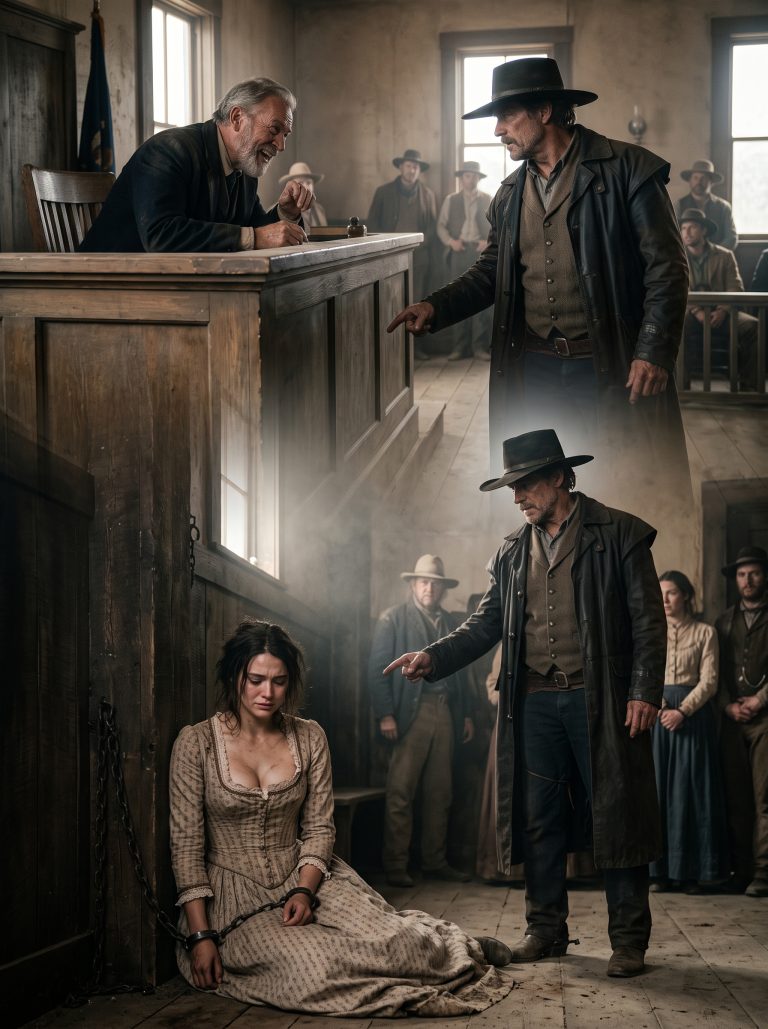
“I’ve never slept beside a man,” she said softly—then the mountain man answered with a promise she couldn’t escape.

PART 1
Jasper planted all four hooves in the drift and would not budge.
Caleb Whitfield had learned, across nine winters in the Ironwoods, never to argue with that stubbornness. The mule’s instincts had kept him breathing longer than his own judgment more times than he cared to count.
Tonight the wind came down off the peaks in sideways sheets, scouring the last light out of a sky already bruised purple. Any man with sense would have turned back an hour ago.
Then Jasper’s ears snapped flat, and he blew hard through his nose at a drift heaped beneath a lodgepole pine.
Caleb followed the animal’s stare and found nothing at first — just rock, snow, black timber. Then the wind lifted, and a smear of green cut through the pale. Nothing living out here wore green like that.
He waded in on foot, rifle slung, and dropped to his knees beside the drift. Gloved hands cleared powder until fabric became a shoulder, a shoulder became an arm, and the arm belonged to a woman curled so tightly into herself she seemed to be trying to disappear.
Her clothes belonged in a drawing room, nowhere near a mountain trail — a velvet cloak gone stiff with ice over a silk gown, fine kid boots useless against snow, dark lashes crusted white against cheeks gone the color of skimmed milk.
He pressed two fingers under her jaw.
A pulse answered. Weak. Ragged. Alive.
“Hang on,” he told her, though she couldn’t hear a word of it.
He shrugged out of his buffalo coat, bundled her into it, and hauled her up onto Jasper, who eyed him as if his rider had finally lost the last of his sense.
“We’re taking her,” Caleb said. “Argue later.”
The walk back doubled in length under her weight and the storm’s. By the time the cabin rose against the granite, ice had sealed his beard shut and her pulse had gone fainter under his palm.
He kicked the door open with a boot.
One room — hewn logs, a stone hearth, a root cellar beneath the boards. The embers still glowed. He fed them until flame roared up the flue, cut the frozen dress away with his eyes elsewhere, wrapped her in wool and hide, warmed stones and tucked them at her feet, spooned broth to her lips drop by drop.
The storm held the cabin hostage for two full days. Caleb barely slept through either of them. He watched the blue fade out of her skin and fever climb in behind it. In her sleep she spoke to people who weren’t there.
“No, I won’t.” “Please don’t make me.” “I don’t belong to him.”
Fragments. Fear, whole and unbroken.
On the third night her eyes opened — pale as frost, wide with terror — and she scrambled back until her spine hit the log wall, blankets clutched to her chest like armor.
“Don’t come near me.”
Caleb lifted both hands where she could see them and stayed exactly where he was.
“I won’t. You’re safe. My cabin, up in the Ironwoods. Found you froze near Sable Hollow.”
“Who are you?”
“Caleb Whitfield.”
She studied him the way any woman would study a bearded stranger with a knife at his belt, and he let her take her time doing it.
“You were dying of cold,” he said quietly. “I brought you in. Nothing more than that has happened, and nothing more will, unless you ask for it.”
Her breath shook loose. “What do people call you out here?”
“Whitfield’s enough.”
“And what should I call myself?” A pause, longer than it should have been. “Eleanor.”
He heard the hesitation and chose not to pull at the thread. “Eleanor, then.” He handed her sweetened coffee in a tin cup. “Slow.”
She drank. The heat brought water to her eyes, though she refused to let it fall.
By morning the truth came out, since lies were heavier to carry than the cold. Her name was Eleanor Hargrove. Her father’s ranch outside Larkspur had gone under a mountain of debt to a copper baron named Malcolm Ashford.
“He called it an arrangement,” she said, staring at the fire. “Debt forgiven for my hand. Except he wanted an heir and an alliance, not a wife. He looked at me like livestock already paid for.”
Caleb’s jaw went tight enough to ache. “Your father agreed to this?”
“He was sick and frightened. He asked me to think of my duty.” Her voice thinned to almost nothing. “So I ran the night before the wedding. A stage driver took my money, and the axle broke in the storm. He went for help and never came back. I tried walking — in these boots.”
“Desperate rarely gets the luxury of a good plan,” Caleb said, and something in how he said it — no judgment in it at all — undid something behind her eyes.
“Do you know the name Malcolm Ashford?” she asked.
“By reputation. Men like that send their names ahead like smoke.”
“He’ll come looking.”
“I expect he will.”
“You should hand me back before he burns your whole life down for keeping me.”
Caleb stirred the coals with a length of iron. “My life’s already survived a fire or two.”
The storm broke its grip within the hour. But three nights later, after the fire burned low and the cabin had gone quiet with something like safety, a rifle shot cracked through the dark and ended it.
Caleb was on his feet with the lamp out and the Sharps off the wall before the echo finished rolling down the mountain.
A voice bellowed from the tree line.
“Whitfield! Send the girl out! Ashford pays good money for property returned — he don’t pay a thing for your corpse!”
Eleanor’s blood went to ice all over again. “They found me.”
Caleb thumbed the rifle’s hammer back with a sound like a door closing.
“No,” he said. “They found us.”
PART 2
The first volley hit the cabin like hail with a grudge.
Lead chewed into log walls. Eleanor flattened herself to the floorboards while Caleb moved through the dark by memory alone, found the firing slit, breathed once, and fired.
A scream answered from the trees.
“That’s one,” he said.
“Caleb—”
“Stay down.”
The voice outside belonged to Silas Crane, he told her flatly — a bounty man who’d drag a corpse home for the same price as a live prisoner.
“Fire the lean-to!” Crane roared. “Smoke him out!”
Kerosene met dry pine, and flame ran up the outer wall.
Smoke crawled through the chinking. Eleanor’s heart slammed against her ribs, but the fear didn’t own her the way it once might have.
“Tell me what to do,” she said.
He shoved a Winchester into her hands. “Load. Keep loading.”
Her fingers shook. She obeyed anyway.
Caleb hauled back the bearskin rug, revealing a trapdoor. “Back door. Runs to a drainage tunnel, comes out in the ravine. Move.”
She went first into the black, the rifle clutched to her chest. He followed, dragging the trapdoor shut above them as the roof caught overhead.
The tunnel was narrow and cold enough to bite through wool. They crawled while gunfire thudded above, palms scraping raw against frozen earth, until they broke out through brush into the ravine and the cold hit fresh.
Behind them, Caleb’s home of nine years stood wrapped in flame.
“I’ve ruined everything you had,” Eleanor whispered.
He looked at her, not the fire. “You’re still standing. That’s the only ledger I keep.” He took her hand. “Now move — before they learn we’re not ashes.”
They fled through the ravine until dawn bruised the sky gray, Caleb breaking trail through waist-deep drifts. Near sunrise, he stumbled.
She caught his arm. “You’re bleeding.”
The stain down his side — a graze torn wider by hard walking — said more than he would. She was tearing a strip from her chemise to bind it when a voice cut through the trees, calm as a man remarking on the weather.
“Well. Isn’t that touching.”
Silas Crane stood twenty yards off with two riflemen behind him, blood crusting one cheek, grinning like the trouble had been worth it. Past his shoulder rode Malcolm Ashford himself, immaculate in a fur collar, five men at his back — looking less like a bridegroom than a banker come to collect flesh instead of coin.
“Bravo, Eleanor.” His eyes flicked over her ruined dress, her bloodied hands. “I came hunting a runaway bride. I find a mountain savage wearing my property.”
“I was never your property,” she said, barrel steady.
Ashford’s gaze slid to Caleb, pale and swaying. “Kill him,” he said, almost bored. “Leave her breathing enough to travel.”
Five rifles rose — and Caleb wasn’t looking at a single one of them. He was looking straight up, at the great cracked shelf of snow hanging over the ravine’s rim, thawed and ready to fall.
PART 3
“Eleanor,” Caleb said, very quietly. “When I say move, you dive for the tunnel mouth.”
“I won’t leave you.”
“Not leaving. Surviving.” He scooped the Sharps up off the snow. “Trust me.”
Ashford frowned, sensing something wrong a half-second too late. “What is he—”
Caleb fired straight up into the overhang.
The heavy round struck the cornice with a crack like the mountain’s own bone breaking. For one impossible second, nothing happened at all.
Then the whole ridge let go.
Thousands of tons of ice, rock, and uprooted timber came down into the ravine in a roar that swallowed every scream beneath it. Ashford’s horse reared and bolted. Caleb threw himself and Eleanor backward into the tunnel mouth as the white wall hit, and then there was nothing but the earth shaking apart and darkness pressing down from every side.
Silence, when it finally came, felt like its own kind of violence.
“Caleb?” Eleanor coughed dust and grit out of her lungs.
A groan answered from beside her. “Still here.”
“Are we alive?”
“For now.”
It took them three hours to dig clear, her nails torn bloody on frozen roots, his good arm working past the point exhaustion should have stopped him. When her hand finally broke through into daylight, she sobbed once and dug harder.
They crawled out into a ravine that no longer existed — smoothed under a single unbroken slope of white. No riders. No horses. No Malcolm Ashford. The mountain had taken money, cruelty, and certainty in one indifferent breath and left nothing behind to argue with.
Caleb made it two steps before his knees buckled.
“Caleb!”
His bandage was soaked through, his skin gone the gray of old ash. She dropped beside him, more furious than frightened.
“No,” she said. “You hauled me out of a snowdrift. My turn now.”
She was too small to carry him and he was too stubborn to die tidily, so she dragged and steadied and half-carried him through two days of timber. The first night she built a fire in a hollow cedar break the way she’d watched him do it a dozen times without knowing she was memorizing the steps — kindling first, then bark shavings, then the small careful patience of feeding a flame instead of smothering it with too much wood too soon. He slipped in and out of sense beside her, sometimes lucid enough to correct her grip on the hatchet, sometimes murmuring names she didn’t recognize into the dark.
On the second afternoon they came to a half-frozen creek she didn’t trust and he did, and his instinct proved right even feverish — the ice held, though her heart didn’t stop hammering until they’d crossed it. She packed his wound with pine pitch and clean cloth, tore fresh strips from a petticoat she no longer had any use pretending was fine, and talked to him the whole while, not because he could always answer but because the sound of her own voice was the only thing keeping her hands steady.
“You are not allowed to die on me,” she told him somewhere in the gray hour before dawn. “I ran through a blizzard and lost a fiancé and a house and I am not also losing you. Do you understand me, Caleb Whitfield?”
He didn’t open his eyes, but his mouth curved, faint as a whisper. “Bossy.”
“Alive,” she shot back. “Stay that way.”
On the third day they staggered into the logging settlement of Pine Hollow, and men ran from the sawshed, and a doctor above the apothecary took one look at Caleb and began barking orders Eleanor refused to leave the room to escape.
He fought fever for a month. She never once left his side.
She traded the last intact scrap of her velvet cloak for bandages and medicine, learned to brew willow bark tea and change a dressing without flinching, learned the difference between deep sleep and the kind of stillness that frightened her. When fever made him mutter names into the dark, she answered him. When he tried standing before his legs could hold him, she threatened, quite seriously, to tie him to the bedframe with his own trap line.
Halfway through that month, word came up from the mill that a stranger had been asking after a woman traveling with an injured trapper — a man with a bandaged knee and a temper, drinking alone at the saloon and asking too many questions for anyone’s comfort. Eleanor’s stomach dropped straight through the floorboards when she heard it.
She found him herself the next morning rather than wait for fear to find her first. He turned out to be one of Ashford’s wounded riflemen, Tobias Reyes, minus a rifle now and minus, it seemed, most of his nerve — a man who had survived an avalanche that had buried his employer and his pride in the same afternoon and wanted nothing more than a stage fare east and a reason never to mention the Ironwoods again.
“I ain’t hunting nobody, ma’am,” he said, hands raised before she’d even reached for the pistol at her hip. “Sterling’s — Ashford’s — dead. So’s the bounty. I’m just trying to get home.”
She studied him the way Caleb had once studied her, weighing fear against truth, and decided she believed him. She bought him passage on the next eastbound stage out of her own thin purse, more to be rid of the last loose thread of that old life than out of any charity, and didn’t tell Caleb until the fever had broken enough for him to laugh instead of reach for a gun that wasn’t there.
“You gave Ashford’s man traveling money,” he said, incredulous, propped against his pillows a week later.
“I gave a frightened man a reason to leave and never come back. Call it self-interest, if it suits you better.”
“It suits me fine,” Caleb said, and something in his chest loosened that had been tight since the mill gossip first reached him.
“You talk like a wife already,” the apothecary’s wife told her one evening.
Eleanor looked at Caleb, pale and still against the pillow.
“Not yet,” she said softly.
Spring reached Pine Hollow’s rooftops before it reached anywhere else — snow sliding off shingles in long wet ropes, mud swallowing the last of the ice in the street, oxen dragging fresh-cut timber toward the mill. Caleb healed slowly and resented every single day of it.
“You’re alive,” Eleanor reminded him, the morning he glared hardest at his bandages. “Try gratitude instead of murder.”
“I’m plenty grateful. I can be grateful and murderous.”
“That is not how gratitude is meant to work.”
He laughed despite himself, and something in the room warmed that had nothing to do with the stove.
Once he could stand without swaying, he taught her to shoot properly instead of desperately — how to breathe out before the trigger instead of flinching into it, how to let the Winchester’s weight settle into her shoulder rather than fight it. Her first dozen shots went wide enough to embarrass her. By the second afternoon she’d put four rounds through a tin can at forty paces and looked so pleased with herself that Caleb, leaning on a fence post with his side still wrapped, decided not to mention that forty paces was closer to practice than danger.
“You’re better than most men who come through Pine Hollow,” he told her, and meant it.
“I had good reason to learn quickly.”
“That you did.”
The first morning he sat upright in a chair by the window, freshly trimmed and washed, more gray showing in his hair than she remembered noticing in the cabin, she poured water into a basin and said what needed saying.
“You don’t have to stay,” he told her. “Ashford’s gone. Your father’s debt died with him. You could go back to Larkspur, or further — Denver, Chicago, anywhere with floors flat enough for proper shoes.”
She set the kettle down and crossed to him.
“I am finished choosing places because they look respectable from a distance.”
“I don’t have a cabin anymore,” he said. “Just a burned patch of mountain and a long rebuild ahead of me.”
“Good.”
His eyebrows rose.
“I’d hate moving into somewhere everything was already decided,” she said. “There’s nothing easy in the life you’re offering.”
“No pianoforte. No callers. No silver tray.”
“Caleb Whitfield, I ran through a blizzard in silk slippers to get away from a silver tray.”
He laughed, then winced and pressed a hand to his side, and she scolded him without any real heat in it at all.
“I never doubted your nerve,” he said, serious now. “Not once.”
She touched his jaw, felt the rough stubble under her fingers.
“The life I was meant for started the moment your mule stopped in that drift.”
“Jasper will be thrilled to hear it.”
“I mean it.”
“I know.”
Their eyes held.
“I told you once I’d never shared a bed with anyone,” she said quietly. “You made me a promise that night.”
His hand covered hers against his cheek. “I did.”
“Did you mean it?”
“Forever,” he said, and it came out low and certain, like something already decided long before either of them had said it aloud.
They married two weeks later in Pine Hollow’s small chapel, with the apothecary and his wife as witnesses, three loggers scrubbed up badly for the back pew, and Jasper tied outside voicing his objections to the whole affair for anyone within earshot. Eleanor wore plain blue wool. Caleb wore a borrowed coat one size too small, the seam straining at one shoulder, his side still wrapped beneath his shirt though she’d made him swear not to lift anything heavier than a coffee cup.
Someone had strung dried wildflowers along the chapel rail — the apothecary’s wife’s doing, most likely, since she denied it too quickly to be believed. The mill’s cook sent over a ham nobody had asked for and a pie nobody could identify the fruit in, and both were gone before the afternoon was half over. One of the loggers produced a fiddle from somewhere and played three songs badly and a fourth surprisingly well, and Eleanor danced with Caleb slow and careful so as not to strain his side, her hand resting light over the place where the bandage still sat beneath his shirt.
“This is not the wedding anyone in Larkspur would have planned for me,” she said, laughing, flushed from dancing and cider both.
“Is that a complaint?”
“It is the opposite of a complaint.”
When the preacher reached the word obedience, Eleanor’s eyes narrowed dangerously.
“Partnership will do,” Caleb said gently.
The preacher coughed and revised his script. “Partnership, then.”
The kiss that followed carried none of the danger or desperation of the mountain — just something careful and certain, a beginning rather than a claim.
They stayed on in Pine Hollow through the last weeks of the thaw, in a small rented room above the apothecary that smelled of dried herbs and lamp oil, learning each other in the ordinary ways courtship in a burning cabin hadn’t allowed for. Eleanor discovered Caleb hummed off-key while sharpening tools and pretended not to notice when she caught him at it. Caleb discovered Eleanor talked in her sleep the same way she had during her fever, though now the words were softer — his name, mostly, and once, clearly, an argument with someone about a coffee ration that made him laugh so hard the next morning she threw a boot at him for it.
They were not, either of them, easy people. Caleb kept silences the way other men kept coin, spending them carefully and only when he judged the moment worth the cost. Eleanor pushed at those silences sometimes, more out of habit than need, and had to learn — slowly, and not without a few sharp words on both sides — that some of his quiet wasn’t distance at all, only a different language for the same devotion.
“You go quiet when you’re worried,” she told him one night, “not when you’re angry. I keep waiting for the anger and it never comes.”
“Would you rather I shouted?”
“I’d rather you told me which one it was, so I’d know whether to leave you be or sit closer.”
He’d thought about that for a long moment, the way he thought about most things that mattered to him, and then reached for her hand without a word, which she decided, after some consideration, was answer enough.
They went back to the burned site once the pass cleared. The sight of it still hurt: blackened logs collapsed under melting snow, the stone hearth standing scorched but whole, the lean-to gone entirely, the bed frame reduced to ash. Only the root cellar and the tunnel beneath it remained — proof that foresight sometimes outlasted the roof over it.
“We can build here again,” Eleanor said, slipping her hand into his.
“You’re certain?”
“The view’s good. The tunnel’s useful. The chimney’s stubborn. I’ve always admired stubborn things.” She glanced at him. “Present company included.”
So they built — not quickly, not easily. Caleb cut timber before the doctor would have allowed it, and Eleanor learned to scold in a tone that could move Jasper from twenty paces. There were fights, small ones, about whether he was strong enough to notch a joint himself or whether she was strong enough to haul a beam alone, and both of them lost those fights about equally often, which seemed, to Eleanor, like the fairest kind of marriage there was.
Men from Pine Hollow came twice to raise walls, repaying debts Caleb had never once mentioned owing him. The apothecary’s wife sent garden seed. A logger arrived with an iron bedstead as a wedding gift, declaring it too fine for his own bunkhouse and not fine enough for a banker, and Eleanor laughed until she had to sit down. By midsummer the walls stood square and true, and Eleanor found she had opinions of her own about the placement of windows, the height of the mantel, the exact spot where morning light should fall across the kitchen table — opinions Caleb indulged without a single argument, which surprised her more than it should have.
By autumn the cabin stood again — larger this time, two rooms instead of one, glass windows that caught the morning light, a bed set where the hearth warmed the room without choking it in smoke. Eleanor hung her few plain dresses on pegs Caleb had carved himself, planted beans and onions and hardy kitchen herbs, learned to shoot straighter than most men in three counties, learned mule moods and weather signs and how to brew coffee strong enough that Caleb called it respectable, which from him was no small compliment.
The second room, the one nobody spoke of aloud but both of them had quietly agreed to build larger than it strictly needed to be, sat empty through that first autumn except for a chair Caleb had made and a shelf Eleanor had asked for without explaining why. Neither of them said what they were building toward. Neither of them needed to.
Word eventually reached them from Larkspur. Malcolm Ashford’s holdings had collapsed within weeks of his death, creditors tearing through mines and ranch notes like wolves through a carcass. Eleanor’s father, freed from Ashford’s grip too late to undo the damage it had caused, sent one letter asking forgiveness. She read it by the fire and cried for everything that couldn’t be recovered, but she didn’t go back. She wrote instead, with more grace than the letter deserved:
I am safe. I am married. I am not anyone’s property, and I never will be again. I hope you find peace, but I won’t come back to prove that I’ve forgiven you.
Caleb posted it for her himself, the next time he rode down to Pine Hollow.
Winter returned to the Ironwoods a second time, and this time Eleanor didn’t flinch at the first snow. She watched it gather along the new sill while bread baked and Jasper complained in the lean-to and Caleb stacked more firewood than they could possibly need, out of habit as much as anything else.
“Expecting a siege?” she asked.
“Winter’s always a siege, one way or another.”
“Then we’re better provisioned than we were last year.”
He came up behind her and wrapped his arms around her waist, and she leaned back into him without thinking twice about it.
Somewhere under fifty feet of snow and broken rock, Malcolm Ashford and the men who’d believed money could command a mountain lay forgotten, and the wilderness hadn’t wasted a single thought mourning them.
Inside the cabin, the fire held, and the bread rose, and the woman who had once run from ownership into freedom rested her hands over the ones wrapped around her.
“Forever’s a large promise,” she said.
His beard brushed her temple. “So is winter.”
“And yet?”
“And yet,” he murmured, holding her closer as the snow thickened past the glass, “we’ve both learned how to weather worse.”
By the following spring, a second letter arrived from Larkspur, this one asking not for forgiveness but for permission — her father wished to visit, if she would allow it, and would understand entirely if she wouldn’t. Eleanor sat with that letter longer than she’d sat with the first, turning the decision over the way Caleb turned a green log before deciding where to cut it.
“You don’t have to answer today,” he told her.
“I know.” She folded the letter along its old crease. “I think I want to see him. Not the man who signed me over to Ashford. Whatever’s left after that man’s been burned out of him.”
Her father came in early June, older than she remembered, thinner, walking with a cane he hadn’t needed the last time she’d seen him. He stood at the edge of the new garden for a long moment before he could make himself cross it, and when Eleanor finally closed the distance herself, he wept in a way she’d never once seen him allow himself in Larkspur, where feelings were kept as carefully controlled as ledgers.
“I should have burned the notes myself before I ever let that man near you,” he said.
“You should have,” she agreed, because there was no kindness in a lie between them anymore, only in the truth that came after it. “But you’re here now, and I’m alive, and neither of us has to keep carrying what’s already over.”
He stayed a week, slept in the loft, learned — badly — how to split kindling under Caleb’s patient instruction, and left promising to write more than the one letter a year Eleanor privately suspected he’d manage. He shook Caleb’s hand at the wagon before he left, held it a moment longer than a simple farewell required, and said only, “Take care of what I couldn’t.” Caleb nodded once, and that was the whole of it — no more words needed between two men who had already understood each other perfectly well without them. It was enough. It didn’t need to be everything.
That second winter, when the first real snow came down thick and quiet over the Ironwoods, Eleanor stood at the window with a hand resting low over her own stomach, a secret not yet a month old and not yet shared, watching Caleb split wood he didn’t need to split, out in the yard, breath fogging white in the cold.
She thought of a woman half-buried in a drift beneath a lodgepole pine, certain that winter was the thing that would kill her.
She had been wrong about that, she thought, watching her husband work, watching the wood split clean and the snow settle soft over a home that had already burned once and risen again taller for it. Winter, it turned out, was only ever the thing that had brought her home — and now it was simply the season she meant to grow old inside, with a good fire, a stubborn mule, and a man who had never once asked her to be anything smaller than she already was.