Rich Cowboy’s Simple Supply Trip Turns Into a Shocking Marriage That Changed His Destiny

PART 1
Some of this I have from newspaper clippings my great-aunt kept in a cedar chest. The rest is the version she told me every summer at her kitchen table, repeated so many times over so many years that I can’t promise every word is exact. But this is the story as it was carried down to me, and I’m telling it the way I got it.
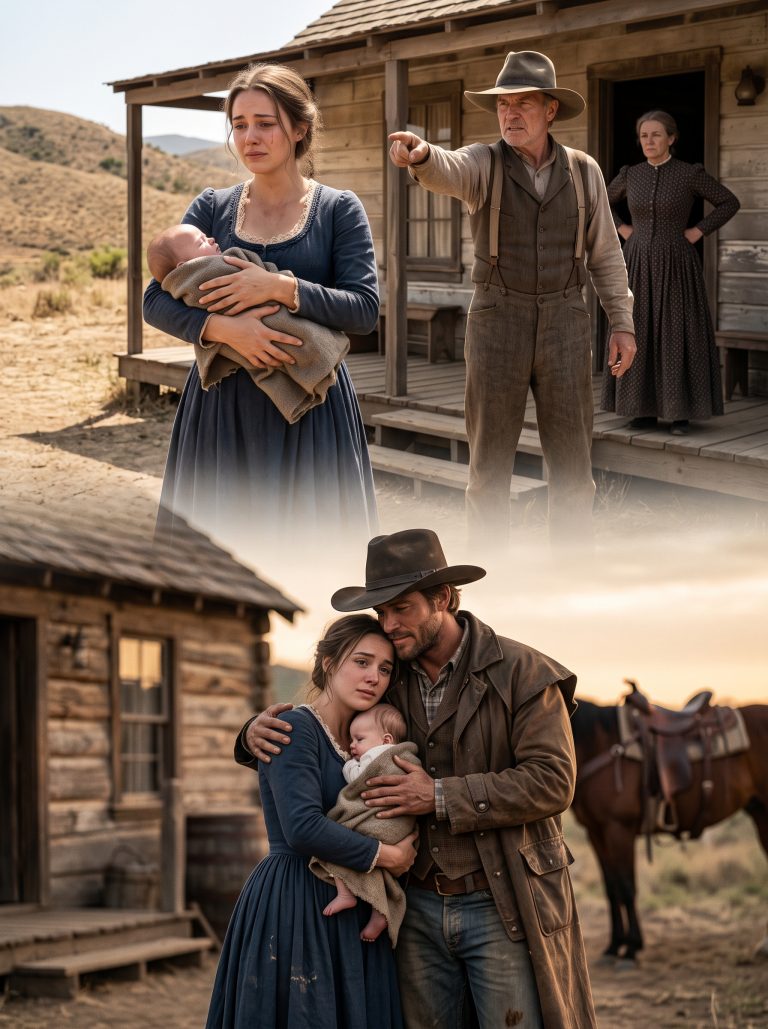
His name was Caleb Ward, and he rode into a dying town called Redemption Springs planning to be gone before the sun went down.
He wasn’t looking for trouble. He wasn’t looking for anything, really, except supplies, a hot meal if the prices weren’t robbery, and two more days of hard riding to the hundred acres of nothing he’d bought five years earlier — land he’d chosen specifically because it demanded nothing from him but sweat and silence.
That had been the deal he made with himself after he walked away from fifteen years of being a hired gun. No entanglements. No reasons to stay. He’d learned the hard way that getting involved in other people’s fights only ever ended in more graves.
He was reaching for the door of the general store when he heard her voice.
Tight. Controlled. Trying very hard not to sound afraid.
“I’ve told you no. I’ll keep telling you no.”
A man laughed back at her, the kind of laugh that has cruelty braided through it like thread through cloth.
“That’s not how this works, sweetheart. Your daddy’s debts don’t disappear just because he did.”
Caleb told himself it wasn’t his business. He told himself that for exactly as long as it took his feet to carry him around the corner of that building anyway.
What he found in the alley was a woman with her back pressed to a sun-bleached wall, one hand white-knuckled around a satchel, the other flat against the boards behind her like she was trying to push herself through solid wood. She was young — twenty-five, maybe — dark hair coming loose from its pins, a faded blue dress mended at the seams. Her eyes weren’t the eyes of someone caving. They were the eyes of someone doing math on how many seconds she had left to fight.
The man looming over her wore a tin star, tarnished and crooked. Deputy. Which meant the law in this town was already spoken for. Two more men flanked him — hired muscle, the kind that follows orders because thinking costs more than they’re willing to spend.
“You’ve got one week, Laya,” the deputy said, close enough that she flinched. “Accept my brother’s proposal or the bank takes that pretty little property your daddy left you. Then where will you be? Teaching school in a tent camp?”
“I’ll pay what’s owed,” she said, and her voice didn’t break, though it clearly wanted to. “But I won’t marry Clayton Briggs. Not for land. Not for money. Not for anything.”
The deputy reached out and caught a loose strand of her hair between two thick fingers.
“You think you got choices here?”
That was the moment Caleb’s voice cut into the alley.
“Sounded like a man threatening a woman,” he said. “Usually that kind of thing happens in public. Stops being private.”
Four heads turned. The deputy’s hand drifted, slow and deliberate, toward the gun on his hip. Caleb didn’t move. He’d been in this exact stretch of silence more times than he could count — the moment right before a man decides whether his pride is worth dying for.
“You got no idea what you’re stepping into, stranger.”
“Maybe,” Caleb said. “But I’m here right now. And right now, the lady said no.”
Somebody’s finger twitched toward a trigger. Caleb watched it happen the way he’d watch weather roll in — with the flat, waiting calm of a man who already knew how this particular storm behaved.
Nobody drew. The deputy backed off first, jaw working, promising this wasn’t over. Laya slipped past him and out of that alley on legs that were shaking harder than her voice had let on.
She told Caleb her name on the schoolhouse steps. She told him her father had died six months earlier, found at the bottom of a ladder below the roof he’d been too proud to hire someone else to fix — his heart, the doctor said, though she’d never quite believed a man could fight for ten years and then simply stop. She told him he’d left her a school, a house, twenty acres — and a $15,000 debt to a bank that had trapped him in it: forged renewal papers, compounded interest quietly stacked for years, and a clause buried in the fine print that let Clayton fold three smaller loans into one crushing balance the moment her father died. Fifteen thousand dollars, on paper, for a man who’d never borrowed a quarter of that in cash.
“Clayton Briggs is sixty-three,” she said. “He’s buried three wives already. And he looks at me like I’m livestock he’s deciding whether to purchase.”
Caleb had seen this story before, in a dozen towns between here and Montana. Powerful man. Desperate woman. Debt as a leash. Usually the woman bent, because bending was the only door left open.
Something about Laya Harper told him she’d choose breaking over bending, every single time.
He asked her one question before he turned to walk toward the general store.
“How long until the bank forecloses?”
“Seven days,” she said.
He nodded once, like he was filing the number away for later.
What he said next, he hadn’t planned to say. It came out of him before he’d fully decided to mean it.
“What if you had more time than that?”
By the next morning, Caleb Ward would walk into Briggs Bank with a locked leather case full of banknotes — and turn a quiet frontier debt into a war that would cost him almost everything he had left to lose.