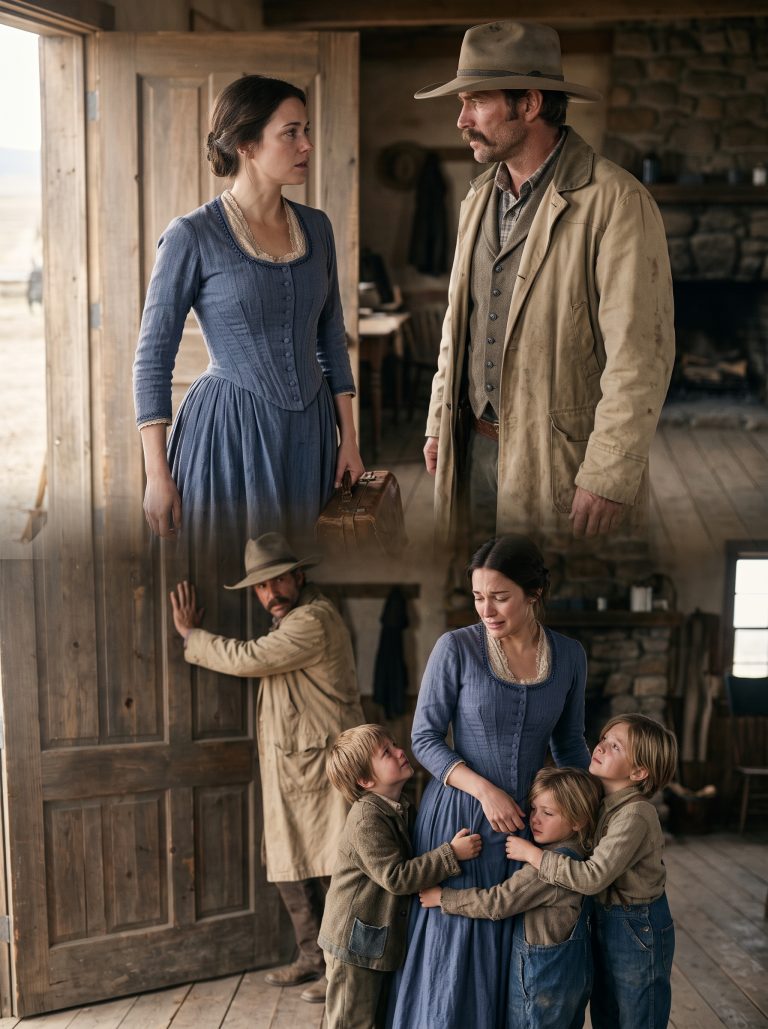
The CEO Offered $750,000 to Calm Her Nonverbal Son—Then the Janitor Sat Down and Whispered One Word

PART 1
I heard him from the third floor.
Not the sound of a brat throwing a fit. Not a kid who’d been told no about candy. That sound has edges — anger, performance, a bid for attention. This was something else. A frequency I knew in my chest before my brain caught up: raw, airless, the cry of a child trying to communicate in the only language available to him when words have been locked away since birth.
I set down my wrench and went toward it. Some instincts can’t be overridden.
My name is Warren Paige. I’m forty-seven. I fix the systems that keep this building alive — boilers, elevators, door closers, the thousand invisible things nobody notices until they fail. In two years at Hartwell Global, not one person whose name is on the letterhead has ever spoken to me. I’m part of the infrastructure. Furniture that walks. I made my peace with that a long time ago, because I’ve learned that the most important people in any room are usually the ones nobody looks at.
What I found when I stepped out of that stairwell was a disaster of good intentions.
The boy was maybe seven, curled on the marble in a ball so tight it looked like he was trying to collapse inward, both hands clamped over his ears, his whole body vibrating with something that had long passed sound and become pure physical agony. Crowded over him were six adults doing everything they had been trained to do. A doctor crouching nearby, speaking in calm, measured cadences. Two specialists with lanyards reaching in, coaxing. An assistant at the edge clutching a phone.
And kneeling at the center of it all, in a silk blouse that probably cost more than my truck: Vivienne Hartwell.
Founder. CEO. The kind of woman whose face appears on magazine covers next to words like *visionary* and *relentless*. I had watched her from service corridors, from the far corners of conference rooms, from everywhere a maintenance man is invisible. She was always composed.
Not now.
Now she was reaching for her son with shaking hands, saying his name over and over — *Marcus, baby, please, tell Mama what you need* — and the more she reached, the more he screamed. The more he screamed, the more the specialists leaned in. And the more they all leaned in, the worse it got.
They were drowning him.
Not on purpose. With love. With everything they had. But every reaching hand was an input. Every soothing voice was an input. Every anxious face angling into his line of sight was another wave crashing over a child who was already far beneath the surface. They were so focused on fixing the behavior they couldn’t see what they were doing to the boy.
I’d spent sixteen years learning the difference.
My son Callum is twenty-three now. Holds down a job, lives alone. When he was Marcus’s age, he was exactly where that child was — non-verbal, overwhelmed by a world that ran too loud for him. Grocery store lights. The tag in his shirt collar. A change in dinner time. These weren’t small things. They were seismic. And when he screamed, the world saw a problem to manage. I saw my son trying to tell me something in the only language he had.
It took years of doing everything wrong before I learned to hear him. The turning point came on a night when Callum had been in distress for two hours and I’d tried everything and finally just slid down the kitchen cabinets and stopped. Not because I gave up. Because I had nothing left.
Four minutes later, he crawled across the floor and pressed his back against my arm. Not a hug — he couldn’t do hugs then. Just his back against my arm. And he went quiet.
I sat there at midnight and understood what I’d been getting wrong for years. I’d been trying to pull him out of the water. He didn’t need pulling. He needed me to get in and stop thrashing so he could see the water wasn’t going to kill him.
That’s the night I started learning his language. Sixteen years of wrong guesses and 3 a.m. recalibrations. Every specialist who handed me a pamphlet instead of an answer. I paid for that education with everything I had.
Which is why, standing at the edge of that lobby watching six credentialed adults accidentally hold a child underwater, I knew exactly what I was seeing.
And then Vivienne Hartwell said it — loudly, with the wild logic of a woman who had run out of reasonable options:
“I will give $750,000 to anyone in this building who can help him. Anyone. I mean it.”
The room went still.
And I walked in.
—
PART 2
“Everybody step back. All the way. And stop talking.”
My voice wasn’t loud. It didn’t need to be. There was something in it — not authority exactly, but certainty, the kind that comes from sitting on a thousand kitchen floors — and the room responded before anyone had consciously decided to.
The specialists looked at me the way people look at furniture that has started talking.
The doctor began to object.
Vivienne Hartwell looked at my face. Something in it — some recognition of a certainty she didn’t have — made her say quietly: “Do what he says. Everyone, back.”
They moved.
Then it was just me and Marcus and a lot of empty marble.
I didn’t go to him. That’s the first rule. You don’t invade a child already overwhelmed by invasion. I sat down several feet away, angled slightly off, looking at the same patch of floor he was looking at.
And I went bone quiet.
Every instinct in your body when a child is screaming is to *do* — to reach, to fix, to make it stop. Choosing stillness instead takes everything you have. It is not passivity. It is the most active thing I know: holding a calm so steady that a drowning child can climb onto it like a raft. My body knew how to build that raft. I’d built it ten thousand times.
Slowly, the screaming came down. Just slightly — the way a boil comes off the heat. Because for the first time in over an hour, the world had stopped adding things to Marcus.
That’s when I started watching him. The quiet, patient kind of watching sixteen years with Callum had taught me. And I noticed what none of the six experts had noticed, because they’d been looking at the behavior instead of the boy.
One of Marcus’s hands was not over his ear.
It was down on the marble. And the fingers were moving — tracing the same shape, slow and deliberate, even in the middle of the storm. A circle. Small lines radiating outward.
I looked at the floor nearby and saw it: a small toy knocked loose in the chaos. Yellow. A circle with rays.
A sun.
A child drowning in the worst moment of his week had been reaching, the entire time, for the one thing that was his anchor. And not one of the people paid to help him had seen it. They were trying to stop a behavior. I was watching a little boy tell me exactly what he needed, in the only language he had.
I picked up the toy quietly and held it in my open palm. Then I leaned in and whispered the one word that mattered.
“Sun.”
Marcus went still.
His fingers stopped. His head turned toward a stranger who had impossibly said the name of his safe thing. He saw it in my open hand.
After a long, trembling moment, he reached out and took it. Pulled it to his chest.
The screaming stopped.
—
PART 3
The silence that followed was the kind that has weight.
I stayed on the floor beside Marcus and let him have it — this small, hard-won piece of quiet. His breathing came down from ragged gasps to something almost steady. A tear ran down his face that wasn’t a screaming tear anymore. Just the leftovers of a storm that had passed.
I did not get up and take a bow. I did not say another word. I stayed at his level and let the calm belong to him, because it was fragile and new and the last thing it needed was another input.
Around us, the lobby was completely silent.
Six specialists. A crowd of employees who had gathered at the edges. And Vivienne Hartwell on her knees with both hands pressed over her mouth, staring at a maintenance man sitting on the floor next to her son, who was turning a small yellow sun over in his fingers like nothing in the world had happened at all.
When I finally stood — slowly, giving Marcus space — I picked up my toolbox. I had a door closer on the third floor that still needed a new bracket.
“Wait.”
Her voice shook.
She crossed the lobby toward me, this woman whose name was on the building, and I watched the composure she was famous for come entirely undone at the seams. She stopped in front of me and for a moment didn’t seem to have the words for what she needed to say.
“How,” she finally managed. “How did you do that? We had the best people in the country. How did you —”
“I didn’t fix him, ma’am.” I kept my voice even. “There’s nothing to fix. I just speak a little of his language. I have a son — he’s twenty-three now. When he was your boy’s age, he was right where Marcus is. Non-verbal. Overwhelmed by a world that’s too loud for him. I spent sixteen years learning to hear what he couldn’t say out loud. So when I saw your boy’s hand on the floor, I knew what he was telling you. He was telling you the whole time. He just needed someone quiet enough to listen.”
She looked at me for a long moment.
And then Vivienne Hartwell, CEO and founder of a company that occupied thirty-two floors of prime real estate, began to cry.
Not the desperate, fractured crying from before. Something different. Something that looked like relief and grief and humility all arriving at the same moment, all tangled together. Because I think she understood, in that lobby, that the answer she had been spending millions searching for had been walking past her in a gray work shirt for two years, and she had never once learned his name.
She told me later that what broke her open wasn’t the gratitude, though that was enormous. It was the shame. The particular, quiet shame of realizing you had decided in advance where wisdom was allowed to live, and had walked past it every single day without looking.
Then she remembered the money.
“The reward,” she said, steadying herself. “I meant every word of it. It’s yours. $750,000 — it’s the absolute least, Warren — please.”
I looked at her for a moment.
Then I said no.
—
I want to be clear about why, because it isn’t about nobility. I’m not a noble man. I’m a maintenance man with a bad back and a grown son and a truck that needs a new alternator. I said no because of Callum. Because sixteen years ago, when my boy was screaming on a kitchen floor and I was learning his language one wrong guess at a time, there was no one to help me. No specialist flying in from three states over. No reward money. I did it because he was my son. And you do not get paid to love your son.
What I did in that lobby — sitting beside a frightened child and speaking his language for a few minutes — was the same thing. I loved a drowning child the way I had learned to love my own. And you cannot take a check for that. The moment you do, you’ve turned the purest thing a person can do into a transaction, and I would rather have stayed poor my whole life — which I mostly have — than do that to the memory of every hour I spent on the floor with Callum.
There was something else underneath it too. Something harder to put into words.
If I had taken that money, then somewhere in the back of every parent’s mind, on every kitchen floor, for the rest of time, there would be this lie: *reaching your child is a service. A commodity. Something the wealthy can purchase and the rest of you cannot.* And that is the cruelest possible lie, because the truth is that what reached Marcus in that lobby was not expensive. It was free. It was patient and learnable and available to anyone willing to get quiet and stop thrashing. I was not going to let a check rewrite that truth.
So I told her to keep it.
But I told her what to do with it instead.
“You’ve got a boy,” I said, “who’s going to need a whole life of people who speak his language. There are thousands of parents right now on kitchen floors learning their kids the hard way — alone, without help, without money, without anyone telling them they’re not crazy and their child isn’t broken. Build something for them. A center. A program. Somewhere that teaches people to actually hear these children. Give those families what nobody gave me. Spend your $750,000 on that, and spend ten times more, and put Marcus’s name on the door — so that everywhere he goes for the rest of his life, he knows the world finally learned his language.”
She stared at me.
Then something shifted in her face. Not performance. Not the practiced look of a person who has made a decision. Something clicking into place that wouldn’t click back out.
I went upstairs and fixed the door closer.
—
Vivienne Hartwell did it.
Within a year, there was a center — a real one, not a press release with a logo. The Marcus Hartwell Center for Communication. It teaches parents, educators, and therapists how to actually listen to non-verbal children: how to stop adding and start watching, how to get low and go quiet, how to read what a child is saying with their hands and their eyes and the objects they reach for when the world gets too loud. It’s free for families who can’t pay.
Last count I heard, it had helped over three hundred children.
Because a little boy traced a sun on a marble floor and somebody finally saw it.
I went to see it once, after it opened. I sat in the parking lot for a while before I could make myself go in, because I knew what it was going to do to me.
Inside, the rooms were soft-lit with adjustable dimmers. There were quiet corners. Spaces with nothing in them designed deliberately to give a flooded nervous system somewhere to rest. The staff moved slowly and spoke low and had learned — were still learning — to get on the floor.
Near the entrance, there was a wall where families had pinned photographs of their children. All those beautiful, particular kids the world had labeled difficult. Smiling in their own ways, in their own time.
Underneath the photographs, someone had painted six words.
*Not broken. Just speaking a language worth learning.*
I had to go back out to the parking lot.
Because those words were the thing I had believed alone on a kitchen floor for sixteen years with nobody to say them back to me. I had held them privately, stubbornly, through every stare in every grocery store, every well-meaning relative, every specialist who handed me a pamphlet and a patronizing look. I had known it in my bones about my son, and I had never once seen it written down anywhere.
And now it was painted on a wall where thousands of frightened parents would walk in on the worst day of their lives and read it and feel — maybe for the very first time — that they were not crazy, and their child was not broken, and there was a way through.
—
A few weeks after the center opened, Vivienne Hartwell came to find me.
She asked if I would help.
Not as a maintenance man — as someone who knew. She asked if I would come in on my own time, paid fairly for my expertise, and train the staff. Teach them what sixteen years with Callum had taught me.
That I said yes to. Because that isn’t getting paid to love a child. That is getting paid to teach others how, so more children get heard. The difference matters, and I think you already know why.
I still do maintenance. I still keep the building running — the lights, the elevators, the thousand invisible systems nobody notices until they fail. But two evenings a week, I sit in a bright room at the Marcus Hartwell Center and I teach young parents and new therapists the only real skill I have.
How to be a calm place.
How to listen to a child who has no words.
How to see the sun on the floor.
—
The night after everything happened, I called Callum.
He lives in his own apartment now. Works a job he loves — sorting and organizing in a shipping warehouse, because his precise and particular brain makes him exceptional at it. My non-verbal boy who has words now. His own careful words, hard-won over twenty years.
I told him about Marcus and the sun and the lobby.
Callum was quiet for a moment on the line, the way he is. Then he said, in his careful way:
“You heard him.”
Two words.
I had to pull over.
Because that was everything, wasn’t it? Every midnight floor, every wrong guess, every year of learning a language nobody offered to teach me. That was the whole of it, in two words from a man who once had none.
*You heard him.*
Yeah, buddy.
You taught me how.
—
There is a version of that day where I take the check. I’m comfortable. The alternator gets fixed. A center never gets built. Three hundred children stay unheard. And I’m just a man who got lucky once on a marble floor.
There is no version where I take the check and also get to be the man who turned one boy’s quiet moment into a thousand other children getting heard.
The money would have fixed things that didn’t matter. It wouldn’t have touched the thing that did.
Here’s what I’ve come to understand, in all the years since Callum was small: the love you give a child the world overlooks doesn’t disappear when the child grows. It compounds. It goes out into the world and finds other children. Every hard hour I spent learning my son, I thought I was spending only on him.
Turns out I was making a deposit in a bank I didn’t know existed.
And sixteen years later, it paid out all at once — on a marble floor, into a little boy reaching for a yellow sun. And from him into a center. And from that center into three hundred children I will never meet.
That is the secret nobody tells you about the hardest love.
It is never wasted.
It is never only for the one.
It is the most patient investment there is.
And it pays the whole world back, eventually, in a currency that money cannot touch.