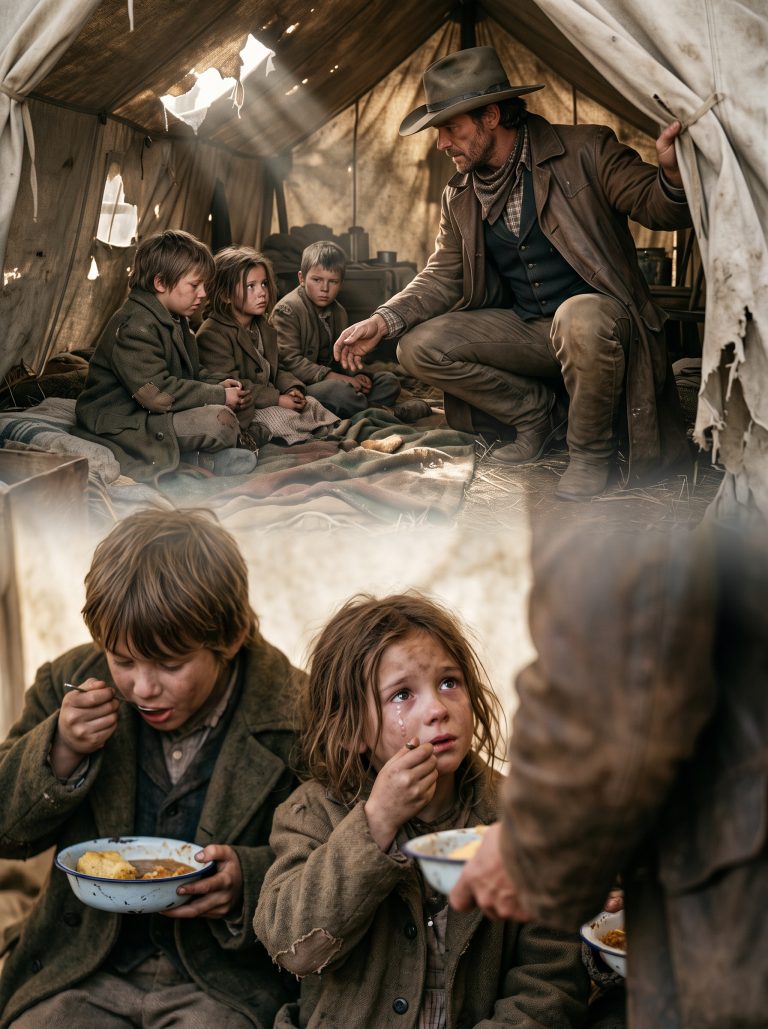
She Was Raising Three Kids In A Tent, The Cowboy Said, “You’ll Sleep Under A Roof Tonight”

Part 1
The wind came off the Montana flats like something with teeth, and Abigail Reed had learned, over eleven weeks of living beneath torn canvas, exactly what that meant. She pulled her two youngest closer under the flap of the tent and watched her oldest, Lily, eight years old and far too solemn for it, drive a stake back into the hardening ground with the flat of a stone.
“It won’t hold, Mama,” Lily said, not looking up.
“It’ll hold long enough,” Abby answered, because that was the only kind of promise she had left to give.
Three months since the fever took Daniel. Three months since she’d watched her husband go from a man laughing over a land claim map to a body wrapped in a horse blanket in the space of six days. The claim had lapsed. The wagon had been sold for his burial. The last of her mother’s silver had bought cornmeal that hadn’t lasted the month. Now there was only this: a rotting square of canvas on the edge of Miller’s Bend, two silver dollars sewn into her hem, and three children who had stopped asking when supper was.
Noah, five, pushed a stick through the dirt and made it gallop. Rose, barely three, slept fitfully against Abby’s shoulder, her breathing too shallow, her weight too light. Abby had learned to measure disaster in ounces now — how much thinner Rose had gotten since Tuesday, how much less bread there was to go around.
The storm had been building since noon, a wall of green-black cloud stacking itself over the western ridge. When the first gust tore a support rope loose with a sound like a rifle shot, Abby knew the tent would not survive the hour.
That was when she heard the horse.
A rider came out of the gathering dark at an easy lope, and Abby’s hand found the cold grip of Daniel’s revolver before her mind had finished deciding to be afraid. The man reined up well short of the camp, hat low, coat snapping in the wind.
“Evening, ma’am.” His voice was pitched to carry over weather without shouting. “Name’s Caleb Whitfield. Foreman out at Silver Creek. Didn’t mean to startle you — saw your camp from the ridge road and didn’t like the look of that sky over it.”
“We’re managing,” Abby said, the way she’d said it to a dozen men before him, most of whom hadn’t meant well by asking.
As if to argue with her, the wind hit the tent broadside and tore it half off its poles. Rose woke screaming. Noah bolted to Abby’s skirts. Lily’s face went the particular gray of a child trying not to be afraid in front of her mother.
Caleb was off his horse before the canvas finished collapsing, hands raised, voice steady. “There’s a line cabin a mile east. Stone chimney, solid roof. I’m not offering you charity, ma’am — that cabin needs a caretaker or the field mice will have it by spring. But whatever we call it, we’ve got about ten minutes before that storm makes the decision for us.”
Abby looked at her daughter’s face, colorless with cold, and felt the last of her pride give way to arithmetic. Ten minutes. Three children. One roof, real or not.
“All right,” she said. “Just for tonight.”
He didn’t smile, exactly, but something in his shoulders eased. He moved fast after that — swinging Noah up onto his sorrel mare, helping Lily scramble up behind, offering Abby his arm with a grip that didn’t waver even as hail began stitching itself into the rain. She rode in front of him with Rose crushed against her chest, and for the length of that mile she made herself trust a stranger’s hands on the reins because the alternative was letting her children freeze to prove a point.
The cabin, when it emerged from the sheeting rain, was smaller than it had looked in her imagination and finer than anything she’d slept under in three months — one square room, a stone hearth, a floor that didn’t shift under her feet. Caleb got the fire going with the unhurried competence of a man who’d built a hundred fires in worse weather, and within the hour there was a pot of cornmeal and beans steaming over the flame, and her children — her starving, silent children — were crying not from fear but from the shock of a full plate.
“Why?” Abby finally asked, once the children were asleep in a nest of borrowed blankets. “You don’t know us.”
Caleb was quiet a long moment, staring into the fire. “Someone did the same for my mother once,” he said. “I made her a promise a long time ago that I wouldn’t ride past it if I ever had the chance to return the favor.” He didn’t elaborate, and something in the careful way he said it — too careful — made Abby file the moment away without understanding why.
Outside, the storm broke itself apart against the mountains. Inside, for the first time in three months, nobody was hungry.
Part 2
The tent, they learned by morning, was beyond saving. But Caleb’s offer — a season’s use of the cabin in trade for mending work at the main house — was not one Abby could afford to refuse twice. Mrs. Doyle, the ranch’s iron-spined housekeeper, took one look at Abby’s stitching and hired her on the spot, and by the time the aspens along the creek had gone from green to a papery gold, the Reed family had become, in every way but paperwork, part of Silver Creek.
Lily thrived in Mrs. Doyle’s kitchen. Noah found his calling gentling a young colt nobody else had patience for. Rose, no longer measured in ounces lost, grew round-cheeked and loud.
Caleb came by most evenings on some thin excuse about a hinge or a roof shingle, and it was on one of those evenings, mending the cabin’s sagging porch step by lantern light while Abby held the nails, that she first caught herself watching his hands instead of the work they were doing. He talked while he worked — easy, unimportant things, the price of cattle, a mare that wouldn’t take the bit — and she found herself answering back more than the conversation required, reluctant to let the silence fall and send him back out into the dark toward Silver Creek.
Another evening, in early September, she came out to find him kneeling in the dirt beside Rose, patiently rebuilding a toy corral out of twigs the wind had scattered, his hat pushed back, laughing at something the girl had said with the whole of his attention on her small, serious face. Abby stood in the doorway longer than she needed to before either of them noticed her, and understood, watching him, that she was no longer simply grateful to this man. She was something closer to undone by him.
He asked her to the harvest dance in October. She said yes before she’d finished deciding whether she should. By November there was a length of blue wool wrapped in brown paper and a dinner at the Miller’s Bend hotel, and by the second week of December there was a small, worn ring box that Caleb carried in his vest pocket for two weeks before he found the courage to open it on her porch.
She said yes to that, too.
It should have been simple after that — a wedding, a future, the sort of quiet second chance she’d stopped believing existed. But two nights before the banns were to be read, Abby found Caleb standing alone at the corral fence in the dark, his hat off, his jaw set like a man bracing for a blow he’d been expecting a long time.
“There’s something you don’t know about me,” he said, when she came to stand beside him. “Something I should have told you back in that cabin, the first night, and didn’t have the nerve to.”
Abby felt the ground shift under the words before he’d even said them.
“Before I came to Silver Creek,” Caleb said, “I rode two years with a traveling doctor out of Bozeman. Learned enough to set a bone, dose a fever, know when a man was past saving.” He turned to face her fully, and for a moment he seemed to lose the words entirely, his jaw working around something he’d carried too long to say easily. “Abby — I was in Green River in the spring you lost Daniel. I was the doctor’s boy who came to that land office the day your husband fell sick.”
Part 3
For a moment Abby couldn’t make her mouth work. The wind moved through the corral rails and she heard, absurdly, the small ordinary sound of a horse shifting its weight in the dark, as though the world hadn’t just tilted sideways beneath her.
“You were there,” she said finally. “You treated him.”
“I tried to.” Caleb’s voice had gone rough, stripped of its usual calm. “Doc Abernathy was three days out on another call. I was twenty-two, and I’d sat with plenty of sick men by then, but I’d never carried a fever like that alone, with no one to send for and no one to tell me I was doing it right. I did what I knew — cool cloths, willow bark tea, kept him drinking what water he’d take. It wasn’t enough. I’ve known since that day it wasn’t enough, and I’ve told myself every kind of story about why, and none of them changed the fact that your husband died under my hands, and three months later I rode up on his widow starving in a tent and told myself it was fate, or Providence, or my mother’s memory calling me to do right.” He shook his head. “It wasn’t only that. It was guilt, Abby. It’s been guilt, some large part of it, since the first night. I should have told you before I ever asked you to marry me. I was afraid that if I told you the truth, you’d see everything I’ve done for you as payment on a debt instead of—” He stopped. “Instead of what it actually is.”
Abby stood very still, turning the new knowledge over the way she might turn a torn shirt to find where the seam had given way. She thought of Daniel — feverish, delirious, calling for water she couldn’t cool fast enough — and of a boy, barely more than a boy himself, kneeling beside a stranger’s deathbed with nothing but willow bark and his own inadequate courage. She thought of the doctor who hadn’t come, of the town that hadn’t sent for help sooner, of a hundred small failures that had nothing to do with the young man who’d stayed.
“Did you do everything you knew how to do?” she asked.
“Yes.”
“Then you didn’t kill my husband, Caleb. A fever killed my husband, in a territory with one doctor for four hundred miles and no medicine worth the name. You were a boy trying to save a stranger with willow bark, and you’ve spent all this time punishing yourself for not being able to do what nobody could have done.” Her voice caught. “But I need to understand something. When you rode up on that storm — when you gave us the cabin, the work, all of it — was that a man discharging a debt, or was that a man choosing to love a woman and her children?”
“Both, at first,” he admitted, and she respected him more for the honesty of it than she would have for a prettier answer. “I won’t lie to you and say guilt didn’t put me on that road. But Abby — the debt was paid a hundred times over the first week. Everything since has been mine to choose. I chose you at that dance. I chose you every evening I found some excuse to ride out to your cabin when I didn’t need one. I’m choosing you right now, telling you the one thing that could lose me the best thing that’s ever happened to me, because you deserve to build a marriage on the truth instead of a kindness you didn’t know had a debt attached.”
The banns had already been read once. In two days, the whole of Miller’s Bend would gather in the little white church to watch her marry this man. Abby thought of pride, and of the desperate widow she’d been, who had once believed that nothing came without a hidden price — and she thought, too, of how tired she had grown of waiting for the other shoe to drop on every good thing life offered her.
“I need a few days,” she said. “Not because I don’t love you. Because I want to be certain I’m choosing you, and not just accepting the last man standing between my children and hunger.” It was the hardest, most honest sentence she had said to him yet, and she watched it cost him something to hear it without flinching.
“Take as long as you need,” Caleb said. “I’ll still be here.”
She spent those days doing the one thing she had never let herself do since Daniel died: she wrote him a letter she would never send, sitting at the cabin table by lamplight while her children slept. She told him about the tent, and the storm, and the man who had ridden up out of it. She told him about the willow bark and the fever and the doctor who never came. She asked him, in the silence that was the only answer she would ever get, whether he could have hated a frightened boy who’d done his imperfect best — and she found, somewhere in the writing of it, that she already knew the answer, because she knew the kind of man Daniel had been, generous even in the small ways, and she could not imagine him wanting his death to become a chain around anyone’s neck.
She folded the letter and burned it in the hearth, not because the words weren’t true, but because she understood, watching the paper curl to ash, that grief did not require a debtor. It only required, eventually, permission to set the ledger down.
On the third evening she rode out to Silver Creek alone, in the blue wool dress Caleb had given her, and found him mending fence in the last light of day like a man who needed his hands busy to keep from riding to her door himself.
“I choose you,” she said, before he’d fully turned around. “Not the boy who couldn’t save Daniel. Not the debt you thought you owed a ghost. You — the man who’s spent every day since telling me the truth even when it cost him, who built a life out of a kindness and then had the courage to make sure it was honest. That man. I choose him.”
Caleb crossed the distance between them and did not trust himself to speak for a long moment. When he finally did, his voice had steadied back into the low, sure register she’d first heard over a dying campfire in a storm. “Then I promise you this,” he said. “Everything after today, I build with you in the light, nothing left in the dark corners. That’s the only kind of forever worth having.”
They married two days later, as planned, in the small white church with pine boughs on the rafters and half the county in the pews. Lily stood as junior bridesmaid with a seriousness that made the whole congregation smile; Noah carried the rings with the solemnity of a boy entrusted with the fate of nations; Rose scattered flower petals with more enthusiasm than aim. Mrs. Doyle cried and denied it fiercely. Mr. Whitcombe, the old rancher who’d come to think of Caleb as the son he’d never had, gave Abby away with a grip on her arm that told her, without words, that she had found a second family as well as a second husband.
They built a good life at Silver Creek — not an easy one, but a true one, stitched honestly, with nothing hidden in the seams. Lily grew into a schoolteacher. Noah became the finest horseman in three counties. Rose filled the ranch house with drawings of mountains, never remembering the tent, the hunger, or the mother who had once measured disaster in ounces.
On quiet porch evenings, Abby sometimes thought back to the rider who came out of the storm. The truest gift he’d given her wasn’t the cabin or the ring — it was the courage, years into their marriage, to tell her the truth and let her choose him freely.
Grief, she had learned, does not ask to be repaid. Only to be set down.
THE END