A Broken Cowboy Found Them at Their Lowest — What He Did Next Changed Everything

Part 1
Caleb Reed had buried enough neighbors to know that grief did not wait for a man to be ready. The Wyoming range taught that lesson early and repeated it often: cattle died in droughts, men died in winters, and the grass kept growing regardless of who was left to cut it. Caleb had learned to keep moving because the alternative was standing still long enough to feel everything at once.
So when the scream cut across the dry afternoon air, high and small and terrified, something in him that had gone quiet years ago sat up straight.
He had been checking the west fence since sunup, and his mare, Dust, was already tired of the heat. He reined her toward the sound without thinking twice, following it down into a shallow wash where a wagon lay tipped on its side, one wheel shattered, canvas torn and flapping like a wounded bird.
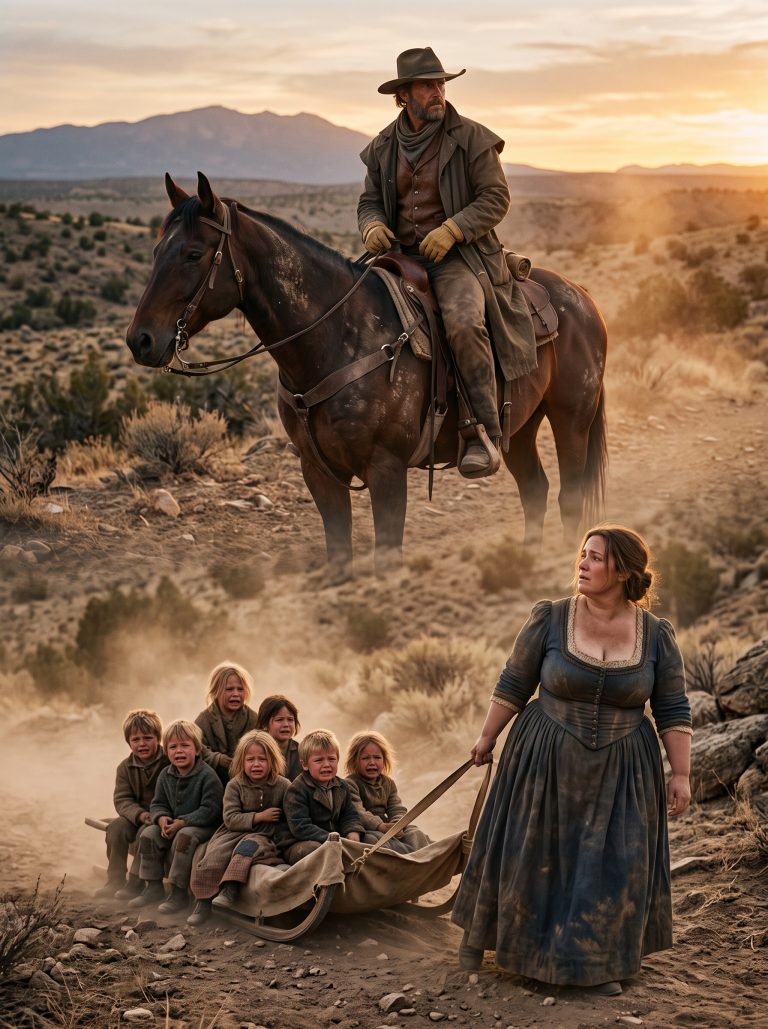
A woman lay still in the dirt near the wheel. Standing over her, feet planted and both hands wrapped around a broken axle rod, was a girl no older than ten. Her eyes were dry, hard, calculating — the eyes of someone who had already decided she would fight and lose rather than not fight at all.
Behind her, two boys clung to each other. The younger one, maybe four, was the one screaming. Off to the side, silent as a shadow, a smaller girl watched everything and said nothing at all.
Caleb raised both hands, empty and open.
“I’m not here to hurt anybody,” he said. “Name’s Caleb Reed. Ranch is two miles north. I heard the noise.”
“Stay back,” the girl with the rod said. Her voice did not shake.
“Yes, ma’am.” He didn’t move closer, but he didn’t retreat either. “What’s your name?”
“Doesn’t matter.”
“Fair enough. Is that your mama on the ground?”
The girl’s jaw tightened, and that was answer enough.
“She’s hurt,” Caleb said gently. “Bad, from the look of it. Those boys need water. Your sister over there looks like she’s cried herself dry. I’m not going to pretend you should trust a stranger — you’d be a fool to, on my word alone. But I can tell you what I see, and you tell me if I’m wrong. I see one girl trying to hold a whole family together by herself, and she’s about out of road.”
Something in the girl’s shoulders dropped an inch.
“Her name’s Sarah,” she said finally. “My mama. She’s been sick two days. Fever.”
“And yours?”
A pause. “Abby.”
Caleb knelt by the unconscious woman, pressed two fingers to her neck, found a pulse — thin, but there. Her skin was burning even through the dry heat of the day.
“She’s alive,” he said, and looked up. “Abby, I need you to fetch my canteen for your brothers while I see to her.”
Abby went, walking slow and deliberate, making it plain she was choosing to help, not obeying. She gave the water to the older boy first — Wyatt, seven, careful and solemn — who tipped it to his little brother Sam’s mouth until the screaming dissolved into ordinary crying. The silent girl, Nora, did not move from the scrub brush until Abby called her name in a voice gone suddenly soft, and then she crossed the distance in a rush and pressed into her sister’s side.
Caleb carried Sarah Colton to his horse. She weighed less than she should have. Much less.
“How long have you been on the road?” he asked.
“Nine days,” Abby said, reciting it flat, like a fact she’d repeated to herself too many times. “From Buffalo. Trying to reach our uncle’s place near Casper.”
“Your papa?”
A pause a second too long. “Gone.”
Caleb didn’t ask how. He lifted the boys onto his mare in front of the saddle, settled Sarah across it in front of himself, and looked down at Abby, who still held the broken axle rod like she might need it yet.
“You can leave that.”
“No.”
He almost smiled. “Fair enough. Let’s walk.”
The two miles back were long and quiet, the ranch house rising slow out of the heat-shimmer at the end of them. Abby kept pace the whole way without complaint, Nora’s hand locked in hers, and did not slow once.
“This your place?” she asked at the fence line.
“It is.”
“You live here alone?”
“I do.”
“Why?”
Caleb thought about that longer than the question probably deserved. “Haven’t found a reason that made sense yet.”
Abby considered this with the gravity of someone twice her age. “Then who’s going to take care of my mother?”
“I am,” Caleb said, and meant it before he understood why.
By nightfall Sarah Colton lay fevered in Caleb’s own bed, and Caleb sat beside her with a basin and clean rags, trading out cool cloths, coaxing water past her lips a swallow at a time. Abby had wanted to stay, had fought him for ten minutes with everything a tired ten-year-old had left, before he’d convinced her that dropping from exhaustion would help her mother less than sleeping would.
“You swear you’ll stay with her,” Abby had said. Not a question. A test.
“On this whole ranch,” Caleb answered. “I swear it.”
Something in the girl’s shoulders had finally let go.
Near midnight, Sarah’s eyes opened — gray, sharp even through fever-fog, and full of the same watchful intelligence he’d seen in her daughter’s face in the wash.
“Where,” she rasped.
“My ranch. You’re safe. Your children are safe. All four, asleep in the barn room.”
Her hand shot out, caught his wrist with surprising strength. “Abby—”
“Fought me for ten minutes before she’d let me help. Strongest child I’ve ever met.”
Something like pride moved across Sarah’s ravaged face. “She takes after her father.”
“She takes after herself,” Caleb said, and settled the cloth against her forehead. “Sleep if you can. I’ll be here.”
“Why,” she whispered, already fading, “are you doing this?”
He thought about the honest answers — because it was right, because no decent man rode past a woman in the dirt, because a scream like that didn’t leave a man’s ears once he’d heard it. All true. But what he said was simpler.
“Because your girl stood over you with a length of broken wood and wasn’t going to move for anybody. That kind of love deserves protecting.”
Sarah’s breathing had already evened into sleep, but before her eyes closed all the way, Caleb saw the faintest pull at the corner of her mouth.
Not a smile yet.
Only the possibility of one.
Part 2
Sarah’s fever broke and climbed and broke again over three days, the way bad fevers do. Caleb did not leave the chair beside her except to feed the children and check the stock. On the fourth morning she woke clear-eyed and furious about having been frightened, and demanded to know exactly what conversations had been happening around her.
That was when Abby told her about the men.
Two riders had come the day before, sent by a lawyer named Whitmore, representing Sarah’s father-in-law, a cattle baron named Silas Ashford, who had filed a custody petition in Buffalo claiming Sarah unfit to raise four children alone. Caleb had turned them back at the gate with nothing but a calm voice and the plain fact that a Buffalo order held no force in this county until reviewed.
“He’ll come himself next,” Sarah said, staring at her hands. “Silas doesn’t stop. My husband’s father has wanted our land grant — forty acres with the only good spring for ten miles — since before Thomas died. If he gets guardianship, he gets the water, and there’s nothing left of what my husband built for us.”
“Then we slow him down until the law can do it right,” Caleb said. “Pastor Ellis rides through Thursday. He’s known the county clerk in Casper thirty years.”
Sarah looked at him with the particular exhaustion of a woman who had been fighting alone too long to trust an easy offer.
“You don’t owe us anything, Mr. Reed.”
“No,” Caleb agreed. “I don’t.”
He held out the water glass instead of an argument.
“But your girl carried this family eleven days on a fever and a broken wagon, and you carried it before that. Right now the thing that helps everybody is you getting well. Everything else, we handle one piece at a time.”
Sarah drank. Something in her rigid shoulders eased, barely, like a window cracked in a house shut up too long.
“One thing at a time,” she repeated, testing the weight of it.
“That’s all anybody can manage.”
Pastor Ellis rode out Thursday as promised, carrying word toward Casper and a friend at the county clerk’s office — a man named Thomas Briggs who, Ellis said, “knows his law and doesn’t scare easy.” Caleb watched him go and felt the particular stillness that comes before a storm a man has chosen to stand in rather than run from.
Two days later, hoofbeats came up the south road — unhurried, businesslike, the sound of men accustomed to other people stepping back.
Caleb walked out to meet them before they’d finished dismounting.
Part 3
There were two riders at the gate, one lean and citified in a coat too fine for ranch dust, the other broad and silent. The lean one did the talking.
“Caldwell,” he said. “I represent Silas Ashford in the matter of custody of the Colton children. We have reason to believe they’re on your property.”
“They are,” Caleb said. “And you’re in Natrona County now, not Buffalo. That order needs review by the local magistrate before it means a thing here.”
Caldwell’s smile thinned but held. “The children’s grandfather is a patient man, Mr. Reed. But not an unlimited one.”
“Tell him his daughter-in-law is recovering under care, his grandchildren are safe, and if he wants this settled, he can do it in front of a judge like the law requires. That’s the only conversation happening today.”
They rode off. Caleb sent word to Pastor Ellis to ride for Casper that same hour instead of waiting for morning, and by the time the sun rose again, Thomas Briggs himself had arrived with news that reshaped everything Caleb thought he understood about the fight.
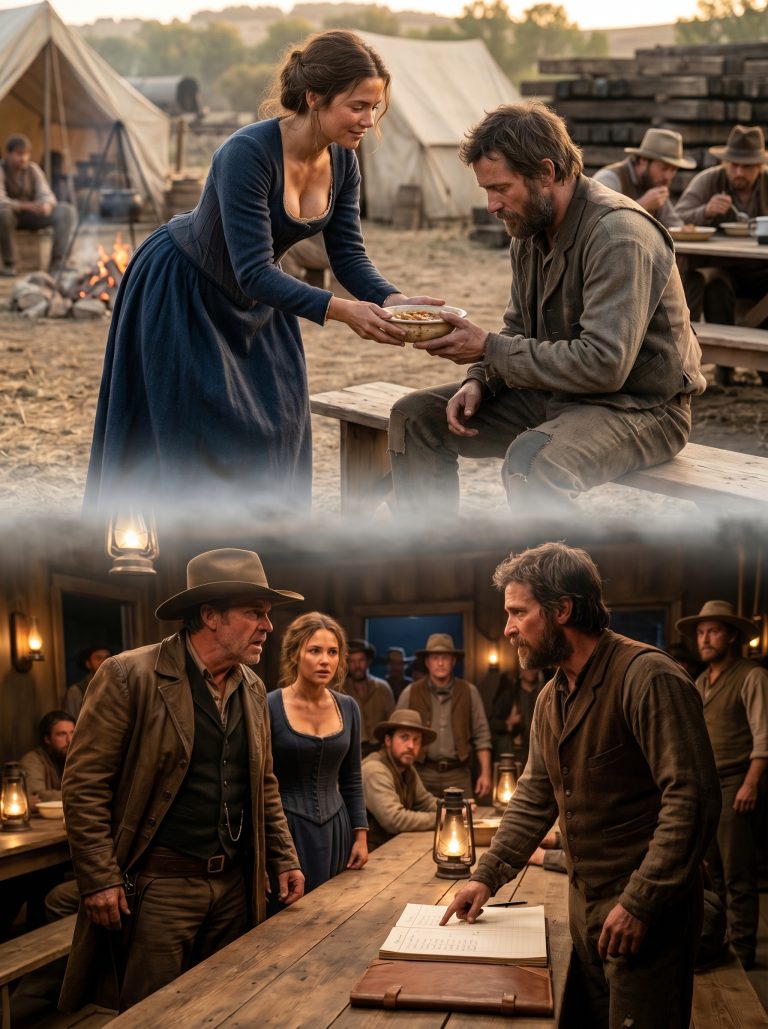
“There’s a problem with the incapacity motion,” Briggs said, laying documents across the kitchen table while Sarah sat rigid in a chair, Abby standing close behind her. “It names a Dr. Everett Hale as the physician who examined Sarah and found her unfit. I know Hale. Wired him last night.”
“And?” Sarah’s voice had gone very still.
“He never examined you. Never met you. His signature on that affidavit is forged.”
The kitchen went silent enough to hear the windmill turning outside.
“Silas forged a doctor’s signature,” Sarah said slowly, and something raw crossed her face — not surprise exactly, but the particular pain of watching an old suspicion become undeniable fact.
“That’s the strange part,” Briggs said, frowning at his own papers. “I sent a second wire, to a clerk I know in Buffalo who handles Ashford’s business filings. Silas Ashford didn’t retain Caldwell. Caldwell was retained — and paid — by a man named Josiah Whitmore. Silas’s own lawyer of fifteen years.”
Caleb looked up sharply. “Whitmore’s working for himself.”
“I believe so. I pulled the land office records this morning before I rode out. Six weeks ago, a survey crew logged a mineral claim application on file — for the very spring on the Colton grant. Silver, not water. Whitmore filed the preliminary paperwork under a shell name, but the notarization traces back to his own office stamp.”
Sarah’s hand had gone flat and white-knuckled on the table. “He’s been telling Silas I’m unwell. That I can’t manage the children. That the land needs a steady hand until they’re grown.”
“And once he had guardianship papers naming Ashford as custodian,” Briggs said, “Whitmore would’ve controlled the land through him — an old man who trusts his lawyer and doesn’t read fine print as closely as he used to. Whitmore gets the silver. Ashford gets blamed for the cruelty of it. And you and your children get nothing at all.”
Abby’s face had gone the color of old paper. “Grandpa didn’t know.”
“I can’t say what Silas Ashford knows and doesn’t,” Briggs said carefully. “Only what the documents show.”
Caleb thought of the man he’d turned away from the gate the day before — not Ashford himself, only his emissaries — and felt the ground of the fight shift under him. He had built his understanding of this war around a simple villain, a grandfather grown cruel with money and time. The truth was messier, and messier truths were harder to fight, because they left room for a man to be both dangerous and deceived.
“We need to get word to Ashford directly,” Caleb said. “Before Whitmore does.”
Sarah looked at him like he’d suggested walking into a fire. “He tried to take my children.”
“He tried to take them because a man he trusted told him lies for fifteen years and forged the proof to back them up,” Caleb said. “That doesn’t make him safe. But it might make him useful, if what’s true finally reaches him before Whitmore can bury it again.”
It was Abby, silent through all of it, who spoke next.
“I’ll write to him,” she said.
The room turned to her.
“He came to see us twice, before Papa died. He wasn’t warm, but he wasn’t cruel either. He asked me once what I wanted to be when I was grown, like he actually cared about the answer.” She looked at her mother. “I don’t trust him. But I don’t think Mr. Briggs found a lie Grandpa built. I think he found one built around him.”
Sarah’s jaw worked. It took her a long moment to nod.
Abby wrote the letter at the kitchen table that afternoon, in a careful, deliberate hand, and Caleb rode it into town himself to send by the fastest wire he could arrange, because some things could not wait for regular post.
Silas Ashford arrived four days later — not with Caldwell, not with hired men, but alone, on a tired black horse, looking a decade older than the portrait of ruthless wealth Sarah had painted of him.
He stood at the gate with his hat in his hands, and for once it did not look like performance.
“Sarah,” he said. “I need to see the documents Mr. Briggs found.”
She studied him a long moment before she let him in.
He read the forged affidavit twice at the kitchen table, his face going the gray of a man discovering the ground beneath him had never been solid. When he reached the mineral claim filing, his hand began to shake.
“Fifteen years,” he said, mostly to himself. “I trusted that man with my son’s estate for fifteen years.”
“You trusted him enough to believe I couldn’t raise my own children,” Sarah said. There was no forgiveness in her voice yet, only fact.
“I believed I was protecting Thomas’s legacy,” Silas said. “I believed — God help me, I believed what I was told, because it was easier than sitting with my own grief over my son and doing nothing useful with it. That’s not an excuse. I know it isn’t one.” He looked at her, then at the four children arranged warily around the room, then at Nora, who had not spoken a word to him in all the months since her father died. “I was wrong about you. I was wrong in a way that nearly cost me everything that’s left of Thomas in this world.”
Sarah said nothing for a long time.
It was Nora who broke the silence — small, clear, the same steady voice that had once stopped a yard full of armed men cold, months before, when she’d first found her words again.
“You should tell the judge the truth,” she said. “Not just us.”
Silas Ashford looked at his silent granddaughter as if she had struck him.
“I intend to,” he said. “I’ll ride to Casper myself. I’ll sign whatever affidavit Briggs needs. Whitmore will answer for the fraud, not any of you.”
He was true to his word. The territorial court’s ruling came three weeks later: the incapacity motion voided and marked fraudulent, the custody petition withdrawn at Ashford’s own formal request, and a separate criminal referral opened against Josiah Whitmore for forgery and attempted theft by deception — a case that would occupy Cheyenne courts for the better part of a year and end, eventually, with Whitmore disbarred and the mineral claim struck from the record as fraudulently filed.
Silas Ashford did not ask for reconciliation. He asked, instead, if he might write to the children — and if, someday, when trust had been rebuilt one honest letter at a time, he might visit as what he actually was: a grieving grandfather who had let his grief be used against the family he claimed to love.
Sarah did not answer him that day. But she did not burn the letter either. She folded it and set it in the desk drawer beside the other papers she kept — the ones that mattered, the ones worth remembering even when they were hard to look at.
The ranch became a home the way most true things become real — not in a single moment, but in the accumulation of ordinary days. Abby got a garden planted before first frost, working the turned earth with the same fierce, unsentimental focus she’d once aimed at a broken axle rod. Wyatt learned every fence post on the property and asked Caleb sharper questions than Caleb always had good answers for. Sam stopped feeding biscuits to the horses, for about a week. Nora filled page after page with charcoal birds — flying, lifting, and, more and more often now, simply at rest.
One evening in early autumn, Caleb came in from the south fence to find Sarah at the stove, Abby at the table sketching beside her sister, Wyatt reading aloud from a book too advanced for him while Sam listened with fierce four-year-old concentration. Sarah turned from the stove and looked at him, and in her eyes was the whole weight of everything they’d survived together — not carried now as a wound, but as the history of a life that had turned out, after all, to be worth fighting for.
“Dinner’s almost ready,” she said.
Caleb Reed, who had ridden past death more times than he could count and never once stopped to grieve it properly, who had spent years in a house that only ever echoed, hung his hat on the hook by the door.
“Good,” he said.
And he came home.
It was Abby, years later, telling the story to her own children on a porch not so different from that one, who found the words for what it had all meant. Courage, she told them, was never the single brave act on the single desperate afternoon — not the broken axle rod, not the two riders turned away at a gate. It was the plainer, harder thing: choosing every ordinary day afterward to stay, to look honestly at hard truths even when a simpler villain would have been easier to hate, and to hold the door open until the people who needed to come through it — even a grandfather undone by his own trust — finally found their way.
Once a family chose each other in dust and fever and fear and forgiveness, she said, no lie, no forged signature, and no man’s cruelty — deceived or otherwise — could ever fully take that from them.
Not really.
Not ever.