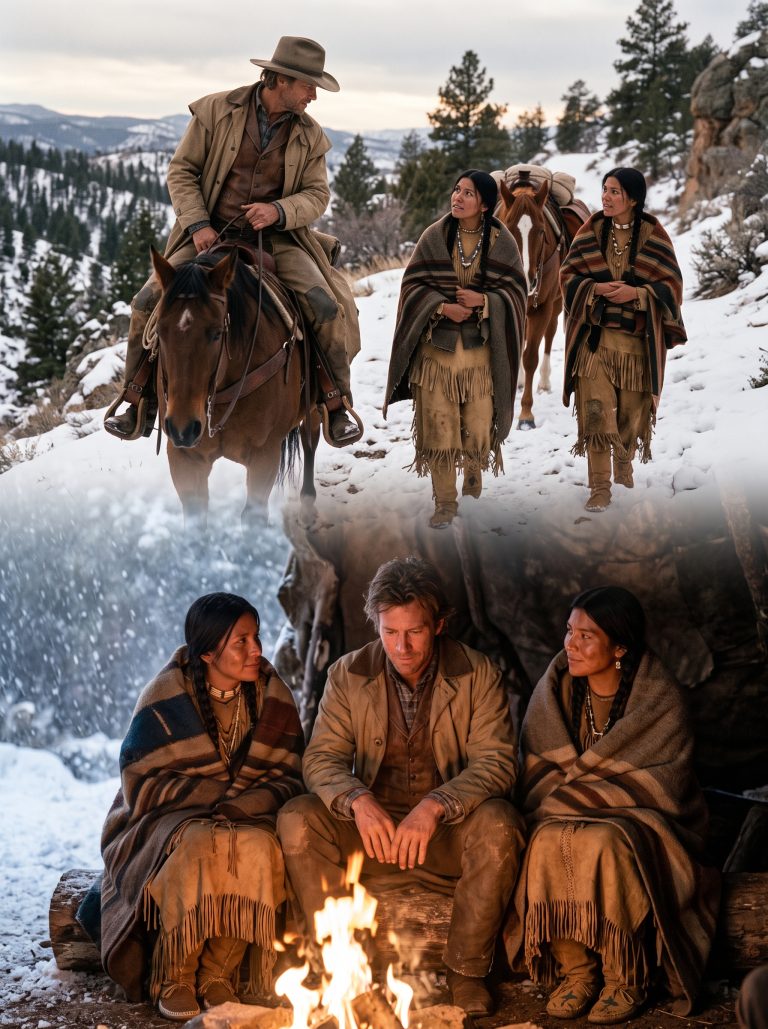
Sold for a Horse at 19 — She Thought It Was the End… Until the Cowboy Spoke

PART 1
Nineteen years old, and her uncle sold her for a horse.
Iris Vale stood in the mud outside a farmhouse in Red Hollow, watching a young rancher named Ian Thorne run his hand along the flank of a four-year-old mare named Nell. Twenty-eight, maybe twenty-nine. Quiet in the way of men who’d learned to keep to themselves. And he was, without knowing it yet, about to become the second half of a trade.
She’d known this morning was coming. Her uncle had woken her before dawn, told her to wash in the creek, told her to look presentable for once in your worthless life. She didn’t ask why. Asking only ever made things worse.
Clyde Marin had raised her since she was twelve, since fever took her parents and left her nowhere else to go. He never let her forget the debt.
Now he was collecting — and he’d brought paperwork to make it look proper. A guardianship transfer, he called it, already signed, needing only Thorne’s name beside his own. Legal and binding, he said. Nobody can say otherwise.
“You sign this,” Clyde told the rancher, sliding the paper across a fence rail, “give me the horse, and she’s yours to look after. Ward, not property. Keeps it clean.”
Ian read it twice. Iris watched his jaw work like he was chewing on something bitter.
“No,” he said.
Her uncle’s face went ugly fast. He called it an arrangement, already struck. Thorne folded the paper, handed it back, and started toward his horse.
She let him get three steps before her pride gave out.
“Wait.” Her voice cracked. “He’s going to kill me.”
Thorne stopped. Turned. Looked at her — not at her body, the way men usually did, just at her face — like he was actually asking a question and waiting for a real answer.
“Is that true?”
“Yes.”
He picked the paper back up. Crossed out a line, wrote something above it, and signed.
“I’ll take the guardianship,” he said. “Not the rest of it. She’s not property. Say so in writing or there’s no deal.”
Clyde blinked, caught off guard, then shrugged and scrawled his own signature rather than lose the horse.
Iris didn’t understand yet what that single changed line would mean. Didn’t know it would matter, months later, in a way that saved both their lives. All she knew, riding away with a folded paper in Ian’s saddlebag and his jacket around her shoulders, was that for the first time in seven years, nobody’s hand was raised against her.
It wasn’t safety yet. But it was quiet. And quiet, when you’ve never had it, feels a lot like a beginning.
PART 2
Weeks passed before Iris stopped flinching at the sound of his boots on the porch.
He never touched her door. Never asked for anything in return for the paper folded in his desk drawer — the one that said, in his own hand, ward, not property. Every morning there was coffee already made and no explanation offered for the kindness of it.
It took her most of a month to walk out to the barn on her own. Longer still before she said more than a few words to him at a time. Ian Thorne, she was learning, wasn’t a man who rushed anything — not fences, not horses, not the careful, patient work of earning trust from someone who’d never been given a reason to have any.
By the second month, she was helping with the horses. By the third, she was teaching him the songs her mother used to sing, and he was teaching her to read.
It was months in, over nothing more than a shared pot of coffee, that he finally told her the shape of what he’d lost — not the whole of it, not yet, just enough for her to understand why the house had felt like a held breath before she arrived.
“There’s a reason I live alone out here,” he said. “A reason I stopped expecting anyone to stay.”
“You don’t have to explain it tonight,” Iris told him.
“I know.” He looked at her for a long moment. “I want to, though. Just not yet.”
Something shifted after that — not romance yet, just two careful people learning they could trust each other with the parts still too raw to say out loud.
Her uncle hadn’t given up, though. He came back once, drunk and furious, threatening to burn what Ian had built, and it took the sheriff and half of Red Hollow’s patience to send him off. Iris understood, watching Ian stand between her and a man who’d owned every part of her life for seven years, that something had changed in her that she hadn’t given herself permission to name yet.
She wasn’t just grateful anymore.
PART 3
I. A Slow Kind Of Trust
The cabin sat small and solid against the foothills, and for the first weeks Iris treated her own bedroom door like the only thing standing between her and everything she’d left behind. She locked it every night. Ian never once tried the handle.
Mornings came with coffee already made and a note the first day — Help yourself to whatever you need — and then, after that, nothing but the quiet fact of his presence somewhere outside, giving her the whole cabin and all its silence to herself.
She started small. Washing dishes. Sweeping. Things that gave her hands something to do besides shake. Ian never commented, never thanked her, never criticized — just let the changes happen the way he seemed to let most things happen, with a kind of patient, watchful calm.
Four days passed before she worked up the nerve to walk out to the barn.
She found him mending fence. He glanced up, gave a small nod, and went back to work without asking why she’d come. No demands. Just room to exist.
“He’s beautiful,” she said, watching the gray stallion in the corral.
“Yeah,” Ian said. “Knows it too. Proud as the devil.”
It was such an ordinary thing to say that she almost laughed. It was the first time in longer than she could remember that anyone had spoken to her like a person instead of a problem.
Over the weeks that followed, he taught her the horses — how to approach without spooking them, how to read the small signals of fear or trust in the set of an ear or the shift of weight in a hoof. She taught him, without meaning to, how to have another voice in the cabin again. She hummed while she cooked. He stopped eating like a man marking time and started eating like a man who noticed the food.
It was slow. It was supposed to be slow.
One evening, a full season after that first ride into the foothills, she asked him about his family — about the wife whose name the whole town still spoke in careful, hushed tones.
“Sarah,” he said, and told her about the fire. About a son named Elijah. About a wooden horse, carved by a grandfather, kept in the root cellar because he’d never found the strength to move it anywhere else. About the lie he told his dying wife, that their boy was safe, because the truth would have been crueler than the mercy.
“That’s not a lie you should carry like guilt,” Iris told him. “That was love.”
He looked at her the way a man looks at something he hadn’t let himself hope for.
“I’ve been rattling around this place for five years like a ghost,” he admitted. “You’re the first thing that’s made it feel like a house again.”
Nothing happened that night. Nothing needed to. But something had quietly, undeniably begun.
II. The Warning
The first sign wasn’t Clyde himself. It was the fence.
Iris found it on a gray morning, three rails pried loose and dropped in the mud, and the young gelding standing loose and spooked in the near pasture instead of safely penned. Nothing stolen. Nothing burned. Just enough damage to say, clearly, I know exactly where you live, and I can reach whatever I want to reach.
Ian walked the treeline with his rifle for the better part of an hour and found boot prints circling the barn twice before doubling back toward the road. Not a drunk man stumbling through on impulse. Someone who’d waited, watched, and left on purpose.
“He’s not done,” Iris said, watching him check the locks that night for the third time.
“No,” Ian agreed. “He’s just deciding how he wants to do it.”
He didn’t have to wait long to find out.
Clyde came back four nights later — not alone this time, but with a hired man trailing behind him and a pistol worn openly at his hip, no longer bothering to pretend this was a friendly visit. He stood at the edge of the yard in the dark, and there was nothing drunk or clumsy about him this time. He was cold. Deliberate.
“That paper’s just ink to a judge two counties over,” he called out. “Nobody’s coming to check on some ward filed in a drawer. I could take her tonight and be gone before anybody so much as asks a question.”
Ian stepped off the porch, rifle already raised, put himself square between the two men and the door.
“Try it,” he said, “and only one of us walks back to that road.”
“You’d shoot a man over a girl who isn’t even yours by blood.”
“She’s mine to protect. That’s the whole of it.” Ian’s voice didn’t rise. “Take one more step onto this land.”
The hired man’s hand twitched toward his own weapon — and stopped, because Ian’s aim never wavered, never gave either of them an opening. For a long, ugly stretch of seconds, nobody moved. Then Clyde spat into the dirt, cursed them both, and backed toward his horse, the hired man following.
“This isn’t finished,” Clyde called over his shoulder.
It wasn’t quite finished, either. Word came within the week, through Mara, that the sheriff had ridden out to Clyde’s place himself after Ian filed a formal complaint — the signed guardianship paper, witnessed and on record at the county clerk’s office, was enough on its own to make trespassing charges stick if he came near the property again. Clyde was warned, in plain terms, that the next visit would end in a cell, and that the town had already heard enough about him to stop looking the other way.
He didn’t come back after that. But for weeks afterward, Iris still checked the treeline out of habit before she stepped outside, and Ian still walked the fence line every night before he’d let himself sleep.
It had proven something neither of them said out loud: the paper in Ian’s desk drawer wasn’t just words. It held — but it had come closer to not holding than either of them wanted to admit.
III. Four Words
The porch light was low, the mountains dark against a clear autumn sky, when Ian finally said what he’d clearly been working up to for weeks.
“Iris.” He turned to face her fully. “I need you to hear something, and I need you to believe it.”
“Okay.”
“You are not mine.” He said it slow, deliberate, like he’d practiced it. “Not on account of that paper. I didn’t trade a horse for the deed to a person, whatever your uncle wants to call it. A man can’t own another soul just because he’s got ink and a witness saying so. You were never anyone’s to hold, and I won’t be the next one who forgets it.”
Her breath caught.
“Then what is this?” she asked. “What are we?”
“Whatever you want it to be,” he said. “I know what I want. I want you to stay because you choose to, every single day, not because you feel like you owe me something. I want—” He stopped, visibly searching for the right shape of the words. “I want to ask you something, eventually. Not tonight. Not until you’re sure it’s what you want, not what feels safest.”
“I’m already sure,” she said.
“Iris—”
“I know what being owned feels like,” she said. “I spent seven years learning it. This isn’t that. I know the difference now.”
He kissed her then, careful, giving her every chance to pull away. She didn’t. When they broke apart, he rested his forehead against hers.
“Say it again,” she whispered. “That I’m not yours.”
“You are not mine,” he said. “You’re just with me. If you want to be.”
“I want to be.”
IV. Mara’s Proposal
Mara Dune arrived a week later the way she always did — without warning, basket in hand, eyes missing nothing.
“So,” she said, setting the basket down. “Are we doing this properly, or dancing around it until spring?”
“Doing what?” Ian asked, too fast.
“Marriage. Church, papers, all of it. You’ve already got the guardianship signed clean — make the rest of it just as clean. No one in this town gets to whisper about what she is to you if she’s your wife, your equal, standing on paper as good as yours.”
Iris looked at Ian. He looked back, steady.
“Only if it’s what you want,” he said. “Not what makes it easier.”
“I want it,” Iris said. “Not to be safe. Because I choose you.”
“Then that’s settled,” Mara said, already reaching for the wine.
V. The Wedding
The ceremony was small — a handful of neighbors, Pastor Williams reading scripture with barely hidden surprise at the speed of it, Mara beaming from the second pew. Iris barely noticed any of it. Her whole attention stayed fixed on the man across from her, hair dark and unremarkable, nothing gray about him yet, nothing about him that made this feel uneven or wrong. Just steady. Just present.
“I do,” she said, and meant every syllable.
Afterward, at Mara’s house, there was a fiddle and dancing and more warmth in one room than Iris had known in years. Word came the next week, through the sheriff, that Clyde had left the territory entirely — the guardianship paper, witnessed and filed with the county clerk, had closed off every legal claim he might have tried to make, and without that, and without the town’s goodwill, he had nothing left to stand on.
He never came back.
VI. Hope
Spring rebuilt what the season before had left tired and bare. Iris planted a garden that overflowed by June. The horses grazed easy in green pasture. And in late June, when the sickness hit her three mornings running, she finally understood what her body had been telling her.
She told him at sunset on the porch.
“Ian.” She pressed his hand to her stomach. “I’m pregnant.”
He went still, then his eyes filled, and he held her like a man who’d stopped expecting good things to keep happening to him and was slowly learning to let them.
Their daughter came the following February. Healthy. Loud. Theirs.
“What should we name her?” Iris asked.
Ian looked at his daughter for a long moment.
“Hope,” he said. “Because that’s what she is.”
VII. The Truest Ending
Two years later, on an ordinary afternoon, Iris stood on the porch with Hope on her hip, watching Ian work a young colt in the corral — Nell’s colt, the same mare Clyde had traded away that first evening, grown gray-muzzled now and put out to easy pasture, watching her own foal take its first uncertain steps under Ian’s patient hand.
“Dada and horse,” Hope announced.
“I see, sweetheart. That’s Nell’s boy.”
Ian finished with the colt and climbed the steps to wrap his arms around them both.
“Funny thing to still have her,” Iris said, nodding toward the old mare dozing by the fence. “After everything.”
“Never had the heart to sell her on. Figured she’d earned her keep the day my uncle-in-law traded her for you.” He almost smiled. “Best bargain that ever crossed this fence line, and she doesn’t even know she was half of it.”
“Thinking about how far we’ve come,” Iris said.
“Long way,” he agreed. “From a signed paper on a fence rail — and a horse who never asked to be part of any of it.”
“Best decision you ever made.”
“You made it too,” he said. “I never owned you. I just got to keep you. There’s a difference, and I still think about it every day.”
Hope wriggled free to chase a butterfly through the grass, laughing, and they watched her go — proof that something steady and real could be built out of a morning that started with a stranger’s signature and a horse traded at a fence line.
The girl who’d once been offered up as part of a deal had become a woman who knew, without doubt, that she’d never been anyone’s property — not on paper, not in truth.
The man who’d lost everything once had learned how to build something again, slowly, without ever mistaking love for ownership.
THE END