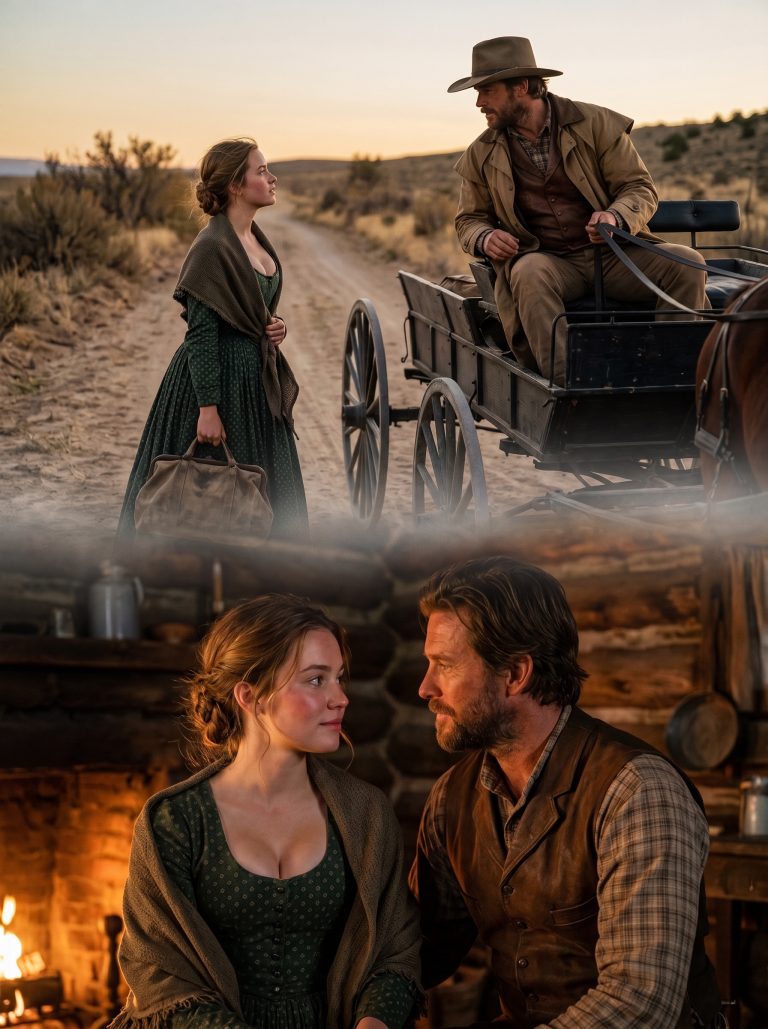
A Lonely Rancher Took Refuge With Two Apache Sisters — By Morning, Nothing About Him Was the Same Again

Part 1
The wind came down off the Bighorns like something with teeth, and Thomas Garrett knew before the first flake fell that he had misjudged it.
He was twenty-four, and the three hundred acres below the ridge were his — inherited five years back, when a fever took both his parents inside the same week and left him alone with a half-built barn and a herd of thirty-nine head. He had built the rest himself: fences, patience, a silence he mistook for peace. His mother’s last words to him, whispered so thin he’d had to lean close to catch them, had become the only scripture he kept. Keep your heart shut tight, Tommy. This world takes what you show it. He had obeyed her for five winters running.
Now the sky over the north pasture had gone the color of a bruise, and his cattle were scattering, and Thomas was a mile and a half from his own front door with no more idea which way was home than a man dropped blindfolded from a wagon.
He gave his mare, Belle, her head. She fought the drifts with her whole body, and Thomas fought the ice sealing his lashes shut, and somewhere in the white roaring nothing he saw a smear of orange that should not have been there.
Fire.
He half-fell from the saddle and staggered toward it, past a shoulder of rock, until the shape resolved into a tipi he’d had no idea stood on his own land’s edge. His father’s voice rose up in him, hard as a slammed door — can’t trust them, boy — but the cold was already past listening to fathers. He knocked on the lodgepole by the flap the way his mother had taught him, manners before everything, even dying.
“I’m caught in the storm,” he said, teeth cracking around the words. “I mean no harm.”
The flap lifted. A young woman stood there, black hair in a single braid, dark eyes taking his measure in one pass. Behind her, an older woman rose from beside the fire, her hand drifting toward the knife at her belt.
They spoke to each other in a language Thomas didn’t know. Then the older one nodded, once, and the younger said, “Come. Bring horse.”
Inside, the warmth hit him like a fist. They took his coat, pressed a clay cup of bitter tea into his ruined hands, told him to sit before his legs decided it for him.
“I’m Thomas Garrett,” he managed. “Ranch’s about a mile off. I think.”
“Mary,” the younger woman said. “My sister, Sarah.” She caught his surprise. “Mission school. Easier names for easier tongues.”
He should have asked why two Apache women were camped alone on land that wasn’t reservation land, why their men weren’t with them, why the older sister’s eyes kept cutting toward the door like she was counting exits. He didn’t. The tea worked into him, and for the first time in five years Thomas Garrett talked — really talked — about the ranch, the silence, the ache of eating supper across from an empty chair.
It was Sarah who went still first.
She had reached to hang his coat nearer the fire and her thumb had caught the torn seam of the lining — an old coat, his father’s once, patched inside with a strip of doeskin his mother had sewn in years ago, decorated with a small run of beadwork gone dull with age. Sarah’s fingers stopped on the pattern. She said nothing. But she looked at it a long moment, then at Thomas’s face, then back at the fire, and did not mention it again that night.
He didn’t notice. He was too busy learning, for the first time since his mother died, what it felt like to be looked at by someone who wasn’t waiting for him to leave.
“Why help me?” he finally asked. “I’m the last man your people have reason to shelter.”
Mary considered him across the flames. “Storm doesn’t care if you’re white or Apache. Cold kills the same. We know what it costs to need shelter and be refused it.”
Something in the way she said refused — flat, worn smooth by repetition — told him it wasn’t a hypothetical.
“Our men were taken to the reservation,” Sarah said, when he asked. “We chose a different road.”
Fugitives, then. Living free and unlawful both. He should report them. He knew that the way he knew his own name.
He also knew, watching the fire move light across their faces, that he would not.
The blizzard screamed outside until past midnight and did not touch the three of them at all. Before sleep took him, Thomas thought he heard, under the wind, something like his mother’s voice — not the warning this time, but softer, saying a thing he couldn’t quite catch, like a sentence with half its words worn away.
He woke to silence and gray light and the smell of woodsmoke, and for the first time in five years, going home didn’t feel like going back to anything.
Part 2
He returned three days later with flour, coffee, a haunch of venison, and — because he couldn’t help himself — a small hand mirror with a carved handle, the kind of foolish gift that marked a man as sweet on someone if anyone in Cedar Falls ever found out.
“No one ever gave me something for no reason before,” Mary said, turning it in the light.
After that, Thomas found reasons three, sometimes four times a week. He learned their true names — Ayana, Nashota — and was asked to keep using Mary and Sarah where anyone else might hear. He learned that Sarah had lost a husband to an army sweep, that Mary’s promised match had died at Sand Creek along with the future it would have made. He told them things he’d never said aloud: his father’s hard lessons, his mother’s softer ones, the fear that had sealed him up like a jar.
“Good teaching helps you live,” Mary told him one evening, her hand over his. “Bad teaching just keeps you from it. Which was yours?”
He didn’t have an answer yet. But he kept coming back for one.
More than once he noticed Sarah watching him with an attention that had nothing to do with courtship — a narrowed, searching look, like she was trying to finish reading a sentence written in bad light. Once, mending the tipi’s entrance flap, he caught her staring at the old doeskin patch in his coat lining again, her mouth tight.
“Something wrong?” he asked.
“Not yet,” she said, and would say no more.
By the time the first hard thaw came, the sisters had agreed to move to a hidden valley two miles north of Thomas’s fence line — not onto his land, Sarah insisted, not hiding under a white man’s protection like property, but close enough that paths could cross.
“This changes things,” Mary told him the morning they left the old camp. “Makes it real. You understand?”
“I understand,” Thomas said, and for the first time in his life, he believed himself.
Part 3
The trouble that came for them did not wear a uniform.
Word had gone round Cedar Falls that smoke had been seen up near Garrett’s north fence, and that the hermit rancher wasn’t quite so hermited as folks had thought. Thomas heard it secondhand at the saloon — Dobs, Jim Henderson’s mean-eyed hired man, and Pete Henderson running their mouths about renegades and duty — and he rode for the hidden valley at a hard gallop, arriving with the warning already too late to matter.
They came at dawn. Eight or ten riders, no discipline, no badges, Dobs at the front in his yellow coat.
“Come out, Garrett,” he shouted, “and maybe we let you live.”
Sarah was already in the rocks with her rifle before Thomas had his coat buttoned. Mary stood at his shoulder, refusing every order he gave her to hide.
“We stand together,” she said, “or not at all.”
What Dobs and his mob hadn’t counted on was who else had been watching the valley. Ruth Miller came riding in with her husband Harold, a young discharged cavalry sergeant who’d seen enough of this kind of morning to hate it, Jorge and two of his vaqueros, the blacksmith Samuel, Mrs. Chen’s son — and, to everyone’s shock, Jim Henderson himself, hat in hand, siding against his own boy.
“Our duty,” Jim said, “is minding our own business. Get on home before someone bleeds for nothing.”
A shot cracked from Sarah’s rifle when one man went for his gun — a shoulder wound, not a killing one — and the rest broke and ran, Dobs snarling threats he lacked the nerve to make good on.
When the dust settled, Thomas stood shaking, not from fear this time but from the plain fact that his neighbors — some of them, enough of them — had chosen to stand where hate expected them not to.
It was that evening, with the danger past and the valley quiet, that Sarah finally said what she’d been carrying since the first night of the storm.
She asked to see the coat.
Thomas brought it to her by the fire, confused, and watched her turn the old doeskin patch over in her hands the way a person turns over a coin they’ve been carrying so long its face has gone smooth.
“My mother made beadwork like this,” Sarah said quietly. “This pattern — it isn’t decoration. It’s a name. Her name, worked into cloth the way our women do, so it travels even when the maker can’t.”
“That’s not possible,” Thomas said. “That coat was my father’s. My mother sewed the lining herself, before I was born.”
“Tell me how she came to have Apache cloth to sew with,” Sarah said.
He didn’t know. He’d never asked. His mother had died with a great many things unasked.
It was Ruth Miller, of all people, who filled in what neither of them could. She’d known Thomas’s mother in the years before he was born, when both families had been part of the same wagon party working north along the Platte. There had been a fever that year too — diphtheria, tearing through the wagons, killing children in their sleep. Thomas’s mother, five months gone with child and burning with sickness herself, had been given up on by the train’s own doctor.
“Two Apache women came into camp that winter,” Ruth said slowly, watching Sarah’s face change as she spoke. “Nobody wanted them there. But one of them had medicine the doctor didn’t, and she used it on your mother anyway, Thomas, for no reason the wagon train ever deserved. Saved her. Saved you, before you were even born to know it.” She looked at Sarah. “I never got her name. Your mother’s, I mean — the healer’s.”
“Ashkii Bidziil’s wife,” Sarah whispered. It was a long moment before she trusted her own voice again. “Our mother. She spoke of it once, before Sand Creek took her chance to say more. A white woman she saved on the Platte, near death and carrying a child. She gave the woman a length of beaded cloth as a parting gift — so the child, when it grew, would carry protection it never knew it wore.”
Thomas sat with the coat in his lap and felt the ground of his whole life quietly shift under him.
Keep your heart shut tight, Tommy. This world takes what you show it.
He had held those words for five years like scripture, the last thing his mother gave him. But he had been eleven when she died, half out of his mind with grief, and children remember dying words the way water remembers a stone dropped into it — the shape blurs, and only the ripple stays. Ruth had known his mother longer than he’d had the chance to. She told him, gently, what she remembered his mother saying more than once while she lived, long before the fever took her — not a warning to wall the heart up, but the opposite. Keep your heart open, Tommy, even when it costs you. Somebody kept theirs open for you before you could even say thank you for it.
Somewhere between his mother’s sickbed and his own grief-fogged memory, the sentence had turned itself inside out. He had spent five years obeying a lesson she never taught him — armoring the very heart she’d begged him to leave unguarded.
“She wasn’t warning me away from people,” Thomas said, half to himself. “She was warning me away from becoming a man who couldn’t take a stranger in from a storm.”
Mary took his hand. “Then you didn’t fail her. That night you found us — you did exactly what she asked.”
“She saved my life before I could breathe,” Thomas said to Sarah, “and your mother’s kindness is the only reason I lived to grow up cold enough to nearly die again in a blizzard, and be saved a second time by her daughters.” He shook his head, something between a laugh and grief breaking loose in his chest. “That’s not luck. That’s a debt finding its way back to the ones who’re owed it.”
Sarah pressed her palm briefly to the beadwork, an old and private kind of goodbye, then closed his coat over it.
“Not a debt,” she said. “A circle. Our mother didn’t help yours so it would come back around. She helped because that’s what her heart was for. It came back around anyway. That’s the part worth noticing.”
The army patrol that had been rumored for weeks never found the valley — misdirected, some said later, by rumors that traveled a little too conveniently west toward the mountains, courtesy of a network of neighbors who’d decided which side of history they meant to stand on. Land claims got filed, with the discharged sergeant’s help, making the valley legally the sisters’ own. Dobs found fewer men willing to ride with him after that dawn, and eventually left the county the way cowards do — quietly, blaming everyone but himself.
Thomas and Mary married two weeks later beneath cottonwoods just starting to bud, with a traveling preacher willing to risk his own standing to say the words, and a gathering that would have scandalized Cedar Falls to its foundations: the Millers, Jorge and his vaqueros, Mrs. Chen and her son, Samuel the blacksmith, a Jewish merchant and his wife, Jim Henderson standing apart with his hat in his hands, and Sarah beside her sister, fierce and unashamed.
“I do,” Thomas said, and did not falter, because for the first time the words felt like something built rather than something risked.
A community grew up slow around the creek in the years after — cabins, then a shared fence line, then a schoolhouse Sarah had dreamed aloud one autumn evening, where Apache children and Mexican children and Black children and white children learned their letters under one roof, and where Sarah herself taught the plant-lore her mother had once carried across a dying wagon camp on the Platte.
The town stayed divided; some things a single winter, or even a decade, cannot mend. But the valley held. Two years after the blizzard, Thomas stood on the ridge above it all with his and Mary’s son on his hip — a boy with his mother’s steady dark eyes — and watched the smoke rise clean from a dozen chimneys that hadn’t existed when he’d been a man who ate supper alone and called the silence peace.
“Do you regret staying?” he asked Mary, who had come up beside him.
“We didn’t stop being Apache because we built a home,” she said. “We made a place where being Apache and having a home weren’t two different things.” She touched the small blue-wrapped mirror still hanging at her throat. “And you? Regret opening a heart you spent five years keeping shut?”
Thomas thought of a fever camp on the Platte he’d never known about, a length of beaded cloth sewn into a poor man’s coat lining, a dying mother’s words worn smooth by a grieving boy’s memory until they said the opposite of what she meant. He thought of how close he’d come to living out his whole life obeying a lesson that had never existed — armored against the very kindness that had already, once, saved him before he’d drawn his first breath.
“No,” he said. “I just wish I’d understood sooner what she was really asking of me.”
“Would it have changed anything?” Mary asked. “You still found us. Still opened the flap that night.”
“No,” Thomas admitted. “I think fear finds its own way to break, in its own time, no matter what you tell it to do.” He looked down at the valley, the school, the smoke, his wife, his son, his sister by marriage ringing a bell to call children in from the creek. “I just wish I’d known, all those cold years, that the door was never supposed to be locked at all. That somebody already proved it was safe to open, long before I was born to need proving.”
The wind moved over the grass, gentler now than it had been the night it nearly killed him, carrying nothing but a schoolyard’s worth of laughter.
A heart locked too tightly, Thomas had come to understand, does not stay safe. It only starves quietly, mistaking the ache for peace.
His had nearly finished starving before a fire in a blizzard, lit by two women whose mother had once saved his own without asking for anything back, taught him — a second time, a debt neither side had known was owed — how to open it instead.