“You expect her to survive this?” they laughed—then she stepped off the wagon into a dead West, three starving hens, and a cabin that looked buried in sin… until the silent boy pressed a stone into her palm and the earth started whispering secrets no one could explain.

Part 1
The crows gathered on the fence rail three mornings running before Iris Bellamy understood what they meant.
Not death. She had stopped fearing that word years ago, the way a person stops fearing a storm they have already lived through a dozen times. What the crows meant was smaller and colder: that her family had finally found a way to be rid of her without calling it cruelty.
Her body was the excuse, though it had never been the reason. Too broad through the shoulders from years of hauling feed. Too plain beside her cousin’s wife, who wore her thinness like a medal. Too capable, which made her useful, and too visible, which made her an embarrassment to be useful in a house that wanted to pretend it needed no one.
She stood in the yard behind the Bellamy ranch house in Sable Creek, Montana, breath fogging in the November air, and watched the birds until her uncle’s voice cracked through the kitchen window like a dropped plate.
“Iris. Come in. We’re waiting.”
She did not hurry. She never hurried for Garrett Bellamy. It was the only rebellion left to her that cost nothing.
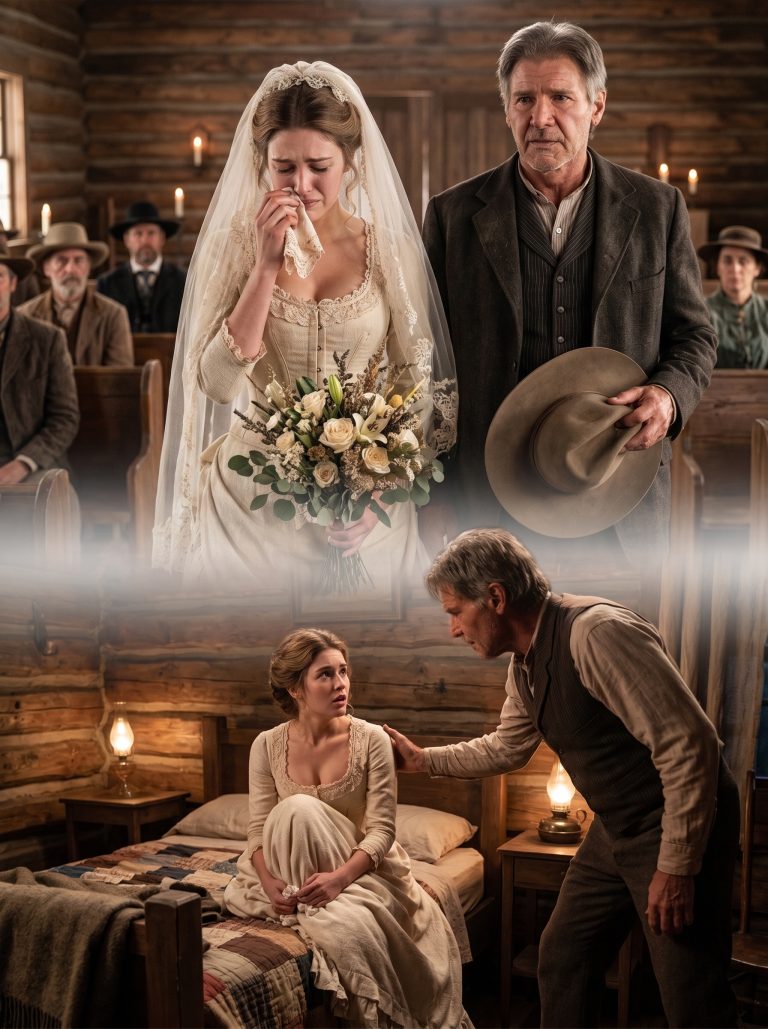
Inside, the kitchen smelled of scorched coffee and her aunt’s nervous habit of rearranging cups that did not need rearranging. Garrett sat at the head of the table, heavy-jawed and solemn in the particular way of men who have decided to do something shameful and want witnesses to mistake it for solemnity. Her aunt Delphine kept her eyes on her hands. Her cousin Wade leaned in the doorway with his hat pushed back, already smiling at whatever was coming.
No chair had been set for her. That told her everything before a word was spoken.
“We’ve come to a decision,” Garrett said.
“Families usually include everyone the decision touches,” Iris said.
Wade laughed under his breath. Garrett ignored him and pushed a folded paper across the table. “Your great-uncle Silas left that broke-down claim up at Stone Hollow. Nobody’s touched it since he died. You’ll take it. Two dresses, the black kettle, bedding, a sack of meal, and the three hens too old to lay proper. That’s more charity than most give an unmarried woman past thirty.”
“And this?” Iris did not touch the paper.
“A release. You sign that you accept Stone Hollow as your full portion and hold no further claim on this family or its holdings.”
“My portion of what? The mine hasn’t turned a profit in three years, by your own account at supper.”
Garrett’s face went the color of raw meat. “Sign it, Iris.”
She thought of Silas — a hard, silent old man who had never once in her memory raised his voice or his hand to her, who had let her read his newspapers aloud on winter evenings when the rest of the house found her tiresome. When he’d taken sick that spring, nobody else in the house would climb the ridge to nurse him. Garrett said the old man had always been contrary and could die in the bed he’d made. So Iris had gone. Four months she’d sat with him, and in the last week, delirious with fever, he had gripped her wrist and said, the ground remembers who kept faith with it, and she had thought it only the fever talking.
She looked at the paper. Then she folded it once, neatly, and set it back on the table without signing.
“I’ll be ready when the wagon’s loaded,” she said.
Garrett blinked, thrown by the absence of a fight. “That’s all?”
“What did you expect? That I’d beg to keep scrubbing your floors?”
Nobody answered. She walked out before her hands could betray her by shaking, and behind the tool shed, out of sight of the kitchen window, she pressed both fists against her mouth and did not cry. What rose in her instead was quieter than grief and much more useful.
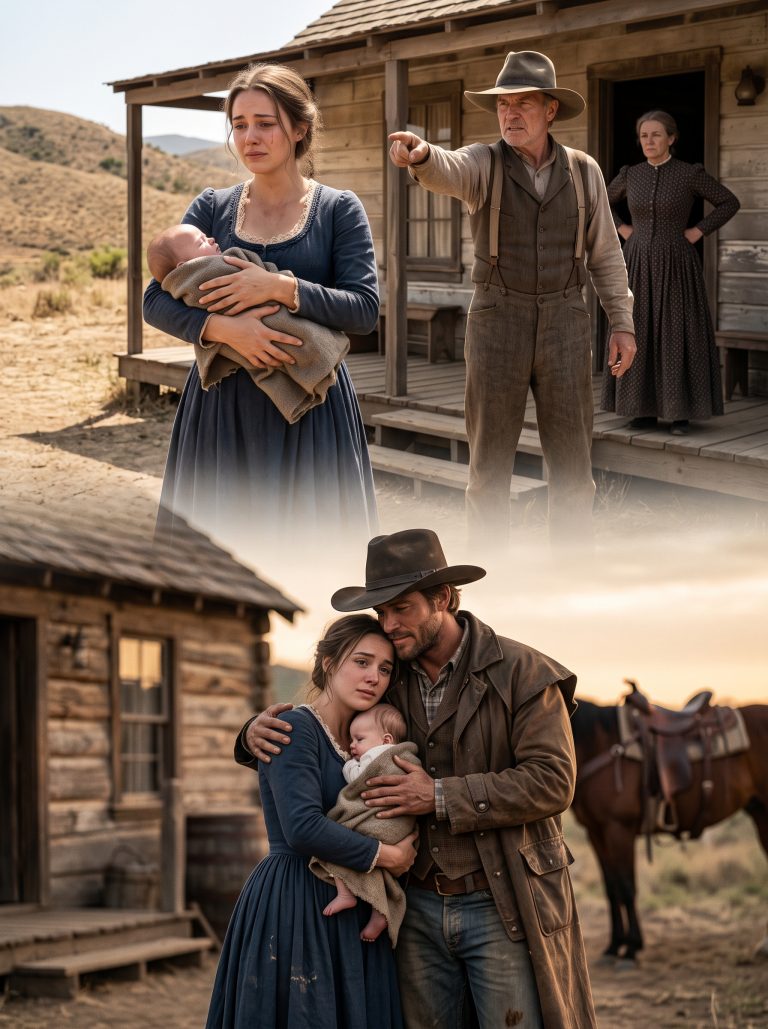
By Tuesday the frost lay thick and white, and a wagon waited at the gate. Hank Pruitt, the same teamster who had once hauled her up to nurse Silas, loaded her few belongings without asking questions he already guessed the answers to — the kettle, the bedding, a tin box of garden seed saved from her mother’s old plot, a small framed photograph, and last, the three hens, indignant in their crate.
Delphine did not come outside. Garrett stood on the porch with his coat buttoned to the throat, already looking past her toward the road, as though she were a debt being paid off rather than a person leaving.
Wade came out chewing a biscuit. “Don’t get proud out there,” he called. “The winter won’t care how hard you worked.”
Iris climbed onto the wagon seat and did not look back. Above the house, the crows lifted off the fence rail all at once, as if satisfied their message had been delivered, and scattered toward the ridge she was about to climb.
Part 2
The road west narrowed from wagon ruts to a pale scratch through sage and broken shale. Two hours brought them into a basin cupped by red rock, where a cabin leaned under a sagging roof, one window boarded, the door hanging crooked on a single hinge. A collapsed corral slumped nearby, and an old well sat capped with rotting planks.
It did not look abandoned. It looked punished.
Hank set the kettle on the porch step. “I hauled for Silas some, toward the end. Man wasn’t much for talk, but he knew this ground better than most men know their own hands. Don’t judge it by first light. Some things only look dead because nobody patient’s touched them in a while.”
Then he was gone, the wagon wheels fading, the silence closing in behind him like water over a dropped stone.
Iris opened the hen crate. “Go on, then.” A reddish one, a speckled one, a pale one with a crooked tail feather stepped out and surveyed their inheritance with visible disapproval. “Rust. Bramble. Judith,” she named them, and almost smiled.
Then something thumped beneath the cabin floor.
Low. Deliberate. Twice more before she found the nerve to lift the hoe from the wagon pile and push through the broken door. Dust, mouse droppings, cold ash. In the back room, a loose board jumped again, and a badger — furious, dust-caked, offended beyond reason — shot out from beneath it, bolted between her ankles, and vanished into the yard with the hens scattering after it in three directions of outrage.
Iris sat down hard on the doorstep and laughed until it turned into something rougher, something with tears in it, streaking the dust on her face. Her first enemy at Stone Hollow had been a badger. It seemed, given the last four years, entirely fair.
Part 3
The first storm came before she’d finished patching the roof, and she spent the night moving buckets from drip to drip while thunder walked the ridge like something with business there. She woke stiff, furious, and — she noted with some surprise — glad to be alive to be furious.
She rebuilt the place in pieces, the way a person mends a life rather than a house: one dry corner first, then the door brace, then the coop. She buried her family’s names in the work without meaning to. Garrett. Hammer. Delphine. Pull. Wade. Snap. By the seventh day her hands had blistered and split and begun, finally, to harden.
It was on the ninth day, clearing brush behind the cabin, that she found the spring.
The ground there was greener than it had any right to be in November. She dug her fingers into it and found them wet. Beneath the roots of an old cottonwood, water slipped from the rock in a clear, cold thread — not runoff, not a puddle, but a living vein of it, steady as a pulse. She knelt and drank from her cupped hands, and the water tasted of stone and snow and something older than her grief.
Water was not scenery in that country. It was leverage. It was the difference between a worthless claim and a fortune, and it explained, with sudden clarity, exactly why Garrett had wanted her signature so badly on a piece of ground he called broke-down.
She rang the spring with stones and said nothing to anyone, and began, in the last weak days of autumn, to plant seed she had no real hope of harvesting — because a covered row of dirt was a way of saying I am still here, and she needed, that week, to say it to someone, even if the someone was only the ground.
The nights were the hardest part, in those first weeks. Iris had grown used to a house full of noise she resented — Delphine’s china, Wade’s boots on the stair, Garrett’s voice carrying through the walls like weather — and its absence at Stone Hollow felt, for a while, like a held breath she didn’t know how to let out. She took to talking to the hens simply to hear a human voice in the room, even if it was her own.
“Rust, if you lay before Bramble I’ll be shocked,” she told the reddish one, scattering grain across the frost-hard yard. “You’ve the disposition of a woman who complains about everything and does nothing.”
Rust regarded her with the flat contempt hens reserve for people who talk too much, and went back to scratching.
It was in that quiet, unwatched space that Iris began to notice what work did to a person left alone with it. She had spent her whole life performing capability for an audience that resented her for succeeding at it — cooking well enough to be useful, never so well as to be praised; carrying water without complaint, because complaint would have been called ingratitude. At Stone Hollow, there was no one to perform for. She simply did the thing, and the thing simply got done, and some knot low in her chest that she hadn’t known was a knot began, very slowly, to loosen.
A rider came over the eastern rise eight days later, leading with open hands the way a man does who has learned not to startle either horses or lonely women. He introduced himself as Asa Reeve, ran cattle beyond Crow Ridge, had seen smoke from a chimney that had been cold since Silas died and come to see nobody was hurt.
Behind him in the saddle sat a boy of about seven, dark-eyed and rigid with a silence that had clearly been earned rather than chosen. “My son, Micah,” Asa said. “He doesn’t talk much. Not since his mother passed.”
Iris did not lower the hoe, but she did not raise it further either. “I don’t take charity,” she said, when Asa offered a sack of seed barley.
“Didn’t offer it,” he said. “Offered barley.”
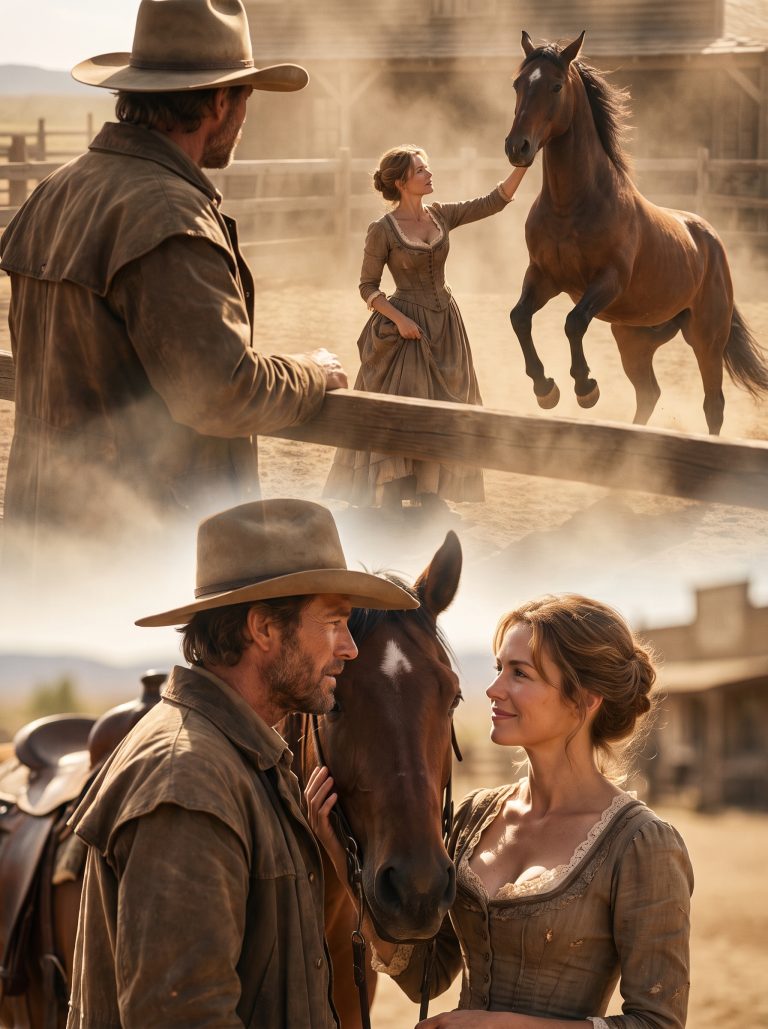
He came back once a week after that, with nails or wire or advice phrased so it could be refused. He never once told her the ladder was no place for a woman her size, never once looked at her the way most men did — sliding away in discomfort or measuring her like stock at auction. His eyes stayed where the conversation was.
Micah gave his devotion to the hens, and once, when he thought no one could hear, Iris caught him whispering to Judith, you don’t have to be scared, she won’t let nothing get you, and had to go stand behind the cabin wall for a while before she trusted her own face again.
It was good, for three weeks. It lasted exactly long enough for her to begin believing in it.
She came back from the spring one afternoon to find the cabin door forced, her seed tin overturned, the mattress slashed, and the loose floorboard in the back room pried up a second time — not by any badger. A splinter of cedar lay near the crack, and cedar did not match the pine of the floor.
Wade Bellamy stood by the well when she stepped outside, a shovel in one hand, mud on his boots, smiling like he’d walked into the old kitchen and found her still there to torment.
“You’ve made the dump almost charming,” he said, looking at the mended roof, the cleared yard.
“What were you looking for?”
“Property belonging to my father.”
“You forced my door.”
“That paper you wouldn’t sign won’t save you forever,” Wade said. “Words are cheap in a courtroom, cousin. Especially yours.”
“Why does a worthless claim need my signature so badly?”
Something flickered across his face before he could smooth it into contempt. “Worthless land gets useful fast when the right men own it.”
Asa rode in then with Micah behind him, and something in Wade’s posture changed the moment he registered another man’s presence — not fear exactly, but the particular caution of a bully recalculating odds. He left with a threat about surveyors and stakes and a company called Kestrel Land and Grazing, and Iris watched him go with her stomach cold and her mind, for the first time since the wagon ride west, entirely clear.
He said buried trouble. She thought of Silas’s fevered grip on her wrist. The ground remembers.
That evening, Micah knelt by the pried board without being asked and set against the wood a smooth gray stone he’d carried in his coat pocket since the day they met — a stone with a single white stripe running through it, a gift he’d once pressed into her palm and called, in the only full sentence she’d yet heard from him, a rock that marks where the mountain remembers. The stripe in the stone lined up near-perfectly with a pale scratch scored into the plank beneath it.
Under that plank was not dirt but a flat slab of stone, and under the slab, wrapped in oilcloth, a cedar box.
Inside: silver coin, a survey map, water-right filings, a bundle of letters, and a sealed envelope addressed to her in Silas’s crabbed hand.
Her hands shook too badly to open it at first. Asa held the lamp closer and said nothing, only waited, the way he waited for most things.
Iris,
If you are reading this, Garrett has done what cowards do — made theft look like family duty. Do not sign anything.
The claim at Stone Hollow is not his to give. I filed the transfer six weeks before I took sick, Cyrus Pruitt witnessed it, and Judge Aldous holds the second copy unless Garrett has frightened him into losing it. I chose you because you were the only one who came when there was nothing in it for you.
But there is more you should know, and I have put off the telling of it longer than a dying man has any right to.
Your mother was my daughter. Not my niece by marriage, as you were raised to believe, but my own blood, born before I married and given quietly to my brother’s household to raise so the shame of it would not follow her. When she died birthing you, I let the lie stand, because by then it was the only shelter either of you had. Garrett has known the truth for eleven years. He learned it from a letter of mine he was never meant to find, and he has used the silence around it ever since — to push me out of my rightful third of the Bellamy mine, which our father’s will names to me by blood, and which by that same blood now names to you.
He did not send you to Stone Hollow to be rid of a burden. He sent you here hoping the winter would finish what shame could not, before you ever learned what you are owed.
You are not my niece, Iris. You are my daughter’s daughter, and you are the last Bellamy with an honest claim to anything that family holds.
A seed underground looks buried only to people who don’t understand waiting.
— Silas
Iris read it through twice before she trusted her own voice, and then read it a third time aloud, because the cabin seemed to need to hear it as much as she did.
Micah leaned his head against her arm. Asa turned toward the window, giving her the privacy of his back, though she saw his shoulders were not quite steady either.
“What do I do,” she asked, when she could speak again.
“Tomorrow,” Asa said, “we don’t ride to Garrett. We ride to the courthouse.”
They did not sleep much. Before dawn, smoke woke them — not from the chimney but from the coop, flames already licking dry straw, a dark shape bolting from the spring channel where feed sacks stamped BELLAMY MERCANTILE had been shoved into the water to choke it. They beat the fire down with buckets while Micah stood in the doorway clutching Judith against his chest, white-faced but, Iris noted even in the chaos, not silent — he was shouting directions at them, clear as a bell, and did not seem to notice he’d found his voice until well after the flames were out.
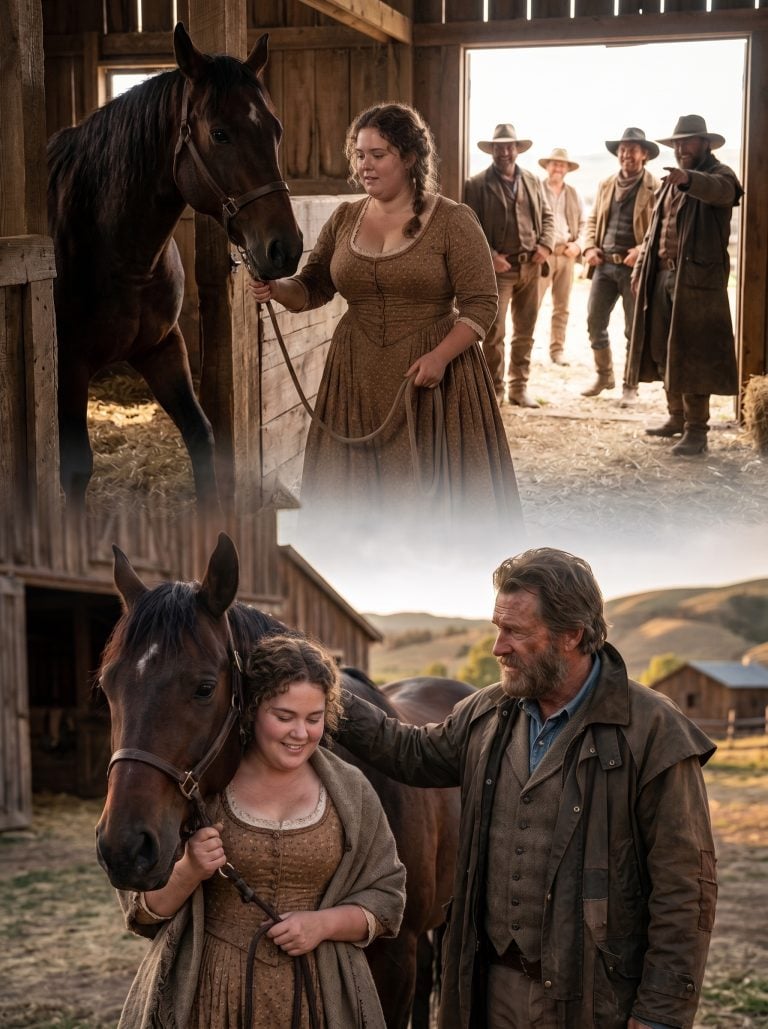
By sunrise, Hank Pruitt had gathered half the basin — old Cyrus Pruitt with his bent back and sharp eyes, a rancher named Odette Marsh who’d once broken a man’s nose for insulting her mule, and three others who owed Garrett Bellamy nothing and disliked him plenty. They rode into Sable Creek together, Iris at the front with a cedar box of proof and a scorched feed sack as evidence, and by the time they reached the courthouse steps, Garrett was already there, along with Delphine, Wade, and a man in a gray suit introduced as a representative of Kestrel Land and Grazing.
“What is this circus,” Wade said.
“A public matter,” Iris said, “where there used to be a private lie.”
It took the better part of a day. Cyrus Pruitt swore to the deed filing. Judge Aldous’s clerk found Silas’s transfer misfiled — not lost, only buried, in a drawer that had clearly not wanted finding. The original Bellamy partnership will, forty years old and yellowed, named Silas as full third owner of the mine’s mineral rights, rights Garrett had spent a decade quietly buying out of other men’s ignorance and one dead man’s silence.
The gray-suited man from Kestrel Land and Grazing tried, twice, to argue that his company had negotiated in good faith with the party who held the deed on paper. Judge Aldous took off his spectacles to look at him properly.
“With a man who did not own what he sold you?”
“We had assurances—”
“From a thief,” Odette Marsh offered.
“Miss Marsh.”
“Alleged thief, Judge. My mistake.”
The room’s laughter did more to unsettle Garrett than any of the paperwork had. Iris watched something go out of him then — not remorse, she thought, but the particular deflation of a man who has always mistaken other people’s silence for approval, and is only now discovering the difference.
Garrett’s face went through several colors trying to explain a decade of paperwork that would not explain itself. Wade said nothing about the fire, which was itself its own confession, and Odette Marsh sat rather firmly on him when he tried to leave before the sheriff arrived.
Delphine stood at the end of it, handkerchief wrung to a rag in her hands. “I didn’t know everything,” she said. “I swear it, Iris.”
“No,” Iris said. “You didn’t know everything. But you knew enough to keep quiet, and to let a chair go unset at that table for twenty years running. That’s not innocence. It’s just a quieter kind of permission.”
Delphine sat down as if her bones had given out.
The months after did not turn Iris into a fairy-tale heiress, and she was glad of that, in the end — it would have been too easy, and not nearly true enough to the years it had cost her. The law moved the way law does, slowly and on its own schedule. Garrett lost the mercantile to the investigators who came sniffing after duplicate ledgers. Wade spent a season awaiting trial for the fire and found that charm bought little in a cell with poor ventilation. Kestrel Land and Grazing withdrew its claim on the spring rights and did not come back, not after Odette Marsh made certain the whole county knew their name.
Iris did not take the mine. She signed her third of it over to a trust that paid a fair wage to the men who worked it, which was more than Garrett had ever done, and kept only what the law confirmed was hers outright: Stone Hollow, the spring, and — quietly, without needing to say it to anyone — the truth of who she was.
She thought, in the weeks after, that people would expect her to want more. To press her claim to the family name, to sit at last at the head of some table with a chair set for her and make Garrett watch. She understood the appeal of it, the way she understood the appeal of a fever dream — vivid, satisfying, and no place to actually live. What she wanted instead was simpler and harder to explain to anyone who hadn’t spent twenty years being told their wanting was already too much: a door she could paint whatever color she chose, with nobody standing behind her rating the choice.
Cyrus Pruitt told her once, over coffee at his kitchen table, that Silas had asked him years before whether it was a cruelty to leave a young woman a ruin instead of an inheritance already fixed and comfortable.
“I told him a fixed house teaches a person nothing but gratitude,” Cyrus said. “A ruin teaches a person what they’re made of. He said he hoped he wasn’t wrong to bet on you finding that out the hard way.”
“He wasn’t,” Iris said, and meant it.
She painted the cabin door blue that spring, the way her mother, whom she had never really known, was said to have loved. She built a springhouse of stone, raised a new coop, and hung a hand-lettered sign at the gate:
STONE HOLLOW — IRIS BELLAMY, OWNER
and beneath it, in Micah’s crooked, newly confident hand:
NO MEAN PEOPLE. JUDITH BITES.
She never painted over it.
Asa came by less as a neighbor after that and more, slowly, carefully, as something else — he asked her permission before he asked anything more, the way a man does who has learned that need can be a kind of chain if you let it. She said yes, slowly, the way she meant it.
One evening in early summer, she carried Micah’s stone down to the spring and knelt at the first hill of corn that had made it through a hard winter, and instead of keeping the stone on a shelf, she buried it — not to hide it, but to plant it, the way Silas might have understood better than anyone.
Micah found her there. “You hiding my rock?”
“No,” she said. “Giving it roots.”
He considered this with great seriousness. “Rocks don’t grow.”
“Maybe not,” Iris said, watching the water run clear and cold from the mountain that had kept its secret and, in its own slow time, given it back. “But people do, when somebody finally believes they can.”
THE END