An Old Cowboy Asked for Water—Then He Froze at the Photograph Above Her Fireplace

Part 1
The first frost of the season came to Willow Bend Valley the way it always did — quietly, without warning, as if the mountains themselves were holding a secret. It settled over the fence posts and the barn roof in the small hours of the morning, and by the time the sun cleared the eastern ridge, the whole valley glittered like something out of a dream. Ellie Hargrove had learned, over eleven long years of ranching alone, not to trust a pretty morning. Beauty like that was usually just winter’s way of clearing its throat.
She stood at the edge of the north pasture, checking the last of the fence wire her hands had strung the day before. At thirty-nine, Ellie had the look of a woman who had traded comfort for competence a long time ago and never once regretted the bargain. Her sleeves were rolled to the elbow, her palms toughened by rope and rein, and beneath her collar, resting against her collarbone on a thin chain, hung a single brass button — the last piece of the coat Nathaniel had been buried in, kept not because his death was a mystery, but because it wasn’t.
Eleven years now since his horse had lost its footing on an icy switchback during a hard November storm, and eleven years since the valley had gathered to bury him beside the creek he’d loved. There had been no question about how it happened. Only, in the years since, a quiet, unanswered question about what he’d left unfinished.
“Ma, you’re gonna pull that wire clean off the post if you keep testing it,” called Jonah, her son, hauling a bucket of water toward the corral. He was thirteen, all elbows and ambition, with his father’s steady eyes and his mother’s stubborn jaw.
“Wire’s fine,” Ellie said. “It’s the winter I don’t trust.”
“Wexford’s men were out again yesterday,” Jonah added, kicking at the base of a fence post. “Measuring along the creek same as before.”
Ellie’s jaw tightened. “That man’s bought up half this valley in the last two years, and I still haven’t heard him give an honest reason why.” She shook her head, as if to shake the thought off with it. “Not our worry this morning.”
Jonah set the bucket down and squinted toward the trail that wound down from the ridge. “Someone’s coming.”
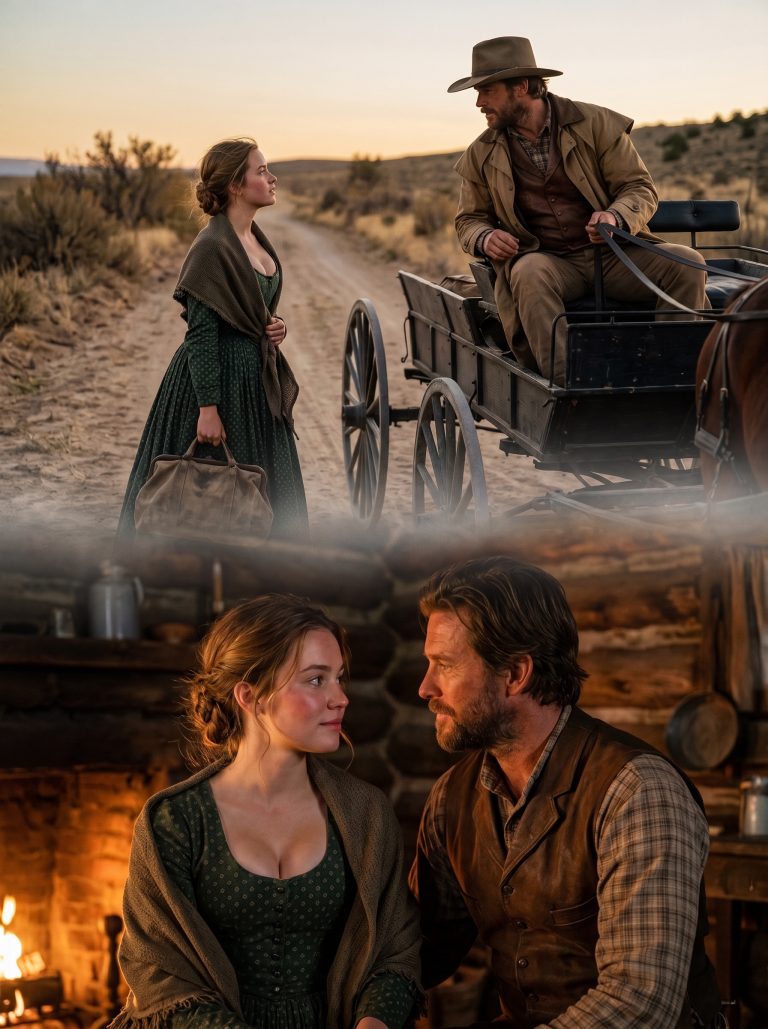
Ellie followed his gaze. A rider moved toward the ranch at an unhurried pace, his horse plodding with the particular weariness of an animal that had covered a great many miles. The man sat tall despite it, a battered gray hat shading a face creased by sun and years. Neither Ellie nor Jonah reached for the rifle propped by the door. There are men who ride toward trouble, and men who simply ride until they arrive somewhere, and it was easy enough to tell which this one was.
He stopped at the gate and removed his hat before he spoke. “Ma’am. I’d be obliged for water, if you can spare it. For myself and the horse both.”
“Nobody goes thirsty past my gate,” Ellie said, already moving to unlatch it. “You’ve come a long way, by the look of you.”
“Longer than I planned,” the stranger admitted, “though I suppose I always knew I’d end up somewhere like this.”
He gave his name as Silas Boone, and while Jonah led the tired horse to the trough, Ellie brought the old cowboy inside for coffee, because a man who thanks you twice for water is a man raised right, and those were rare enough to feed. The cabin was warm with the smell of woodsmoke and yesterday’s bread. Silas took off his hat at the door and held it against his chest the way men had been taught to do a generation ago, before he’d half-forgotten how.
Then his eyes drifted to the wall above the hearth, and everything about him went still.
There, in a plain wooden frame, hung a faded photograph — three young cowboys standing shoulder to shoulder in front of the Wind River peaks, grinning like the whole world belonged to them. Silas Boone’s hand found the back of a chair and gripped it.
“Where,” he said slowly, “did you come by that photograph?”
Ellie followed his stare. “That’s my husband. Nathaniel. On the left.”
The room seemed to hold its breath along with him. Silas set down his hat and crossed to the frame, tracing its edge with a finger scarred pale and thin, like a rope had once burned clean through skin and bone.
“We were boys when that was taken,” he murmured. “Thought ourselves men, which is the surest sign we weren’t.” He turned to face her, and something in his weathered features had cracked open, decades of carried weight showing through. “Your husband saved my life, Mrs. Hargrove. I’ve spent a long while trying to find my way back to thank him for it.”
Jonah, who had come in quietly behind him, spoke first. “Pa never told us that.”
“No,” Silas said, with something between a laugh and a sigh. “That sounds exactly like Nathaniel.”
Ellie set three cups on the table with hands that were not quite steady. “Sit down, Mr. Boone. I think you’d better tell it from the beginning.”
And so, as the fire cracked low and the first snow began sifting past the window, Silas Boone told them of a cattle drive twenty-five years gone — nearly two thousand head pushed through Monarch Trail ahead of an early winter, three young point riders racing the weather, and a rockslide that had come down on a narrow ridge trail without warning. His horse had gone out from under him. He remembered the world tilting, the ravine opening beneath him like a mouth, and then a hand closing hard around his wrist.
“Nathaniel never hesitated,” Silas said quietly. “Pulled me back over that edge like it cost him nothing, though the rope burned clean through his glove doing it.” He turned his scarred palm upward. “I’ve carried this mark twenty-five years.”
“Twenty-five years,” Ellie repeated slowly. “That’s long before he and I ever met.”
“It is,” Silas agreed. “I expect a great deal happened to him between that day and the day you married him. I only knew the boy on that ridge. Seems I’ve come here to learn the man he became.”
Part 2
Silas reached into his saddlebag and drew out a bundle wrapped in oiled cloth — a brass compass, a leather notebook, and a folded, well-worn map.
“He asked me to hold these until the work he’d started was finished,” Silas said. “Came back for some of his other things over the years — his rifle, his tack — but always told me to keep these a while longer. Never did explain why.”
“These were his,” Ellie whispered, reaching for them as though they might dissolve at her touch.
Silas unfolded the map carefully across the table, and his brow furrowed. His finger stopped at a torn edge along the crease. “This map should have a second sheet. It’s missing.”
“Maybe it was lost,” Jonah offered.
Silas shook his head slowly. “Nathaniel never lost a thing in his life he didn’t mean to.” He looked up at Ellie. “I don’t think this was lost, Mrs. Hargrove. I think your husband tore it off on purpose — because he wanted somebody to come looking for the rest. And knowing him, I’d wager he did it not long before the end came for him, not back in our cattle-drive days.”
Ellie’s eyes drifted to the small, deliberate pencil mark scratched into the map’s corner — a shape like a bent arrow inside a circle, so faint it might have been mistaken for a smudge of dirt.
Silas’s breath caught when he saw it. “I know that mark. A trail sign. Only three men in this territory ever knew what it meant — Nathaniel, a hand named Ezra Lawson, and myself. We used it when one of us found something on the range worth coming back for.”
“Is Ezra still living?” Jonah asked.
Something passed over Silas’s face. “Ezra passed on, oh, ten winters back now. Fever took him out in Nebraska. I always figured whatever that mark led to had gone into the ground along with him and Nathaniel both, and I was the only fool left who still remembered it meant something.”
Silas was quiet a moment, turning the map over in his hands, and then something else seemed to surface in him. “You know, I’ve wondered about something for years and never had cause to ask,” he said slowly. “Last time I saw him wear that riding coat of his, the collar looked different — restitched, and none too neatly. Nathaniel never was much of a hand with a needle. Always meant to ask him why he’d bothered doing it himself instead of taking it to somebody who could sew a proper seam. Never did get around to it.”
Ellie was already crossing to the cedar chest by the hearth. She lifted out Nathaniel’s old riding coat, heavy and gray with mountain dust that had never quite washed free, and as she folded it over her arm, her fingers caught on something stiff sewn into the lining near the collar — a small, careful seam that didn’t match the rest of the stitching, just as Silas had described.
She worked it open with her sewing scissors, and a single folded sheet slid free. The edges matched the torn map exactly.
“He hid it in his own coat,” she said, voice unsteady. “All this time.”
The second sheet showed the same range of mountains, carried further — a line of small, careful marks running past the pine forest toward a cluster of boulders Ellie didn’t recognize, and beside them, in her husband’s hand, four words: for whoever comes after.
Silas looked at the reunited map for a long moment. “Then I expect we ought to go and see what he wanted found.”
Outside, the snow kept falling, gentle and unhurried, as if the valley itself already understood that something long buried was about to surface.
Part 3
They rode out from Willow Bend at dawn beneath a sky scrubbed clean by the night’s snowfall. Ellie led on her bay mare, the reunited map tucked safe in her saddlebag; Jonah followed on his sorrel gelding, wide-eyed at mountains he’d never had cause to ride into; and Silas Boone brought up the rear on his aging chestnut, moving through the foothills like a man reading a book he’d once known by heart and was only now remembering how to pronounce.
“We used to drive three thousand head across that ridge at a time,” he said, pointing toward a distant saddle of rock.
By midafternoon they’d climbed high enough that the valley below looked like something painted rather than lived in — gold cottonwoods threading along the creek, the Hargrove ranch a small brown square against the immensity of the land. Silas slowed his horse twice, closing his eyes as if listening for something the mountain still remembered, before he finally reined up hard beneath an ancient, moss-throated pine.
“I’d know this tree anywhere,” he said, swinging down. “Tied my horse right here the day Nathaniel showed us his mark.”
Beneath years of moss, his glove uncovered a carved arrow, weathered nearly to nothing but unmistakable once seen. Following the second map sheet, it pointed not toward the old trail but up a narrow deer path Silas had never once ridden, toward a jumble of boulders farther up the slope.
“That’s new to me,” Silas admitted. “Whatever he hid, he hid it long after that cattle drive was over and done.”
The largest boulder leaned against the mountainside at an unusual angle. Silas knelt, and Jonah dropped beside him. Together they cleared away fallen branches, loose stones, and years of thick moss until they uncovered a flat stone, its edges shaped too deliberately to be accident. With Silas’s help, Ellie pushed it aside. Beneath it rested a narrow cavity, and inside sat a weathered iron box, rust-eaten but remarkably intact — the oilcloth wrapped around its contents still holding tight, as though it had been placed there not so very long before it was meant to be found.
Inside, wrapped in that oilcloth, lay Nathaniel Hargrove’s leather journal, a set of original survey documents, several signed and sworn statements, and county land records bearing official seals that did not match the copies filed in town. On the journal’s first page, in handwriting Ellie would have known blind, was a single line:
If you are reading this and I am not the one who brought you here, protect the truth, and protect the valley.
Ellie held the journal against her chest for a long moment, snow-bright mountain light falling across her face, and said nothing at all, because there was nothing that needed saying.
They did not know, as they packed the box behind Ellie’s saddle and turned their horses back toward town, that they were being watched. Far across the basin, three riders sat motionless on a distant ridge, one of them lowering a small brass spyglass before wheeling his horse toward Willow Bend at a hard gallop. Word was already racing ahead of them — word that would reach a man named Edgar Wexford long before Ellie Hargrove ever reached the courthouse steps.
Part 4
They rode into town the next afternoon to find it already murmuring with rumor, as frontier towns always did. By the time Ellie tied her mare outside the courthouse, half of Willow Bend had gathered on the boardwalk, drawn by nothing more than the particular electricity that travels ahead of the truth.
Marshal Cole Barrett met them on the steps, his eyes going first to the iron box, then to the stranger beside Ellie’s son. “You’ll be Silas Boone,” he said. “Nathaniel spoke of you, years back. Said if you ever came through Willow Bend, I was to treat you like family.”
“Wish it had been under kinder circumstances,” Silas said, shaking his offered hand.
Inside, the county clerk, a sharp-eyed woman named Louisa Pratt, cleared the long oak table and began laying Nathaniel’s survey maps beside the official county copies, page by careful page. The room filled slowly — ranch families, shopkeepers, old friends of Nathaniel’s, all of them talking in low voices that fell away entirely once the doors were shut — and among them, arriving last, calm as still water in an expensive black coat, came Edgar Wexford.
“What’s all this commotion?” he asked pleasantly, as though he hadn’t already known the answer for a full day.
No one answered him. Marshal Barrett closed the courthouse doors.
Louisa Pratt worked in silence for the better part of an hour, comparing signatures, boundary lines, survey stakes, the room holding its breath in stages as she moved from one page to the next. When she finally looked up, her voice was flat with the particular authority of a woman who does not enjoy being right about something so ugly.
“These documents are genuine,” she said. “And they don’t match the county’s current land records. Boundary lines were altered after Nathaniel Hargrove filed his original survey — every alteration benefiting a single buyer.” Her eyes lifted, slow and deliberate, to Wexford. “You.”
“This is absurd,” Wexford said smoothly. “Old paper proves nothing. A dead man’s scribblings against thirty years of honest business.”
“They prove a great deal,” Louisa said, and laid the original survey directly over the county’s altered copy. The differences were plain enough for the whole room to see — creek frontage moved, water rights quietly reassigned, hundreds of acres shaved from three different ranch families and folded, one careful line at a time, into Wexford’s holdings. A murmur went through the boardwalk families seated along the back wall; more than one of them recognized their own creek frontage in the lines Louisa was tracing.
A rancher near the door, a broad-shouldered man named Otis Kettering, rose half out of his seat. “That’s my south fence line she’s pointing at. I paid taxes on that ground for six years running before Wexford’s man told me the boundary had ‘always’ sat where it sits now.” He looked around at his neighbors. “I thought I’d misremembered my own land.”
“You misremember nothing, Mr. Kettering,” Louisa said. “The county’s own older ledgers, the ones from before these were re-filed, agree with Nathaniel Hargrove down to the rod. Somebody went back afterward and rewrote history in ink.”
Wexford’s composure held, though something behind his eyes had gone very still. “Clerical errors happen over thirty years of record-keeping. I hardly see how a few discrepancies in dusty ledgers amount to a conspiracy against me personally.”
“A few discrepancies might not,” Louisa said evenly. “Every single one of them running in your favor does.” She let that sit in the silent room a moment before turning back to the table. “I’ve compared eleven parcels this morning, Mr. Wexford. Eleven. Every alteration adds acreage to your holdings and takes it from someone else’s. That isn’t clerical error. That’s a pattern, and patterns don’t misfile themselves.”
Somewhere along the back wall, a woman Ellie recognized as the Petersons’ eldest daughter had gone very pale, her hand tightening on her father’s sleeve. Marshal Barrett said nothing, but his eyes had not left Wexford since the doors closed.
It was then that Silas Boone stepped forward, opening Nathaniel’s journal to a page marked with a strip of faded leather.
“There’s more to this than land,” he said. “That rockslide on Monarch Trail, the one that nearly sent me over a cliff and put this scar on my hand — I always told it as bad luck. Wrong footing, loose shale, an early winter. That’s the story I believed for twenty-five years.” He looked at the page in his hand. “Nathaniel didn’t believe it. Says here he went back up that ridge two days after and found blasting powder residue packed into a seam that had no business breaking loose on its own.”
He set beside it one of the statements from the box. “And here’s a sworn affidavit, taken and notarized within days of the slide itself, from a powder merchant in Lander — swearing that a man had bought blasting powder that same week, on the account of one Edgar Wexford, for reasons the merchant was never told.” Silas’s eyes, hard now, found Wexford across the room. “Nathaniel was riding point to a land office to file testimony against a fraudulent survey you’d already started running, Wexford. That slide wasn’t the mountain’s doing. It was meant to stop him before he ever got there.”
The courtroom went utterly silent. Ellie’s hand found Jonah’s shoulder without her quite deciding to move it.
Silas turned another page. “There’s one more thing he wrote, and I expect it’s why none of us ever saw a page of this until now.” He read it slow, the way a man reads something he doesn’t fully want to say aloud. Wexford has a man inside the county office — I have watched my own filings altered within a week of submitting them. If this evidence surfaces before I can carry it somewhere beyond his reach, it will vanish the way the last complaint did. Better it wait, hidden, than disappear entirely. I have spent years gathering what I could a little at a time, careful not to be seen doing it, and only this past autumn did I finally have enough — the last witness, the last signature — to make a case no judge could wave off. Silas closed the journal gently. “He meant to carry all of this to the territorial capital himself, over Wexford’s head entirely, where no local hand could touch it. Only the storm on that switchback came first, and he never got the chance.”
“Preposterous,” Wexford said, but the color had gone out of his voice along with his face.
“He never told me any of it,” Silas went on, quieter now. “Let me believe the slide was chance, so I could ride on and live easy. That’s the kind of man your father was, Jonah — the kind who’d rather carry the whole weight himself than hand even a sliver of it to a friend. But he wrote it down. Because he knew, someday, the truth would have to be heavier than the kindness.”
Marshal Barrett read the account through twice before he spoke, his voice carrying to every corner of the room. “Edgar Wexford. On the strength of this evidence, I am placing you under arrest on charges of land fraud, forgery of county records, and conspiracy to commit murder, pending a full territorial investigation.”
Wexford’s composure finally broke, not into anger but into something smaller and more honest — the plain fear of a man who has spent a very long time believing his money made him untouchable. He did not resist when the marshal’s cuffs closed around his wrists. No one in the room cheered. It was not the kind of moment that called for cheering. It was the kind that called for quiet, and the town gave it that.
Part 5
Winter finally reached Willow Bend not long after, though by the time it arrived the territorial investigators had already come and gone, the disputed acreage had begun its slow return to the families who’d lost it, and Edgar Wexford had been sent east to answer, in a proper courtroom, for a good deal more than land.
The Hargrove ranch looked, that last clear morning before the snow set in, very much like it always had — cattle grazing easy along the creek, the newly mended fence catching the early light, smoke rising thin and steady from the stone chimney.
Above the hearth, Nathaniel’s photograph hung where it always had, though it meant something different now. His death itself had never been the mystery — a horse losing its footing on an icy trail was tragedy enough on its own, and no evidence ever said otherwise. What had remained hidden was the truth he’d spent his final years quietly protecting, and the plan, cut short by that same storm, to see it carried somewhere Wexford could never reach.
Silas Boone tightened the cinch on his chestnut horse in the yard while Jonah watched, arms crossed the way his mother crossed hers when she was working up to say something difficult.
“You don’t have to go,” the boy said.
“Son, I’ve spent most of my life riding from one horizon to the next,” Silas said, not unkindly. “Man gets used to a certain shape of loneliness. Hard to unlearn it all at once.” He reached into his coat and drew out a small folding knife, its wooden handle worn smooth by another man’s hand. “This was your father’s. Carried it the day he pulled me back from that ledge. I expect he’d want you to have it now, rather than me.”
Jonah closed his fingers around it carefully, the way a person holds something they understand they will keep for the rest of their life. “I’ll take care of it.”
“I know you will.”
Ellie came out onto the porch as he swung up into the saddle, and for a moment neither of them said anything at all — there didn’t seem to be a sentence built quite right for what had happened between a stranger’s arrival and a family’s understanding of what her husband had truly spent his last years defending.
“You came here hoping to settle one debt,” she finally said.
“I did.” Silas settled his hat low against the morning light. “Seems I found a good deal more than that waiting on the other side of it.”
“You’re always welcome at this gate, Mr. Boone. Water or otherwise.”
He smiled at that, tipped his hat, and turned his horse west, toward the mountains that had once nearly taken his life and, in the end, given something back to the family of the man who’d saved it. Ellie and Jonah stood together at the fence line and watched until horse and rider dissolved into the gold haze of the foothills, riding on toward whatever stretch of open country came next.
Inside the house, morning light fell across the photograph above the fireplace — three young men who had once believed, the way the young always do, that the mountains in front of them were simply scenery, and not the very thing that would one day test what they were made of. Nathaniel was gone now, and Ezra Lawson before him. Only Silas remained, riding on toward whatever came next — but the truth the three of them had once carried together no longer belonged only to the dead.
Time may weather a mountain, but it never weathers an honest promise. That, in Willow Bend Valley, was worth more than any acre of land Edgar Wexford had ever tried to steal.
— THE END —