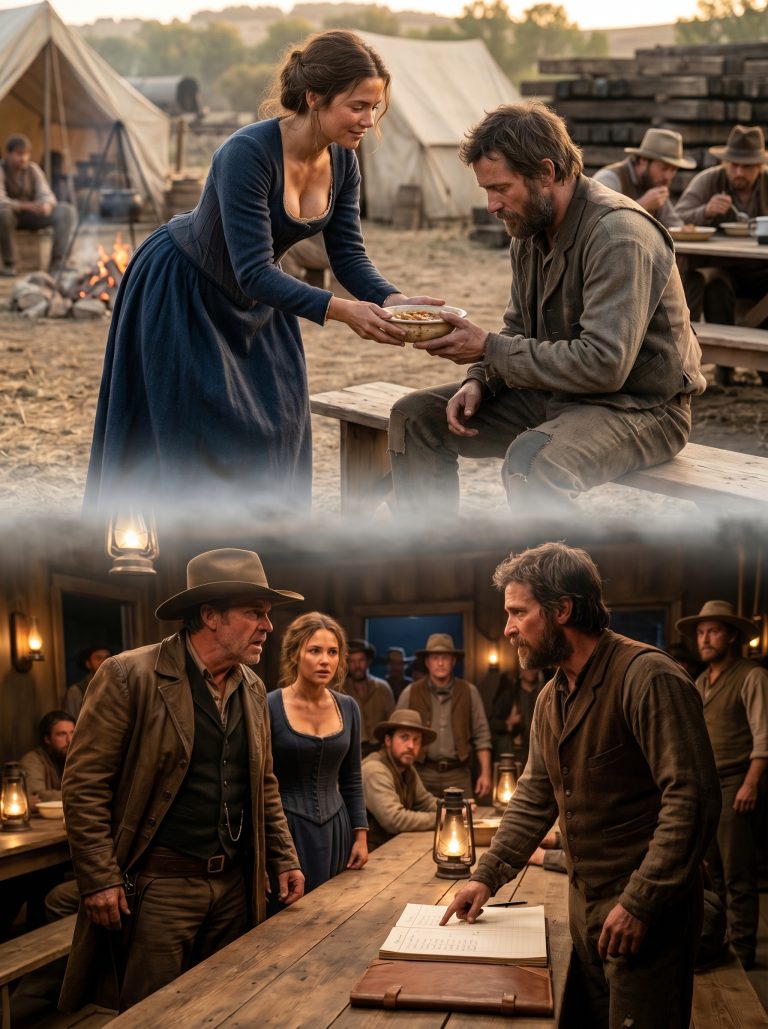
“You’ve got nowhere left to go tonight, have you?” the rancher said coldly—then offered her shelter on a road no one ever returns from, changing both their fates forever.

Part 1
Clara Whitfield walked out of the Ashford house with one carpetbag, an old Bible, and twelve years folded up somewhere behind her ribs like a letter she would never get to finish reading.
She was thirty-four. The dust of the drive clung to her hem, and the strap of the bag had worn a line into her palm that stung worse than anything Reginald Ashford had said to her that afternoon — though he had said plenty.
Mrs. Eleanor Ashford had died on a Tuesday, quietly, in the room Clara had aired every morning for over a decade. Clara had come to the house at twenty-two, hired as a companion-housekeeper to a widow everyone in Millbrook called difficult. She had learned the old woman’s moods the way a farmer learns weather — by watching, not asking. She had read to her when her eyes failed. She had sat up through fevers. She had never once heard Mrs. Ashford say thank you, and had never once needed to.
“You’ll be looked after,” the old woman had told her, three nights before the end, gripping Clara’s hand with a strength that surprised them both. “I haven’t forgotten what you are to me.”
Clara had believed her, because grief makes believers of practical women.
Reginald Ashford arrived from the capital before the last mourner had left the parlor. He was Mrs. Ashford’s grand-nephew, narrow-shouldered, soft-voiced, with the kind of politeness that felt like a hand closing slowly around a wrist. He walked the house with a notebook, cataloguing silver, counting linens, running a finger along picture frames as though dust were a personal insult.
By noon he had reclaimed the cameo brooch Mrs. Ashford had pinned to Clara’s collar on her thirtieth birthday.
“Estate property,” he said.
By one, the good wool shawl.
“Estate property.”
By two, he stood over her in the parlor and told her to open her bag.
“I beg your pardon?”
“I said open it. We must be certain nothing has left this house that oughtn’t.”
Clara knelt on the floor she had scrubbed a thousand times and turned her life out onto it. Two dresses. A comb. Stockings mended at the heel. A worn Bible with a cracked spine that had belonged to her mother — the one thing Reginald glanced at and dismissed as worthless sentiment, keep it. Her last week’s wages in an envelope, counted twice by the clerk as though she might have palmed a coin.
“There’s no provision for staff that I’m aware of,” Reginald said, when she had buckled the bag shut again. “The house has no further need of you. You may be gone by nightfall.”
Nightfall. Twelve years, and he gave her until nightfall.
She did not cry. She walked instead — out the servants’ door, past the kitchen garden she’d planted herself, down the long drive and onto the Millbrook road, because sitting down would have meant believing it was true.
The sun went from gold to gray to the color of a bruise. Pastures opened up on either side, fences leaning, the world emptying itself of people. Somewhere a dog barked at nothing. Clara’s feet had stopped hurting an hour ago, which frightened her more than the pain had.
She was still walking when the wagon came up behind her.
It slowed before it reached her — no crowding, no looming. A big man sat the bench, hat low, a coil of rope beside him and a dog curled at his boots. He drew the horse down and simply looked at her, the way a man looks at weather he’s trying to read.
“Evening,” he said.
“Evening,” Clara answered, and heard how thin her own voice had gotten.
“Coming on dark,” he said. “Larkspur’s four miles on. Millbrook’s behind you, and I don’t expect you’re walking back toward it.” He said it as fact, not a question, and something in her chest loosened a fraction at not being asked to explain herself.
“Have you got somewhere to sleep tonight?”
The plainness of it undid her more than any kindness could have.
“No,” she said. Then, because the truth had been sitting in her throat all day like a stone: “I was turned out this afternoon. Twelve years in a house, and I have nowhere to be and no one to be it for.”
The man didn’t flinch, didn’t soften his face into pity, which she was grateful for more than she could have said.
“I’m Silas Cole,” he said. “Run cattle out past the creek. Lost my housekeeper to marriage last spring and the place has gone to ruin since. I can offer honest wages, a room that locks from the inside, and a roof tonight regardless of whether you take the position.”
“Why?” Clara asked, before she could stop herself. “You don’t know me.”
Something moved behind his eyes — quick, almost sorrowful — there and gone. “Man doesn’t need to know a woman’s whole history to know a decent one,” he said. “Coming?”
Clara looked down the darkening road, then up at his outstretched hand.
She climbed into the wagon because the alternative was the ditch — and because, for the first time since noon, something in her believed that not every roof in the world was built to be pulled out from under her.
Part 2
The Cole ranch sat four miles past the creek crossing, its buildings silvered under a rising moon, its porch sagging with the particular neglect of a house no one had loved in some time. Silas carried her bag to a small room off the kitchen — clean, cedar-smelling, a narrow bed under the window.
“Lock’s sound,” he said, tapping the inside latch. “I’m across the hall. No one troubles you here.”
Clara sat on the bed a long while after he’d gone, her hand pressed to the latch, before she let herself cry — not the sharp tears of the afternoon, but something quieter, like a kettle finally allowed to stop boiling.
Morning showed her the truth of the place: good bones under a season of dust. Cold hearth. Curtains gone limp. A pantry in disarray. Silas stood in the doorway looking almost ashamed of it.
“I told you it wanted work,” he said.
“You told me the truth,” Clara answered, already tying on an apron she’d found on a peg.
She scrubbed floors to the grain, boiled linens, beat the dust from every rug in the house, and by the second week the kitchen smelled of bread instead of neglect. Silas mended fence, hauled water, and did whatever she pointed him toward without complaint, never hovering, never commanding — simply making room.
It was in the back pantry, moving a crate to reach a high shelf, that Clara found the quilting frame — dismantled, wrapped in oilcloth, tucked behind flour sacks like something hidden rather than merely stored.
“That was my sister’s,” Silas said quietly, when he found her running a hand over the wood that evening. “She passed some years back. I never had the heart to sell it, and never the use to keep it out.”
Clara looked up at him, and something in her face must have asked the question before her voice could.
“I quilt,” she said. “It’s the one thing I do better than anything else on this earth.”
Silas didn’t answer right away. He only looked at the frame, then at her, the way a man looks at a debt he didn’t know he was owed being quietly repaid.
Part 3
He set the frame up himself, three days later, in the front room where the light was best, and said nothing more about his sister — but Clara noticed he came to sit near it most evenings after, mending harness he didn’t need to mend, listening to the small sounds of needle and thread the way another man might listen to music.
By autumn, the ranch no longer looked like a place a lonely man had let go quiet. Curtains moved clean at the windows. The porch rail was scrubbed pale. And in the front room, quilts came off the frame one after another — log cabin and flying geese, wedding ring and star, each one folded over a dowel Silas had built for exactly that purpose, as though he’d been waiting to be asked.
The first time Clara sold one — to Mrs. Odell from the north road, for a sum that made her hands shake as she folded the bills — Silas stood in the barn doorway afterward with a look on his face like the whole ranch had quietly gained something it couldn’t be sold back.
“That’s yours,” he said, when she tried to press half of it into the household accounts.
“It was made under your roof.”
“The roof didn’t sew a stitch of it.” He tapped the bills once, the way he tapped fence posts to test them. “A person keeps what her work earns, Clara. I don’t hold with any other kind of arithmetic.”
She thought of Reginald calling her mother’s own Bible worthless sentiment and her twelve years of labor estate property, and she took the money without another word, because arguing further would have meant crying in front of him, and she was not yet ready to let him see all of that.
Word travels faster in small towns than weather does. By November a Millbrook shopkeeper named Purdy offered to sell her quilts on commission, and Clara walked into town with Silas beside her, trying not to feel the eyes that followed them down the boardwalk. Someone had already decided what to whisper about a woman living, unmarried, under a bachelor rancher’s roof. Silas heard it same as she did. His jaw went tight and still, like weather building over the hills, but he said nothing until Purdy, unwrapping her work across the counter, named a price barely worth the thread.
“That insults the work,” Silas said.
“It’s a fair opening figure for—”
“Say a fair number, or wrap it back up.”
Purdy said a fair number.
Outside, Clara stopped him on the boardwalk. “You didn’t need to do that.”
“Wasn’t about need.” His eyes held hers, plain as always. “It was about it being true.”
She didn’t have an answer for that, so she said nothing, and they walked the rest of the way in a silence that had started to feel like its own kind of conversation.
Reginald Ashford came to the ranch on a bright morning in May, stepping down from a hired carriage as though the dirt itself owed him an apology. Clara was shaking a rug over the porch rail and felt, for one terrible second, that she was kneeling on the parlor floor again with her stockings exposed to a stranger’s eyes.
“I’ve come,” Reginald said, removing his gloves finger by finger, “regarding the patterns you’ve been selling under my late aunt’s name.”
“I sell nothing under her name. I sell my own work.”
“Designs learned in her household are the household’s property.”
“A needle was never once in your aunt’s hand,” Clara said, “and everything I’ve stitched came out of my own memory and my own invention. There is nothing of hers in it but what she taught me to love.”
Reginald’s mouth thinned into the same shape it had made over her open carpetbag. “I’m prepared to be generous. Sign away any claim to future sales, and I’ll refrain from asking uncomfortable questions in town about what else you may have carried off besides an old Bible.”
The word Bible landed strangely — too specific, too remembered, for a man cataloguing an estate a year gone. Clara felt something cold slide down her spine that had nothing to do with fear of him.
“You searched that bag yourself,” she said slowly. “You know exactly what left that house. Why would there be anything left to ask about?”
Reginald’s eyes flickered — the first crack she had ever seen in him.
It was Silas’s voice that broke the moment, coming quiet across the yard. “You calling her a thief on my land?”
Reginald recovered his composure quickly, but not quickly enough. He left soon after, with threats about uncomfortable questions trailing behind him like smoke — and Clara stood in the yard with her heart going hard and strange, turning over the one word that didn’t fit: Bible.
That night, mending the Bible’s cracked spine by lamplight — a small, ordinary task she’d been meaning to do for months — Clara felt something shift beneath the loosened binding. Not paper worn soft with age. Paper folded small and deliberately, tucked where a careless search would never find it, because Reginald had handled that Bible with his eyes, never his hands — worthless sentiment, keep it, he’d said, and moved on to things that gleamed.
Her fingers trembled as she worked the fold free.
My dear Clara, the letter began, in Eleanor Ashford’s own unsteady hand, dated eighteen months before her death. If you are reading this, then either I have finally found the courage to give it to you myself, or I have died a coward’s death and left it for chance to deliver. Reginald visits more often now, and I no longer trust what he might do with a formal will he has means to contest or destroy. So I have done what an old, stubborn woman does — I have written it twice. Once with my lawyer, in ink he cannot argue with. And once here, in my own hand, hidden where only you would ever think to look — because you are the only person in this house who has ever mended anything of mine without being asked.
You gave me twelve years I did not deserve and never properly thanked you for. What follows this letter is not charity. It is wages, long overdue, and the small comfort of knowing that if the world tries to tell you I forgot you, you will have proof, in my own hand, that I did not.
The house on Larkspur Lane is yours. So is the money in Tillman’s keeping, and so was always my gratitude, which I was too proud and too old to say aloud nearly enough.
— E.A.
Clara sat with the letter in her lap for a long time before she could make herself stand.
She rode into Millbrook the next morning with Silas beside her — silent, steady, asking nothing until she was ready to say it herself — and found Silas Tillman, Mrs. Ashford’s attorney, in a cramped office that smelled of ink and dust. He went pale reading the letter, then pulled a locked drawer from his desk with hands that weren’t quite steady.
“There is a codicil,” he said. “Filed and witnessed, eighteen months back. I have been trying to locate you for the better part of a year — Mr. Ashford informed me you had taken a position east and left no forwarding address.” He looked up. “I begin to suspect that was untrue.”
“It was,” Clara said. “He told me the same lie in reverse — that there was no provision for me at all.”
Tillman’s jaw tightened. “Then he has lied to a court officer as well as to you, Miss Whitfield, which is a rather different matter than lying to a servant he thought had no recourse.”
It was here that the second thread pulled loose — the one Clara hadn’t known to look for.
“There is something else,” Tillman said slowly, “that I think you’re owed the truth of, now that the rest has surfaced. Mrs. Ashford wrote to me some months before she died, concerned for what would happen to you once she was gone and Reginald had his hands free of her. She asked me to find a decent household that might take you in, should the worst come to pass suddenly — and she named, of all people, a young rancher she’d once employed as a stable hand in his boyhood, before his own family’s land came to him. A man she trusted to do right by someone with nowhere else to go, without ever needing to be told why it mattered.”
Clara turned slowly toward Silas, who had gone very still beside her, hat in his hands, looking like a man caught out in a thing he’d never meant to explain.
“You knew,” she said. “That evening on the road. You weren’t just passing.”
“I was passing,” Silas said quietly. “I’d been passing that stretch most evenings for a fortnight, is all, on account of a letter I got from a woman I owed a great deal to, asking me to keep an eye out for a hard road and a harder day, should it come.” His jaw worked. “I didn’t lie to you, Clara. I never once claimed it was chance. You just never asked.”
“Why didn’t you tell me?”
“Because I didn’t want you thinking I’d only stopped that wagon out of a promise,” he said, and his voice roughened the way it did when he meant something all the way through. “I wanted you to know it was me that kept stopping it, every day since — not a dead woman’s request. The letter got you found. Everything after was mine to choose, and I chose it every single morning you were still here to choose it back.”
Clara stood in that cramped office with a hundred-year-old grief finally answered and a fresh, trembling gratitude opening up beside it, and found she could not tell where one feeling ended and the other began — only that for the first time since a parlor floor and an open carpetbag, she did not feel like something waiting to be discovered by someone else’s mercy. She felt like a woman who had been chosen, twice over, by two people who had each, in their own quiet ways, refused to let her be thrown away.
Reginald Ashford was made to answer for the false statements to Tillman, the destroyed household copy of the will, and a year of rents collected on a house that was never his. He left Millbrook before the county seat could finish saying his name in the same sentence as the word fraud, and no one much minded watching him go.
Clara kept the house on Larkspur Lane — not to live in, in the end, but to lend, at fair rent, to women who needed a roof and a lock that worked from the inside while they found their footing. She made certain none of them was ever asked to empty a bag onto a floor to prove she deserved to stay.
Silas asked her to marry him on the porch that autumn, plainly, the way he did everything — no polish to it, no performance, just a man saying the truest thing he knew out loud because he’d finally run out of reasons to wait.
“I don’t want you choosing me because you’ve nowhere else to go,” he said. “You’ve a house of your own now. Money enough. Work that will keep you fed in any town in this county. I want you to marry me only because, with every door standing open, it’s mine you’d still rather walk through.”
Clara thought of the road at dusk, the locked door that had asked nothing of her, the quilting frame kept all those years for no reason a sensible man could explain — except that he had been waiting, without knowing it, for someone to need it as much as she did.
“I already tried the other doors,” she said. “I built two of them myself. I still like yours best.”
They married in the front room where the quilting frame stood, hung round with finished work in every color grief and love had taught her to use — and when people in Millbrook asked, in later years, how the Cole ranch had gone from ruin to the warmest house on the road, Silas would only say that a woman had come walking down it one evening with nowhere to sleep, and he’d had the good sense, for once in his life, not to let her keep walking.
What he never said — because he didn’t need to, and because Clara had long since stopped needing him to — was that a promise kept quietly, for no reward and no witness, is very often the truest kind of love there is. Not the kind that announces itself in a will or a courtroom or a parlor full of mourners saying the right things over a coffin, but the kind that simply keeps showing up on a dark road, evening after evening, asking for nothing but the chance to be of use.
That, in the end, was the whole of what Eleanor Ashford had tried to say twice — once to a lawyer, and once, more carefully, to a girl who’d have mended anything given into her hands: that devotion, however quietly given, is never truly lost. It only waits, sometimes for years, to be found by someone willing to look.