Everyone Mocked Her for Marrying a Penniless Mountain Man—Then He Took Her Above the Clouds to a Kingdom No One Knew Existed

Part 1
Eleanor Hart learned what a woman was worth in the Montana Territory on a platform crusted with ice, a train pulling away behind her.
The wind came down off the Bitterroot peaks like something with a grudge, driving snow against the depot boards and snapping her skirts around her ankles. She stood beside one small trunk, the last thing left of a life that had ended the day her father’s freight company collapsed under debts he’d hidden even from his own ledger. The newspapers called it recklessness. The bank called it fraud. Her mother, taken in by a brother in Ohio who would not extend the same charity twice, called it the end of Eleanor’s prospects entirely.
The teaching post advertised in the territorial paper had gone to the sheriff’s cousin before Eleanor’s train even arrived. The boardinghouse woman had looked at her thin coat and said plainly that a pretty face didn’t pay for coal.
Now Sheriff Amos Hollis stood under the awning, thumbs hooked in his belt, watching her the way a man watches an unpaid debt.
“Can’t stay in town without work,” he said. “Not this time of year.”
“Then I’ll find work.”
He didn’t answer that. He looked instead toward the edge of the platform, where a man stood alone in the worst of the blowing snow — a broad shape in a hide coat patched so many times no original cloth remained, his hat pulled low, a beard hiding half his face.
“Thomas Wren,” Hollis said. “Comes down from the high country twice a year to trade pelts. Asked this morning if any unattached women came in on the train.”
Bitterness slipped out before Eleanor could catch it. “And you thought of me.”
“I thought you were unattached.”
She looked at the man they called Ragged Wren. He was not looking at her the way men looked when pricing a desperate woman. He was watching the mountains, as if the town behind him were only temporary.
“What kind of man is he?”
“Poor. Strange. Keeps to himself something fierce. But he’s never put a woman in the ground, which is more than I can say for some respectable husbands in this county.” Hollis said it as if that settled the matter. It chilled her instead.
“Bring him here,” Eleanor said.
Thomas Wren crossed the platform without a sound, with the quiet economy of a man who had spent years learning never to waste his strength. Up close he was taller than she’d guessed, and his eyes surprised her — not wild, but calm, patient, amber-brown.
He removed his hat. Not roughly. With respect.
“I asked if any woman had been left without protection,” he said, when she pressed him on his intentions.
“That sounds kinder and somehow worse.”
Something moved behind his eyes. Not amusement. Recognition.
“I have a cabin,” he said. “It’s far. The road is hard. There’s cold, and work, and silence. But no man there will touch you without your leave. No one will shame you for needing a roof.”
A man near the freight office laughed. “Poor as a church mouse, that one.”
Wren didn’t turn. Eleanor did, and held the laughing man’s eyes until his smile died. She had lost a great deal in the last year. She had not lost the ability to make a fool feel the smallness of his own manners.
“You are poor,” she said to Wren, because everyone had said so and she needed it spoken aloud before she stepped into it.
“Yes.”
“What would you require of me?”
“To survive the winter.”
“And after?”
His gaze went to the peaks. “After, you may choose.”
Choose. The word sounded strange after a day of being told she had none left.
The circuit judge married them in a cold office with two witnesses tracking snow across the floor. When it was done, Hollis handed Wren the paper with a smirk. “Treat her gentle, mountain man.”
Wren folded the paper into his coat and looked at the sheriff without heat. “I know exactly what she’s worth. Do you?”
Hollis said nothing more.
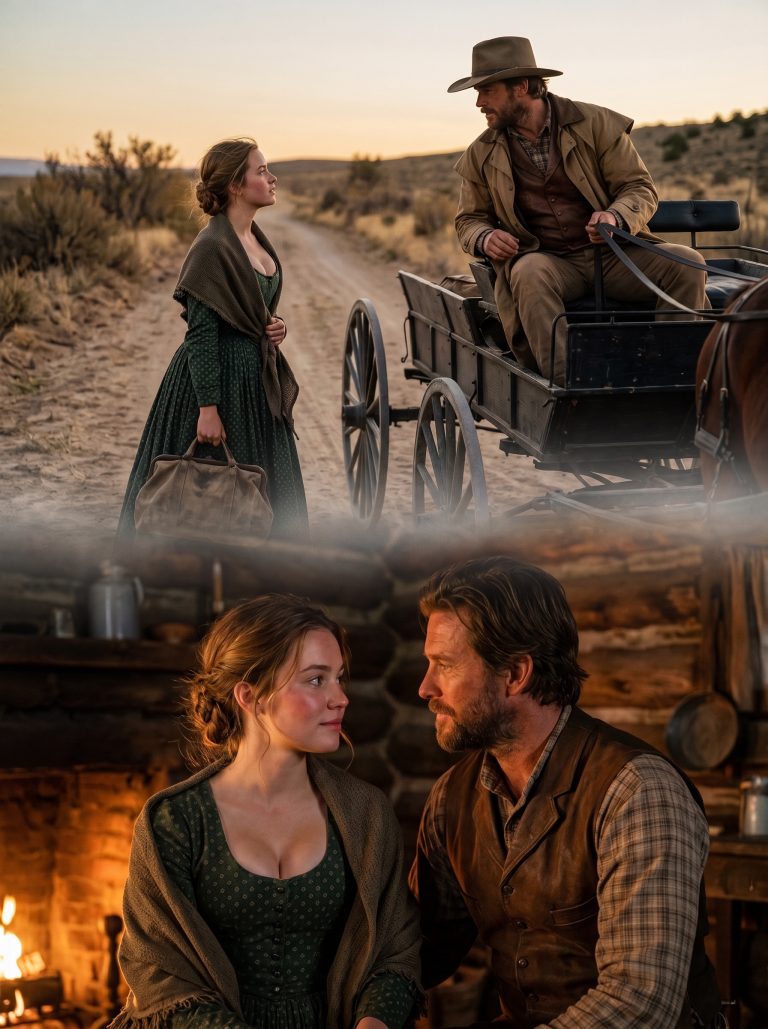
Outside, Wren lifted her trunk onto one shoulder like it weighed nothing and started not for any wagon road, but toward the black timber beyond the last buildings.
“There’s no road,” Eleanor said.
“No. Follow my tracks. Don’t look back once the town’s gone. Looking back wastes heat.”
She gathered her skirt and stepped into his footprints, and the forest closed over them both.
They climbed for hours. Twice she stumbled; twice his hand came back, steadying, never lingering. At a frozen stream he broke the ice and gave her water so cold it hurt her teeth.
“Why did you marry me?” she asked.
“The sheriff would’ve found you worse by morning.”
“That isn’t the whole answer.”
He was quiet a long moment. “I know what it is to be judged by the shape of your ruin.”
Near midnight a storm caught them on the open rock, and they sheltered beneath an overhang while he built a fire from nothing but flint and patience. When the cold turned dangerous, he offered her his coat, then — when she refused — the warmth of his own body beneath a buffalo hide, arms carefully outside it until she whispered that he could.
“If you meant harm,” she said against his chest, “no one would hear.”
“I would hear,” he said. Nothing more. It was, somehow, the only thing she needed him to say.
She told him, half-asleep, about the long freight routes her father used to run, and how he’d once put a revolver in her hands at fourteen and made her practice on fence posts until her aim was steadier than her brothers’. “Every woman who crosses this territory should know how to defend herself,” he’d said, before the ruin of another man’s greed ever touched their family. Wren said nothing, but she felt him listening the way he listened to the mountain — for something worth remembering.
Part 2
Morning brought a climb that left her legs shaking and her breath tearing. Near the top, Wren pulled aside a screen of frost-heavy branches to reveal steps cut into the rock — carved, not natural.
Warm air touched her face at the top.
Eleanor stopped so abruptly he nearly walked into her.
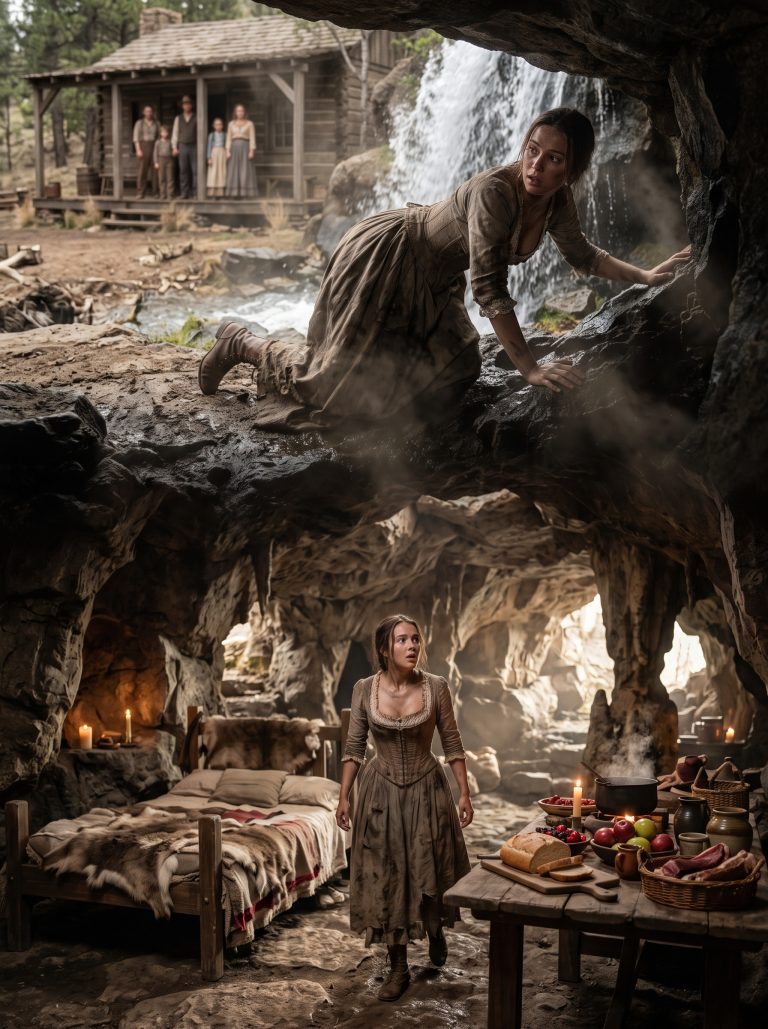
Below them lay a valley that should not have existed: green grass steaming beside hot springs, pines standing tall in windless air, and at the far end, built into the mountain itself, a house of stone, cedar, and glass that caught the morning sun and threw it back in gold.
“That,” Wren said quietly, “is home.”
“You said you were poor.”
“I am. What you see here can’t be spent without losing it.”
Inside, the house was a library and a workshop and a sanctuary all at once — shelves of books, rolled drawings, instruments she couldn’t name. He gave her a room with a lock and a key of her own, “if you wish the marriage to remain only on paper.”
The room beside it stood closed. She learned, without asking, not to open it.
One afternoon a week later, gathering frost-bitten greens in the garden beds, Eleanor slipped on the ice ringing a spring and went down hard, wrenching her ankle badly enough that she could not stand. Wren found her before the cold could do worse, carried her in without a word of blame, and set the joint with hands so careful she barely felt the pain beneath the care. He sat up with her through the night, feeding the fire, pressing willow-bark tea into her hands whether she wanted it or not, and when she finally slept, it was to the sound of him still awake beside her, listening for her breathing to even out.
In the week that followed, hobbling on a cane he’d carved for her, she found the door to the closed room open for the first time — not by accident. Inside stood a woman’s writing desk, a shelf of sheet music, a wardrobe of pressed silk long gone soft with dust.
“Rose’s room,” she said.
“Yes.”
“You don’t have to show me this.”
“I wanted to.” He stood in the doorway like a man crossing a threshold he’d sealed shut for seven years. “I thought keeping it closed was loyalty. Lately I’ve wondered if it was only fear.”
Eleanor touched nothing. “I won’t change anything here without your leave. Not ever.”
“I know.” His voice roughened. “That’s why I’m asking you to help me choose what stays.”
They found, stuffed in drawers and rolled beneath tables elsewhere in the house, drawings signed with another name entirely — Julian Ashford, Architect, New York, 1879 — beneath sketches of bridges and glass-roofed halls.
She confronted him in the workshop. “You were Julian Ashford.”
“I was.”
“The papers said a fire. A scandal. A wife who died in it.”
His hands went still over the cedar plank. “I built for men who wanted monuments to themselves. My business partner, Silas Crane, insisted the fire exits stay locked and concealed during a gathering — said it spoiled the façade to have them visible, and swore to me the city inspector had already approved the arrangement. I never checked. There was a fire. Rose was inside. The papers called me negligent. In trusting Crane instead of my own eyes, I was.”
“Who is Crane to you now?”
“My ruin, and my silent partner still, wherever he is.” He said the name like something rotted. “I came west with enough money to vanish and enough guilt to do it badly.”
“And built this instead.”
“At first, to punish myself.” His eyes lifted to hers, unguarded for one dangerous second. “Now I don’t know what it’s for.”
Before the first true seal of winter, Wren made a last trip down to a supply cache at the base of the ridge, where a trapper named Ezra Voss — the only man alive who knew the valley existed and had kept the secret twenty years running — left goods and collected letters twice a month for the nearest telegraph line. Wren had never once used the arrangement to write anyone. That day, at Eleanor’s asking, he carried down a sealed letter addressed to her father’s old clerk in Philadelphia, requesting anything further ever written about the Ashford fire — court records, corrections, anything at all.
Part 3
The smoke appeared in the third week — a faint orange smear against low cloud, far down in the timber where no one camped in winter unless they were following.
Three men. One mule. Tracks that stopped just short of the hidden passage.
Crane had spent years chasing rumors of a vanished architect in the western mountains before a paid tip from a small-town lawman finally gave him a direction worth following.
At dusk, a voice rang off the stone. “Ashford! Seven years is long enough to hide.”
Wren’s face went the color of ash. “Silas Crane.”
“You said Crane blamed you for the fire,” Eleanor said. “Why hunt you now?”
“Warm springs above the clouds,” Crane called, as if he’d heard the question. “Health resorts for railway men. I have investors, Julian. You always did build best for richer men.”
Wren raised his rifle. Eleanor put her hand on the barrel.
“Don’t answer him with a shot he can turn into a story. Answer with what you have that he doesn’t — the truth, on paper.”
That night, searching through Wren’s old strongbox for anything useful, Eleanor found the original partnership contract between Ashford and Crane, its clauses dry and easy to miss on a first reading. One line stopped her cold: should either partner be convicted of professional negligence, or vanish without contact for a period of years, all rights to their jointly held patents — including the new steel truss system the firm had just perfected — would revert entirely to the surviving partner.
“He didn’t just cut corners to save money,” Eleanor said slowly. “If you went to prison, or simply disappeared, the patent became his alone. He needed you ruined. Or gone.”
It was still only a theory built on a contract and an old, unsent letter of protest Wren had written the fire inspector years before — proof he’d once suspected wrongdoing, not proof Crane had caused it. Eleanor refused to accuse a man of murder on suspicion alone; she wanted paper, not conviction, to carry the weight of it.
They had almost given up expecting an answer — the same storms battering the ridge had delayed the courier route nearly ten days — when Ezra Voss finally came up through the last open pass ahead of the worst weather of the season, half-frozen and grim-faced, carrying a courier’s satchel that had been building for weeks at the telegraph office below. Inside were the clerk’s reply and everything he had unearthed: corrected court testimony from the original fire inspector, who now swore under oath that no such approval had ever been given for locking the exits; and, most damning, a letter Crane had written to his investors a full two weeks before the fire, promising them sole control of the truss patent within the month.
Eleanor read that letter twice, hands shaking, before she looked up at Wren.
“He didn’t only ruin you,” she said. “He profited from it. And now he’s followed the profit here.”
They laid a trap using what each of them knew — Wren the stone, the water, the habits of desperate men; Eleanor the vanity of cowards and the weight of paper. At dawn she stood in an unshuttered window as bait while Wren slipped through a service tunnel below the spring.
Crane’s rope snare caught one hired man outright; a fired shot spooked the mule and sent the second man fleeing down the ridge, where he was taken by county riders two days later and, faced with a hanging charge he wanted no part of, swore out a full statement admitting Crane had promised them each a share of the valley’s mineral rights.
On the high ridge, Crane held a burning rag toward the dry cedar lattice of the greenhouse and smiled at Wren’s raised rifle.
“Put it down, Julian. You always did love beautiful structures.”
Wren lowered the rifle. Crane lifted the torch and touched it to the lattice. Flame climbed fast and orange through the dry cedar, smoke rolling thick between them and stinging their eyes, burning wood cracking loudly overhead, before Eleanor, running from the shed, threw a bucket of snowmelt across the frame and beat the rest out with her coat, the wood scorched black but the frame still standing.
In that same breath Wren was on Crane, driving him to the frozen ground, one knee between his shoulders, wrenching the arm that still held the pistol until the wrist gave with a sound like a dry branch. Crane screamed and the weapon fell away. Wren’s knife came up to his throat.
“He killed Rose,” Wren said, voice savage and broken. “For a patent.”
“I know,” Eleanor said. “But I also know what your hands are for. Don’t let him decide that too.”
Slowly, the knife came away. It was Crane, reaching with his uninjured hand — the other wrist ruined and useless beneath him — for a second, smaller derringer hidden in his boot, who nearly finished it. Eleanor’s shot took him in the shoulder before he could raise it, and the little gun fell harmlessly into the snow.
They brought Crane and the man caught in the snare down to Laram Station in chains, along with Eleanor’s satchel of deeds, water rights, the partnership contract, the inspector’s corrected testimony, and Crane’s own letter to his investors.
The county judge, unwilling to rule on charges from a fire that had happened a thousand miles east seven years before, ordered Crane held in the territorial jail while telegrams went out to New York. It was nearly three weeks before authorities arrived by rail with a proper warrant, built on the recovered contract, the inspector’s sworn correction, and the investor letter Eleanor had carried down the mountain herself.
At the sheriff’s office, it was Hollis’s own ledger that closed the last gap: a payment, dated the week Eleanor arrived in town, from a Crane agent for “information regarding the hermit of the high country.” Hollis had sold Wren’s whereabouts for fifty dollars and never once asked why a stranger wanted to know.
He had not meant to burn a greenhouse or put a bullet through a woman’s window. But the town council did not weigh intentions so finely. Within the month, Hollis surrendered his badge before they could take it from him. Taking Crane’s money had not made him an accomplice to arson — but it had made him unfit to stand watch over a town that trusted him to know the difference between a stranger’s curiosity and a stranger’s threat.
“You were practical, Sheriff,” Eleanor told him before he left, not unkindly. “That’s what men call themselves when a woman’s desperation turns a profit for somebody.”
He didn’t argue. He didn’t meet her eyes again.
The climb home was quieter. Near the overhang where they’d survived their first storm together, Wren stopped.
“When we’re back,” he said, “I can move to the east wing. You’ve done enough from duty — you don’t owe me more.”
“You are an infuriating man,” Eleanor said. “You’re trying to abandon yourself before I can choose you.”
She took off one glove and touched his cold, weathered face.
“I loved you on that platform,” he admitted, “when you looked at those men like poverty had taken your shelter but not your spine. I told myself it was gratitude I felt. It was never gratitude.”
“Then stop rationing it,” she said, “like it’s something you don’t deserve.”
He kissed her like a man finally allowed to stop holding his breath.
Spring came to the valley like a secret deciding to bloom. The greenhouse frame, scorched but unbroken, was mended and replanted. Eleanor redrew the library catalog and told Wren his seed-storage system was “a crime against order.” He laughed, which she learned was rare and worth collecting.
Rose’s room stayed as it was, but the door no longer stayed closed. Some evenings Wren sat there and told Eleanor small, unguarded things — the sound of Rose’s laugh, her impatience with unfinished drawings, the particular way she used to say his name when she was teasing him. Eleanor listened without jealousy, understanding at last that loving her did not require erasing what had come before. Grief and love, it turned out, could keep the same house without one evicting the other.
They built together after that — not a man indulging his wife, not a wife decorating a husband’s ambition, but two people who had each been told, separately, that they were worth less than they were, discovering they’d been wrong.
In autumn, Eleanor went back once to the platform at Laram Station. Not because she needed anything there, but because some fears have to be faced in the room where they were born. A young woman stepped off the last train that day, a carpetbag clutched to her chest, no one waiting for her.
“Do you have lodging?” Eleanor asked.
“I thought I did.”
Eleanor heard the whole story in those five words, because she had lived it.
“There’s a place,” she said. “It’s far. The road is hard. But you’ll be safe there — and no one will decide your worth for you ever again.”
The valley never became a rich man’s trophy, and it never stopped being a secret. But over the years it became something sturdier than either: a house where people who had been discarded by the world below learned, slowly, that the shape of their ruin was never the shape of their worth — and that a roof freely offered, and freely chosen, could outlast even the coldest winter a person had survived alone.