At 19, she was forced into marriage with a hardened mountain man raising five kids—no one expected what happened inside that broken household next

Part 1
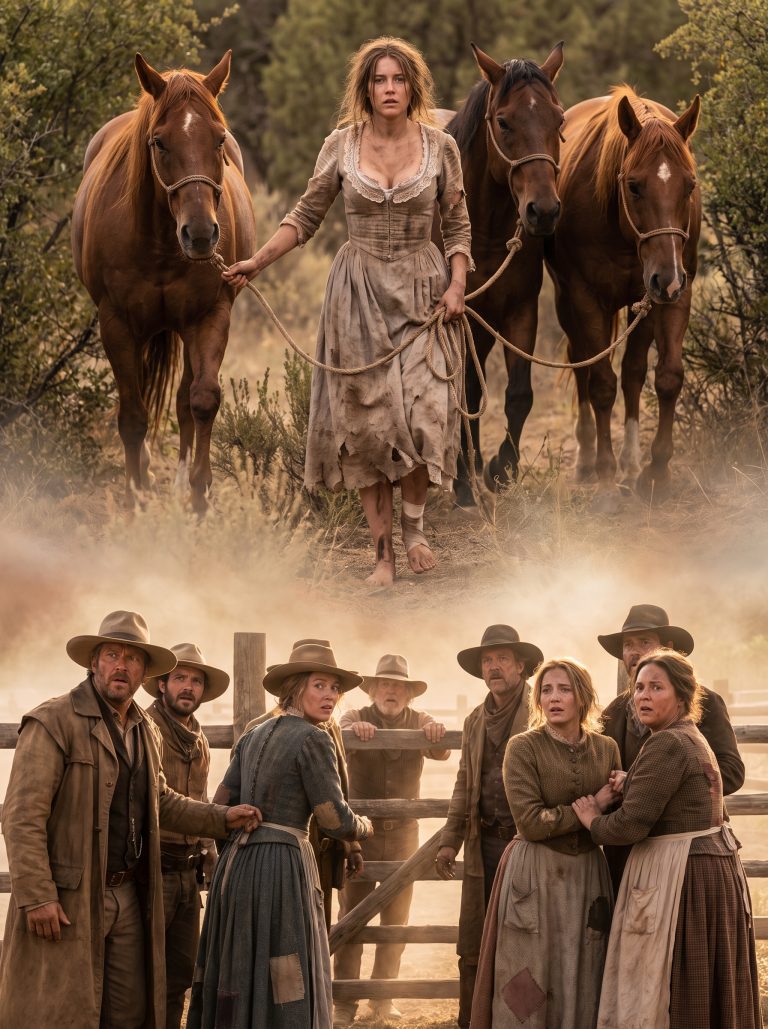
Clara Ashworth counted the ceiling beams of Whitmore’s General Store rather than look at the men who were deciding her life for her.
Fourteen beams. She had counted them twice already.
Her father’s debt was written in Whitmore’s ledger in a hand too neat for a man who could no longer sign his own name without the letters trembling: $58.40. It was the price of two seasons of whiskey, one bad winter of unpaid rent, and a mortgage on land that no longer grew anything but regret. Silas Ashworth stood beside his daughter and did not look at her either. He smelled of the saloon even at nine in the morning.
“She’s able,” he said to the man across the counter. “Cooks, mends, doesn’t talk back more than she has to.”
The man he said it to did not answer right away. Ezra Calloway was the kind of tall that made low doorways personal insults. He worked timber on Copper Ridge, six miles and four thousand feet above Millhaven, and he had the look of a man who had run out of patience with easy things a long time ago. His coat was elk hide, cracked at the shoulders. His eyes were a pale, tired brown, the color of creek water in October.
He set a canvas pouch on the counter. Coin struck wood with a flat, final sound.
“That squares it,” Whitmore said, already sliding the pouch out of sight.
Clara did not cry. She had promised herself, somewhere around beam number nine, that she would not give this room the satisfaction.
“Name’s Clara,” she said, before anyone could introduce her like livestock.
Ezra looked at her for the first time. Not unkindly. Not kindly either. Like a man checking the weather.
“Ezra Calloway,” he said. “I’ve got five children and no wife. I need someone who won’t quit by Christmas.”
“I don’t quit,” Clara said. “I get told to leave, or I choose to. There’s a difference, and I intend for you to learn it.”
Something in his jaw moved. It might have been the beginning of a smile. It might have been nothing at all.
The ride up the mountain took most of the afternoon. Millhaven watched them go from behind curtains and porch rails — the same town that had watched her father drink away her dowry now watched her get sold to settle it, and found both equally entertaining. Clara did not look back.
The road narrowed to a trail. Pines pressed close enough to touch. The air thinned and sharpened, and by the time the cabin came into view, dusk had turned the sky the color of a healing bruise.
The door slammed open before the wagon stopped.
Five children stood on the porch like a jury that had already reached its verdict.
The oldest, a boy of thirteen with his father’s flat stare, held an old shotgun with the ease of someone who’d been told not to touch it and touched it anyway. “Who’s that,” he said. Not a question. An accusation.
“Nathaniel,” Ezra said. “Gun goes inside.”
“We don’t need her.”
“Gun. Inside.”
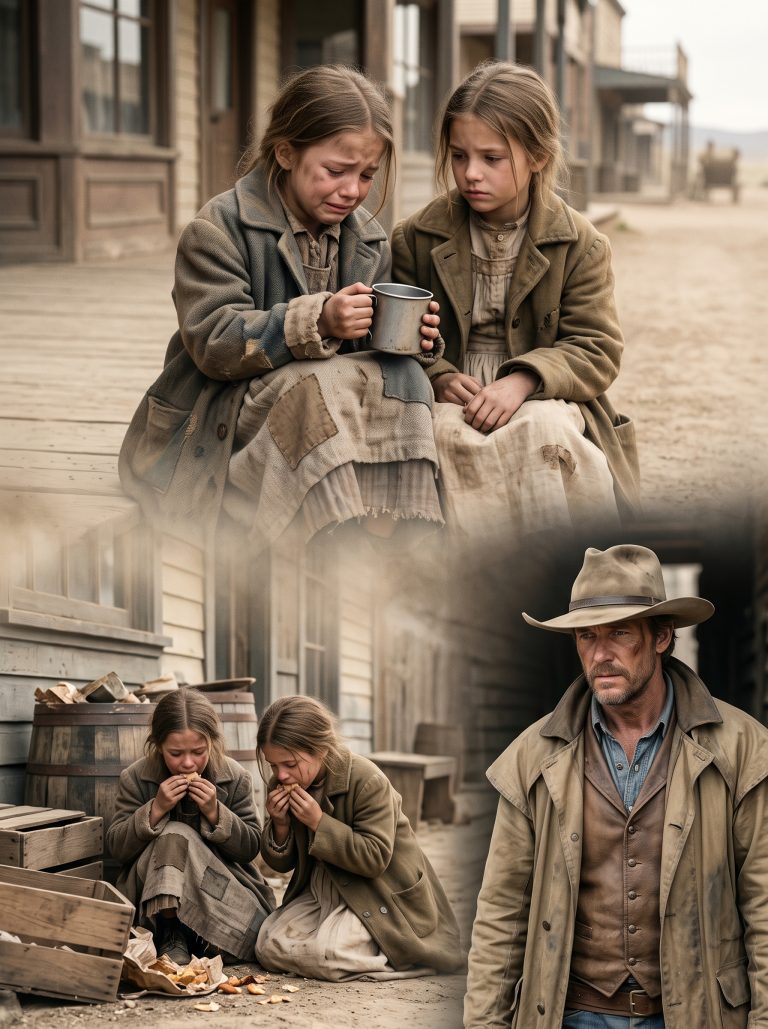
The boy went, dragging his heels loud enough to make his opinion known. A girl of ten with a torn hem and a look of ancient suspicion planted herself in Clara’s path. Behind her, a boy of seven peered out from a nest of unwashed hair, and a four-year-old girl clung to the doorframe like she meant to defend it with her teeth. A toddler sat on the porch boards, solemnly eating a strip of bark.
“You’re not our mother,” the ten-year-old — Beatrice — said.
“No,” Clara agreed. “I’m the woman who’s about to find out where you keep the soap, because God help us all, this house needs it.”
She walked past the girl and into a room that smelled of old grease, wet wool, and a grief nobody had bothered to clean up after. Dirty plates. A cold hearth. A silence that had clearly been shouted into a hundred times and had shouted back.
Clara set her bag on the table, took off her coat, and picked up the poker.
“Someone fetch water,” she said to the room. “We have work to do.”
By the fire that night, after five children had finally gone still in the loft above, Ezra spoke for the first time since the wagon.
“Their mother’s name was Margaret,” he said, watching the flames instead of her. “She died of a fever two winters back. Buried her myself, up past the tree line, ground was too hard for the town to send anyone to help dig.”
Clara said nothing. There was nothing yet to say. But she noticed — filed away, the way she filed away everything useful — that he had not looked at her when he said it, and that his hands, usually so still, had not stopped moving the whole time: turning a piece of kindling over and over, like a man handling something he wasn’t sure was safe.
“Get some sleep,” he said finally. “Morning comes early on the ridge.”
She did not sleep for a long while. She lay listening to the wind test the corners of the cabin, and to something else, smaller — the particular quiet of a man who had told the truth about everything except one thing, and knew it.
Part 2
The work did not soften Clara. It sharpened her.
Water hauled from a creek a quarter mile down a killing grade. Lye soap that cracked her knuckles open. A stove that hated her for the first two weeks and grudgingly cooperated after. Nathaniel tested her with silence and small sabotage — smoke-choked fires, upended buckets — until the night she put a plate against the wall beside his head hard enough to make the whole cabin flinch, and told him his mother was dead and she was not going to pretend to be anyone but herself.
Ezra came in halfway through it, looked at the mess, looked at his son on the floor, and said only, “Clean it up, Nathaniel,” before sitting down to a cold supper like nothing had happened.
But something had. After that night, the war became a truce, and the truce, slowly, became something like trust. Beatrice stopped hiding the matches. Owen stopped tracking mud. Ivy still bit when startled but stopped being startled quite so often. The baby, Daniel, began following Clara’s skirts with a rag tied round his waist, self-appointed and very serious about his duties.
In November, fever took Ivy — the same wet, tearing cough Nathaniel swore had taken his mother. For two days Clara held the child over pine-steam and refused to let her quit breathing, while Nathaniel hauled snow and would not sleep and would not cry until it was over, and then cried without sound at all.
Ezra came home from three days in the high timber to find his son asleep against Clara’s skirts and his daughter breathing easy against her collarbone. He said nothing dramatic. He only reached out, brushed a damp strand of hair from Clara’s face with a hand rough as sandstone, and told her to sleep. He’d take the watch.
It was somewhere in that stretch of sleepless nights that Clara found the locket.
It had slipped from a loose board near the hearth while she was sweeping — a small oval of tarnished silver, a woman’s face inside it, dark-haired, unsmiling. On the back, scratched crooked, as if by an unpracticed hand: M.C. — write when you’re able.
The ink of the date beneath it was smudged, but the year was not the year Margaret Calloway was supposed to have died. It was a year after.
Clara did not ask him about it. Not yet. But she put the locket in her apron pocket, and she carried it, and she began — quietly, the way she did everything — to watch.
Part 3
Spring came the way it always came to Copper Ridge: reluctantly, and then all at once.
By March the snow had softened enough for the trail to open, and Ezra took Clara and Nathaniel down to Millhaven for flour, salt, and the particular satisfaction of watching Whitmore weigh his scales honestly under Clara’s stare. The town had expected a broken girl. They got a woman who checked the flour to the ounce and called Whitmore by his mistakes. Ezra stood behind her the whole time, one hand at the small of her back — not ownership, she’d come to understand, but something closer to a wall.
It was two weeks after that trip, on a raw grey afternoon with mud sucking at the yard, that a woman walked up the last stretch of the trail on foot, alone, a carpetbag in one hand and her coat too thin for the wind.
Clara saw her first, through the window, and felt the world tilt very slightly on its axis.
It was the face from the locket. Thinner. Older. But unmistakably itself.
“Ezra,” the woman said, when he came to the door, and her voice cracked on the single syllable of his name.
He did not look surprised. He looked, Clara thought, like a man who had been waiting two years for a debt of his own to come due.
“Margaret,” he said.
The children went very still. Nathaniel’s hand found the doorframe and gripped it white-knuckled. Beatrice said, in a voice gone suddenly small, “Mama’s dead,” as though saying it again might make it true a second time.
“No,” Margaret said, and her eyes were wet and terrified and fixed only on her children. “No, baby, I’m not.”
They sat her by the fire. Clara made tea out of habit, her hands steady even as her mind was not, and listened to a story that rearranged everything she thought she’d understood about the family she had spent a winter building.
Margaret had not died of fever. After Daniel’s birth, something in her had come loose — a darkness the doctors down in the valley had no good name for, that made her afraid of her own hands around her own children, that had her walking the tree line at midnight talking to a husband who was three miles off in the timber and couldn’t hear her. One night, in a fog she still couldn’t fully account for, she had nearly dropped the baby into the hearth reaching for wood that wasn’t there. Ezra had found her sitting on the floor afterward, shaking, begging him to take the children away from her.
There was no asylum on the ridge, no doctor who understood such things as anything but madness or moral failure, and Ezra had watched enough hard winters take mothers away from their children in worse ways to know what Millhaven would do with a story like hers — the whispers, the stares, the shame that would follow his children the rest of their lives, the very real threat that the county would take them from a father married to a “madwoman.” So he had done the only thing he could think to do. He had sent her to her sister in Helena, where there was a doctor who specialized in nerves and grief, and he had told the mountain — and eventually his own children — that she had died. It was, he said now, staring at his hands, easier to bury a woman than to explain her.
“I let them grieve something simple,” he said. “Instead of something true.”
Margaret had written, at first. The letters had stopped when the fever season made the trail impassable, and by the time it cleared again, Ezra told himself the kindest thing left to do was to let the lie finish what it started. He had not expected her to come back. He had not, he admitted, quietly, entirely wanted her to — not because he didn’t love his children’s mother, but because the man who’d made that choice two winters ago had been drowning, and drowning men make promises to themselves that don’t survive dry land.
Clara sat through all of it without a word, the locket a small hard weight in her apron pocket, and understood, with a clarity that felt almost like relief, exactly what kind of story she had walked into. Not a rescue. Not a romance. A house built, quite literally, on a grave that had never been dug.
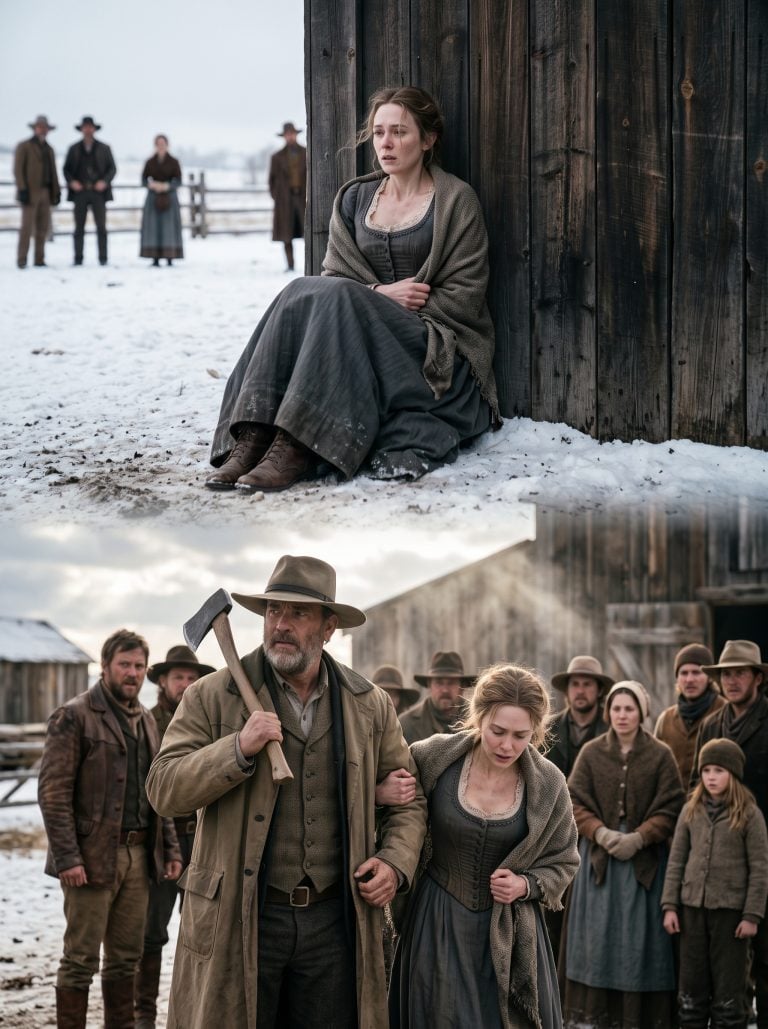
That night, after the children — stunned, wary, unable to stop staring at their mother as though she might vanish again if they blinked — had finally gone to sleep in a loft too crowded now for the number of feelings in the room, Clara found Ezra outside, splitting wood he didn’t need in the dark because his hands required something to do.
“You should have told me,” she said.
“Would you have stayed, knowing?”
“You’ll never know now, will you.” She let that sit. “I’m not angry you buried a story to protect her from a town that eats women alive for being sick. I understand that better than you’d think.” She thought of her father’s ledger, of a debt with her name on it, of a town that had decided long before she arrived that she would break. “I’m angry you let me build a life on ground you knew wasn’t settled.”
He set the axe down.
“What do you want me to do, Clara?”
“I want you to ask her what she wants. Not what’s easiest. Not what protects you from the shame of it.” Clara’s voice was steady, though something under it was not. “And then I want you to ask me the same, once you know.”
Margaret stayed a week. She was thin and quiet and flinched at loud noises, but she was, Clara came to see, not the fragile thing the town’s imagination would have made of a woman like her — she was someone who had done the hardest thing a mother can do, which was to remove herself before she did harm, and then the second hardest thing, which was to come back and face what that had cost.
She did not ask for her old life back. She sat with Ivy and relearned the shape of her daughter’s face. She let Nathaniel be angry at her, without flinching from it, for three straight days, until his anger wore itself down into something closer to grief he could finally hold. She told Clara, on the porch on her last evening, that she had watched her with the children all week and seen exactly what the ridge had needed and exactly what she herself had not been able to give it, not because she loved them less, but because love had not been enough to fix what was broken in her, and it had taken her a long time and a good doctor to stop believing that was a failure of love.
“I’m not here to take anything from you,” Margaret said. “I came to stop being a lie. What happens after that isn’t mine to decide.”
She and Ezra sat up late that final night, and Clara did not ask what was said, only that in the morning Margaret signed papers Ezra had ridden down to Millhaven to fetch from a circuit judge passing through — a legal end to a marriage that had, in every way that mattered, ended two winters before in a fevered midnight beside a hearth. It was not unkindness. It was, both of them agreed, the truest thing either of them had done for the other in years. Margaret would return to Helena, to the sister and the doctor and the slow work of living, and she would write — real letters this time, with a real return address — and in summer, when the trail was easy, she would come back to see her children as what she’d chosen to become: not a ghost, not quite a mother in the old sense, but someone who had earned, through hard and honest telling, the right to be present.
When the wagon carrying her down the mountain disappeared past the tree line, Nathaniel stood on the porch a long time before he went back inside.
“You knew,” he said to Clara. Not an accusation this time. Just tired.
“I found a locket,” Clara said. “I didn’t know the whole of it. I don’t think your father did either, not really, until he had to say it out loud.”
“Are you leaving?”
The question surprised her less than it should have.
“No,” she said. “I came up this mountain because I had nowhere else to go. I’m staying because I decided this is where I want to be. Those aren’t the same reason, and only one of them is still true.”
Ezra found her by the woodpile that evening, the axe idle in his hand.
“I owe you a debt now too,” he said. “Different kind. Can’t square it with coin.”
“I don’t want it squared,” Clara said. “I want it acknowledged. There’s a difference, same as before.”
“I’m asking you to stay. Not as hired help. Not as a ledger entry, the way you were the day I bought your father’s debt. As — ” He stopped, searching for a word big enough. “As the woman who held this family together when I couldn’t tell you the truth of what it was made of.”
“That’s a strange proposal, Ezra Calloway.”
“It’s the honest one. I’ve got no interest in another kind.”
Clara looked past him, to the cabin windows glowing gold against the dusk, to five children silhouetted at the table — Beatrice teaching Ivy to fold a napkin properly, Owen asking Nathaniel a question he clearly didn’t want to answer, Daniel gnawing solemnly on his rag. A family that had been assembled out of debt and grief and a lie told out of love, and that had, somehow, in the space of one hard winter, become something sturdier than the truth it was hiding.
“Ask me properly in the spring,” she said. “When there’s a preacher on the circuit and no snow on the ground and nothing left buried between us.”
“And if I do?”
“Then I expect I’ll say yes.” A ghost of a smile. “But you’ll build the wedding bed yourself. I’ve hauled enough water for one lifetime.”
He laughed — the short, rusty laugh she’d learned meant more from him than most men’s speeches — and for the first time since she’d stood counting ceiling beams in Whitmore’s store, Clara Ashworth let herself believe that the life in front of her was one she had chosen, and not merely one she had survived.
The mountain kept its secrets a long time. But it had also, in its slow and brutal way, taught her the one thing worth knowing: that a family is not the story you’re told about how it began. It’s the truth everyone finally has the courage to tell, and what you build, together, once the lying stops.
— END —