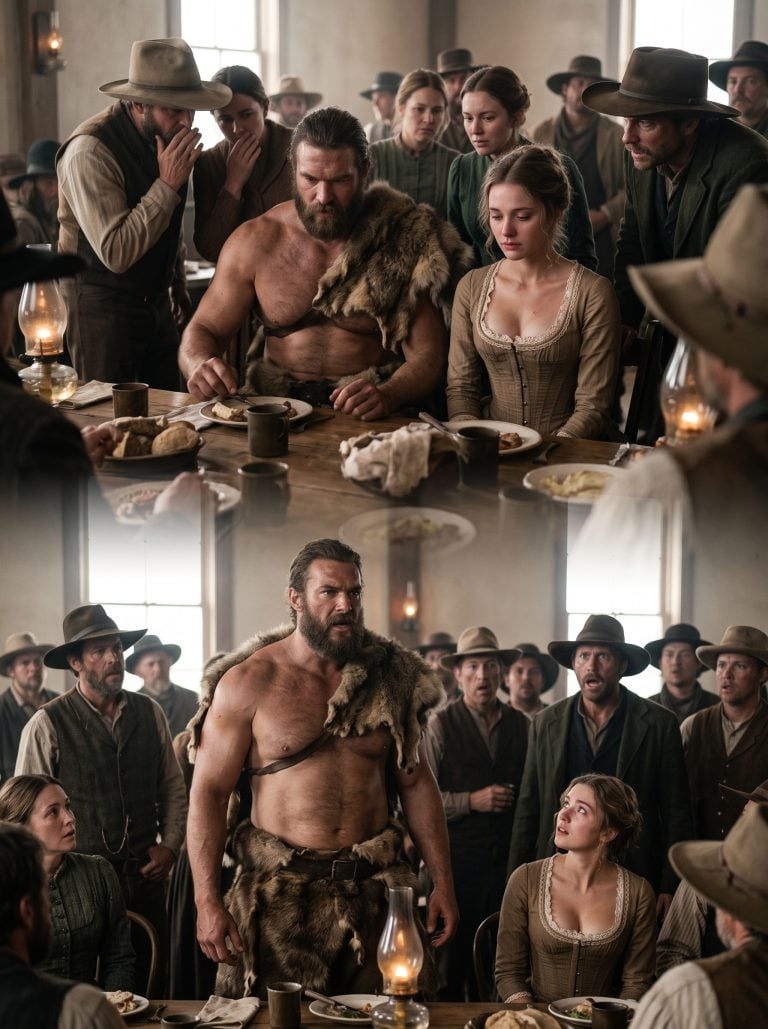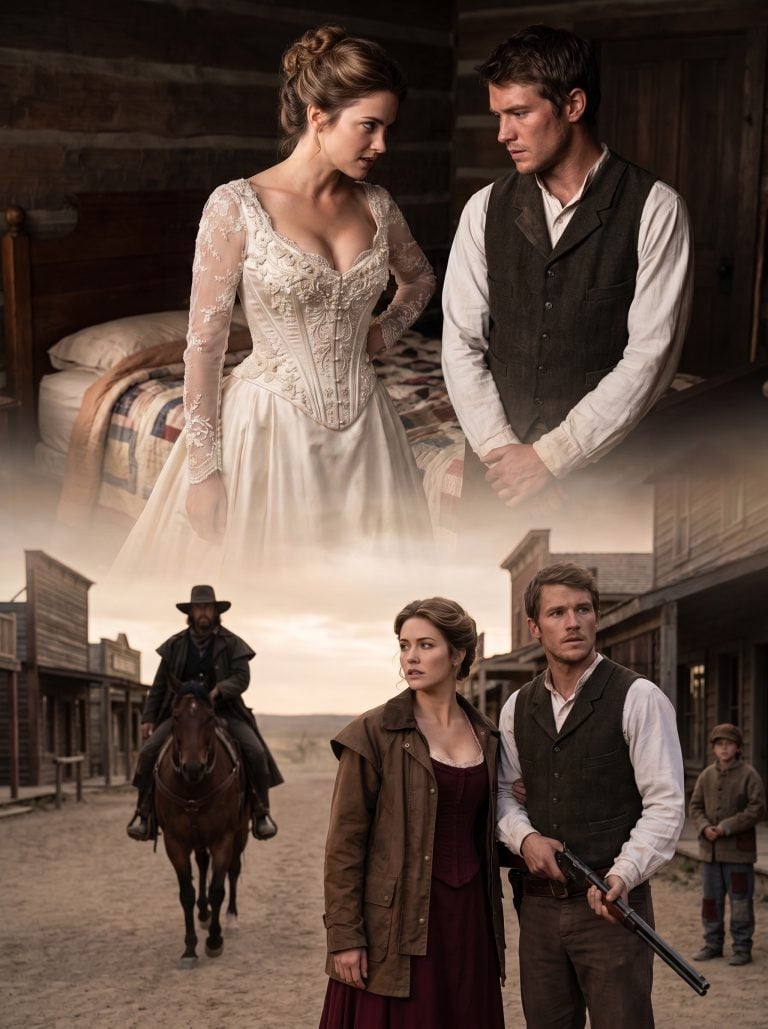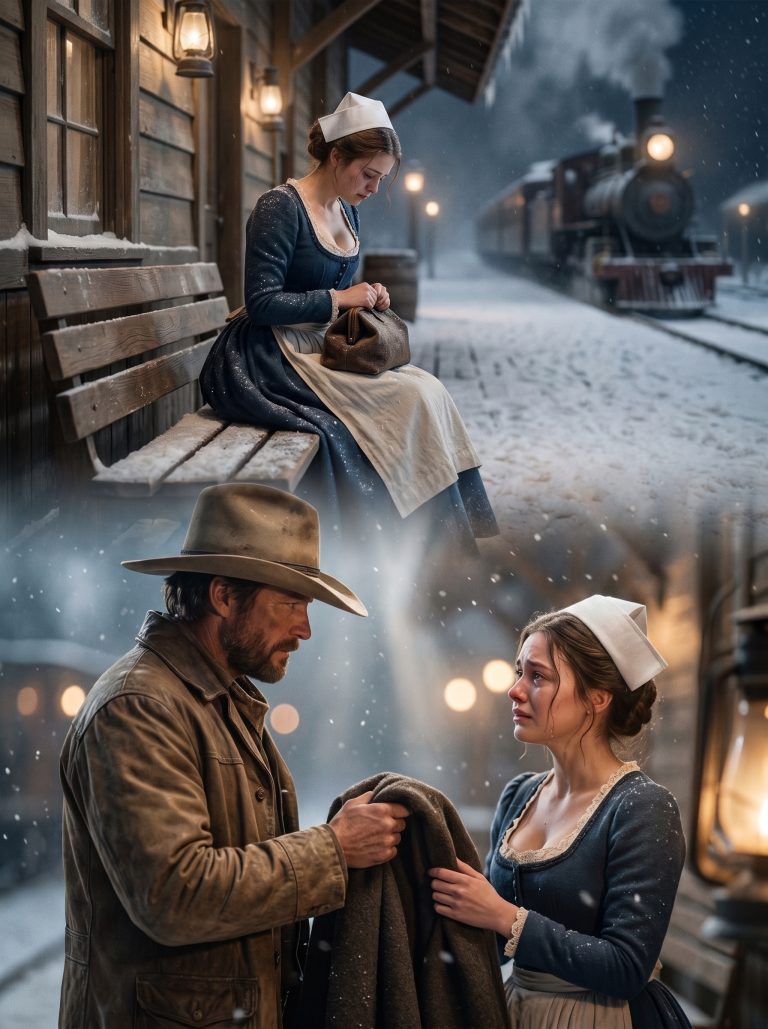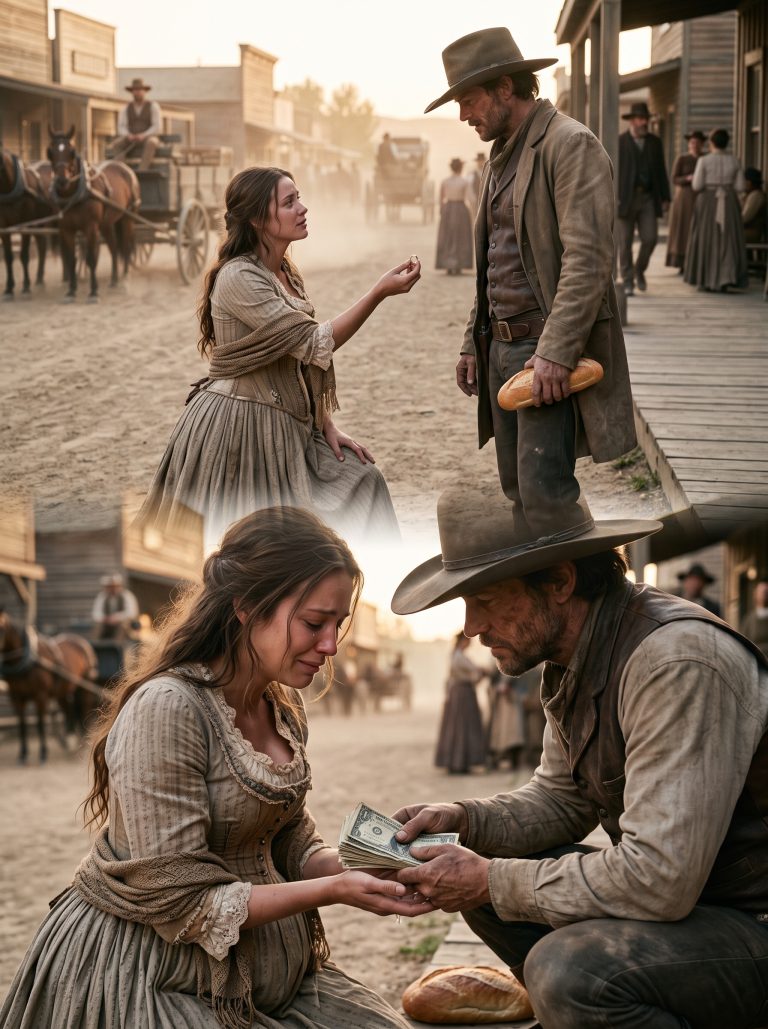
“Each morning the twin girls arrived starving… until a lone cowboy followed them home and found a truth no one dared to see.”

Part 1
Silas Whitmore had not wept since the day they buried his wife, Clara, four years back, in ground so frozen the gravediggers had to build a fire over it first to soften the earth.
Since then he had built a life the way a man builds a fence: post after post, until nothing wandered in or out. He came into the town of Ironhollow three mornings a week — Mondays, Wednesdays, Fridays — bought what needed buying, spoke when speaking was required, and rode home before the street filled with people who still looked at him with old sympathy in their eyes.
It was a good system. It had worked for over a year without a single crack in it.
Then, on a scorched morning in June, his stirrup strap snapped on the road into town, and he had to walk the last half mile past the back of the Silver Spur Saloon — a route he never took. That was where he heard them.
Not crying. That was what stopped him first. Two small girls, maybe four years old, crouched by the saloon’s refuse barrel, breaking apart a thrown-out heel of bread between them with the quiet, practiced efficiency of people who had done this many times before. One held the other back with a stiff little arm the moment Silas’s boot scraped gravel.
“Easy,” Silas said, raising both hands and lowering himself to their level. “I’m not going to touch you or your food.”
The taller girl did not move her eyes off him. The smaller one peered around her sister’s shoulder.
“I’m Silas,” he said. “What’s yours?”
Silence. He drew a wedge of cheese from his coat pocket — bought that morning, forgotten in his rush — and held it out at arm’s length, then set it on the ground and stepped back. The taller girl darted forward, snatched it, retreated, and without looking, broke it exactly in half and passed a piece behind her.
“Josie,” the smaller one offered, pointing at her sister. “I’m Willa.”
Silas nodded as if he’d been introduced to two grown women at a social. “Pleased to meet you both. Do you have somewhere you sleep?”
The silence that followed had weight to it. It was Willa who finally spoke: “Nowhere bad.”
That was not the same as saying somewhere good, and Silas understood the difference better than most.
He came back the next morning with bread and salt pork and left it on a crate, then watched from behind a rain barrel as the girls appeared from the direction of the old grain mill, moved through the alley like water finding the lowest path, and divided the food between them with the same careful math. Before she ate, Josie looked dead at the rain barrel and held his gaze three full seconds. She had known he was there the whole time.
By the third morning he stopped hiding.
“Is there an adult with you?” he asked.
“No,” Willa said. Josie didn’t correct her.
“Where are your parents?”
Josie set her bread down. “Gone,” she said, and picked it back up. It was not an answer. It was not nothing, either.
That afternoon Silas went to Nora Fitch’s laundry at the end of Main Street, where every piece of town gossip eventually passed through with the wash water.
“Vance girls,” Nora said without looking up from her washboard. “Father was Ezra Vance. Worked the Halloway claim up on the ridge. Died in a shaft collapse this spring — him and two other men. Mother, Mary, died two weeks after. Doctor called it grief. Heart just stopped.”
“And the children?”
“No kin in the territory. Sheriff Garrick said arrangements were being made to send them to the county home in Bozeman.” Nora’s scrubbing slowed. “That was four months ago.”
“They’re still here.”
“I know they’re still here.” Nora looked up at him then, something sharp and tired in her face. “Ezra’s claim was the richest strike on that ridge, Silas. Everybody knew it. He’d had a surveyor up from Helena not two weeks before the shaft came down. Sheriff Garrick has bought five properties in this valley in two years. Every one from a family that had some misfortune right before they sold.”
Silas sat with that a long moment. Then he went to see Doctor Eli Marsh, whose hands shook when they weren’t occupied and whose eyes went to the window whenever a conversation got dangerous.
“Mary Vance came to me three days before she died,” Marsh finally admitted, voice barely above a whisper. “She wasn’t sick. She was frightened. She said she had papers — Ezra’s records. Proof of who’d been paid, and when, and what land followed. She asked me to keep them safe. I told her to take them to someone with real authority. I turned her away.”
He opened his bottom drawer and set a worn, sweat-creased envelope on the desk between them.
“I couldn’t bring myself to destroy it,” he said. “I’ve thought of nothing else since May.”
Silas slipped the envelope inside his coat and walked back into the heat of Main Street with a dead man’s evidence against his ribs, and the memory of a four-year-old girl saving half a biscuit in her dress pocket pressing against something in him that had been sealed shut for four years and had just, without permission, come open.
Part 2
That night Silas laid Clara’s photograph beside the envelope on his kitchen table and asked her, out loud, what she would do. He already knew the answer. Clara had never once in her life decided injustice wasn’t her problem.
In the morning, a flat stone sat in the exact center of his locked house, a cross scratched into its face. Every window was still latched. Nothing was broken.
He found the girls behind the Silver Spur.
“You were in my house,” he said.
“We had to know if you were safe,” Josie said. “You sleep with your rifle close, but not close enough to grab fast. Scared men keep it closer than that. You’re not scared. You’re careful.”
Silas absorbed being read more accurately by a four-year-old than by most grown men he’d known.
“I need to ask about your mother,” he said gently. “About what she was carrying.”
The twins exchanged the silent look they seemed to trade in place of words. “She had a tin box,” Willa finally said. “Under the kitchen floorboard. She showed us where. She said if anything happened, find a safe man and show him.”
“Can you take me there?”
“After dark,” Josie said. “The sheriff’s men watch the road in daylight.”
That night the girls led him a mile out of town to the ruined Vance house, moving through the dark with a competence no child should have had to earn. Josie pried up a floorboard and lifted out a small tin box.
Inside the house, and inside the box, Silas found what Ezra Vance had spent his last months building: ledgers, dates, payments, a pattern of accidents that always arrived just after a claim’s true worth became known. Ezra’s final entry, dated two days before the collapse, instructed whoever found it to carry everything — not to the county, not by telegraph — but directly to Federal Marshal Thaddeus Cole in Helena, the one clean hand Ezra had confirmed.
Sheriff Cole Garrick’s name appeared eleven times. A lawyer named Voss appeared nine.
Silas sewed the tin box into the lining of his riding coat using Clara’s old sewing kit, still faintly smelling of lavender after four years untouched.
“All right, Clara,” he said to the empty kitchen. “I’m paying attention now.”
Part 3
Nora Fitch agreed to hide the girls while Silas rode. “If Garrick finds those documents gone,” she warned, pouring him coffee at dawn, “his patience ends. He’s been letting those children starve slow because it solves his problem without him lifting a finger. Don’t give him a reason to lift it.”
Silas took the creek trail out of Ironhollow, screened by cottonwoods, adding forty minutes he judged well spent. Eight miles out, a rider cut from a draw to the east — young, hands visible, a card already in his outstretched fingers.
“Jonah Reed,” the young man said. “Correspondent, Helena Territorial Gazette. Nora sent me. Told me to tell you the coffee’s getting cold.” It was Nora’s phrase for move faster.
Reed had spent three weeks building a parallel record of the valley’s land grabs — witness names, sale dates, two miners, Amos Kelley and Frank Doss, willing to testify if there was ever federal protection to testify under. Ezra Vance, it turned out, had split the truth deliberately among several people so no single death could bury it. Nora knew the marshal’s name. Marsh had the documents. Reed had the witnesses.
They were four miles from town when Josie stepped out of the tree line into the trail, chin lifted, Willa close behind her, both girls’ feet wrapped in strips torn from their own hems.
“Men came to Nora’s before sunrise,” Josie said. “We got out ahead of them. There’s more blocking the south road.”
Garrick had sealed the obvious way out. Silas chose the canyon route east of the ridge instead — a passage he’d surveyed eight years earlier for a mining outfit that had gone bankrupt before it ever broke ground. He lifted both girls onto his horse. Josie climbed up behind Willa without being asked twice.
Inside the canyon, Josie read the ground before Silas’s own memory caught up to it. “Left side,” she said twice, unprompted, correctly both times. “Rocks that fall land on the danger side. The safe side stays smooth. That’s the side that gets walked on.”
An hour in, horses echoed somewhere behind them in the rock — too far back to matter if they kept moving, close enough that no one said so out loud. They came out into open plain by late afternoon, the canyon’s danger behind them, Helena’s flat gold light ahead.
They reached Marshal Thaddeus Cole’s office on Clement Street the next morning. Silas set the oilcloth-wrapped tin on the clerk’s desk and said only, “This concerns Ezra Vance, Sheriff Cole Garrick, and a land consortium operating on federal mining claims.” The inner door opened before the clerk finished blinking.
For an hour, Silas laid out what he had. Reed added the witness names. Cole read every ledger twice, asked exact questions, and then called for a deputy without raising his voice.
“Lock the front. Send a rider to Judge Halloway directly — no county telegraph. Prepare warrants for Garrick, for the lawyer Voss, and for anyone in these transfers who falls under federal jurisdiction.”
By half past three, deputies brought Garrick through in irons, his silver badge already gone from his coat. He looked at Silas, then at the two small girls standing close enough to touch his sleeve, and something crossed his face that might have been calculation or might, for once, have been something closer to shame.
“You have no idea what you’ve started,” he told Silas.
“No,” Silas agreed. “But it started. That’s the part your system counted on never happening.”
The trials took four months — justice, it turned out, moved like a river through flat country, patient but never hurried. Silas took rooms in Helena so he’d be available to Cole, and Josie and Willa learned, morning by morning at a boarding-house table, that biscuits would still be there tomorrow, and did not need to be hidden in a pocket to prove it.
It was in the third month, while Reed was cross-checking mine payroll ledgers for the prosecution, that the twist surfaced — not from Garrick, and not from Voss, but from a payroll clerk’s water-stained sign-in sheet from the Halloway claim, dated the very night of the shaft collapse.
Ezra Vance’s name was on it twice. Once, signed in his own hand, clocking into shaft four that morning. And once again, six hours after the collapse was reported to the county, signed by a different hand entirely — a rough, left-leaning copy of his signature, on a supply requisition for a camp forty miles north, in territory the consortium didn’t yet control.
Reed brought it to Marshal Cole white-faced. “Either someone forged Ezra Vance’s name to cover a theft,” he said, “or Ezra Vance was still alive six hours after they told his wife he wasn’t.”
It took two more weeks of quiet work — Cole didn’t want hope handed to two four-year-old girls on a rumor — before deputies rode out to the northern camp and found a man working under the name Ezra Vale, his left arm healed wrong from a fall, his face half-covered by a beard he hadn’t worn before, who had spent four months telling himself that the men who’d pulled him half-dead from a side tunnel and warned him his family would die if Ironhollow learned he’d survived were not bluffing.
Garrick, it turned out, had never intended a body in that mine. A dead miner drew questions. A miner presumed dead, silenced by fear for the family he believed was already being watched, drew none — and kept the one witness who could testify to exactly which supports had been sabotaged, and by whose order, from ever speaking at all. Mary’s death two weeks later had not been planned. Grief, this time, appeared to have been real — grief for a husband she’d been told, by the same men, was gone. Nobody had told her the truth either.
Ezra Vale arrived in Helena on a Tuesday, thinner than the man in the one photograph Mary had kept, walking with a stranger’s caution into Marshal Cole’s office, where Silas had brought the girls that morning on the pretense of a picture-book from Reed.
Josie saw him first. She went very still, the way she went still before deciding whether a stranger belonged to the category of danger. Then something in the shape of him — the way he stood, maybe, or simply four months of instinct finally meeting its match — broke that stillness apart entirely, and she crossed the room at a dead run.
Willa was slower. Willa had learned, more thoroughly than her sister, not to trust a good thing until it had proven it would stay. She stood by Silas’s chair and watched her father drop to his knees on the office floor with Josie wrapped around his neck, and she did not move until he looked up, over Josie’s shoulder, and said her name — just her name, nothing else — in a voice that cracked clean in half.
Then she went too.
Ezra’s testimony, once he was well enough to give it, closed the last gap in the case against Garrick and the consortium above him. Voss was convicted that autumn. Garrick, facing federal charges that reached further than county influence could shield him from, was sentenced the following spring. Some of the men above them fled the territory; some lost everything but their freedom; a few lost neither, which Silas came to understand was simply how far real justice reached in that country, and no farther. It was farther than nothing. Some months, that had to be enough.
Silas did not raise the girls after all — not in the way he had, for a few strange months, quietly begun to plan for. He gave up guardianship gladly, without a trace of the loss he might once have expected to feel, the day Ezra Vale stood steady enough to sign the papers making it official again: father, in his own hand this time, the real one.
But he did not disappear from their lives either. Ezra asked him to stay — asked him, in fact, to help rebuild the house at the edge of the old claim, the roof mended, the kitchen floorboard replaced and left, this time, with nothing hidden beneath it. Silas sold his own house at the edge of Ironhollow, the one built for a man trying not to be part of anything, and bought the lot beside the Vance land instead. He grew roses in his own south-facing yard, badly at first, on Willa’s exacting advice.
Ruth — Josie — kept the brass button from that first crate her whole life, though she never told anyone but her sister exactly what it had meant to leave it there, or why, when Silas finally asked her years later, she only said: It meant you’d earned the right to know where the barn was. Some kinds of trust, it turned out, were built one deliberate, unspoken test at a time, and never fully explained even after they’d been won.
When people in Ironhollow asked Silas Whitmore, years afterward, why a man who’d spent four years building walls around himself had torn every one of them down for two hungry strangers behind a saloon, he never spoke of courage, and he never spoke of justice. He said only that a child had once put half a thrown-away biscuit into her pocket because she didn’t know when she’d eat again — and that watching her do it had shown him, all at once, that the wall he’d built wasn’t protection at all. It was refusal. And a man could spend a whole life refusing to be needed, and call it peace, and never once notice it was only ever grief wearing peace’s clothes.
He said Clara had been right about being a human being in good standing.
And he said that on a hot June morning in 1884, two little girls had found him behind a saloon — though for a long while afterward, he privately believed it had happened the other way around.