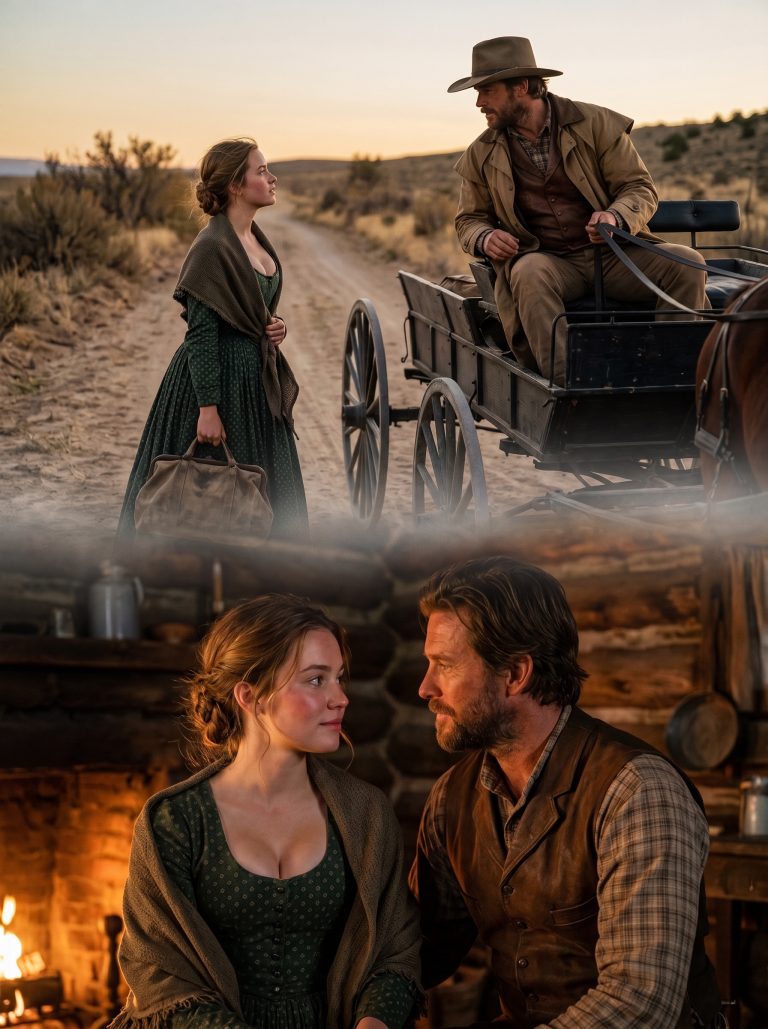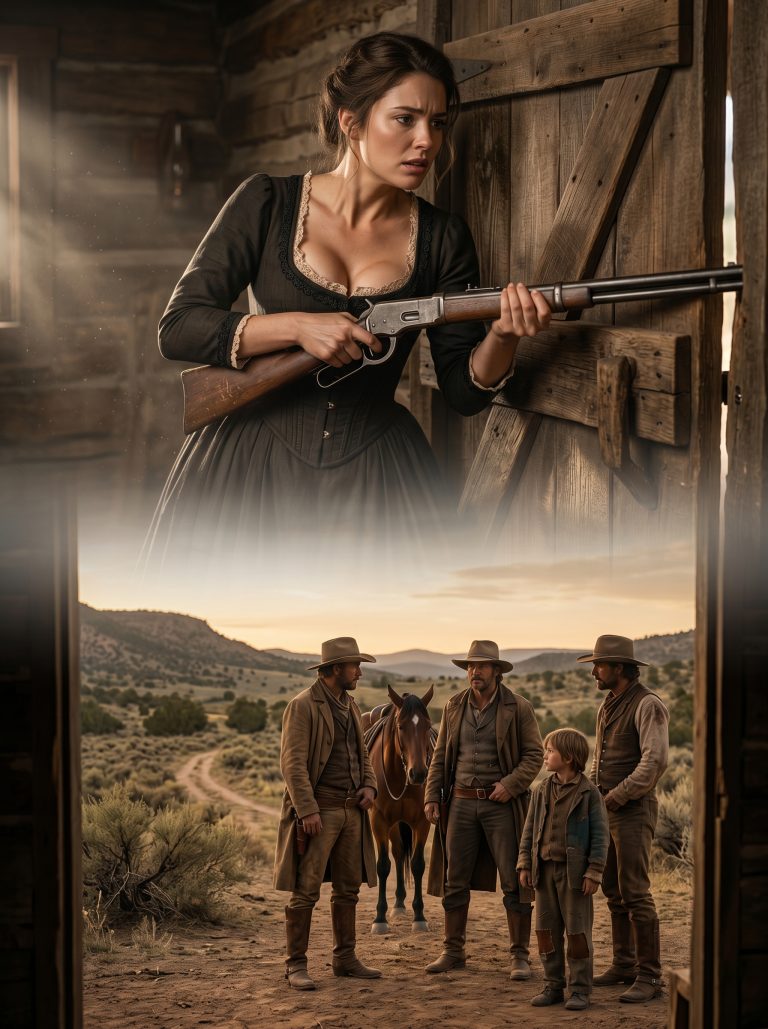
“Come with me now,” the silent cowboy whispered as he found a struggling widow alone with seven crying children in the dust of the frontier.

Part 1
Sarah Bennett’s hands had gone past pain into numbness an hour before the horse appeared.
She was pulling a handcart through drifting Montana snow, five children strung out behind her like beads on a fraying string, everything they owned lashed to a frame with one wheel already splitting under the load. Three days ago she’d had a roof. Now she had a road that did not end and a sky that would not stop falling.
Her youngest, four-year-old Charlie, had stopped crying an hour ago too. That was the part that frightened her. A crying child was a child still fighting the cold. A silent one had started to give in.
“Mama.” Ellen, eleven, had the baby-sized boy wrapped inside her own coat, arms locked so tight her knuckles had gone white. “He’s not answering me.”
Sarah dropped the cart handle and went down on her knees in the snow. Charlie’s eyes were open but unfocused, his breath shallow and slow.
“Charlie. Look at me. Right now.”
“Just resting,” he mumbled.
“Nobody rests out here.” She pulled him against her chest, rubbing warmth into his arms with hands that could no longer feel her own effort. Behind her, Robert, nine, stood with his jaw set the exact way his father’s used to set, and the twins, Grace and Hope, clung to each other without a sound.
That was the worst of it — how quiet her children had become. Not since the bank took the wagon. Not since the letter about the cabin. They had simply stopped arguing, stopped asking, because she was the only fixed point left in their world and every one of them was holding onto her with both hands.
A light moved through the storm. Amber, swaying, growing.
“Is it the county men?” Ellen whispered, stepping back.
“Stay close.”
It was not a wagon. It was one horse, and on it a man in a wide hat, his shoulders bent against the wind. He stopped ten yards off and simply looked at them for a long moment before he spoke.
“How long you been walking?”
“Long enough,” Sarah said, chin up, because she had learned in the fourteen months since James died that people decided who she was before she opened her mouth, and she was done letting them.
“You’re not fine,” the man said. Not cruelly. Like a fact.
He swung down before she’d agreed to anything, and held his arms out for Charlie without asking. There was no bargain in the gesture, no expectation. Just a man saying, without words, let me carry the boy.
She handed her son over.
“Caleb Whitfield,” he said, settling Charlie into the saddle. “Ranch is two miles. Walk faster than I’ll ride. We’ll get there together.”
“Sarah Bennett.”
He nodded once, and started walking.
He did not fill the silence the way most men did, uncomfortable with it, needing to talk over whatever sat underneath. Caleb Whitfield walked beside his horse and a stranger’s half-frozen son and said nothing at all, and Sarah understood, somehow, that it wasn’t the silence of a cold man. It was the silence of someone who had been emptied out and hadn’t yet decided what, if anything, to fill himself with again.
The ranch rose out of the storm in pieces — fence line, then a house with a leaning gatepost, then a long bunkhouse with smoke already curling from a second chimney he must have lit before he ever left to check the road. He carried Charlie inside himself, started the stove, and left without a word while Sarah stripped her son’s wet clothes and wrapped him in wool.
He came back with a pot of stew thick enough to have come from something that had lived, not something poured from a tin.
“There’s plenty,” he said.
“What about you?”
“Ate already.”
She knew a kind lie when she heard one, but her children were already moving toward the pot with the single-minded urgency of real hunger, and this was no moment for pride.
“Mr. Whitfield.” She stopped him at the door. “I need you to know — I’m not that kind of woman. I’m a widow with five children and nothing to offer anybody. Tomorrow we’ll be gone.”
“There’s no expectation,” he said. “Stay as long as you need.”
“That’s not how the world works.”
“I’m not the world,” he said, and walked out into the snow.
For three days she watched him from the bunkhouse window, rising before light, working past dark, never once asking why five strangers were eating his food. On the fourth day, Robert went looking for him and came back with his jaw set the way it did when he’d decided something.
“I asked if I could help with the fence,” he said. “He didn’t say much. Just handed me a hammer and showed me everything.”
That was how it began. Not with terms, not with declarations. With a hammer handed to a boy who needed to feel useful, and the plain gravity of two broken households finding, without meaning to, that they fit against each other’s cracks.
Part 2
The town found out within a week, the way small towns always do.
“You’re the one staying out at the Whitfield place,” Mrs. Calloway said at the dry goods counter, loud enough to carry. “Alone, with all those children.”
“That’s right,” Sarah said, and asked about credit.
She didn’t get it. The store, it turned out, didn’t extend credit to women without a man’s signature — a polite way of saying something uglier that Sarah had heard in other voices her whole life, ever since she’d been a girl who grew too big too fast for anyone’s comfort.
She walked the two miles back without slowing down.
That evening she brought Caleb a basket of mended shirts she’d found forgotten in a corner. He didn’t look up from the harness leather he was working.
“Helena give you trouble?”
“Nothing new.”
“My wife’s name was Anna,” he said, unprompted, still not looking up. “My daughter was Lily. She’d have turned six in the spring. They died in a fire two years back. House caught while I was in town.”
He set the leather down.
“I’ve been alone here since. Having your boy on the fence line is the first time in two years I’ve worked beside somebody. If that’s worth something to you staying, you can accept it as that.”
“It is,” Sarah said.
That night she allowed herself thirty seconds — no more — to imagine that things might become something other than what they were. Then she folded the feeling away like the length of brown wool he’d left wordlessly at her door, and got up to face the next day.
She did not yet know that a letter was already moving toward her from Cheyenne. She did not know her brother-in-law, Edmund Bennett, had been asking after her in three counties since the week the bank took her cabin. She did not know that the parcel of land James’s grandmother had left her — land she’d forgotten she owned — sat, according to a surveyor’s report Edmund had paid handsomely to keep quiet, over one of the richest copper seams in the territory.
She only knew that her youngest had color in his cheeks again, that Ellen had laughed that morning for the first time since the funeral, and that outside the window she could hear Robert and Caleb working the fence line, steady as a heartbeat, in the gray Montana cold.
Part 3
The letter came addressed to Caleb, with her name inside it. Edmund was filing for guardianship — grounds of “physical incapacity, instability following bereavement, and inadequate moral environment.” Sarah read the words aloud once, plainly, because she’d learned that saying ugly things out loud made them smaller.
“He means my weight,” she said.
Caleb didn’t answer that directly. “I know the name Bennett. A man came through Helena a month before I found you on the road, asking after a widow with five children. Didn’t think much of it then.”
Sarah sat with the letter until two in the morning, and the truth arrived the way truth does when the mind finally stops fighting it. The land. If Edmund controlled the children, he controlled the claim through them. He didn’t want a family. He wanted a mine, and he needed her broken enough to hand it over rather than fight.
She woke Caleb by knocking until he answered.
“Do you know a surveyor named Harper, out of Billings?”
Something shifted in Caleb’s face. “I know the rumors. Copper, maybe silver, out on the old Bennett section in Wyoming. Nothing confirmed.”
“Confirmed enough that Edmund’s been planning this since before he ever found me on that road.”
They sat at his kitchen table until the sky turned from black to gray. He told her what he knew of mining claim law. She told him what little she remembered of the deed. Somewhere in the third hour, she said, “Why are you doing all this, Caleb? A real answer. Not the fence line.”
He was quiet long enough that she thought he wouldn’t answer.
“Lily would’ve been six in March,” he said finally. “Your boy leaned his whole weight into me on that horse because he was too cold to hold himself up anymore. That’s as honest an answer as I’ve got.”
Three days later, Edmund rode into the yard himself, well-dressed, smiling the smile Sarah had hated for twelve years. He offered her a document — sign over the mineral rights, and he’d withdraw the guardianship filing. “The court’s going to ask what kind of example a woman your size is setting,” he said. “You could make this simple.”
“Get off this property,” Caleb said, stepping out of the barn.
Edmund’s smile thinned, but he left the way men like him always did — pretending it was choice, not retreat.
The rumor mill turned uglier after that, seeded, Sarah suspected, by Edmund’s own money: that she was living as Caleb’s mistress, that the children ran wild, that Caleb had taken to drink. The last lie was the cruelest, because Caleb Whitfield hadn’t touched a drop since the night his house burned with his wife and daughter inside it.
Mrs. Calloway delivered the gossip to Sarah’s face on Main Street, wrapped in false concern about “stability” and “a mother who can be present.”
“My children are present,” Sarah said. “They are warm, fed, and learning to trust the world again — which is more than some children raised in fine houses by mothers who’ve never missed a meal.” She walked away before her hands started shaking.
It was that night, while Caleb sat up late with a letter from his lawyer, that the second truth surfaced — the one neither of them had been looking for.
The lawyer, a careful man named Prior, had dug deeper into the mineral survey than anyone expected. The copper seam beneath Sarah’s Wyoming parcel didn’t stop at her property line. It ran north, through unclaimed federal ground, and directly under the acreage that had once belonged to Caleb’s late wife, Anna — land Caleb still held, adjoining his ranch, land that had sat idle and unmentioned for two years because he couldn’t bring himself to touch anything that had been hers.
Prior’s letter laid it out plainly: two years earlier, before Anna and Lily died, a man matching Edmund Bennett’s description had approached Anna’s family attempting to buy that exact parcel for a fraction of its worth. Anna had refused. Two weeks later, the fire.
The county fire report from that night, buried and never properly investigated at the time, noted an accelerant smell no one had followed up on — because a grieving widower burying his wife and daughter was in no state to demand answers, and because the sheriff at the time answered to men with money.
Caleb read the letter twice. His hands, which Sarah had never once seen shake, shook.
“He didn’t just come after you,” he said quietly. “He’s been coming after this valley for four years. Anna refused him, and he burned her out of the way. He waited on the rest of the seam until your husband’s grandmother’s land came free, and then he came for you.”
Sarah felt something go very still and very cold inside her — not shock, but the settling of a shape she’d been circling without seeing whole.
“He killed your family for a copper vein,” she said, “and now he wants to take mine the same way. Not with fire this time. With paper.”
“Paper first,” Caleb said. “If paper doesn’t work, he’ll try what worked before.”
They took everything to Prior the next morning — the survey dates, the buried fire report, the pattern of a man who had spent four years turning grief into leverage. Prior went pale reading it and said only, “This isn’t a custody case anymore, Mrs. Bennett. This is a case for the county prosecutor, if we can prove it in time.”
Time ran out at two in the morning, three weeks later.
Sarah woke to the horses screaming and the barn already burning — not starting, already — with shapes moving along the fence line in the orange light. She took Caleb’s rifle from above the mantel with hands that no longer shook, because she had learned exactly what this fire was and exactly who had lit it.
A man in a scarf stood at the porch steps. “Mr. Bennett sends his regards. Sign the document on the gatepost, and the fire stays in the barn.”
“Get off this property,” Sarah said, and fired once into the fencepost six inches from his ear.
He stopped laughing.
Caleb came through the gate at a dead gallop, and what happened after was fast and short — hired men scattering into the dark the moment they understood the woman on the porch would not miss twice, and the man Caleb caught by the collar giving up Edmund’s name before Caleb even finished asking. Neighbors came within the hour, lanterns bobbing down every road into the valley, because a fire in the night sky meant something in a place where people had learned to look out for one another. They beat the flames back before the barn was lost entirely, and by dawn Sarah stood in the ash with blistered hands and her children safe behind her, and understood, finally, what Caleb had meant weeks before: I’m not saying you can’t do this alone. I’m saying you don’t have to.
The arson charge changed everything the guardianship filing could not. A hired man talked, then another, and the buried fire report from two years earlier resurfaced under a prosecutor who could no longer be paid to look away, not with a second fire in the same valley and a rifle-toting widow willing to testify in front of God and Judge Bowmont both.
Edmund Bennett’s guardianship suit collapsed in Bowmont’s Missoula courtroom in under an hour, buried beneath the mining survey timeline, a discredited “doctor” whose license had lapsed a decade earlier, and — read into the record last, in Prior’s flattest and most devastating voice — the arson report tying him to a fire that had killed a woman and a four-year-old girl two years before he ever heard Sarah Bennett’s name.
He did not go quietly. He never did. But three appeals and a criminal indictment later, even Edmund Bennett ran out of rooms to talk his way into, and the last Sarah heard of him was a federal judge’s letter describing his conduct as among the worst examples of bad-faith manipulation the court had encountered in twenty years.
She read that letter at her kitchen table, folded it into a tin box with the others, and went back to making breakfast, because Charlie wanted more biscuits and the morning was clear and there was nothing left of Edmund Bennett worth another minute of her attention.
Two weeks after the trial, Caleb asked her to marry him badly — at six in the morning, over coffee, with half his planned words apparently lost somewhere between the stove and the table.
“I think we ought to marry,” he said.
“That’s your proposal?”
“I had better words. Lost most of them.”
Then, more plainly: “You think I saved you off that road. You’re the reason I stayed alive on this ranch instead of just standing in it.”
“Yes,” Sarah said, before he could lose the rest of his nerve. “I’ll marry you.”
They wed that March in the Helena church, five children in the front pew, half the valley crowded into the back because word had traveled about the widow who’d stood a burning porch down with a rifle and lived to open a community kitchen with her own two hands the following spring. Mrs. Calloway attended. She did not say a word about anyone’s size, that day or ever again.
The adoption papers came through that April. Charlie practiced his new name out loud three times before he ran to find Caleb in the yard.
“Can I call you Dad now?”
Caleb crouched to meet him at eye level, the way he always did with the children — never looming, always coming down to where they stood.
“You’ve been calling me that in your head two months already,” he said. “Reckon it’s time.”
The rebuilt barn went up bigger than the old one, because Robert drew the plans himself and refused to build anything that wouldn’t hold under hard weather. Anna’s old parcel, the one Caleb could finally bear to speak of once the truth behind the fire was known, was folded quietly into a trust for every child in the valley whose family couldn’t afford a doctor or a winter’s coal — because, as Caleb put it, some ground was never meant to be dug up for money in the first place, only tended.
Years later, on an ordinary evening with snow falling soft and unhurried over the ranch, Sarah stood at the same gate where a stranger on a horse had once stopped and asked how long she’d been walking. Caleb came to stand beside her, unbothered by the cold the way he’d always been.
“You’ll freeze out here,” he said.
“I was thinking about that road.”
“You were half dead when I found you.”
“No,” she said. “I was still walking.”
He was quiet a moment, the way he still went quiet before the truest things he had to say.
“You told me once you weren’t people,” she said. “Just a man who happened by.”
“I did say that.”
“You were wrong. You were exactly people. The kind I’d stopped believing existed.”
“You made me one again,” Caleb said, and took her hand, and they went inside together, out of the snow, into a house full of boots by the stove and biscuits on the table and children who no longer flinched when the wind rose — because they had learned, the hard way and then the good way both, that surviving alone and surviving well were never the same thing, and that the second kind only ever came from someone willing to stop, on a dark road, and ask how long you’d been walking.