Eight Pregnant Mares Crossed a Deadly Blizzard for Help—What This Widow Did Stunned the Entire Mountain

Part 1
I had four cords of firewood, a bad hip, and a heart that had already buried more than its share. That was the winter the storm came down off Colorado’s Sawtooth Ridge like a verdict instead of weather.
Folks called the hollow beneath the ridge Marsh Hollow, after an old mailbox left by a homesteader named Marsh decades back. Elena only laughed the first time she heard it — she’d ended up, by pure accident, living in the one place on the mountain that already carried her name.
The wind didn’t announce itself. It simply arrived, shoving snow sideways until fence posts vanished and porch lights turned into pale smudges hanging in nothing. My thermometer read fourteen below, and with the wind behind it, the cold cut closer to forty.
That was the night seven starving mares walked past three ranches with heated barns and full haylofts, men sleeping warm inside every one, and kept walking half a mile down the mountain to the smallest, poorest place on the whole ridge.
Elena Marsh’s cabin.
People have asked me for years why those animals chose her door instead of any other. I don’t have a clean answer — only a night I can’t stop turning over, and a woman who taught me the arithmetic I’d built my life around was missing a variable.
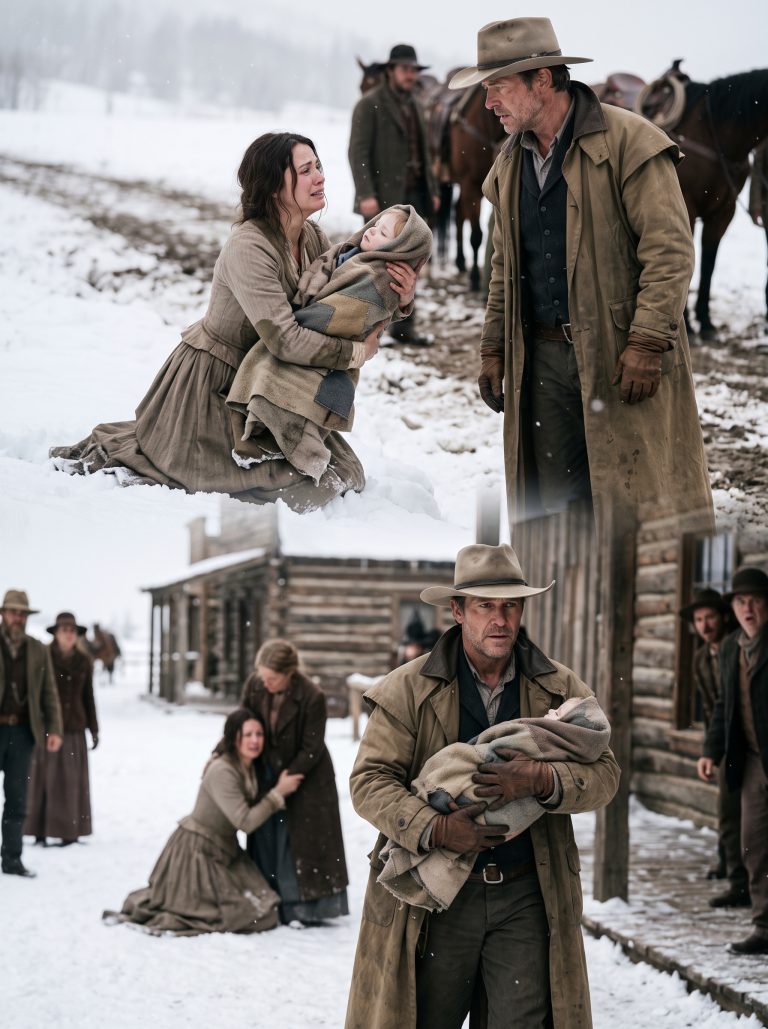
My dog, Scout, woke me first, spine up like a fence rail, barking the way he only did for something wrong. I pulled boots on over bare feet, and the cold took the breath out of me before I’d even found the horses. Then I saw them — seven dark shapes moving single file along the county road, heads low, leaning into the wind like they were walking uphill.
I keep a notebook, weather on one side, everything else on the other. That night I wrote: Seven mares, heavy with foal, moving off Hutchins land toward the Marsh place. Underneath, a line I’m not proud of: I almost went back to bed.
Roy Hutchins ran better than five hundred acres on the north side. If his fence had failed and his stock wandered, that was his trouble, not mine. I was sixty-four with enough hard winters behind me to know other people’s disasters could swallow you faster than a spring creek rises.
Then I saw where the mares were headed, and I stopped being able to talk myself out of anything.
Elena’s cabin sat under a rock shoulder that broke the worst of the wind, one square window burning gold in all that white — the nearest shelter, and the only light, for half a mile in any direction. Any animal with sense left would have made for that spot. The lead mare — a rawboned bay with a blue eye and one white sock — stopped at the rail fence and lowered her head over the top board like she was knocking.
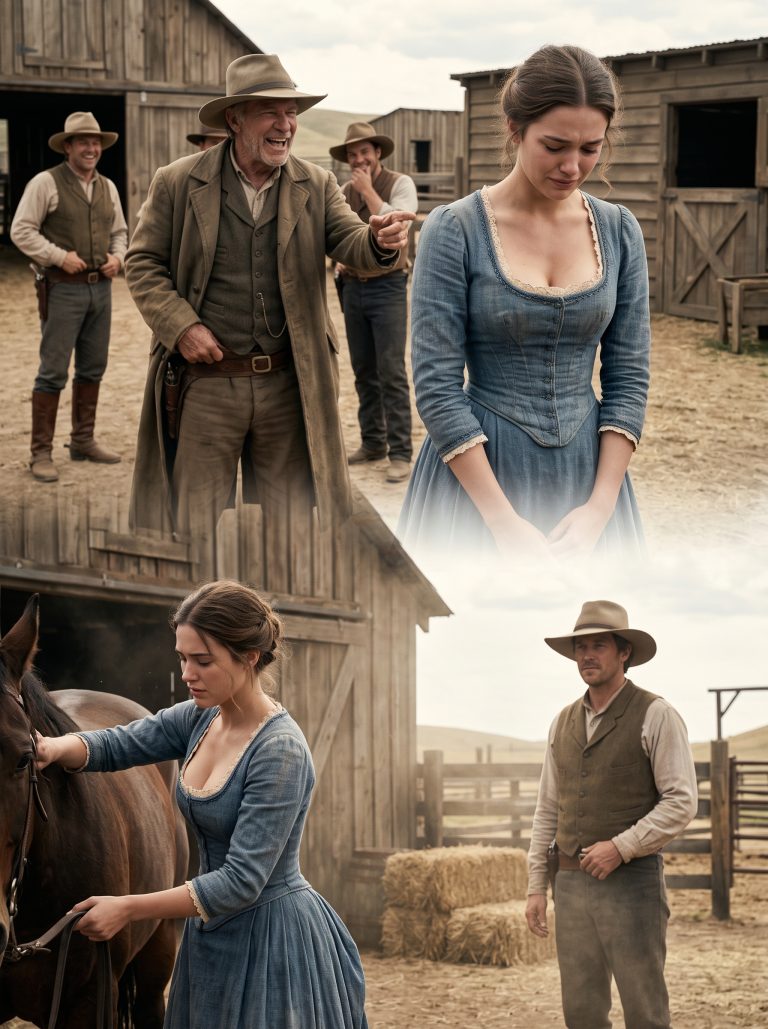
Elena came out in a coat two sizes too big and a headlamp strapped over a wool cap. She didn’t shout or wave her arms. She moved among the mares touching each one on the shoulder, counting under her breath. People count, I’ve noticed, when a thing gets too large to feel all at once.When she reached the blue-eyed bay, the mare pushed her head into Elena’s chest and went still, the way a spooked animal goes still around somebody it trusts. Something about the mare pulled at Elena hard enough that she almost reached for a name. Then the wind howled, the mare shivered, and the feeling slipped away, and Elena went back to counting.
I got in the truck telling myself it was neighborly concern. That wasn’t the whole truth. Thirty years earlier I’d watched something terrible happen from safety and called it none of my business. I’d regretted it every day since, quietly, the way you regret a debt nobody’s ever going to collect.
By the time I reached her yard the headlights turned the snow to hammered silver. Elena didn’t look up.
“They’re all in foal, Walt,” she said, and her voice cracked on the word all. “Half frozen, and every one of them carrying.”
I put my hand on the lead mare’s neck. She didn’t flinch — an animal too weak to be afraid has stopped expecting anything good from the world.
“These are Hutchins’s,” I said.
“I called him.”
“And?”
Her jaw went tight. “He said they weren’t his problem anymore. Said if I wanted loose stock I could keep them or let the storm handle it.”
I learned the rest later, in pieces. Hutchins had picked the mares up cheap off a failed breeding outfit two states over, planning to fatten and sell them come spring. Then hay prices climbed and winter came early, so he cut a gap in his back fence and let the mountain do what he wouldn’t pay to. Some men can make a call like that and sleep just fine.
Elena looked at her lean-to, then at the seven of them standing in the yard shaking with cold. “I’ve got two bales of hay left and forty dollars in a coffee can. The shelter might hold three if they stand close.”
She looked at me.
“I can’t afford them. I probably can’t save them.” A breath, ragged, visible in the headlamp beam. “But I’m not letting them die in a ditch because it’s convenient.”
There she was — a widow with almost nothing, in the same spot Hutchins had stood, coming out the other side with a different answer.
I felt something in my chest that had been asleep a long time. Shame first. Then, strange as it sounds, hope.
“I’ve got hay,” I said. “And a barn, and a bad hip that won’t let me haul it alone. So we do this together, or not at all.”
Elena studied me a long moment in the snow. Then she nodded once, and neither of us had any idea yet what we’d just agreed to.
Part 2
The storm made moving them impossible, so we built what shelter we could out of pallets, fence rail, and the doors off Elena’s garden shed. She dragged her own mattress out and lashed it to the fence to block the worst gap.
“You’ll have nowhere to sleep,” I said.
“I’ll worry about that if morning comes.”
I ran the truck across the pasture once the road disappeared, hauling hay until my hands stopped answering me. Elena rubbed ice from their coats with towels that froze stiff between uses, talking to them low and steady the whole time, and somewhere in those hours she started naming them. The blue-eyed bay became Ember. A black mare became Grace. The smallest, a dun with a dark stripe down her spine, became Copper.
“Why name them?” I asked.
“I can walk away from a number,” she said. “I can’t walk away from a name.”
Near four in the morning, Copper went down, folding into the snow mid-stride, breathing wet and ragged.
“We can get her under cover,” I said.
“She might not survive moving. If we spend two hours on her we could lose two others.” It was cold, clinical triage, and it was true.
Then something in her face closed like a door. “I buried my husband on a day so cold they had to bring the machine back twice,” she said. “I did every reasonable thing that week, all the way to the bottom. I’m not doing one tonight.”
She lay down and wrapped both arms around Copper’s neck. I wasn’t leaving her to the open air over it, though — I dragged the lean-to’s back wall around them both to cut the wind, packed straw in tight, and piled on every blanket and spare coat in the truck bed. It wasn’t warm. It was the difference between dying and not.
“I’ll check every fifteen minutes,” I told her. “You answer me every time, or I’m hauling you out myself.”
She answered every time, all night, my own hands going numb and stupid with the cold, until I’d lost count of the trips between her and the other six.
Dawn came the color of dishwater. Six mares stood exhausted but breathing in the yard. For ten seconds I let myself believe the worst of it was over.
Then I looked toward the lean-to, where Copper and Elena hadn’t moved in hours, and the fear I’d been holding off all night came back at once.
Elena lay motionless, frost thick in her hair, lips gone the color that scares you. For one terrible second I thought the cold had taken them both.
Then Copper lifted her head.
Elena stirred, opened her eyes, and made a sound I still can’t describe when she saw the mare looking back at her.
I stood in the doorway with tears freezing on my face, understanding I was no longer helping with a temporary problem. Whatever came next, I was part of it now.
Part 3
News travels fast on a small mountain, even where hardly anyone lives.
The Hobbs boy came first, nineteen years old on a snowmobile, counting the mares twice like the number might change. He came back that afternoon with three bales of hay, an old vet kit, and sixty dollars from his mother, and wouldn’t be thanked for any of it. “Family had a bad winter once,” he muttered. “Somebody helped.”
After that it happened without anybody organizing a thing. A jar appeared by the register at the feed store. The sawmill owner spent a Saturday building a real shelter out of scrap lumber. A widow who never left her property brought a crock of stew every third day and drove off before anyone could catch her. Teenagers hauled water. A retired vet made two calls and never sent a bill.
I had spent most of my life believing people cut the fence when the cost got high enough. I had evidence — I’d cut one myself once, thirty years back, and built a whole philosophy on top of the shame of it, because a philosophy is easier to live inside than a memory. That winter didn’t erase what I’d done. It did something more useful. It cracked the certainty enough to let light through.
The mares filled out. Ember’s ribs disappeared under new flesh. Copper turned out bossy and thieving, stealing gloves out of coat pockets the second anyone stood close.
Somewhere in the long nights of watching over them, Elena told me about her husband, Daniel. Forty-one years old, a heart he’d been quietly nursing through two bad scares that year and calling fine every time she asked, until it finally stopped for good washing dishes on an ordinary Tuesday. She’d sold their house because every wall held his fingerprints and driven north to buy the cheapest, emptiest place she could find.
“I came up here to disappear,” she said. “I don’t think I planned to survive the winter. Then seven dying animals needed me not to.”
I told her a little of my own old regret that night — not everything, I wasn’t ready for everything — but enough that she understood why I’d driven down the mountain instead of back to bed.
Then, in March, the county investigator came to take statements about Hutchins, and Elena said something that stopped being simple the moment the paperwork was in front of her.
“I need to see the bill of sale,” she said. “The original one, from when he bought them.”
The investigator obliged. Elena read it twice, and her hands started shaking before her voice did.
The breeding operation Hutchins had bought the mares from, two states over, had a name on the letterhead she recognized instantly, because she’d signed papers with that same name herself, three years earlier, in a lawyer’s office two weeks after Daniel’s funeral. It was the outfit her husband had built from nothing over fifteen years. She’d been forced to liquidate it when the hospital bills from his two bad years, the mortgage, and the funeral costs stacked up faster than grief let her think straight about any of it. She hadn’t been able to watch the herd get sold off piece by piece, so she’d signed the papers, taken the check, and driven away without looking back, telling herself it was the sensible thing.
Elena had never run the day-to-day of that place. Daniel had done the training and the naming; she’d kept the books, paid the vet bills, signed for the feed. By the time she liquidated the herd, most of the young stock were foals she’d barely handled, sold in one lot to a broker she never met — the same kind of man who’d sell them again, cheap, to whoever came along next. Livestock changes hands fast out here. One broker sells to another, another sells at auction, and before long nobody remembers where a horse started.
Ember was the one exception. She’d been the filly Daniel let their niece halter-break the summer before he died, the single horse on the place Elena had actually fed from her own hand. That blue eye had unsettled her the first night of the storm, a familiarity she’d talked herself out of, telling herself starvation could make any horse look like any other horse if you wanted it to badly enough. It took the bill of sale to make her stop arguing with her own memory.
They hadn’t wandered to the poorest cabin on the ridge by accident, or by pure luck, either — not entirely. Ember had led the others toward the nearest shelter, the same instinct any cold, starving animal follows. But when she reached the fence and lowered her head over the rail, something in her had recognized the one hand that had ever been gentle with her, and that was enough to bring the whole exhausted line in behind her.
Elena sat with the papers a long time before she spoke.
“I told myself I let them go because it was sensible,” she said. “I never once let myself wonder what happened to them after.”
“You didn’t know Hutchins would do what he did.”
“No. But I knew what selling cheap and looking away usually costs somebody down the line. I did it anyway, because it was easier than staying.” She looked out at Ember grazing in the yard, heavy and healthy now, weeks from foaling. “I’ve spent this whole winter proving I’m not Hutchins. Turns out I needed proving to myself most of all.”
I didn’t have anything wise to offer her. I just sat with her while she cried, the way she’d sat with me plenty of nights that winter, and eventually she wiped her face and went back out to check the water troughs, because that was still the thing to do next.
The foals started arriving in April. Six came easy. Ember’s did not — a leg turned back wrong, the vet two hours out on a road we didn’t have. I put my arm in up to the shoulder on his instructions, felt the wrong angle, and for one long second thought the practical words: we’re going to lose them, I’m sorry.
Then I looked up and found Elena watching me with the exact expression she’d worn holding Copper in the snow, and I understood I no longer wanted to say those words even if they turned out true.
We got the leg forward. We pulled when the vet said pull. The filly came free in a rush and lay still in the straw, and Elena went to work on her instantly, rubbing hard, blowing into her nostrils, telling her she hadn’t come this far to stop now.
The filly coughed. Then coughed again. Then drew one long, furious breath, and Ember called to her, and something in me that had been closed for thirty years came open at the same time that foal’s lungs did.
Elena named her Hope. I’d have called that too sentimental on any other day. That day, no other name would have fit.
Seven mares went into that storm. Fourteen horses walked out of the spring.
Hutchins lost his livestock-dealer license and faced animal-cruelty charges once the cut fence and the abandoned stock became public. I expected Elena to be glad of it. Instead she said she hoped it didn’t ruin him completely.
“He left them to die,” I said.
“I know. He should answer for it.” She watched Hope try her legs in the April mud. “I just don’t want to spend what’s left of my life running the same kind of math he did — deciding a person’s worth nothing more once they’ve cost me something.”
“What kind of math is that?”
“The kind that leaves things out. It’s not always wrong, Walt. It’s just incomplete. It doesn’t account for what happens if somebody stays anyway. Sometimes staying is the only variable that changes the answer.”
As part of the county’s case, Hutchins signed over whatever claim he had left on the mares rather than fight it in front of a judge, and the herd was placed in Elena’s care, official and on paper this time. She kept most of the herd. Sold two of the young geldings to homes she picked herself, to cover what the winter had cost her, and let the rest live out their lives on that mountain. Years on, I’d watch Hope grow into a strong mare with her mother’s blue eye and, somehow, Copper’s exact talent for stealing gloves — Elena swore the old troublemaker had taught her the trick on purpose — and I’d watch Elena ride her along the ridge on summer mornings, small under all that sky, one hand raised toward my porch.
I always raised mine back.
I’m an old man telling this now the way I told it in my notebook that January — plainly, because plain is what actually happened. For most of my life I believed that when the cold came and the cost got too high, people cut the fence. I had reason to believe it. I had done it myself once, and spent thirty years calling the shame that followed wisdom, because wisdom is easier to carry than regret.
Then seven dying mares walked past every warm barn on that mountain and found the one door with almost nothing behind it, and the woman on the other side did the sum differently. And it turned out one of them hadn’t been choosing a stranger’s mercy at all — she’d been leading the others back toward the one hand that had ever been gentle with her, without either of them knowing it until the storm was long past.
The cold is real. There will always be men who run the numbers and decide mercy costs too much.
But there will also always be a woman lying in the straw beside the one that’s dying. A boy with three bales of hay he can’t really spare. A widow leaving stew on a porch and driving off before she can be thanked. A neighbor who gets out of bed.
And sometimes — not always, because I won’t lie to you about that — but sometimes, when somebody refuses to leave a second time, the thing that should have died opens its eyes at dawn, and so does the person who stayed.
THE END