The “Ugly Daughter” Was His Laughingstock—Until the Rancher Fell for Her Without Warning

Part 1
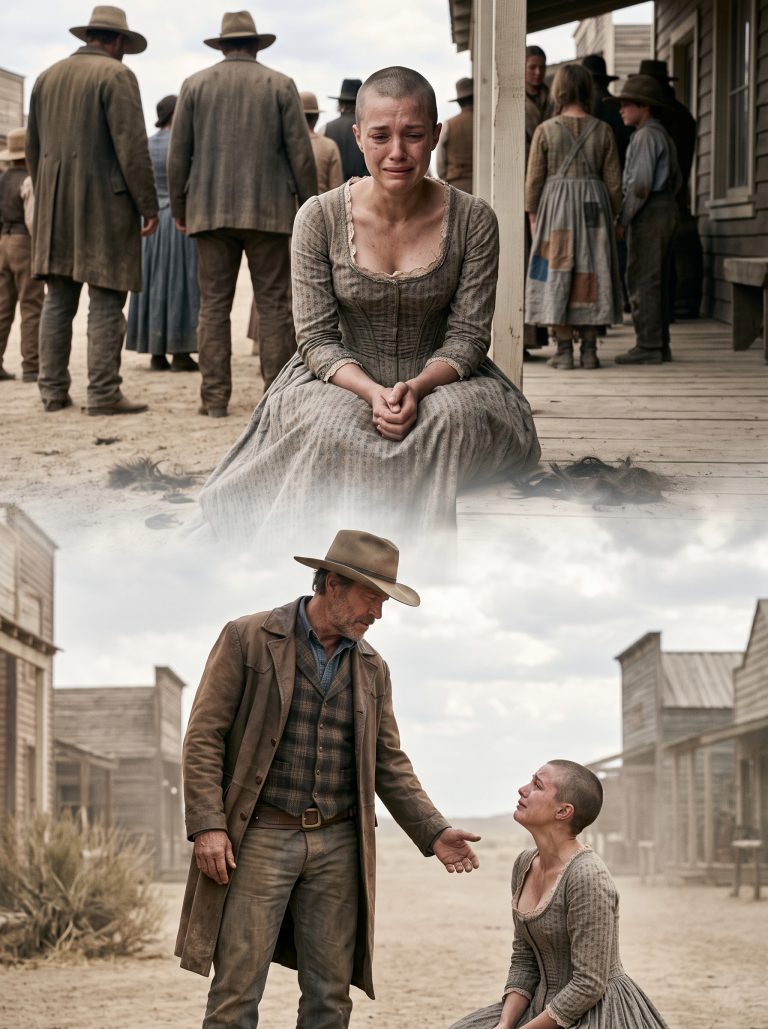
Maren Calloway had been called plain so many times she had stopped waiting for anyone to call her anything else.
Plain Maren. Dull as dirt. The one nobody wanted.
Her brothers said it laughing. Her father said it by never saying her name at all. On the morning everything changed, she stood at the well with a bucket in her raw hands while the sky over the Calloway farm turned the color of weak tea.
“Maren!” Her father’s voice cracked through the kitchen window. “Water. Now. Slow as molasses, that girl.”
“Coming, Pa.”
She lowered her eyes to the bucket. Her reflection wavered there — brown hair scraped back too tight, a sharp jaw, eyes that had learned long ago not to expect kindness and so never looked surprised when it didn’t come.
Inside, her brothers Dale and Gideon lounged at the table, boots propped on the bench, grinning over black coffee.
“Heard talk in town,” Dale said. “Silas Thorne’s putting out for a bride again.”
Gideon snorted. “Scarred Thorne? Man could scare a crow off a fence post.”
“That’s the one. Paying good money to bring a woman out west, no questions asked.”
Their eyes slid to Maren as she set the bucket by the stove.
“Send her,” Gideon said, delighted with himself. “Thorne’ll ship her back by Tuesday.”
Their mother, kneading dough with hard hands, didn’t even glance up. “Might do her good. Teach her some humility.”
Maren said nothing. Silence was the only armor that house had ever allowed her.
That night, through the thin wall by her bed, she heard the truth.
“Broker’s offering twenty dollars to the family, on top of her travel fare, if we send a bride out proper,” Dale muttered, low and pleased with himself, out on the porch where he thought the dark hid his meanness. “We tell her Thorne asked for her by name. She’ll believe it. Climb on that wagon grinning like a fool, and we pocket the twenty regardless of what he does with her after.”
“And if he sends her back?” Gideon asked.
“Money’s already ours by then — broker don’t ask for it back. We’ll have had peace in this house for a few days besides. Man like that, though — I doubt he’ll bother sending her back. Doubt he’ll bother looking at her twice.”
Their laughter rolled into the dark.
Maren lay still, one hand pressed flat over her heart, and did not cry. Crying had never once changed the shape of that house.
At dawn her mother pressed a sealed letter and a sack of hard bread into her hands. “Thorne’s spread is three days west. Don’t shame us. Try, for once, to be worth something.”
Dale smirked from the porch rail. Gideon called after the wagon, “Don’t scare him too bad, now!”
Maren did not look back. The farm behind her had never been a home — only a place she’d survived. The road ahead was dust and uncertainty, and still it felt lighter than everything she was leaving.
Three days later the wagon crested a ridge at sundown, and the Thorne ranch opened below her like something out of a dream she hadn’t let herself have. Fences ran straight as rulebook lines. Horses grazed in grass gone silver with evening light. A red barn stood broad against the sky, and smoke curled gold from the chimney of a house that looked cared for, not merely kept.
A man waited at the gate.
Tall. Broad through the shoulders. A dark hat shadowing a face marked on one side by old, deep scars that ran from temple to jaw — old burns, she’d learn later, though not that night. His eyes, when he lifted his hat, were pale gray and startlingly steady.
Not mocking. Not searching her for the joke he’d surely been promised.
Just steady, the way a man looks at someone he has been waiting a long while to see.
“You’re Miss Calloway?”
“Yes, sir.” Her voice came out smaller than she meant it to.
“You travel light.”
“I don’t have much to bring.”
Something moved behind his eyes — not pity. She knew pity; pity looked away while pretending to care. This was different. He seemed to be listening for the words underneath her words.
He held the gate open. “Supper’s on. My sister Rosalind will show you your room.”
“My room,” Maren repeated, as if the phrase belonged to a language she didn’t quite speak.
His brow creased. “Yes.”
“You’re — keeping me?”
He looked almost wounded by the question. “I sent for a wife, Miss Calloway. Not a guest to be returned.”
Heat rushed up her throat. He was not laughing. He was not looking past her shoulder for the punchline.
Inside, the house smelled of stew and clean pine and lavender soap — smells that had nothing to do with punishment. Rosalind Thorne, a soft-eyed widow with silver already threading her dark hair, greeted Maren as though she had been expected, not merely endured.
“You look tired clean through,” Rosalind said, drawing out a chair. “Sit. There’s plenty.”
Plenty. Maren had to look at her hands to keep her composure.
That night, in a small clean room with a real quilt and a door that locked from the inside, Maren lay staring at a ceiling that belonged, for now, to her. No shouting through the walls. No laughter aimed at her spine like thrown stones.
Kindness, she was discovering, could be its own kind of frightening.
Because kindness made a person hope. And hope, in Maren Calloway’s experience, was the most dangerous thing a person could hold.
Part 2
Maren woke before dawn, because work was the only language she fully trusted, and found the porch steps needing a scrub.
She did not hear Silas until his shadow fell across the wet wood.
“Planning to clean the whole county before breakfast?”
She startled, nearly losing the brush. His hair was damp, sleeves rolled to the forearm, the scarred side of his face plain in the morning light — and so were his eyes, which held something almost warm.
“Seemed like it needed doing,” she said.
“Rosalind will say I’m working you too hard.”
“I don’t mind work.”
“I noticed.” He said it like a compliment, not a complaint, and walked on before she could decide how to answer that.
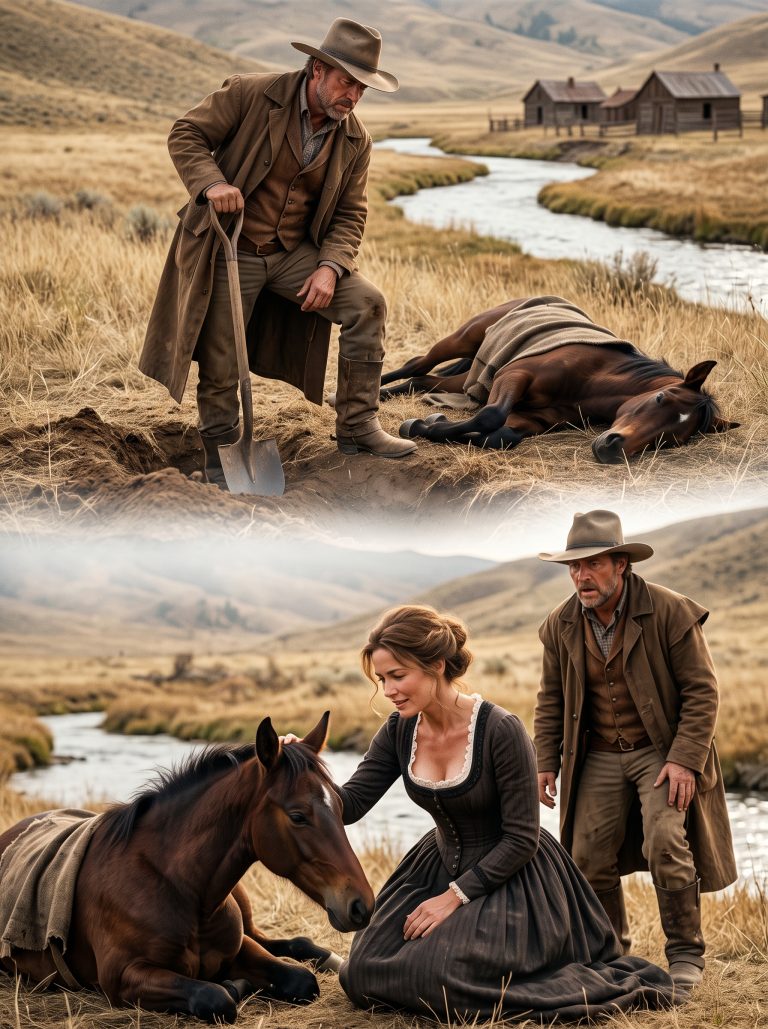
The days that followed stacked themselves into something like a life. She weeded Rosalind’s garden, mended tack, learned the names of the horses. In the barn, she found herself drawn to a gray mare called Willow, watchful and fine-boned.
“She likes you,” Silas said from the stall door.
“Animals don’t judge what they see.”
“People can surprise you.”
“Not in my life,” she said, before she could stop herself.
He didn’t argue. He only said, quietly, “Maybe your life’s about to.”
That evening clouds piled low and mean over the western ridge. “Storm’s coming,” Silas warned. “Willow spooks bad at thunder — mind her stall’s dry.”
When the storm broke, it broke hard. Rain hammered the roof; wind drove dust sideways across the yard. Willow reared in her stall, struck the boards, eyes rolled white.
Maren ran into the rain without thinking.
“Easy, girl. I’m here.” She kept her voice low under the thunder until the mare stopped fighting the rope and leaned, trembling, into the sound of her.
Silas found her there, lantern light shaking gold across the scarred side of his face. “You could’ve been hurt.”
“She was scared. I couldn’t leave her.”
He studied her a long moment, then draped a dry blanket over her shoulders — carefully, without crowding her. “Facing a storm doesn’t mean you have to face it alone.”
No one had ever told Maren that before. At the Calloway farm, if she could carry a burden, they gave it to her; if she couldn’t, they laughed at her for dropping it.
“Go on inside,” he said. “Rosalind will have tea. I’ll finish here.”
“I can help.”
“You already did.”
The words settled somewhere warmer than the blanket.
That night, wrapped in dry wool with tea cooling in her hands, Maren said quietly, “I don’t know what he sees in me.”
Rosalind smiled into her own cup. “Something good, I expect.”
Part 3
By the second week, Maren had begun to notice small things she had no right to notice about a man she’d known only fourteen days.
The way Silas paused before he spoke, as if weighing whether his words deserved the air. The way he never once commented on her face, not even to be kind about it, as though the whole subject bored him. The way his eyes followed her across the yard sometimes, not with hunger but with something quieter — recognition, almost, though she couldn’t account for why a stranger would look at her that way.
She was standing at the corral fence one morning, watching him work a nervous young colt with a patience that seemed to cost him nothing, when Rosalind came up beside her with two mugs of coffee.
“He’s been talking more this week than in the five years since Eleanor passed,” Rosalind said.
Maren’s chest tightened at the name — the first time she’d heard it. “His wife?”
“Fever took her sudden, five winters back. He built half this ranch around her memory and the other half around forgetting he had a heart left to break.” Rosalind sipped her coffee. “Until you came up that road looking like you expected to be sent back before supper.”
“I did expect that.”
“I know.” Rosalind’s eyes were kind and a little sad. “He told me, the day he sat down and wrote your name for the broker to send for, that he finally felt like the ground had stopped tilting under him.”
Maren frowned. “The broker chose me. My brothers said Mr. Thorne asked for me by name, but that was only something they invented to get me on the wagon. A cruelty dressed up as a compliment.”
Rosalind went very still. “Is that what they told you? That it was a lie?”
“They were laughing about it through the wall. I heard them plain.”
Rosalind set down her mug. “Child, you’d best ask Silas that yourself.”
That afternoon, Maren found him mending fence wire at the western boundary, and asked him outright, her voice steadier than she felt. “Did you ask for me? By name? Or did the broker only send whoever answered the notice?”
Silas set down his pliers slowly, as if he’d been waiting five winters for this exact question and still hadn’t rehearsed the answer.
“Four years back,” he said, “before Eleanor was even a year in the ground, I rode into Prescott for supplies and stopped at a church social I had no business attending. Folks stared at my face the way folks do. Mothers steered their daughters clear of me like I was catching. One girl didn’t.” He looked at her. “She was maybe twenty, plain dress, hands rough from farm work, and she sat down next to me at the punch table like there was nothing in the world unusual about it. Told me the lemon cake was better than the pound cake and I’d be a fool to miss it. Didn’t flinch at my face once. Didn’t pity me either. Just — saw me.”
Maren’s breath had gone thin. “I don’t remember —”
“You wouldn’t. It was one afternoon, and you never learned my name. But I learned yours, because your brother hollered it across the churchyard when he wanted you fetching something.” His jaw tightened. “Maren Calloway. I never forgot it. When the broker’s letter came asking who I wanted written for, I gave him your name straight out, not knowing a thing about your circumstances, only that I’d never forgotten a girl who wasn’t afraid to sit next to a scarred stranger at a punch table.”
Maren pressed a hand to her mouth. “Then it wasn’t a lie.”
“No.” His voice roughened. “Your brothers built a cruelty out of something that happened to be true. That’s the worst kind of lie — the kind wearing an honest coat.”
She stood there in the wind with the fence wire humming between the posts and felt something crack open in her chest that had been sealed shut since childhood — the understanding that she had been chosen, not discarded; remembered, not merely disposed of.
“Why didn’t you tell me sooner?”
“Because I didn’t want you staying out of gratitude for a memory. I wanted you staying because the ranch, and the man on it, were worth staying for on their own account.” He almost smiled. “Seems you’ve been deciding that for yourself anyway.”
She hadn’t fully realized, until that moment, that she had.
In the weeks that followed, the knowledge settled into something quieter than a revelation — it became simply true, the way weather becomes true, the way a season does. She stopped waiting to be sent back.
Silas began bringing her into the running of the place in ways she hadn’t expected. He laid the ledger open on the kitchen table one evening and asked, plainly, whether she thought they should sell three head of cattle before winter or hold them through to spring prices. When she gave her answer — hold them, feed was cheap enough this year and the spring market always paid better — he didn’t just nod politely. He crossed out his own plan and wrote hers in instead.
“You could’ve decided that without me,” she said, startled.
“I could have,” he agreed. “I’d rather decide it with you.”
She began riding out with him along the fence lines, learning where the water ran low in August and which draws flooded first when the rains came hard. Rosalind teased that the ranch hands had started bringing their questions to Maren before they brought them to Silas, and Maren, coloring, admitted she liked being asked.
There were quieter moments too — an evening on the porch when a late-summer storm rolled through without violence, just soft rain and low thunder, and they sat together under the eave saying very little, her shoulder against his arm, neither of them in any hurry to go inside. Another evening, mending a torn bridle by lamplight, his hand closed briefly over hers to show her a stitch, and neither of them pulled away as quickly as the lesson required.
She noticed, too, that she had begun to miss him in the ordinary hours he was out on the range — a small, unfamiliar ache that had nothing to do with gratitude and everything to do with wanting. It frightened her a little, how easily it had happened, how far it had traveled past mere relief at being spared her father’s house.
One night, walking back from the barn under a sky gone thick with stars, she said it plainly, because plain was the only language she trusted and she had decided he deserved the truth of it. “I’m not staying because you remembered me, Silas. I know that’s how it started. But I’m choosing this — you, this place, this life — because of who you’ve turned out to be, day after day, whether I was watching or not.”
He stopped walking. In the starlight his scarred face looked neither hard nor sorrowful, only open.
“That,” he said, “is the only kind of choosing I ever wanted from you.”
The trouble came three days later, the way trouble in that family always came — loud, and on horseback.
Sheriff Amos Reyes rode up first, hat in hand, apologetic before he’d even dismounted. “Josiah Calloway’s talking ugly in town, Silas. Saying you bought his daughter like livestock. Saying he means to ride out and collect what’s his.”
“She’s not property to collect,” Silas said.
“No,” Reyes agreed. “Didn’t figure she was. Thought you ought to have warning, all the same.”
The warning gave them only a few hours to prepare. By sundown, three riders came up the road with the light turning red behind them — Dale, Gideon, and between them, Josiah Calloway himself, a hard man whose disapproval had governed that farm like weather.
“Get your things,” Josiah barked at Maren before his boots had even found the ground. “You’ve shamed this family enough.”
Maren felt the old fear rise — and felt something else rise faster to meet it.
“I’m not going back.”
Dale laughed. “Listen to her.”
“You sold me,” Maren said, and her voice did not shake. “For twenty dollars and a lie you thought you’d invented. Only it wasn’t a lie, Dale. He remembered me. He asked for me by name four years before you ever thought to use those words against me.” She let that land. “You tried to make my worth into your joke, and it was true the whole time. That’s yours to sit with, not mine.”
Something flickered across Josiah’s face that was not quite shame, but close enough to unsettle him.
Silas stepped up beside her, not in front of her. “She’s chosen her home. You’ll turn around, or the sheriff will have cause to ride back with you under different circumstances.”
Josiah’s eyes cut between his daughter and the scarred rancher who would not yield an inch of ground. Whatever calculation he ran behind that hard face, it came up short. He wheeled his horse.
“This isn’t finished,” he said.
“It is for me,” Maren answered.
Gideon lingered half a moment, looking at his sister with something that might, years later, become regret. Then he followed his father into the dusk.
When the dust settled, Maren’s knees very nearly gave out. Silas caught her before they did, and she pressed her face against his chest, shaking.
“I didn’t want to drag you into my family’s shame.”
“You’re not shame, Maren.” His arms tightened. “You’re the truest thing that’s happened to this ranch in five years.”
She lifted her face. “Then what am I to you?”
“Someone I should have gone looking for four years ago, instead of waiting for a letter to bring you back to me.”
They married at the end of that autumn beneath a stand of cottonwoods gone bright as coin. Sheriff Reyes stood witness. Rosalind cried and denied it fiercely. Willow put her head over the corral fence halfway through the vows and snorted, as if passing judgment on the whole proceeding.
When the preacher spoke of obedience, Silas cleared his throat and said, plainly, “No. She promises partnership. Nothing less.”
Maren, who had spent twenty-three years learning to expect nothing and receive less, found she did not need to fight her tears that day.
“I promise partnership,” she said. “Truth, and work, and faithfulness freely given — because I choose it, not because I owe it.”
“I promise,” Silas answered, “to never let your kindness become a debt. To see you clearly, even on the days you forget there’s so much in you worth seeing. And to build a home with you, not for you.”
Winter tested them, as winters do. Cattle broke fence. Willow went briefly lame. Rosalind caught a cough that frightened the whole house for three nights running. Maren burned bread twice in one week and cried harder over the second loaf than the situation warranted — some old, wired-in part of her still braced for punishment over waste.
Silas found her in the pantry scrubbing at her eyes with her apron. He picked up the ruined loaf, broke off a blackened corner, and ate it without flinching.
“Terrible,” he said solemnly.
A laugh broke out of her, unwilling and enormous.
“Bread burns,” he said. “Fences fall. None of it changes your place here. I married the woman, not the loaf.”
She kept forgetting that lesson and he kept teaching it, in small ways, all that winter and the ones after — asking her opinion on feed orders as though it mattered, because it did; moving her grandmother’s brooch to the good shelf when its clasp broke rather than to a drawer; standing beside her in town without a word when old whispers followed them, until the whispers, starved of anything to feed on, thinned and finally stopped.
A letter came from Gideon the following spring, badly spelled and coffee-stained.
Pa’s meaner than ever. Dale says worse things about you than he used to but I think that’s because he’s ashamed. I should’ve said something that day at the gate. I didn’t. I’m sorry for some of it. Maybe all of it. I don’t rightly know how to say that proper, so there it is, unproper.
Maren read it twice, folded it, and put it in a drawer.
“You all right?” Silas asked.
“Not healed,” she said. “But all right. There’s a difference, I’ve learned.”
“That’s an honest answer.”
Years gathered the way years do on a working ranch — steadily, unglamorously, and then all at once when you looked up. The Thorne spread grew stronger under two sets of capable hands. Rosalind stayed on, insisting the household required her supervision, a claim nobody bothered to dispute. Willow foaled a bright-eyed colt Maren wanted to name Mercy; Silas said naming a horse after a virtue was asking for trouble, and Maren said trouble could use the mercy more than most.
Two children came, loud and fiercely loved — a daughter with Silas’s steady gray eyes and Maren’s freckles, a son whose laugh made Rosalind press a hand to her chest and declare the house had been waiting years for that exact sound.
One evening, years on, Maren stood at the same gate where she had first seen Silas Thorne waiting in the last light of a long, uncertain road. She thought of the wagon, the dust, the certainty that she had been sent west as a punchline to somebody else’s joke.
Silas found her there, as he often did.
“Thinking?” he asked.
“About how strange it is,” she said, “to be thrown away by people who never once looked closely enough to know your worth — and land somewhere you were already remembered.”
He took her hand, weathered now to match his own. “They didn’t throw you away because you weren’t worth keeping, Maren. They threw you away because keeping you would have required them to be better than they were willing to be. That was their failure. It was never yours.”
She leaned into him, watching their children chase the colt along the fence line, smoke curling from a chimney that had become, in every way that mattered, hers.
She had spent a lifetime being told plainness was a verdict. It had taken a scarred rancher, a widowed sister-in-law, and one honest letter to teach her otherwise: that beauty was never the smoothness of a face, but the courage that kept a person tender after cruelty had done its worst to make them hard — and the quiet, hard-won grace of finally seeing herself the way one good man had seen her from the beginning.
THE END