“Everyone Laughed at the Giant Cowboy—Until He Did the Impossible in Front of the Widow”

Part 1
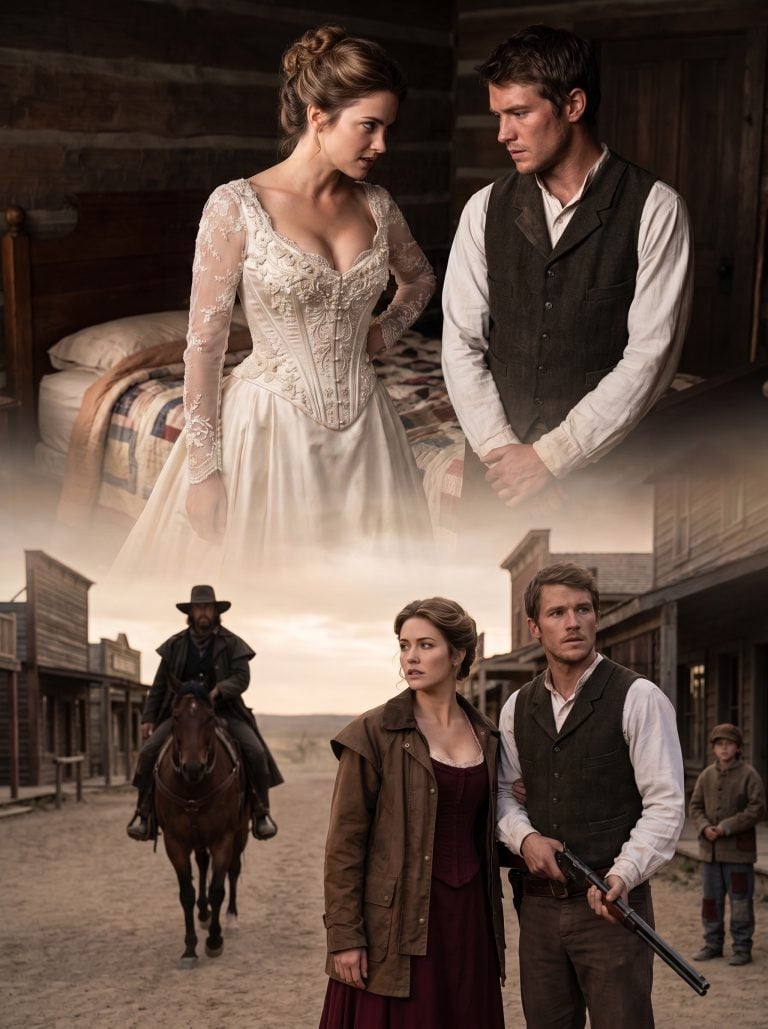
The blizzard hit Wyoming Territory two hours before the man collapsed against Nora Hail’s gate.
She heard the dog first — barking at something too heavy to be wind-blown brush. When she opened the door with a lantern in one hand and a shotgun in the other, she found a stranger face-down in the snow, one arm folded beneath him, blood freezing black against his coat.
“Sam, stay inside,” she told her son.
The boy, seven years old and already too used to his mother giving orders in a crisis, pressed his face to the window instead of obeying.
Nora dragged the stranger onto the porch by his collar. He was enormous — bigger than any man she’d hosted at this table, with a jaw like a shovel blade and hands that looked like they could crush a fence post bare. When she rolled him over, his eyes opened halfway.
“Ma’am,” he rasped. “Didn’t mean to die on your step.”
“You’re not dying. Not on my porch. I just scrubbed it.”
She got him inside, cut away his shirt, and packed the wound in his side with clean cloth. It wasn’t a knife wound. It was a bullet, and it had gone through cleanly, missing anything that would have killed him outright. Whoever shot him had either been a poor aim or hadn’t wanted him dead — just slowed.
By morning the fever had broken. He gave his name as Cole Bishop.
“You running from the law, Mr. Bishop?”
“Yes, ma’am.”
“You going to hurt me or my son?”
“No, ma’am.”
“Then you can stay till you can walk. After that, I don’t care where you go, so long as it’s away from here.”
He nodded like that was more mercy than he’d expected.
He stayed eleven days. In that time he mended the hinge on the barn door, reset two fence posts the wind had torn loose, and never once asked Nora a question she didn’t offer to answer first. Sam trailed him everywhere, the way boys do with men who don’t talk down to them.
On the twelfth day, three riders came up the north road with a torch, and everything Nora had told herself about being safe collapsed at once.
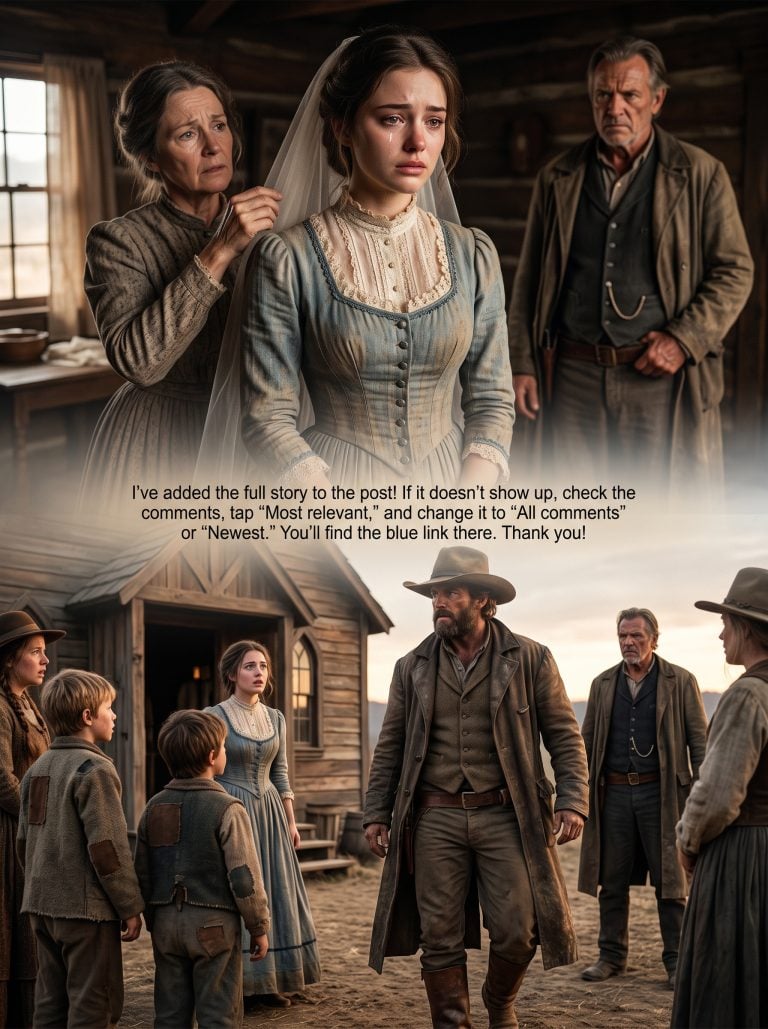
“Compliments of Garrett Sloan,” the lead rider said, tossing a paper into the yard. “Your husband’s debt. Twelve hundred dollars, due in full by the new year, or the bank takes the land.”
“My husband’s been dead eight months,” Nora said. “And he never signed a note like that in his life.”
“Signature says otherwise.”
Cole stepped out of the barn before she’d finished speaking. He didn’t raise his voice. He didn’t have to — his size did the talking. The riders left, but not before the torch caught the edge of the porch rail, and Cole beat it out with his bare coat before it could spread.
That was when the sheriff arrived, drawn by the smoke.
“Cole Bishop,” the sheriff said, hand near his cuffs. “Warrant’s been out on you since October. Murder.”
Nora raised the shotgun again — not at the sheriff, just enough to be seen.
“Why?” she asked Cole directly.
And so, in her yard, with the snow still smoking where the torch had fallen, Cole Bishop told her the truth.
“The man I killed was named Emmett Voss. He ran a silver claim outside Creede, Colorado. My sister Lila married him three years back. He beat her quiet — never where the town could see. By the time I understood what was happening, he’d broken her wrist and locked her in a root cellar for two days because she’d asked him for grocery money.”
“Did he fire at you?”
“He drew first. I was faster.” Cole opened his coat, showed a second scar beneath the fresh wound. “He got a piece of me before I got a piece of him.”
“Your sister testify to any of that?”
“She died four days later. Bled inside from something he’d done to her weeks before, something none of us knew about till it was too late.”
The sheriff looked at the debt paper still lying in the snow. He picked it up, studied the signature at the bottom.
“This isn’t your husband’s hand at all, Mrs. Hail,” he said slowly. “But I know this signature. I’ve seen it before — on a claim deed out of Creede.”
Nora felt the cold reach somewhere deeper than her boots.
“Whose?”
The sheriff turned the paper so she could see.
“Emmett Voss witnessed this note. Which means Sloan and Voss knew each other. Which means —”
Hoofbeats rose beyond the tree line. Not three riders this time. Fifteen, with Garrett Sloan riding at the front of them, smiling like a man who already owned the ground beneath her feet.
Part 2
Sloan didn’t dismount. “Arrest the murderer, Sheriff, and clear the widow off my land.”
“It isn’t your land,” Nora said. “And that note may be forged.”
Sloan’s smile thinned. “It’s legal.”
“It’s witnessed by a dead man from Colorado,” the sheriff said, “who financed silver claims with dirty money and beat his wife into an early grave.”
Fear moved across Sloan’s face for the first time. Then he drew.
The yard broke into chaos. Cole shoved Nora and Sam behind the water trough as a bullet splintered the porch post. The sheriff fired from beside his horse. Sloan’s riders scattered, and Cole walked into the open, drawing every gun toward himself because his size made him impossible to ignore and impossible to miss.
A bullet caught his shoulder and spun him half around. He didn’t go down.
Sloan slipped off his horse and ran for the barn, where Nora had dragged Sam behind the hay. She met him at the door with the shotgun raised.
“You don’t have the nerve,” Sloan said.
She thought of every man who had ever mistaken her fear for permission.
She fired. The blast tore his coat and threw him back into the snow, more shocked than hurt. Cole reached him a second later and ended it with one blow.
The fighting stopped soon after. Without Sloan’s money behind them, his riders dropped their rifles and surrendered to the sheriff, who found in Sloan’s saddlebags six forged deeds, a ledger of debts owed by widows across three counties, and letters tying Sloan to a judge who had rubber-stamped warrants for men who got in his way — Cole’s among them.
Within a month, the warrant against Cole Bishop was suspended. By spring it was dismissed outright.
Sloan was sent to territorial prison. Every stolen deed was returned to the women who’d owned them.
Cole should have ridden out free and clear.
Instead, Nora found him at dawn, saddling his horse anyway, and understood that the hardest part of the story hadn’t been told yet.
Part 3
“You’re leaving,” she said. It wasn’t a question.
“I have to tell you something first, and after I do, you may want me gone anyway.”
Sam was still asleep. The morning was quiet enough that she could hear the leather creak as Cole tightened the girth strap and didn’t look at her.
“I didn’t end up on your gate by accident, Nora.”
She went very still.
“When I buried my sister, I found her letters — years of them, hidden in a trunk Voss never thought to search. Most of them were about him. But some were about the men he did business with. Silent partners who financed his claim and never asked questions about how he treated his wife, so long as the silver kept coming.”
“Cole —”
“One of the names was Elias Hail.”
The wind moved through the yard. Somewhere behind her, a horse shifted in its stall.
“My husband,” she said slowly, “never left this county in his life.”
“He didn’t have to leave it. Voss came to him. There’s a letter from your husband, dated two years back, refusing to keep sending money after he heard what Voss was doing to my sister. He wrote that he wanted no more part of it. That’s the only decent thing I found written about him in that trunk — and it’s the reason I came looking for this ranch. I wanted to find the man who knew and did nothing for as long as he did, before he finally said no. I wanted to ask him why it took him so long.”
Nora’s hands had gone cold around the fence rail. “He never told me any of this.”
“I know. He was already three months in the ground by the time I got here. I found that out from the sheriff at Miller’s Creek before the storm ever caught me on your road. I could have turned around then. I told myself I would.” He finally looked at her. “Instead I kept riding, because I didn’t know what to do with all that anger once the man who deserved it was gone. And then I saw your gate, and I was bleeding, and I told myself I’d just rest one night.”
“You lied to me. By leaving it out.”
“I did.”
“For eleven days.”
“Yes.”
Nora turned away from him, walked to the porch rail, gripped it the way she used to grip it during the worst of Elias’s temper, back when holding onto something solid was the only thing that kept her upright.
“He wasn’t a good man,” she said finally. “I knew that before you ever showed up half-dead in my yard. I buried him and I didn’t cry, and I have spent eight months telling myself that made me a hard woman instead of an honest one. You’re telling me he was worse than I knew. That doesn’t surprise me as much as you think it should.”
“It should matter.”
“It matters that you told me the truth eventually, instead of never telling me at all.” She faced him again. “You came here to hate a dead man and ask him a question he’ll never answer. What did you find instead?”
Cole was quiet a long moment.
“A porch step that needed fixing,” he said. “A boy who follows me around like I’m worth following. A woman who held a shotgun on me the first night we met and hasn’t lowered her guard since, and I have never in my life respected anyone more for it.”
“That’s not an answer.”
“I came here carrying my sister’s death like a debt I meant to collect from your husband. He was already gone. I couldn’t collect it from him.” He set his hand against the horse’s flank instead of reaching for her. “I didn’t know what to do with a debt like that once the man who owed it wasn’t there to pay. So I started paying it forward instead — the fence, the barn, the door. I told myself it was decency. Some of it was. Some of it was me trying to bury my own anger under your work instead of carrying it any further.”
“And now?”
“Now I know staying isn’t about the debt anymore. It stopped being about Elias Hail somewhere around the third day, when your boy asked me to teach him to whittle and I said yes before I’d thought about it.”
Nora studied him — the size of him, the scar under his shirt, the new one still healing, the quiet way he’d told her a truth that could have cost him everything, when silence would have been so much easier to keep.
“You should have told me the first night,” she said.
“I know.”
“You don’t get to decide what I can forgive on your own timeline. That’s not yours to decide for me.”
“I know that too.”
“But you told me before you left instead of after. That’s not nothing.”
She stepped down off the porch into the snow between them.
“I don’t need you to have come here for a good reason, Cole Bishop. I needed you to tell me the true one, eventually, out loud, even knowing I might send you off for it. You did that. Late. But you did it.”
“Are you sending me off?”
“I’m asking you what you plan to do about that porch step, since you’ve mended everything else on this land and left that one thing standing.”
Something in his face loosened, the way it had the first time she’d made him laugh during his fever.
“I believe it may take years to fix properly.”
“I’ve heard you’re a patient man.”
He didn’t move to touch her — he never did, not without asking first, and she’d come to understand that was its own kind of promise, quieter than any vow.
“Nora, I came here angry at a debt I could never collect. I’m asking to stay for a reason that has nothing to do with what your husband owed my sister. I’m asking because I want to be here in the morning, and the morning after that, for reasons that are only about you and Sam and this land — not about him at all.”
“Then stay,” she said. “Not to pay anything off. Just because you want to.”
He stayed.
By summer, Sam had stopped calling him Mr. Bishop and started calling him Pa without seeming to notice he’d done it. Cole froze the first time he heard it, standing in the half-mended barn with a hammer in his hand, and turned away so the boy wouldn’t see his eyes.
Nora saw anyway. She said nothing, the same way she’d said nothing the morning he told her the truth about why he’d really come — because some kindnesses are best left unremarked, so they don’t feel like they’re owed anything in return.
That autumn they married under the cottonwood beside the cabin. Cole made no promise to own her, lead her, or shield her from a world that had already shown her its teeth. He promised only that whatever came next, she would not face it as a debt she carried alone.
Years later, when people in that county told the story of the giant stranger who rode in during a blizzard and stayed to marry the widow Hail, they told it as a rescue.
Nora always corrected them.
He hadn’t come to save her. He’d come to collect a debt from a man who was already gone, and somewhere along the way he’d chosen to set that debt down instead of carrying it any further — and to build something new on the ground where he’d meant only to settle an old score.
That, she always said, was the harder thing. And the truer one.