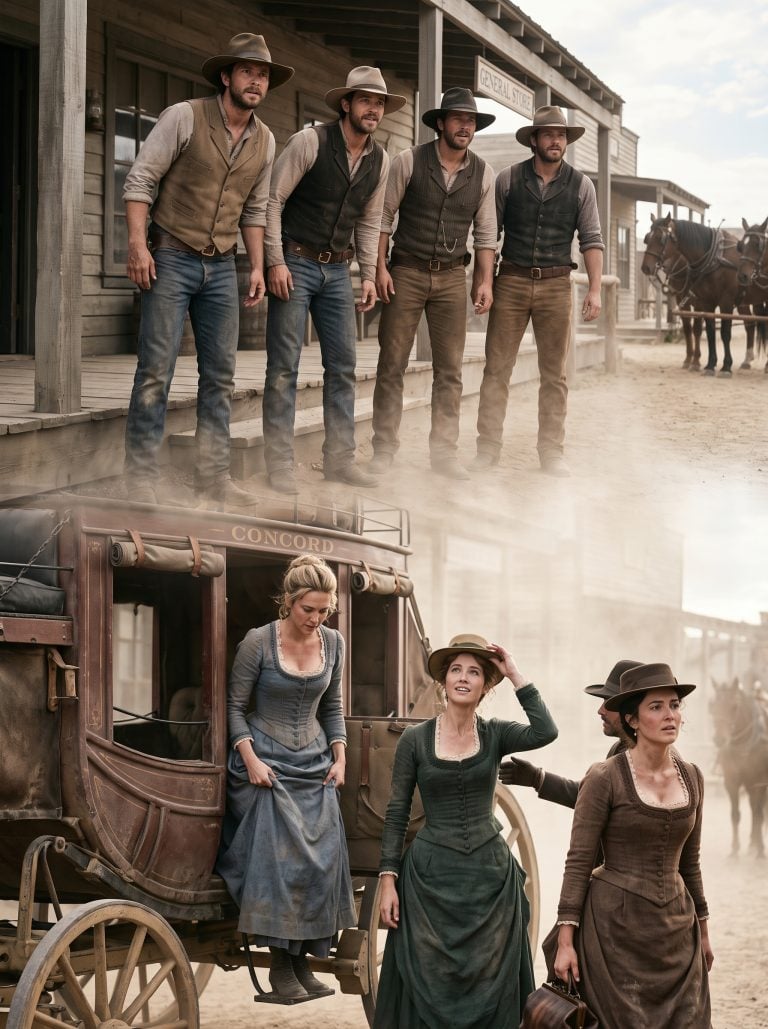
They Sent Her to Replace Her Dead Sister as a Wife—Until a Rugged Mountain Man Stopped the Wedding Cold

Part 1
Josephine Hale rode toward her own wedding in a dress meant for a coffin.
Black wool. Black gloves. A veil pinned so close it seemed the wind couldn’t find her skin. The mourning dress had been sewn for her sister’s funeral, one Josephine was never permitted to attend. Now it wrapped her like a warning nobody in Denver dared say aloud.
She was not traveling to Ironwood Gulch to become a bride.
She was traveling as payment on a debt.
The coach bucked and slammed up the frozen grade, throwing Josephine against the cracked leather bench again and again. Frost crawled across the windows. The wind screamed along the roof. Beyond the glass, the world had dissolved into stone and blinding white.
No aunt sat across from her with smelling salts and soft reassurances. Only a trunk lashed crookedly to the floor and the small drawstring bag she clutched so hard her knuckles had gone bloodless beneath her gloves.
Inside that bag was a letter.
Not the telegram that had summoned her — that one, brutal in its brevity, rode folded in her father’s coat pocket back home. *Lillian taken by winter fever. Buried on the ridge. Send Josephine. The debt remains. Marriage settles the ledger.* Signed, Marcus Vane. Silver baron. Bank shareholder. Widower.
Her dead sister’s husband.
Soon, if the mountain didn’t kill her first, her own.
The letter in her bag was different. She’d found it stitched into the lining of a dress Lillian had mailed home for mending two months before she died — found it only after the telegram arrived, only after their father wept into his hands and said, in a voice scraped hollow, *There’s no other way.*
Lillian’s handwriting had been cramped, urgent, unlike her.
*He bars the doors from outside, Josie. The mine eats the men’s lungs, but Marcus eats their souls. Don’t let Father borrow another cent from him. I’m afraid of the dark here, and Marcus is the dark. If something happens to me, find the black book. He keeps one ledger for lies and one for the truth.*
Josephine had read it until the creases went soft as cloth.
Then she’d packed the mourning dress because her father told her to.
Thomas Hale had once run a respectable dry-goods store in Denver — coffee, lamp oil, good calico, honest prices. He had also borrowed carelessly and trusted men in finer coats than consciences. Marcus Vane had offered help first. Then leverage. Then ruin dressed as generosity.
Three years earlier, Lillian had married him to save the family. Josephine had stood beside her sister in that church and watched Marcus slide a ring onto Lillian’s hand the way a man might stake a claim.
Lillian had smiled, for their father’s sake.
Now Lillian was in the ground.
And Josephine was being delivered to take her place.
The coach lurched hard to the left. Something cracked beneath the wheel like a rifle shot. The horses screamed. For one endless heartbeat the whole carriage hung suspended over the ravine — and then it didn’t.
Wood splintered. Glass burst inward. Her trunk tore loose and slammed the far wall. Snow, sky, black wool, and blood churned together until sound collapsed into a single roar, and the roar went dark.
When Josephine opened her eyes, the silence had teeth.
The coach lay wrecked on its side among blue spruce below the grade, snow sifting through the broken roof onto her hair, her torn skirt, the blood at her temple. Her left arm throbbed with every breath. One boot was gone. Her veil hung shredded across her mouth.
For a moment she didn’t know where she was.
Then it came back to her, whole and terrible.
Ironwood Gulch. Marcus. Lillian.
She dragged herself upright, gasping. “Mr. Doyle?”
No answer from the driver.
She crawled through the wreckage, cutting one palm on broken glass, and found him thirty yards downhill, half buried in snow, his neck bent at an angle no living man’s ever was. The team had bolted, harness snapped, hoofprints already vanishing under fresh white.
Standing over the dead driver, Josephine understood the arithmetic of her situation with terrible clarity.
She was alone. Eighteen miles from Ironwood Gulch and farther still from Denver. Hurt. Dressed for grief, not survival. Late-November cold sinking toward dusk.
A short, brittle laugh escaped her, and the wind stole it instantly.
Maybe this was mercy. Maybe the mountain would take her before Marcus ever could.
Then she thought of her sister’s letter, and shame straightened her spine.
“No,” she said aloud.
She salvaged what she could — a wool blanket, one glove, her drawstring bag still hooked beneath the torn seat, a tin of matches gone damp but not ruined. Her trunk was wedged under a broken timber, immovable. She wrapped the blanket around her shoulders and crawled beneath the overturned frame, her fingers losing feeling, the cut above her brow bleeding cold lines down her temple.
She tried to pray. The words wouldn’t come.
She apologized instead. “I’m sorry, Lillian.”
The mountain gave no answer.
Then came the crunch of snow. Not wind. Not a falling branch.
Footsteps — measured, heavy, descending the slope with purpose.
Josephine forced her eyes open.
A man stood at the edge of the wreckage, and he looked less like a traveler than something the mountain itself had carved for its own purposes. Tall. Broad through the shoulders. Wrapped in buckskin and a dark wolf pelt dusted white with snow. A battered hat shadowed pale eyes the color of a winter dawn. A rifle hung easy in one gloved hand.
His gaze swept the wreck, the dead driver, the shattered coach.
Then it found her, and he moved at once — not hurried, not careless, but with the controlled economy of a man who understood that panic only spent strength he might need later.
He knelt, setting the rifle within reach but never between them.
“Alive under there, or just stubborn?”
Part 2
Josephine’s teeth chattered too hard for words. His gloved hand brushed snow from her cheek, practical but gentle enough to sting her eyes with tears.
“You’re fixing to freeze solid, little bird.”
“Help me,” she managed.
“Already am.”
No hesitation. No question of payment, no inquiry into whether she deserved saving. He drew the blanket tighter, slid one arm beneath her shoulders and the other under her knees, and lifted her like she weighed nothing at all. Josephine cried out when her hurt arm shifted.
“Sorry,” he said, and it sounded like he meant it clean through.
He wrapped part of the wolf pelt around her and started uphill. “Cabin’s two miles. Keep your eyes open.”
“I’m trying.”
“Try harder.”
The bluntness should have offended her. Instead it anchored her to something solid in a world gone entirely white.
“Your name?” she asked.
“Silas Cade.”
She knew that name, the way everyone in the high country did — spoken like rumor more than fact. A scout turned trapper who came down from the peaks twice a year to trade furs and vanished again before conversation could take hold of him. Some called him dangerous. Most called him uncivilized, which in her experience usually meant a man had refused to bow to the wrong people.
“I’m Josephine Hale.”
His stride never faltered. “Then stay awake, Josephine Hale.”
The climb blurred into cold and the steady drum of his heartbeat under her ear. Once she thought she’d drifted off, because she saw Lillian walking ahead of them in white. Then his voice hauled her back.
“Talk to me.”
“About what?”
“Anything. Just talk.”
“I’m cold.”
“Know it.”
“My arm hurts.”
“Know that too.”
“I’m meant to be married.”
His steps slowed half a beat before continuing. “Not tonight, you’re not.”
A laugh broke loose from her and turned into a sob halfway out.
The cabin appeared through the trees, a darker shape against darkening snow — heavy logs, low roof, smoke curling from a stone chimney. Silas kicked the door open, carried her inside, and shouldered it shut against the storm.
Heat met her. Real heat. A low fire glowed in the hearth, furs folded near a cot, tools hung along the wall, a shelf of books that startled her more than anything else in the room. It smelled of woodsmoke, coffee, pine resin, and a life built small and careful.
He set her on the cot and reached for her sleeve, then stopped himself entirely.
“I need to look at that arm. I won’t touch you without saying where first, and why.”
The words reached through her fever more powerfully than any oath sworn in a church.
“Thank you,” she whispered, and for the first time since the telegram, something other than fear moved through her chest.
Part 3
He removed her glove first, careful as breath, then cut the ruined sleeve away rather than lift it over her bruises. Her arm was battered but unbroken. He cleaned the cut at her hairline, pressed a folded cloth to it, and made her drink coffee laced with something that burned like medicine and mercy both. When the worst of her shivering passed, he took the chair by the hearth and cleaned his rifle without watching her too closely, and that restraint felt like its own kind of kindness.
“How long was I out there?” she asked.
“Long enough to worry a man.”
“Mr. Doyle?”
“Gone before I reached you.”
She closed her eyes. “I need to reach Ironwood Gulch.”
The rag in his hand went still. “No.”
“You don’t know why.”
“I know the pass is shut and you can’t stand without swaying.”
“I’m expected.”
“By who?”
The name felt like a brand on her tongue. “Marcus Vane.”
The cabin seemed to change around them — or maybe it was only him. He went very still, the stillness of something wild before it springs.
“Vane owns the Ironwood mine,” he said. “The bank. Half the law in that town, and more men than he’s earned.”
“He’s to be my husband.”
“He just buried one.”
“She was my sister.”
The fire cracked. Snow hissed against the shutters. Josephine drew Lillian’s letter from her bag and held it toward him. He read it slowly, his face darkening line by line, and when he finished he folded it with unexpected care.
“She didn’t die of fever,” he said.
“What do you know?”
“I know miners talk when whiskey loosens their fear. I know Vane’s private doctor signs whatever he’s paid to sign. I know your sister tried sending word to Denver and was never seen in town again.” His jaw tightened. “Men like that don’t misplace wives. They use them up.”
Josephine pressed a hand to her mouth. She had known. She had not let herself know.
“I still have to go,” she whispered. “My father’s debt—”
“Your father sent you to a murderer.”
“He was desperate.”
“Doesn’t make it right.”
She flinched at the sharpness, and his anger gentled at once, though it didn’t disappear. “Not aiming that at you,” he said. “At him.”
“He may lose everything if I refuse.”
“Maybe.”
“He may go to prison.”
“Maybe.”
She stared at him, furious that his honesty offered no comforting lie to hide behind. “What would you have me do? Let him suffer? Let Lillian’s death mean nothing?”
Silas stood, too large for the small room, too wild for its walls, but his voice stayed level. “I’d have you live long enough to choose something besides a grave.”
Tears slid down her face. “I haven’t been given choices.”
“No,” he said, softer now. “Reckon you haven’t.”
He barred the door against the storm, then strung a spare blanket across a rope in the corner, making her a private space beside the cot.
“You sleep there. I’ll take the hearth. Bar’s on your side if you want it.”
“I can’t lock you out of your own cabin.”
“You can tonight.”
He turned back to the fire and spoke without facing her. “Josephine Hale, you are not marrying your dead sister’s husband because a ledger says so. Not from my cabin. Not while I’ve got breath in me.”
“But—”
“That’s not right,” he said, and the words settled into the room like iron driven into stone. “And up here, what isn’t right doesn’t get my help standing.”
For the first time since the telegram had come, she felt something besides fear. Small. Dangerous. Warm.
Hope.
The storm held the mountain three full days, burying the lower half of the door, raking the shutters until Josephine dreamed of claws scraping wood. Silas tied a rope from the porch to the woodpile before stepping out, lest the white swallow him ten feet from shelter.
Inside, the cabin became its own small country. Josephine wore a borrowed flannel shirt over her shift, wrapped in furs that smelled of smoke and cedar, watching her mourning dress steam dry by the fire like she was watching someone else’s skin harden in the heat.
Silas cooked beans and salt pork and corn cakes, checked her wound twice daily, always naming his intentions before his hands moved. He brewed willow bark for her pain. He spoke little — but what he said, she came to realize, covered more ground than most men’s speeches.
“Eat,” he told her once.
“I’m not hungry.”
“Eat anyway.”
“Do you speak this way to every wounded woman in your care?”
“Don’t know many.”
“Perhaps that explains it.”
His mouth twitched beneath his beard, the closest thing to a smile she’d seen.
By the second day she’d insisted on helping, over his objections. She sorted dried beans one-handed, mended a tear in his spare shirt, stacked his kindling by size without being asked.
“You’ve got opinions about firewood,” he observed.
“I have opinions about most things. I was simply trained not to voice them where they weren’t wanted.”
“Here they’re wanted, if they keep this place from looking like a den.”
“It isn’t so bad.”
“That was mercy talking, not truth.”
She looked around anyway — the rifle over the door, the traps stacked by the wall, herbs drying from the rafters, and that one shelf of books she’d nearly wept over. “It’s honest,” she said. “That’s not nothing.”
He told her his history in pieces, because he wasn’t a man who surrendered his past whole. Born in Missouri, orphaned young, raised by an uncle who trapped more than farmed. He’d scouted during the war, guiding men through country they didn’t understand toward battles few of them survived. Afterward he’d drifted west, sick of orders and uniforms and the neat rows of graves that followed both.
“Mountains don’t lie,” he told her one evening, sharpening his knife. “They’ll kill you for foolishness, but they won’t smile first.”
“And people do?”
“Often.”
She thought of Marcus kissing Lillian’s hand at the wedding breakfast, smiling the whole while. “Yes,” she said. “They do.”
On the third night she told him everything about her sister — not just the marriage and the fear, but the whole of who Lillian had been. How she loved lemon drops and blue ribbon. How she could make their father laugh through the worst debts. How her letters from Ironwood Gulch had grown thinner and more cheerful at once, cheerfulness worn like a costume Josephine could see straight through but never remove from a distance.
“I should have gone to her,” Josephine said.
“You weren’t the one who barred the doors.”
“I knew something was wrong.”
“You were taught to doubt yourself instead.”
She looked up sharply.
“That’s another kind of locked door,” he said.
The truth of it struck like a blow. She had doubted her sister’s fear because their father called Marcus respectable, because Denver women said marriage simply changed a woman’s tone, because every voice around her had spoken louder than Lillian’s own handwriting.
“I won’t doubt her again,” Josephine said.
Silas nodded once. “Good.”
That night she woke gasping from a dream of locked doors, and he was on his feet with the rifle before she’d fully surfaced, scanning door and window. Then he saw her face and set the weapon down.
“Dream?”
She nodded, ashamed of her tears.
He didn’t cross the room. “Want the lamp?”
The question undid her more than comfort might have — he didn’t assume, didn’t approach, only offered light and waited for her answer.
“Yes.”
He lit it, bright enough to push back the shadows without exposing her fully, then returned to his place by the hearth.
“I’m afraid of the dark now,” she admitted.
“Then we’ll keep a lamp burning.”
The lamp burned every night after that.
When the storm finally broke, the world glittered blue-white under a hard, clean sky. Silas dug out the door and returned with word that the lower trail was passable, if dangerous, for a careful rider.
Josephine stood on the porch wrapped in his spare coat, breathing air so cold it seemed to polish her lungs clean. Ironwood Gulch waited beyond the ridgelines. Marcus waited beyond that. Her father’s debt. Lillian’s grave. The black ledger.
She had begun to feel safe in this cabin, and that frightened her nearly as much as Marcus did. Safety could become its own soft prison if a person stopped asking what came after it.
Silas seemed to understand. “You could stay till spring,” he said, splitting kindling without looking at her. “Nobody would find you easy up here.”
“Stay and hide.”
“Stay and heal.”
“And Marcus?”
His axe paused. “He won’t stop looking. Not while he believes you’re breathing.”
“Then hiding only delays him.”
“Yes.”
“Lillian wrote of a ledger,” Josephine said. “Two sets of books — one clean, one true. Bribes, stolen claims, forged loans. It’s kept at the Ironwood Assay Office. If we had it—”
“We?”
Heat rose in her face. “I didn’t mean to presume.”
“You didn’t.”
“He wears the vault key on a gold chain. Lillian said the office has guards.”
“I know it does.”
“The town fears him.”
“I know that too.”
“And you still mean to go.”
Josephine looked toward the white ridges. “If I don’t, Lillian stays a fever in a telegram. My father stays debtor to a fraud. Other women become collateral while Marcus tithes at the church he owns half of.” Her fingers tightened on the coat. “I was sent to be his next locked door. I’d rather be the key.”
Something fierce and reluctant crossed his face. “You say things like that and expect no argument from me?”
“I expected you to call me foolish.”
“Might be. Not wrong, though.”
A rifle crack split the morning before either of them could say more.
Silas hauled her down behind the woodpile as bark exploded off a nearby trunk. “Inside,” he said, and they ran low while a second shot struck the cabin wall. He kicked dirt over the fire, drew the shutter nearly closed, and listened to boots crunching in the snow outside.
“Cade!” a rough voice called. “Coach wreck’s down the pass. Tracks lead here. Vane wants his bride back.”
Josephine’s blood went to ice.
“How many?” Silas asked her.
She listened past her own heartbeat — boots, horses shifting, a cough to the left. “Four. Maybe five.”
Approval flickered across his face; he hadn’t expected her ear to be so sharp.
“Send her out and you keep your hide!” the voice shouted.
Silas lifted the rifle, expression gone older than anger. “Stay low.”
“I can help.”
“You can stay alive.”
“Not the same thing.”
He looked at her, seemed to understand that ordering her aside would only make him one more man deciding the shape of her courage, and pressed a revolver into her hands instead.
“Only if they come through that door. Both hands. Aim center. Don’t shut your eyes.”
Her hands shook around the grip. “Silas.”
“Not handing you over.”
“I know.”
The fight that followed was short, loud, and merciless. Silas fired through the shutter; a man screamed outside. Bullets chewed the log walls, splintered the table. A shard opened a thin line across Josephine’s cheek where she crouched behind the woodbox, the revolver heavy and foreign in her hands.
Then the door burst inward under an axe blow, and a scarred man filled the frame with his pistol already rising toward Silas’s back.
Josephine didn’t think of courage. She thought of Lillian behind a barred door, and she fired.
The recoil slammed her shoulder into the wall. The man crumpled across the threshold. Silas spun, saw the body, then saw her, and for one long second nothing moved but drifting smoke.
“You hit?” he asked.
She shook her head, though she wasn’t entirely certain.
Outside, two more shots cracked, then silence. By the time she reached the doorway, Silas had a lean, rat-faced man on his knees in the snow, hands raised, blood soaking one sleeve.
“Enoch Pratt,” Silas said. “Vane’s dog.”
“He’ll skin you alive for this,” Pratt spat.
“Tell him the wedding’s off.”
Pratt laughed, bitter and thin. “One mountain hermit and a runaway woman think they can stand against him?”
“I’m not running,” Josephine said from the doorway, and both men turned to look at her. The words surprised even her.
Silas tied Pratt and the surviving gunman to a pine with rope enough to hold but not enough to freeze them before they worked free, then sent them stumbling down the pass unarmed with a message for their employer. When he came back inside, he found Josephine kneeling beside the man she’d shot, trembling.
“I killed him.”
“He came through that door meaning to kill us both.”
“I know.”
“Doesn’t make it simple.”
“No.”
He reached toward her hands, then stopped and waited until she nodded before covering her cold fingers with his own. “You did what needed doing,” he said.
“I’m tired of what men force women into doing.”
Pain crossed his face. “So am I.”
Neither of them slept that night. They packed instead — ammunition, dried meat, coffee, rope, a pry bar, an old set of field glasses. Josephine took Lillian’s letter, a plain wool dress from a trunk that had belonged to Silas’s mother, and a small knife he insisted she wear at her belt.
At dawn they stood on the ridge looking down at the hidden trail into Ironwood Gulch, the peaks cold and merciless around them. Silas handed her the reins of a sturdy dun mare.
“Last chance to stay behind.”
She mounted, wincing at her bruises. “Last chance to tell me I can’t come.”
His rare smile broke through, brief as sunlight on snow. “Wouldn’t dare try.”
Ironwood Gulch was less a town than an argument against God, built from timber and smoke and silver greed — false-front buildings, canvas tents, stamp mills hammering day and night, mud frozen into black ruts even in winter. Smoke hung low over everything. Somewhere a woman laughed too loudly; somewhere else a miner cursed a debt he’d never outlive.
“This is what he built,” Josephine said from the shadow of an alley.
“This is what he took,” Silas answered.
The Ironwood Assay Office stood at the far end of town, brick-walled, iron-shuttered, two guards at the front and one at the loading dock. Lamplight burned in the upper windows near midnight — Marcus Vane didn’t sleep while profit could still be counted.
Josephine had changed into the plain brown dress and an oversized miner’s coat, her hair tucked beneath a wool cap, Lillian’s letter resting against her heart.
“Once I have the ledger, we take it straight to the marshal,” she said.
“If he can be trusted.”
“Lillian wrote of a Pinkerton man investigating stolen claims — Nathaniel Reyes. Expected on this week’s train. If we reach him—”
“We will.”
“You make impossible things sound simple.”
“Most impossible things are just dangerous things nobody’s started yet.”
A small, wild laugh rose in her throat. Then the dock guard wandered off to warm his hands at a barrel fire, and Silas touched her shoulder.
“I draw him off, you go. If Vane’s inside, you run. No arguing that part.”
“I spent my whole life being protected by men who were really only protecting their own comfort,” she whispered. “Don’t start that with me now.”
“I’m afraid of you dying, Josephine. Not inconvenienced.”
The honesty silenced her. He stepped closer without touching her.
“If it comes to the ledger or your life, I choose your life. Every time. Even if you hate me for it after.”
Her throat tightened. “And if the choice is my life without the truth?”
Pain moved across his face. “I’ll still want you breathing.”
She understood then that his need to protect her wasn’t possession — he wouldn’t deliver her back to Marcus, wouldn’t force her into hiding either. He simply couldn’t pretend a book of numbers outweighed the woman standing in front of him.
She laid her hand over his on the reins. “I’ll be careful.”
“That’s not a promise anybody keeps in gunfire.”
“It’s the only one I can make.”
He accepted it, because he respected her too much to demand another.
The diversion came as a crash near the ore wagons. The guard turned, lantern raised; Silas struck from the dark, fast and silent, and the man went down without a sound. Josephine slipped through the side door into air thick with cigar smoke, ink, and hot iron.
Marcus Vane sat at his desk beneath a green-shaded lamp, counting bills, and didn’t look up. “Pratt?”
“No.”
His head lifted. For one unguarded second he looked almost human in his surprise, and then delight spread across his face, smooth as poison. “Josephine. My dear girl. I’d begun to fear the mountains had damaged my investment.”
“I’m not your investment.”
“Everything is an investment.” He rose, brushing invisible dust from his sleeve, a gold chain glinting beneath his waistcoat. “Your father understood that eventually.”
“He was desperate.”
“Desperation is only honesty without its perfume.”
“You killed Lillian.”
He sighed, as if she’d accused him of a lapse in manners. “Lillian was fragile.”
“She was brave.”
“She was sentimental. Dangerous, in a woman with access to correspondence.” His eyes sharpened. “Where’s the letter?”
Her silence answered plainly enough. His hand drifted toward his waistcoat.
“Don’t make this difficult,” he said softly. “There’s a magistrate waiting. We can still salvage order from this unfortunate episode. Your father’s debts forgiven, your name preserved. You’ll live comfortably, if you learn faster than your sister did.”
“And if I don’t?”
His smile vanished. “Then you’ll be buried beside her.”
The side door opened behind her. Marcus’s eyes flicked past her shoulder, triumphant — but it wasn’t his guard.
Silas filled the doorway, rifle raised. “She isn’t learning that lesson.”
Marcus’s lip curled. “Cade. Of course. The mountain savage playing rescuer.”
“Hands where I can see them.”
“You have no notion what you’re interfering with.”
“Murder. A forced marriage. A stolen ledger. Following along just fine.”
“She belongs to obligations beyond your comprehension.”
“She belongs to herself.”
Marcus drew a small derringer from his waistcoat. Silas fired before the barrel finished rising, shattering Marcus’s wrist and sending the pistol spinning across the floorboards. He screamed and crashed against the desk.
Josephine moved forward, not away. She tore the gold chain from his vest as he cursed and grabbed at her with his good hand, until Silas shoved him hard against the desk and held him there. At the safe, her hands shook so badly the key scraped the lock twice before it caught. The iron door groaned open.
Inside lay coin bags, deeds, stacked papers, and beneath them a black leather ledger. She knew it before her fingers touched the cover. Lillian had died for this book.
She opened it — names, dates, payments, bribes, forged loans, seized claims, men marked *removed*. A line near the bottom read: *Thomas Hale — second daughter available as security should the first fail.*
The words blurred. Her hands nearly lost the book.
Then her sister’s voice seemed to rise straight off the page. *Don’t let him.*
Josephine clutched the ledger to her chest. “I have it.”
Gunfire cracked outside. “Guards,” Silas said, hauling Marcus toward the front doors by his collar. Josephine followed, ledger under one arm, the gold chain still wound around her fingers.
The street below had filled with drawn faces — miners, saloon girls in shawls, guards with rifles half-raised, a worried town doctor. The front guards lifted their weapons and froze the instant Silas pressed his rifle beneath Marcus’s jaw.
“Shoot them!” Marcus shouted, blood running down his sleeve. “Kill them both!”
Nobody fired.
Josephine stepped to the rail, knees shaking, voice steady despite it. “My name is Josephine Hale. My sister Lillian was Marcus Vane’s wife. He murdered her when she found proof that he stole claims, bribed officials, and ruined families with false debts. That proof is here.”
She lifted the ledger. A murmur rolled through the crowd.
“Lies!” Marcus spat.
She opened the book and read — names of miners whose claims had vanished, widows charged for debts their husbands never owed, guards paid extra after convenient accidents, officials paid to look away. With every line the fear in the crowd loosened, and something harder took its place.
A scarred miner stepped forward. “My brother’s name in there?”
She found it. “Yes.”
He lowered his rifle away from her and toward Marcus. Others followed. The empire didn’t fall all at once — it cracked first in the silence of paid men realizing the crowd now outnumbered their wages, then in the faces of miners finally hearing proof of what they’d whispered for years.
“A federal agent named Nathaniel Reyes arrives on the morning train,” Silas called over the street. “This man and this book will be waiting for him. Anyone who interferes can explain to Washington why they helped bury a murder.”
The guards stepped aside. Marcus Vane spent that night locked inside his own vault.
By noon the ledger was in federal hands. By week’s end, statements had been taken across half the town. By month’s end, Marcus’s accounts were unraveling from Ironwood Gulch to Denver, and men who’d once bowed to him discovered the sudden usefulness of memory. Thomas Hale’s debt was declared fraudulent, though Josephine found she felt less relief on her father’s behalf than she once might have.
He had been trapped. He had also sent her. Both things stayed true at once.
He came to see her that December, hat in his hands, smaller than she remembered, weeping when their eyes met, asking forgiveness with the desperation of a man who knew he’d forfeited the right to expect it.
She didn’t refuse him. She also didn’t pretend the wound had never been made.
“I won’t return to the life you tried to buy for me,” she told him.
He bowed his head. “No,” he whispered. “You shouldn’t.”
It was the first honest thing he’d said to her in years.
On a bright morning after Christmas, Josephine stood on the Georgetown platform beside two trunks and a valise, the sky a hard clean blue over the snow-capped peaks. The Denver train steamed on the rails, windows flashing sunlight, travelers hurrying past toward the pull of familiar streets.
She wore blue. Not mourning black. Not bridal white. Blue, like distance. Like open air.
Silas waited at the far end of the platform with two mountain horses, entirely out of place among the polished boots and wool coats, his hat low, his pale eyes fixed on the train like it was an animal whose habits he didn’t trust.
She crossed to him. “Train leaves soon.”
“Denver would be easier.”
“Perhaps.”
“Your father wants you there.”
“My father wanted a great many things that weren’t right.”
He studied her. “I can take you to a widow in Georgetown, if you want time to think. Or to Denver. Or wherever the road runs.”
“And if I ask for your cabin?”
His jaw tightened. “Then I’ll take you there too.”
“But?”
“But I won’t have you choose it just because I carried you out of the snow.” His gaze went to the mountains. “Gratitude fades. Isolation plays tricks. Fear ties people together quick and calls it love. I won’t build a cage and call it shelter.”
Something in Josephine that had stayed locked for years finally came open.
This was love, though he hadn’t said the word yet — not a claim, not a debt, not a bargain struck over her body, but a man standing at the edge of the road with everything he wanted plain on his face, still offering her the whole world in case she chose to leave him.
She reached up and pressed her palm to his bearded cheek. “Silas Cade, I have been carried, sold, sent, and nearly buried by men who called their own wishes necessity. You’re the first one who ever handed my choice back to me.”
His eyes closed briefly.
“When I choose your cabin,” she said, “I’m not choosing to hide. I’m choosing the place I first breathed without needing permission.”
The whistle blew. Passengers called their farewells. He opened his eyes.
“I don’t have fine things.”
“I’ve had my fill of fine things.”
“I don’t talk easy.”
“I noticed.”
“I live hard.”
“I’m not afraid of hard.” She smiled, faint but real. “Only of wrong.”
His face softened, the harsh lines yielding to something achingly tender. “I love you, Josephine.”
The words came rough and plain, and stronger than any vow ever spoken in a church where women were traded like ledger entries. She rose to meet him, and the platform noise fell away — steam, wheels, the clanging bell — until there was only his careful hand at her waist and the astonishing warmth of being wanted without being owned.
When the train pulled out, she wasn’t on it.
Silas lifted her onto the painted mare, mounted his own horse, and together they turned toward the road climbing back into the pines.
Months later, when spring loosened the high country and sent meltwater singing through the rocks, Silas added a second room onto the cabin — a window facing east, because Josephine loved morning light; a shelf for Lillian’s saved letters and the books she’d carried from Denver; a peg by the door for her blue coat. She planted herbs in a box beneath the window and taught him that curtains weren’t a mark of weakness. He taught her to read weather in the shape of clouds, to set a snare, to cross crusted snow without breaking through, and to notice when the forest went too quiet.
They rode often to Lillian’s grave — not the false ridge Marcus once claimed, but her true resting place, found once the investigation finished its work. Josephine left blue ribbons in summer and pine boughs in winter, sometimes speaking aloud, sometimes standing in silence while Silas waited a respectful distance off, close enough for love.
In time, Ironwood Gulch changed too. No silver town built on fear turns innocent overnight, but the mine passed into court oversight, stolen claims were restored, and men who’d coughed their lives away in silence began speaking with straighter backs. Josephine used part of the recovered Hale money to fund a miners’ relief kitchen in her sister’s name, and visited it once a month — not as Marcus’s almost-bride, not as her father’s dutiful daughter, but simply as herself.
Silas rode beside her every time.
One evening, a full year after the wreck, snow began drifting through the pines while Josephine stood on the cabin porch, firelight glowing behind her through the window, coffee warming on the stove, Lillian’s letter resting in a small wooden box Silas had carved with his own hands.
He came up from the woodpile, snow on his shoulders. “You’ll freeze out here.”
“Just remembering.”
“The coach?”
“Yes.” She looked toward the darkened trail. “I thought that day I was riding to my own funeral.”
His hand found hers. “So did I,” he admitted, “until a fool mountain man asked if you weren’t afraid.”
“I was. Terribly.”
“And now?”
She looked back at their cabin — the curtains, the smoke curling from the chimney, the two cups waiting by the hearth, the life she hadn’t been handed as payment but had chosen herself, with both hands.
“Now I know fear isn’t always a warning to run,” she said. “Sometimes it’s the doorway to the first right thing you ever do.”
Silas drew her close, wrapping the edge of his coat around her against the cold. The snow thickened. The pines whispered. Somewhere far below, the towns of men carried on with their noise and their ledgers and their bargains and their laws.
But high in the mountains, where wrong had finally been stopped at a cabin door, Josephine rested her head against his chest and listened to the steady beat of a heart that asked nothing of her except that she live, entirely and permanently, free.