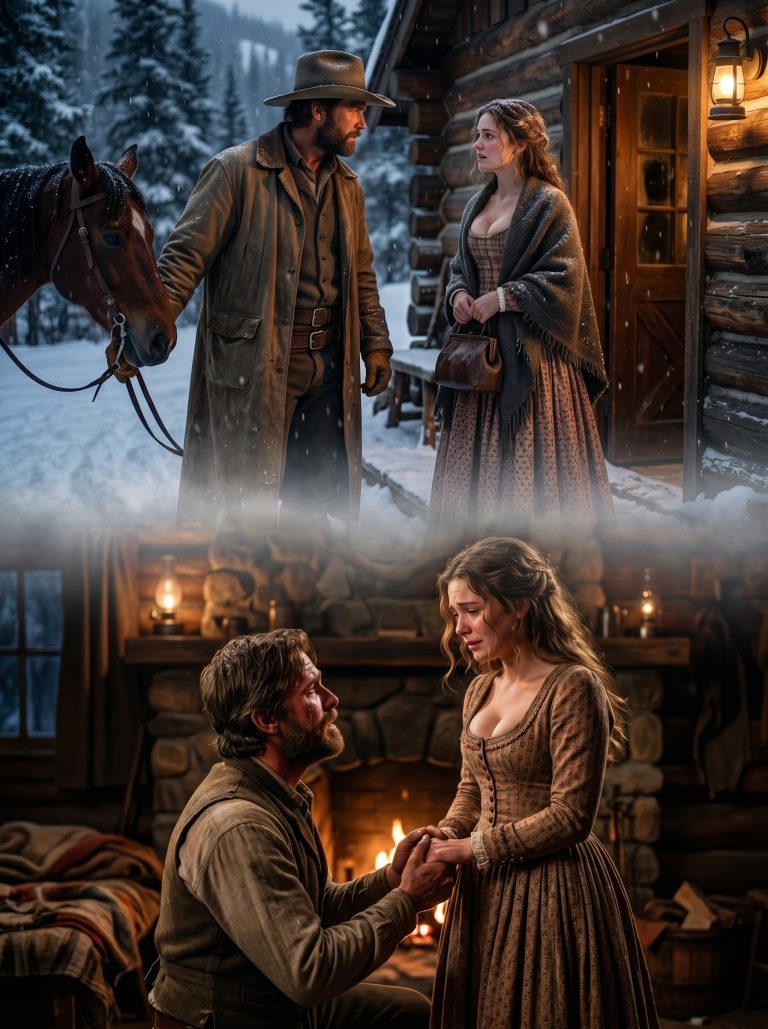
“Do you even know how to touch a woman?” she taunted her shy virgin husband on their first night together—until a blood-stained secret from her past rode into town, turning their forced marriage into a dangerous game of survival where love might be the only thing keeping them alive.

Part 1
The wind in Wyoming never knocked before it came in.
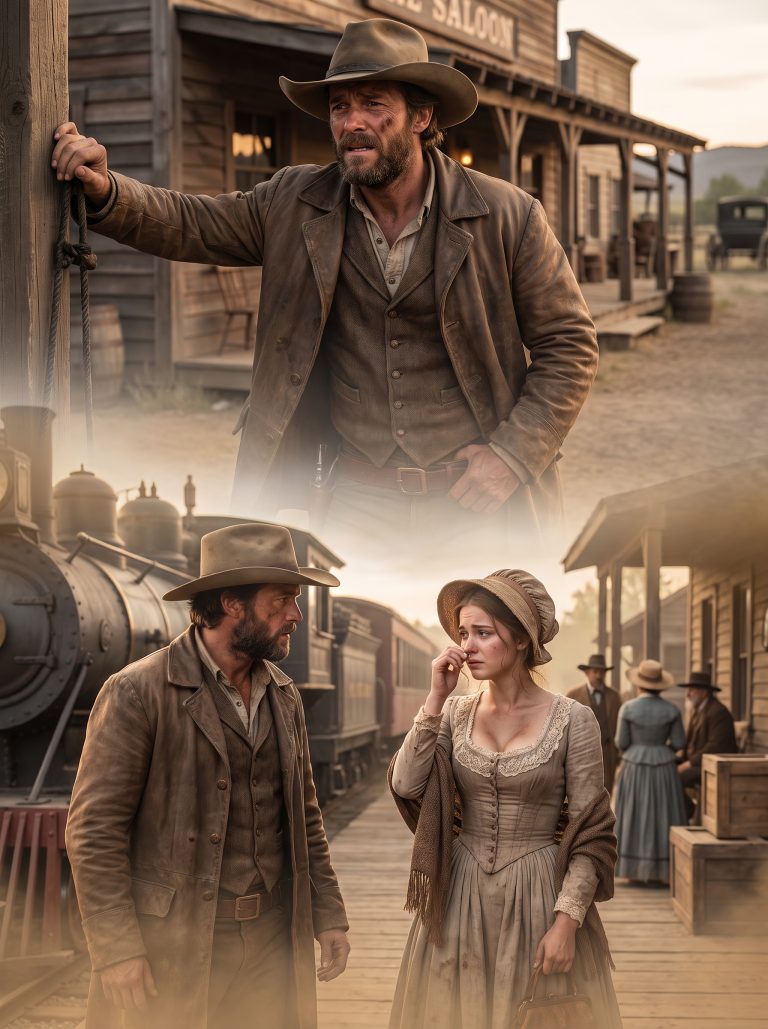
It swept across the flatland in long, restless gusts, dragging dust over the wooden platform where Elias Thorne stood waiting for a woman he had only known through letters.
His hands would not stay still.
That bothered him more than he wanted to admit. A man who could gentle a wild colt with nothing but patience and a low voice shouldn’t be this unsteady over a bride he’d ordered through the mail.
Behind him, Cedar Ridge was watching. Small towns always watched, and they watched hardest when a lonely rancher decided a letter could do what courting never had. Elias could already hear the laughter waiting to happen — too plain for a wife, too quiet for a woman to want him twice.
The whistle came first, then the smoke, then the train itself, groaning to a stop in a wash of steam. Passengers stepped down in twos and threes — a family, a drummer with a case of tin pans, two miners arguing about a card game.
Then he saw her.
She was carrying a small case in one hand and a Bible worn soft at the corners in the other. Her dress was plain gray, her bonnet plainer still. Nothing about her clothes asked to be noticed.
But her eyes did.
They moved across the platform the way a hawk studies open ground — checking every face, every shadow, before they finally settled on him.
“Miss Vance?” he asked.
“Clara.” Her voice was quiet, careful, like a door opened only partway.
He reached for her case. She stepped back so fast her heel caught the boards.
“I can carry it,” she said, too quickly, as if the words had worn a groove in her mouth from being said so often.
Elias lowered his hand at once. “Didn’t mean to startle you.”
Something crossed her face then — not relief exactly, more like confusion, as though she’d braced for anger and found none waiting. After a moment she let him take the case after all.
The ride to his homestead took the better part of two hours and most of it passed without a word between them. Elias wasn’t a talker by nature, and Clara seemed to prefer it that way. But he noticed things. The way her gaze swept the ridgelines. The way a hawk’s cry made her flinch before she caught herself. The way she never once let her shoulders fully rest.
When the cabin came into view beside the creek, she studied it a long moment.
“It isn’t much,” he admitted. “South wall needs mending before winter.”
She looked past him toward the bedroom window. “Does the door lock?”
The question caught him off guard. “Yes.”
She let out a breath she seemed to have been holding since the train. “Good.”
Not pretty. Not cozy. Good. As if a lock mattered a great deal more than comfort ever could.
They ate supper by lamplight, the cabin feeling smaller than it had any right to be. When the meal was done, Clara set down her spoon and folded her hands the way a person does before saying something rehearsed.
“We should speak plainly about the marriage,” she said. “About what you expect of me — as a wife, in every sense.”
Heat crawled up Elias’s neck. “I hadn’t thought that far past supper.”
“I’d rather know now than wonder.”
He turned his hat over in his hands, searching for words that wouldn’t come. Finally he just told her the truth. “I’ve never — I haven’t been with a woman. Not once.”
He braced for laughter. For some quiet judgment he wouldn’t be able to argue with.
Instead her shoulders dropped, as though a weight had slid off them.
“That’s good,” she said.
“Good?”
“Yes.” Something old and painful moved behind her eyes before she blinked it away. “Then we can go slow. However slow I need.”
That night they shared the bed because Cedar Ridge expected nothing less of a married couple, but they lay at opposite edges of it, the quilt a wide, careful country between them. Elias fell asleep first. Clara did not.
She lay listening to the wind and thinking not of her new husband but of a man she’d glimpsed on the platform — tall, still, watching from just outside the lamplight, gone the instant she’d turned her head. She told herself it was nothing. A stranger waiting on someone else.
But she had learned, the hard way, not to trust the things she told herself.
Before dawn she rose and stepped outside into the cold, gray light. For one unguarded moment, standing in the wide, empty quiet, she almost believed she’d left everything behind her in St. Louis.
Then she saw the tracks.
Fresh ones. Circling the creek. Circling the cabin.
Someone had been there in the night.
And deep in her chest, in the place where old fear had lived so long it felt like furniture, Clara understood with total certainty: whatever she had run from had found the road to Wyoming.
Part 2
Clara spent the day pretending everything was ordinary. She hauled water. Mended a shirt. Smiled when Elias spoke to her. But every distant sound made her flinch, and Elias — who noticed everything, though he said little — watched her do it.
That evening, on the porch, he finally said it plainly. “You’re scared.”
“No.”
“You are.”
She stared at the horizon rather than answer, and he let the silence sit instead of pushing into it. That patience frightened her more than anger would have. Anger she knew how to survive. Patience made her want to trust him, and trust was the one thing that had nearly ruined her before.
“It’s nothing,” she said again, and he only nodded, plainly not believing a word of it.
The storm came at midnight. Thunder shook the walls; rain came down like something thrown. A crash sounded near the barn, and Elias was on his feet before Clara had even sat up, one hand already on the rifle by the door.
“Stay back,” he said.
Lightning split the yard white for one instant — and in it, both of them saw a man standing motionless near the barn, watching the cabin. Then the dark swallowed him whole.
Clara’s blood went cold.
“You know him,” Elias said. It wasn’t a question.
She couldn’t answer. Her hand found his arm before she could stop it. “Don’t go out there.”
He covered her hand with his — steady, certain — and said only, “I’ll come back.”
No man had ever made her that promise and meant it before.
He went out into the storm anyway and returned soaked, empty-handed. “No tracks. But somebody was there. Somebody who didn’t want to be found.”
Clara closed her eyes. Whatever she had been running from wasn’t behind her anymore. It was here, circling the only home — and the only man — that had ever made her feel like more than something owed.
“Elias,” she whispered into the dark. “If I told you something terrible about my past —”
“I’d still listen,” he said, without a beat of hesitation.
Before she could find the courage to start, another sound rose beneath the storm — hooves, several sets, coming fast and no longer bothering to hide.
Part 3
The riders came out of the storm like a verdict already decided.
Five horses broke through the rain, hooves throwing up mud in the yard. Lantern light swung wild against the cabin walls. Elias stepped between Clara and the door before she’d even found her feet, rifle raised, voice flat and quiet in a way that scared her more than shouting would have.
“Stay back.”
The lead rider stopped ten yards off. Rain sheeted down the brim of his hat, but Clara knew the shape of him before the next flash of lightning confirmed it.
Cyrus Conroy.
“Well now,” he called, easy as a man remarking on the weather. “That’s a cozy little scene.”
“You’re on my land,” Elias said.
“Your land depends on how much you actually know about the woman behind you.”
“I know enough.”
Cyrus’s smile didn’t move. “She’s a debt, Mr. Thorne. Her father signed papers. Legal ones. She ran before the matter could be settled, and I’ve spent a great deal of money finding her.”
“I was sixteen,” Clara said, her voice shaking but not breaking. “And my father was drunk when he signed.”
Cyrus didn’t so much as glance at her. “You have two days,” he told Elias. “Hand her over, or I take what’s owed.”
“You come near her again,” Elias said, “and two days won’t matter to you at all.”
The riders wheeled and vanished back into the rain. But the fear they’d brought stayed behind, settling into the cabin like smoke that wouldn’t clear.
Elias barred the door, took the blanket from the chair, and wrapped it around Clara’s shoulders without a word. That small kindness undid her more than the threats had.
“I should have told you,” she said.
“Yes.”
“I was afraid.”
“I know. Tell me the rest now.”
So she did, before the sun came up. She told him about St. Louis — a father who gambled away everything but his debts, a cattle baron who paid those debts off in exchange for a daughter he called an investment. She told him about the contract, about the night she heard her father say she’s young enough to learn obedience, and about running with one dress, her mother’s Bible, and eleven dollars sewn into her hem. She told him how she’d worked kitchens and laundries from Missouri to Nebraska, always one town ahead of being found, until she’d read a plain, lonely advertisement from a Wyoming homesteader who wanted help, not a possession.
“I thought,” she said, staring into the fire, “a man lonely enough to write for a wife might be gentle enough not to break one.”
Elias was quiet a long moment. “I was lonely,” he finally said. “But I didn’t order property. You are not a debt. Not payment. Not something a man can collect.”
“I don’t know how to believe that yet.”
“Then I’ll believe it for both of us until you can.”
By the next afternoon, all of Cedar Ridge knew — Cyrus had made certain of that. Clara walked to the general store and felt the whispers follow her like flies. Runaway. Debt girl. Poor fool married trouble. Jeb Carter, who’d mocked Elias for years, leaned against the counter with a grin. “Mail-order bride came with baggage, huh?”
The door opened. Elias walked in, took the flour sack from Clara’s arms, and set himself beside her without raising his voice.
“You got something to say about my wife?”
“Just talk, Eli.”
“It’s cowardice wearing talk as a coat.”
Nobody in the store moved. Jeb’s grin didn’t survive it. Elias took Clara’s hand in front of everyone and said only, “My wife answers to no man here,” and the words changed the air in the room more than any threat could have.
Outside, Clara pulled her hand free. “They’ll hate me more for that.”
“Maybe.”
“Doesn’t that bother you?”
“Plenty. But them hurting you would bother me a great deal more.”
That night, for the first time, her hand found his in the dark without fear driving it there. He never asked for more than she gave. That restraint, she was beginning to understand, was its own kind of tenderness — rarer and steadier than desire ever could be.
The peace lasted three days. Then the fence was cut, two calves went missing, and black paint appeared across the barn door: PAY THE DEBT OR LOSE THE LAND.
Clara stared at the words with a blankness Elias hated more than tears. “No,” he said. “We go to Cheyenne. Federal court. We make the papers matter.”
Thaddeus Holt, Cedar Ridge’s half-retired lawyer, read Clara’s documents with the first sober attention he’d given anything in months. “This isn’t debt,” he said. “This is coercion wearing legal language. Ugly truth’s still truth, ma’am. Truth’s useful once you drag it into daylight.”
They left before sunrise — Elias, Clara, Holt, two horses and what little food they could carry. Snow came early in the mountains, the trail narrowing to ice and stone. On the third day, Elias spotted riders behind them and pulled Clara into a ravine to wait them out. Crouched in the cold beneath the rock wall, his arm around her, she felt something she hadn’t expected to feel again in her life: safety that didn’t depend on a locked door.
“I’ve brought ruin to your life,” she whispered.
“No,” he said. “You brought me one worth living.”
The Witness
The Cheyenne courthouse was built, it seemed, to make poor people feel smaller than they already did. Clara told her story to a young assistant attorney named Nathaniel Black without softening a single word of it, and by the time she finished, his face had lost all its careful neutrality.
“There’ll be a hearing tomorrow,” he said. “Be ready.”
Cyrus arrived at the courtroom clean-shaven and unbothered, as if the law were simply another animal he expected to break to saddle. His lawyer took Clara apart on the stand piece by piece — her poverty, her flight, her mail-order marriage — suggesting, with a smile, that a desperate woman would say anything to escape consequence.
Then Elias took the stand, too large for the chair, too plain for the room, and answered every sneering question with nothing but the truth, until the lawyer’s last question landed flat in a silent room.
“Are you aware this woman was promised under contract?”
“A woman,” Elias said, “is not a steer.”
The gavel cracked down, but even the judge looked shaken.
It was in the recess that followed — while Holt was still laughing about the look on Cyrus’s face — that a man in a worn coat stepped through the courthouse doors and asked, quietly, to speak with Nathaniel Black.
Clara recognized him before he lifted his head.
Her father.
She hadn’t seen him in six years, and for one terrible second she couldn’t tell if the ground under her had turned to ice or fire. He didn’t come toward her. He kept his eyes down, ashamed in a way she had never once seen from him, and spoke only to the attorney — but loud enough for the room to hear.
“I have the real papers,” he said. “The ones Conroy had me sign after he’d already gotten me too deep in whiskey and debt to read what they said. And I have three years of ledgers showing what he did with girls like my daughter, in towns from here to Missouri. I’ve been following you both since the train station, trying to work up the nerve to hand this over without getting shot for it.”
The man near the barn. The watcher at the platform. Not one of Cyrus’s men at all — a father who had spent years too much a coward to face his daughter, but not, in the end, too much a coward to bury him.
Clara’s hands shook so badly Elias had to steady them.
“Why now?” Black asked.
Her father finally looked at her. “Because I’ve spent six years telling myself I sold her to save us both. It was never true. I sold her because it was easier than being a father worth having. I couldn’t undo it. I could only try to stop him from doing it again.”
The ledgers changed everything. What had looked like one desperate girl’s debt case became, in Black’s hands, evidence of a network — Cyrus buying debts across three states and trading the daughters attached to them like livestock, always wrapped in ink polished enough to survive a courtroom, until now.
That evening, in a cramped room above a Cheyenne boarding house, Clara finally let herself sit across a table from her father for the first time in six years.
Neither spoke for a long while. He looked older than the six years should have made him — thinner, grayer, his hands never quite still on the table between them.
“I told myself I was protecting you,” he finally said. “Getting the debt paid before it swallowed us both. It took me two years to admit that was a lie I built so I could sleep.”
“And the other four?”
“Following Conroy’s men from town to town, writing down what I saw. Losing my nerve every time I got close enough to knock on a door.” He looked at his hands. “I told myself I’d make it right once I had enough proof to matter. I don’t expect that to sound like anything but excuses now.”
“It doesn’t,” Clara said. Not cruelly — only honestly, the same honesty she’d learned to give Elias.
“I know.”
“But you stood in the yard for months, watching, instead of walking away for good. That has to count as something.”
“I don’t need it to count as forgiveness,” her father said. “I only need it to count as a start.”
Elias, standing by the window, said nothing at all, but Clara caught the look he gave her — not pushing her toward mercy, only trusting her to find her own way there or not, whichever she chose.
It was Elias who broke the silence a little later, once her father had gone down to fetch coffee neither of them particularly wanted.
“You don’t owe him peace,” he said quietly.
“I know.”
“Whatever you decide tomorrow, or next year, I’ll stand behind it.”
Clara looked at the door her father had gone through, then at the man beside her who had never once asked her to be smaller than her own anger. “I’m not ready to call him family again,” she said. “But I think I’m ready to let him try to earn it. That’s different from forgiveness. I think it might be more honest.”
By evening, the injunction against Cyrus was joined by federal charges that would follow him for the rest of his life — charges built not just on Clara’s testimony, but on ledgers her father had risked his life copying out in secret, town by town, debt by debt, across four years he could never get back.
But paper, Nathaniel Black warned them, burns. Men like Conroy didn’t stop because a judge told them to.
The ride back from Cheyenne was slower than the ride out, weighted with everything that had been said and everything still unsaid. Clara’s father rode a half-length behind them the whole way, not pressing closer, not falling further back — as if he understood, without being told, exactly how much distance he’d been given and meant to respect every inch of it.
On the second night, camped beneath a stand of pines, Clara found herself watching him across the fire, turning a tin cup slowly in his hands the way a man does when he’s trying to remember how to be still.
“He’s not who I thought he’d become,” she said quietly to Elias, “when I used to imagine him at all.”
“People change slower than paper,” Elias said. “Slower than a courtroom likes. But some of them do change.”
“Do you believe that, or is it just a kindness?”
He considered it honestly, the way he considered most things. “Both, maybe. I believe it because I watched a woman climb down off a train too afraid to let a man carry her trunk, and I’ve watched that same woman hold her hand out to the father who sold her. That’s not something a person does because they’ve stopped being afraid. It’s something they do because they’ve decided fear doesn’t get to make every choice anymore.”
Clara didn’t answer, but she reached over and laced her fingers through his, and they sat like that a long while, watching her father across the fire, watching the low country of some future neither of them could see yet but both of them, for the first time, believed they might reach.
What The Land Remembers
He was right. Two days from Cedar Ridge, they saw smoke rising over the valley. By dawn, Cyrus’s men had pushed cattle onto Elias’s land, and Cyrus himself sat on the porch as if the law had never touched him at all.
“You should’ve stayed in Cheyenne,” Cyrus called, standing as Elias dismounted.
“This is my land.”
“Not for long.”
Holt raised the injunction papers. “Federal order, you arrogant —”
A shot cracked the morning open before he finished. Holt went down into the mud, and everything after happened too fast for thought — gunfire, Blackwood men riding up over the rise with borrowed rifles and no real training for this, the sheriff arriving pale and late.
Elias reached Holt first, pressed a cloth to the wound, and heard the old lawyer rasp, “Go. End it,” before he crossed the yard through the noise toward Cyrus.
It was Clara’s father who reached Cyrus first.
He hadn’t come to fight — he’d come only to keep his daughter from being close enough to be hurt — but he stepped into the space between Clara and a raised pistol, and the bullet meant for Elias found him instead.
He went down slow, the way old, tired things do.
Elias reached Cyrus a second later and put him on the ground for good, pinning him hard enough to shake dust from the porch beam. “You’ll hang for this,” Cyrus spat.
“No,” Elias said. “You will. I’ll live.”
Federal marshals crested the ridge minutes later, Nathaniel Black riding at the front of them, and the fight ended almost as fast as it had begun. Cyrus was dragged off in irons. His men threw down their weapons without much argument, men who’d only ever fought for wages, not conviction.
Clara knelt in the mud beside her father as the marshals worked. He was still breathing, barely, one hand closing weakly over hers.
“I didn’t do right by you,” he said. “Not for a long time. I hope this counts for something, at the end of it.”
“It does,” Clara whispered, and meant it — not because it erased anything, but because she understood, kneeling there, that a debt paid honestly was different from a debt owed forever. He didn’t need forgiveness to have earned peace. He’d earned it the moment he chose to stand where the bullet was meant to go.
He held on through the night. Come morning, against every expectation, so did he — weak, gray, but alive, with a doctor from Cheyenne cursing under his breath about miracles he didn’t believe in and couldn’t otherwise explain.
Clara sat with him through the worst of the fever, and on the third night, when he finally woke clear-eyed for the first time since the shooting, he found her still there, asleep in the chair beside the bed with her hand resting near his.
“You stayed,” he rasped.
“I did.”
“Why?”
Clara considered the question honestly, the way she’d learned to consider most things since coming to this valley. “Because staying is different from forgiving,” she said. “I told you that once already. I meant it then, and I still mean it now. But I find I’d rather have you alive and earning it than gone and owed it forever.”
He closed his eyes, and for once the tears that slid down into his gray hair weren’t the kind that asked for anything in return.
Holt was not so fortunate. He was buried beneath the cottonwood by the creek, under a marker Elias carved himself, and the whole valley came to stand for it, awkward and quiet, the way people are when they’ve run out of ways to apologize and started working instead. A sack of flour left on the porch. Nails. Lumber. A mended fence rail.
Clara let them. Work was a language she understood.
One afternoon, Mrs. Whitcomb appeared at the fence line with a jar of preserves and no explanation at all, standing there twisting her apron until Clara finally set down her washing and walked over.
“I said things about you at the store,” Mrs. Whitcomb said, not quite meeting her eyes. “Repeated things, more like. Didn’t stop to ask if they were true.”
“You believed what was easiest to believe,” Clara said. “Most people do.”
“That’s not a kindness, you saying that.”
“It isn’t meant as one.” Clara took the jar. “It’s meant as the truth. I’d rather have that from you than an apology dressed up as something prettier.”
Mrs. Whitcomb studied her a long moment, then nodded once, sharply, as if a debt of her own had just been settled. She came back the following week with a second jar, and didn’t wait to be thanked for it.
What Grew Back
Spring came slowly, the way it does after a hard winter. The barn still bore its scars, but it stood. Clara’s father stayed on through the season, mending fences with hands that shook less each week, learning — slowly, the way a man learns a language late in life — how to be useful instead of owed.
One evening, sitting on the porch under a sky crowded with stars, Clara leaned her head against Elias’s shoulder.
“Do you ever think about the first night?” she asked. “The spoon on the floor. All those questions I had no business asking a stranger.”
“All the time,” he admitted.
“I thought you were weak,” she said. “Too gentle to survive out here.”
“I was gentle. Not weak. There’s a difference, even if this town took its time learning it.”
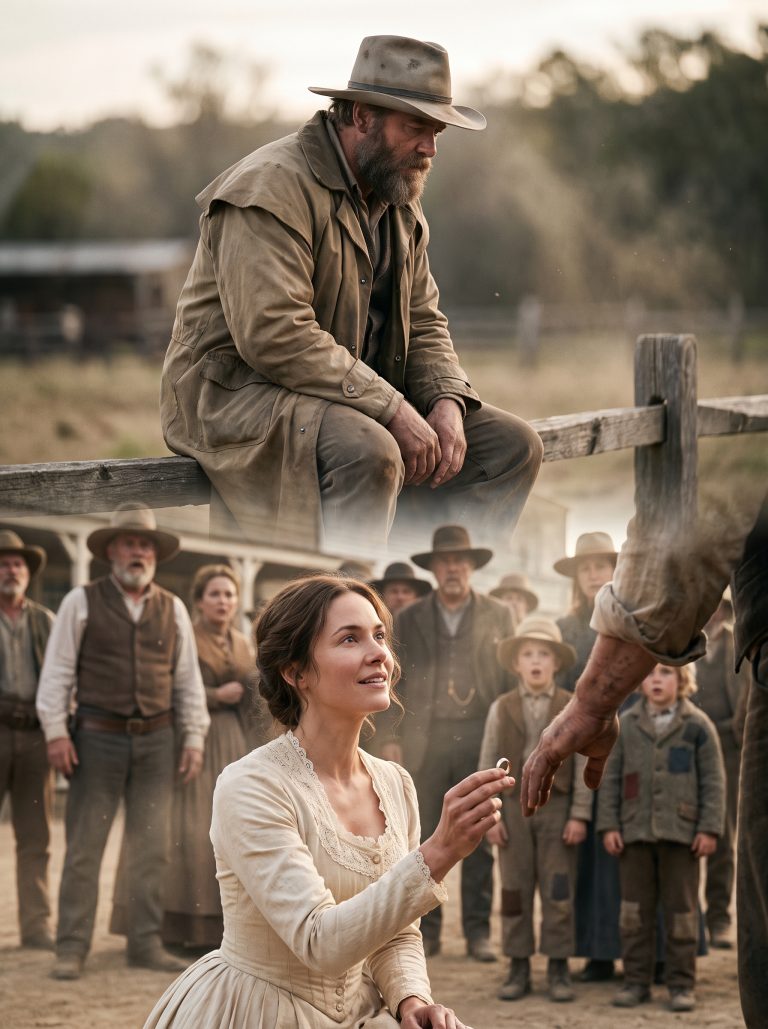
He reached into his coat and drew out a small carved box. Inside sat a plain silver ring, hammered by hand, imperfect in exactly the way that made it beautiful.
“We already said our vows,” he said. “But those were survival, mostly — a contract dressed up as a marriage, same as the one your father signed, except this one we chose to keep. I want you to have something that was only ever a choice.”
Clara touched the ring with a hand that had finally, after all these months, stopped shaking. “No one ever chose me before.”
“I did,” Elias said. “I do.”
They married again that night by the fire — no judge, no contract, no frightened bargain standing behind them, only two people and the truth of what they’d survived to reach each other.
Outside, the Wyoming wind pressed against the cabin walls the way it always had.
It still didn’t ask permission.
But for the first time, it didn’t get in.
Years later, people in Cedar Ridge would still tell the story of the homestead by the creek — the quiet rancher no one mocked anymore, and the sharp-eyed woman who could spot a lie before it finished forming. Some called it strange. Some called it scandalous. A few, remembering the old man who’d limped through his last years mending what he’d broken, called it a kind of grace.
But Elias and Clara knew the truth of it better than anyone.
It hadn’t been love that saved them first.
It had been protection. Then honesty. Then a debt — the real kind, the human kind — finally paid not in silence and shame, but in the hard, daylight work of showing up and staying. Chosen family, it turned out, wasn’t the family that never failed you. It was the family — blood or otherwise — that stayed to fix what it broke, and the one that let it.
That, more than any ring or any ruling, was the miracle.
The End