He Found Her Children Sleeping on His Porch—What He Did Next Shocked the Town

Part 1
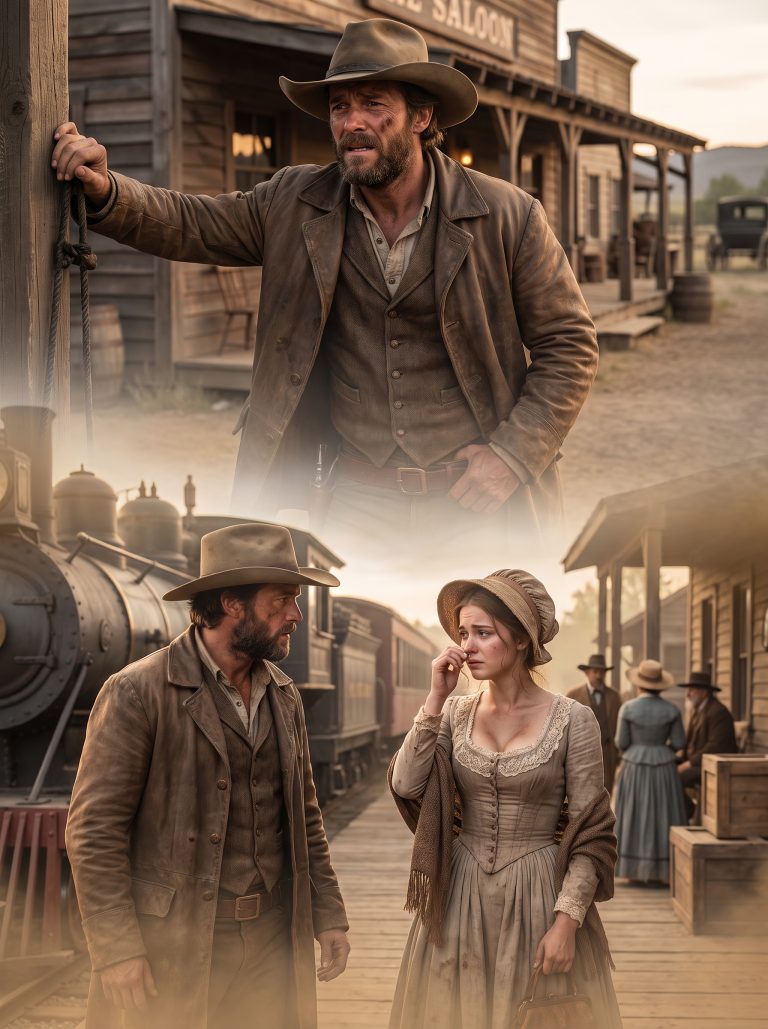
James Caldwell had not prayed in seven years. Not once. Not since the fever took his wife, and not since his five-year-old daughter stopped breathing in his arms with a single whispered word — papa — that still woke him screaming on the worst nights.
He had built a fortress out of grief. Forty miles from the nearest town, high in the Wyoming hills, where nobody could reach him and nothing could be taken from him again, because there was nothing left to take.
That November morning in 1878, dawn broke bitter and gray. Jim stepped onto his porch with a cup of coffee he had no intention of tasting — the same ritual, every single day, for seven years — and his boots simply stopped.
Three bodies were huddled against his door.
The rifle was in his hands before conscious thought caught up with him. Out here, that far from town, you didn’t ask questions first. Drifters. Bandits. People who smiled while they robbed you blind.
His finger found the trigger.
Then he saw her face.
A woman. Pale as bone, her lips cracked and gone faintly blue, her eyes closed but moving beneath the lids — dreaming, or dying, he couldn’t tell which. Her arms were locked around two children like she believed, with everything left in her, that her own body could stop the world from reaching them.
A boy, maybe eight or nine, his breathing shallow and wrong.
A little girl, no older than five, her small fist knotted in her mother’s threadbare coat.
Jim’s hands began to shake.
Emma had been five.
“No,” he said out loud — to the porch, to the wind, to whatever god had stopped listening to him years ago. “Not again.”
He should go back inside. Bar the door. This wasn’t his to carry — he had carried weight like it once before, and it had broken him into the man standing here now, alone, unrecognizable even to himself.
The woman’s eyes opened.
They found his — not pleading, not yet. Just assessing. Calculating, in the way of someone who had learned the hard way, whether the man in front of her was the kind who shot first or the kind who might, possibly, help. Her hand drifted to the knife at her belt.
“Don’t,” Jim said, lowering the rifle an inch. “Ain’t gonna hurt you.”
“Then why the gun?” Her voice came out like gravel dragged over stone. “Why the knife?”
Neither of them answered. The wind picked up, carrying ice that felt like needles against exposed skin. The little girl whimpered in her sleep — a small, broken sound that went through Jim’s chest like a bullet finding old scar tissue.
The woman sat up straighter despite what it clearly cost her. Protective instinct overriding total exhaustion.
“We’ll be gone by sunrise,” she said. “Just needed somewhere the wind couldn’t reach us.”
Sunrise had been an hour ago. She blinked, looked up at the pale sky, and something in her face quietly crumbled.
“Then we’ll go now.”
“Go where?”
“Anywhere that’s not here. We’re not beggars, mister. We just needed—”
“When’s the last time those kids ate?”
Her jaw locked tight. “That’s none of your concern.”
“When’s the last time you ate?”
She didn’t answer. Her hands were trembling now too, and it wasn’t only from the cold. Jim could see the bones at her wrists, the hollowed places beneath her cheekbones. This woman had been starving herself to keep her children fed, and all three of them were losing that fight, right here, on his porch.
The boy stirred. “Mama?”
“Shh, Tommy. We’re going.” She tried to stand. Her legs betrayed her instantly, and she caught herself hard on the porch railing, fury and pride burning in her eyes as she forced her own body to cooperate.
Jim looked at the boy — thin, gaunt, already scrambling upright to grab his mother’s arm, already positioning his small body between her and the stranger with the rifle. Nine years old, and looking at Jim with the flat, ancient wariness of a child who had learned exactly what grown men were capable of.
Just like Jim used to look at his own father, before the mine took him.
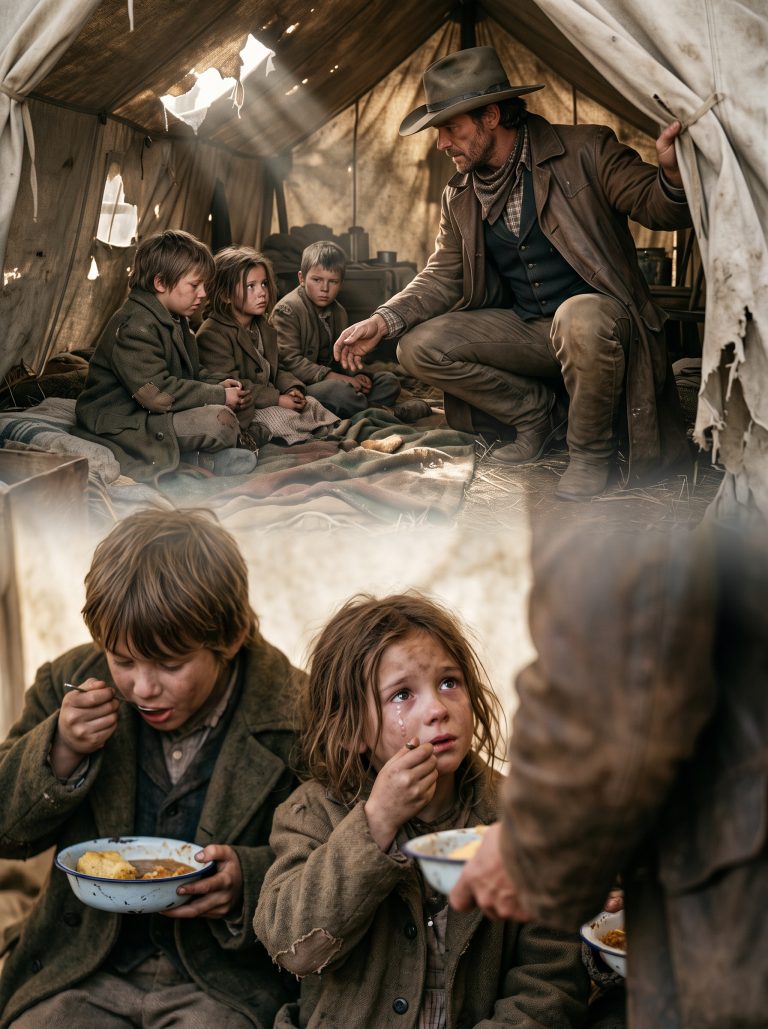
“There’s food inside,” Jim heard himself say, the words out of his mouth before he’d consciously decided to speak them. “Hot coffee. Fire’s going.”
The woman went utterly still. “Why? Why would you help us?”
He didn’t have an answer he could say out loud. He couldn’t tell her that his dead wife’s voice was in his head right now, the way it always used to be when he was about to do something hard — do the right thing, James, even when it’s difficult, especially when it’s difficult — and he couldn’t tell this stranger that he was so tired, so bone-deep tired, of being alone with his ghosts that he would have said almost anything to keep three living, breathing people on his porch for five more minutes.
“Because it’s cold,” he said instead. “And I’ve got food going to waste.”
She studied him a long moment, searching his face for the lie, the trap, the catch that always came with kindness in her experience.
She didn’t find one.
She had absolutely no idea what she and her children were about to walk into — the marriage, the war with the town, the judge with the papers, the morning three riders would ride onto his land and change every future waiting inside that house.
She only knew one thing, in that moment, as she finally, warily, crossed his threshold.
It was warm inside.