A Young Boy Gave His Only Blanket to a Dying Indian Girl… The Next Morning, 700 Warriors Surrounded His Barn

Part 1
The frost hadn’t melted by noon, and the sky stayed the color of dishwater over the Whitfield homestead. Caleb Whitfield came off the porch without his coat, shoulders hunched, breath fogging in front of him. He was fourteen, still growing faster than supper could keep up with, all wrists and watchfulness.
He carried a quilt his grandmother had stitched before she died — patched squares, one corner frayed where the dog had gnawed it as a pup. He hadn’t told anyone where he was going. He wasn’t sure he could have explained it.
The barn sat at the far edge of the property, where the fence sagged and the weeds had taken more ground than the plow ever gave back. Crows lined the roof beam, silent against the pale sky. Caleb heard the wind moving through the boards — and then something under it. Not wind. Not horse.
He found her curled against the fence rail, half in the frost. For one bad second he thought she was dead.
Her buckskin dress was dark with dirt, her feet bare and cracked white. Bruises ringed both wrists — not the kind an accident makes. Her braid was matted with old blood. Her chest rose so faintly it barely counted as breathing.
Then her eyes opened, and found him.
She didn’t speak. Her hand tightened around a small beaded pouch, red and blue, gripped like it was the only thing left that was hers.
“Can you hear me?” Caleb asked, kneeling.
Nothing. He unfolded the quilt and laid it over her shoulders. She flinched at the touch — not from pain, he thought, but because she’d forgotten what gentleness felt like. Then she went still.
He studied her properly then. Young. Starved thin. The marks at her wrists said someone had tied her, more than once. He didn’t have words for what he felt, so he said something ordinary instead.
“I’ll bring water.”
He came back at dawn with a tin cup and half a biscuit hidden in his sleeve. She was still breathing. Still there. This time when she opened her eyes, they held on him.
“You got a name?” he asked.
Her lips moved without sound, then she touched her own chest.
“Sparrow,” she whispered — not her real name, she’d tell him later, just the one she gave strangers who might use a true name against her.
She coughed. Blood spotted the quilt. Caleb’s stomach dropped.
“Don’t die,” he muttered, uselessly.
With more care than confidence, he got her up and across the yard into the barn, into a bed of straw and feed sacks in the back stall. She curled into the quilt and, for the first time, closed her eyes like she meant to trust the dark instead of fight it.
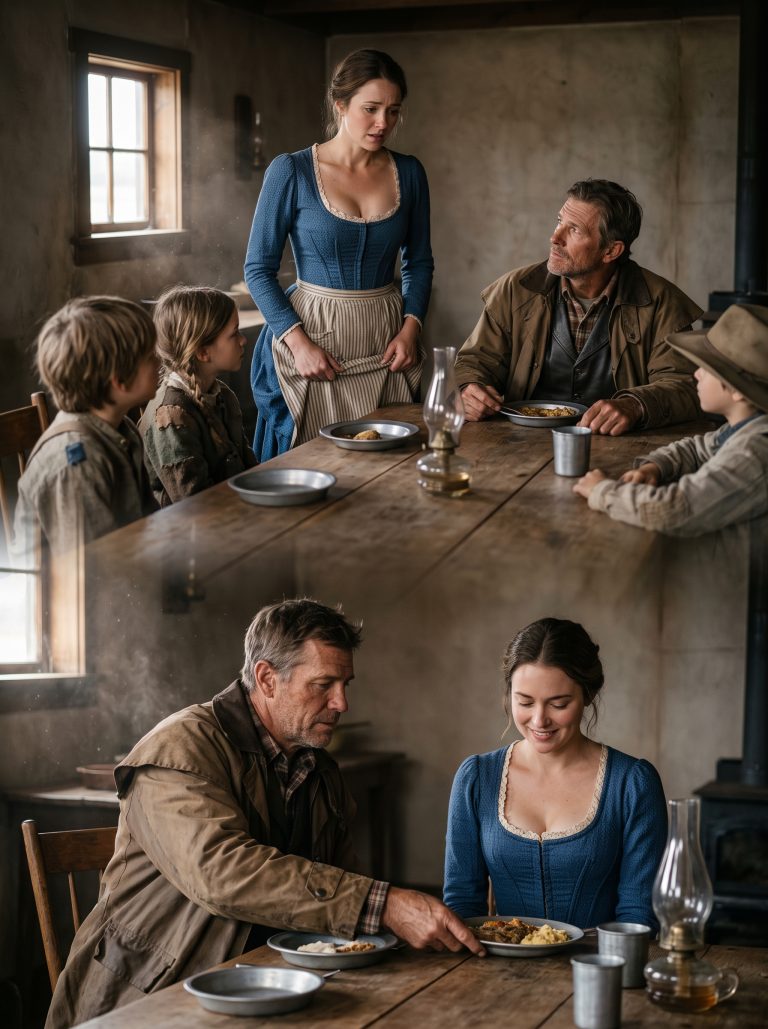
That night, his father Thomas cleaned a rifle that hadn’t needed cleaning in weeks. His mother Eleanor kept her back to the room, stirring a pot long past done. Caleb picked at his food and watched the door.
He dreamed of blue beads scattered on snow.
The wind changed near midnight. The dogs went quiet — wrong, because dogs bark at foxes and shadows and everything else; silence meant something had already arrived. Caleb pulled on his boots.
A light flickered in the barn where no light should be.
Inside, Sparrow was upright, blanket around her shoulders, hair loose, face sharper in the candle glow. Her eyes found him instantly.
“You shouldn’t be here,” she said.
“You shouldn’t be alive,” he answered.
She reached into the pouch and pressed something small and carved into his palm — a horse, or maybe a buffalo, worn smooth by handling.
“You saw me,” she said. “No one does.”
A cold draft moved through the boards. She went still, turning toward the east window in a way that raised the hair on Caleb’s arms.
“What is it?”
She didn’t answer. He crossed to the window and looked out.
Along the ridge, shapes stood against the stars — mounted, unmoving, more than he could count in one glance.
“Do they want you?” he asked.
“They want to see,” she said.
“See what?”
“That you gave me the blanket.”
“I just did what felt right.”
“That,” she said, “is what frightens them.”
He didn’t yet know who them meant. By morning, he would.
Part 2
By dawn, dust rose from every road into Pine Hollow. The church bell rang warning, not worship. Riders lined the ridge like they’d grown there, patient as fence posts, only their braids stirring in the wind.
Thomas stood on the porch with the rifle across his arms. “That many riders never came out for peace in my lifetime.”
“Maybe they’re looking for someone,” Eleanor said.
“They came for blood,” Thomas said, though he didn’t sound sure of it.
Near midmorning, one rider broke from the line and came down alone — unhurried, unarmed, an old man in a weathered hide cloak, gray-streaked hair marking him older than the rest. Sparrow, watching from the stall window, drew a sharp breath.
“Grey Talon,” she said.
He dismounted at the gate. “I was told a daughter of ours lay dying on this land, and a settler’s boy gave her his only blanket.”
“My boy’s been nowhere near your people,” Thomas said.
“Are you certain?”
Eleanor stepped forward. “If he helped her, he did it out of pity.”
Grey Talon’s eyes settled on her. “It was not pity. It was honor.”
Caleb walked out before his father could stop him. “She’s alive. I gave her the blanket because she was going to die.”
Grey Talon studied him a long moment. “What made you help her?”
“She looked like someone who’d been left for the wolves.”
Something shifted in the old man’s face. He looked past Caleb, to the pouch still visible at Sparrow’s hip, and something like relief crossed his features — relief, Caleb would later understand, that the pouch had survived at all.
“That is enough,” Grey Talon said, and knelt.
On the ridge, warrior after warrior dismounted and followed him down onto one knee, a slow ripple of leather and prayer rolling across the valley like distant thunder.
Thomas lowered the rifle. Eleanor’s eyes filled.
Sparrow stepped from the barn on her own legs, crossed the yard, and fell into Grey Talon’s arms — not collapse, but homecoming. He held her, then looked once more at Caleb before turning back toward the ridge.
By dusk, the land was empty again.
But that night, in the straw, Caleb found a new carving waiting for him.
An eagle, wings spread.
He did not yet know it was a warning as much as a gift.
Part 3
Snow came two days later, soft and steady, and something in the Whitfield house changed with it. Thomas spoke less. Eleanor stirred the stew longer than it needed. Even the dogs barked differently, less certain of what counted as a threat now.
Sparrow had not gone with Grey Talon. She stood most mornings at the stall window, the quilt over her shoulders, watching the empty hills.
“You ought to go home,” she told Caleb one morning, without turning. “Your mother wants your hands at table.”
He held out a tin of dried apples instead. “You staying long?”
“I should not have stayed at all.” Her eyes stayed on the snow. “They thought I was already gone. I belong to no one now.”
“You do,” he said, before he could stop himself.
She looked at him fully then. “Your kindness is too large for your frame, Caleb.”
“It was just a blanket.”
“It was the first warmth I’d felt in months.”
Grey Talon had told her, before he left, that she was free to return whenever she chose — that the council did not require it. But something in her hesitated at the word chose. She had not chosen much of anything in a long while.
She swept the barn floor without being asked. She took the soup Eleanor brought without thanks, but with a dignity that made the lack of words feel like its own kind of grace. By the fire at night, she told Caleb her true name — Senna — and that her people, the Windwalker band, had called her Little Sky Ghost as a child, because she wandered after clouds instead of conversation.
“Do the clouds still talk to you?” he asked.
“Not as much.”
“Maybe they’re waiting for you to listen again.”
For a while, it seemed the winter might simply hold — fire, soup, wet boots by the hearth, four people learning not to flinch around each other. Senna laughed once, sudden and full, when Eleanor told a story about Caleb hiding a whole jam jar under his bed as a toddler. It startled all of them. It was the first time Caleb had heard her laugh with her whole body.
Then, on a clear morning after the storm broke, a single rider appeared on the white plain. No paint, no war party — just a man alone in a wolfskin coat, riding slow enough that the snow swallowed every hoofbeat.
Senna’s face changed the moment she saw him.
“Go inside, Caleb,” she said.
He didn’t.
The man dismounted at the fence. Scars crossed both cheeks. “I did not come to fight.”
“Good,” Thomas said, rifle under his arm but lowered. “You wouldn’t win.”
The stranger looked only at Senna. “You left before it was finished.”
“I was never yours to finish,” she said.
“You were promised to me. You wore the red necklace.”
“I was a child. No one asked if I agreed to anything.”
“I never touched you in hate.”
“You touched me in expectation,” she said. “That is a slower kind of harm.”
He turned to Caleb at last. “So this is the boy who gave you a blanket.”
“She was cold,” Caleb said.
“She belonged to us.”
“She belongs to no one,” Caleb said. “Maybe that’s why you lost her.”
The man’s jaw tightened, and for just a moment — a moment Caleb almost missed — his eyes went not to Senna’s face but to the beaded pouch at her side. Not longing. Hunger. The way a man looks at something he’s afraid will talk.
He mounted and rode off without another word.
That night, Senna sat by the fire turning the pouch over in her hands, quieter than Caleb had seen her since the fever broke.
“He’s never once called me by my name,” she said slowly. “Not tonight. Not the first time he came for me, before you found me at the fence.”
“What do you mean, before?”
She hesitated, then untied the pouch and drew out, from beneath the small carved animals, a scrap of tanned hide with markings burned into it — not Windwalker symbols, she said, but a brand. A cattle brand, crossed with a settler’s initial.
“The men who took me and beat me weren’t my people’s enemies,” she said quietly. “They wore paint. They rode like us. But their boots were settler boots, and one of them had this burned into his saddle bag. I took it while they slept, before I ran. I didn’t understand it until Grey Talon explained what it meant — a mark used by men who raid dressed as us, so that soldiers and settlers blame my people, and the land gets cleared quicker for men who buy it cheap once the fighting starts.”
Caleb sat very still. “The man tonight—”
“Wears a wolfskin coat to hide a brand on his own arm,” Senna said. “He’s not Windwalker. He never was. He wants this back before I can show it to anyone who’d believe me.”
It took the rest of that night, and Thomas riding hard to Pine Hollow at first light, to get word to Grey Talon — and it took two more days for the council to send riders back, not for war this time, but to stand witness. Grey Talon arrived with the same stillness as before, but no kneeling this round; there was work to do.
“We suspected such men existed,” he told Thomas on the porch. “We did not have proof that would matter to your courts, or ours.”
“You have it now,” Thomas said, nodding toward the brand in Senna’s hand.
That night, the wolfskin man came back — not alone, and not slow. Six riders in stolen paint moved on the Whitfield fence line under cover of dark, meaning to burn the barn and blame it on the Windwalker, meaning to end the one witness who could unravel them before she spoke to anyone official. But Grey Talon’s men were already stationed along the tree line, and Thomas had every neighbor he could raise standing armed at the house, settler and Windwalker shoulder to shoulder for the first time in either of their memories.
The fight, when it came, was short and one-sided. The wolfskin man — whose name, it turned out, was nothing like the Windwalker names he’d borrowed, but Silas Marrow, a land speculator’s hired hand — was taken alive, along with two of his riders. The brand on his own forearm matched the scrap in Senna’s pouch exactly.
By the time the territorial marshal arrived a week later to take the men into custody, the story had already changed shape in Pine Hollow. It wasn’t a story about warriors on a ridge anymore. It was a story about a girl who’d carried the truth in a beaded pouch through frostbite and fever rather than let it die with her, and a boy who’d given her a blanket before he had any idea what she was carrying.
Spring came slow that year, the way it does after a hard winter. Senna stayed through the thaw. Not because she’d been told to, and not because she owed anyone an explanation, but because — she told Caleb one evening, sitting on the fence rail he’d helped his father rebuild — she had finally been given the one thing no one had offered her before: a choice, with nothing attached to it.
She split her time after that, some seasons with the Windwalker band, some at the Whitfield place, welcomed at both fires. Grey Talon and Thomas Whitfield never became close friends, exactly, but they built a second gate together that spring, and neither of them ever spoke of taking it down.
A year later, the old barn was rebuilt in cedar, a small carved eagle set above the door where anyone passing could see it. People in Pine Hollow still tell the story, though it’s shifted a little more with each telling — some say it was a hundred riders on the ridge, some say a thousand. What stays the same in every version is the smallest part of it: a boy who saw someone freezing and didn’t wait to find out what she was before he covered her.
That was never the whole reason peace held, in the end. The truth needed carrying, and evidence, and people willing to stand together once they saw it. But none of that would have reached anyone if Caleb hadn’t knelt in the frost first, when it would have been easier — safer, even — to walk back inside and say nothing.
The blanket didn’t stop a war by itself. But it was the first thread pulled loose in a lie built to keep two peoples afraid of each other, and once pulled, the whole thing came apart.
Senna kept the blanket. Caleb kept the eagle. And the ridge, when riders crossed it after that, was just a ridge — not a place to watch from, but a place people from both sides of it had learned, slowly, to ride over together.