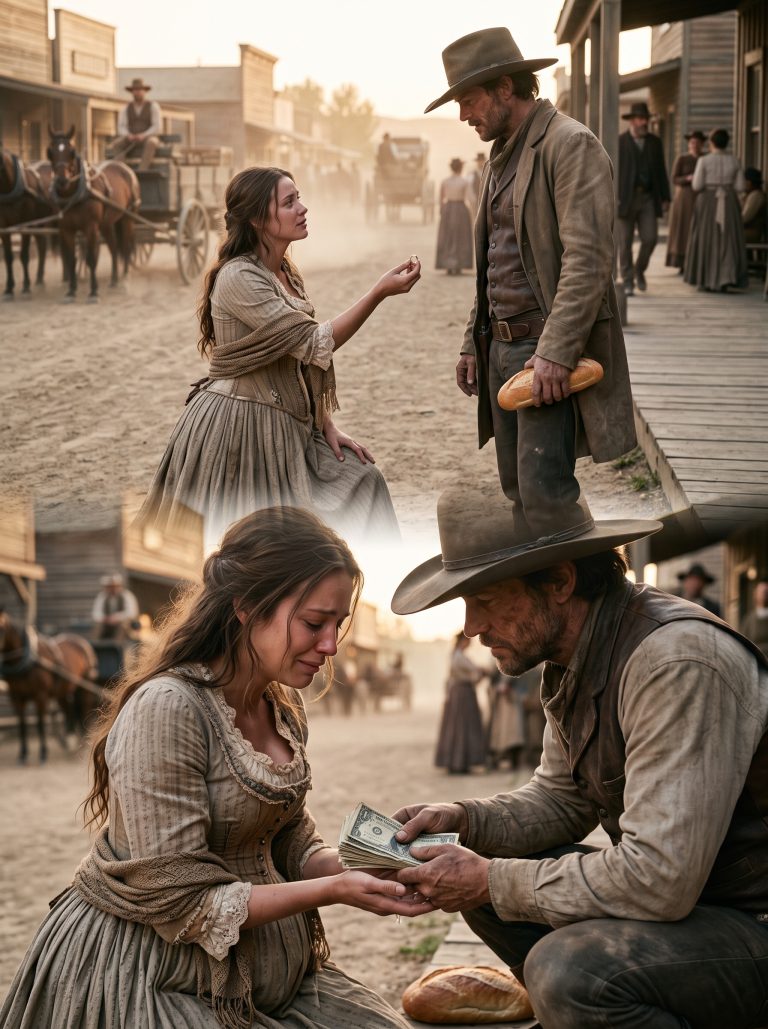
He ordered a wife to endure the winter — but the scarred stranger who stepped off the stagecoach came with secrets too heavy for love and a past that locked every door behind her.

Part 1
The stage rolled into Sagebrush Hollow an hour past noon, its wheels throwing up dust the color of rust. Ezra Colt had been standing by the hitching post since morning, hat low, arms crossed, watching the pass the way he watched a storm front — without hurrying it.
He was thirty-six, broad through the shoulders, with hands roughened by six years of running cattle and breaking horses on land that didn’t forgive mistakes. He’d buried a wife once, fever, three winters back, and buried the sound of another voice in the house along with her. Silence had filled his cabin ever since, patient and total, until it started to feel less like peace and more like a room he couldn’t leave.
So he’d written to the Prescott Matrimonial Bureau in Denver.
I am not a talker. I keep a clean house and a full larder and I will not raise a hand to a woman under my roof. I want someone who can work beside me, not beneath me.
The reply had come with a photograph and a name: Ruth Ashworth, twenty-nine, widowed, literate, capable.
The coach door opened. A cattle buyer stepped down first, then a drummer with a case of tin samples. Last came the woman.
She was smaller than her photograph suggested — or held herself smaller, shoulders drawn in, a carpetbag gripped in both hands like something that might be taken from her. Before she said a word, her eyes had already swept the street: the saloon door, the alley beside the smithy, the road back out of town.
A woman counting exits.
“Mrs. Ashworth,” Ezra said, stopping a few feet off.
“Yes.” Her voice was flat and careful.
“Ezra Colt.”
“I know.”
He didn’t offer his hand. “There’s a meal at the boardinghouse before we ride out. Two hours to my place.”
She nodded once. No smile.
Inside, he let her choose which chair faced the door. She noticed that he noticed, and something in her posture eased by a fraction — not trust, not yet, but the absence of immediate alarm.
“The cabin’s got two rooms,” he told her over stew. “You’ll have the back one, door and latch both. I’ll take the cot by the stove till we know each other better.”
Her spoon stopped. “That’s generous.”
“It’s practical. We’re strangers.”
“Practical men are rare,” she said. “Most men only call themselves practical when it costs them nothing.”
He considered that a long moment, then decided he liked her better for saying it.
On the ride out, a branch snapped under snow-weight in the timber, sharp as a gunshot. Ruth’s arm flew up over her head before she caught herself, lowered it, folded her hands in her lap as if nothing had happened.
Ezra kept his eyes on the team. “Ice does that this time of year. Sounds worse than it is.”
“I know,” she said.
She did not know that. She knew another meaning for sudden sound.
He said nothing more, and something in her shoulders loosened at the not-asking.
The cabin sat below a shale ridge, snow banked at its corners, smoke already curling from a stove Ezra had banked that morning. Ruth climbed down before he could offer a hand, carpetbag pulled tight to her chest.
Inside, she found the matches before he lit a lamp, found the kindling box, the damper, the ash rake — the quick, practiced comprehension of a woman who’d built fires in houses that were never warm enough regardless.
“What needs doing before sleep?” she asked, wiping her hands on her skirt.
“Nothing tonight. Rest is something.”
She looked at him as though rest were a word with a hidden cost. “There’s always something.”
“Not tonight,” he said, and watched her decide, slowly, to believe him.
She thanked him at the door to the back room, then added, almost testing the shape of it: “Mr. Colt.”
“Ezra. If you’re willing.”
“Ezra,” she said, like setting down something heavy to see if she could pick it back up.
The latch dropped a moment later. Ezra stood by the stove a long while, thinking of a woman who guarded one bag like her whole life was sewn into the lining, and wondering exactly how right he was.
He didn’t yet know he was more right than he could imagine.
Part 2
Ruth rose before dawn every morning, stove fed, coffee boiled, sitting with both hands around a cup and her eyes fixed on something only she could see. Days passed in careful, competent silence — mended shirts, sorted grain, fences reset with a strength that surprised him.
On the fifth evening, Ezra dropped a coffee tin. It hit the floor with a bang.
Ruth was across the room before the sound finished, back to the wall, arm raised over her face.
Ezra froze. “My fault. Just clumsy.”
She lowered her arm slowly, smoothing a skirt that needed no smoothing. “I don’t know why I—”
“You don’t owe me an explanation.”
Her eyes lifted to his, startled, like he’d handed her something she didn’t have a place to put yet.
Days later, sleeves pushed back at the washbasin, she didn’t move fast enough to hide the marks on her forearm — faded scars layered one over another, deliberate and finger-shaped, the kind that spoke of years rather than days.
“Who hurt you?” Ezra asked, quiet.
She pulled her sleeve down. “Supper will burn.”
He let it go. That night he washed the dishes himself and said nothing more, and the not-asking did more work than any question could have.
A week later, unprompted, she told him: nine years married to a deacon named Silas Ashworth, a man the whole county called wise and gentle, who never once marked her face because he knew exactly what people would look for.
“He died in February,” she said. “A horse kicked him. That’s what the doctor wrote.”
Ezra didn’t ask if it was true.
Something in her face loosened at that — at the not-asking, again, becoming the shape of the only kind of safety she trusted.
“There’s more,” she whispered. “I’m not ready.”
“You don’t have to be,” Ezra said, and meant it, not yet knowing how much more there truly was.
Part 3
The storm that pinned them inside for three days did something no conversation had managed. Snowed in, hauling wood and banking the north wall together in the dark, Ruth stopped flinching at the crack of the door and started arguing with him about how much salt belonged in venison stew. Small things. Ordinary things. The kind of things a woman only risks once she believes the room won’t turn on her for having an opinion in it.
On the fourth night, she pushed back her sleeve without being asked and let him see all of it — old scars healed to a pale silver, rope-marks faded at the wrist, nine years written on her skin in a hand no decent person had cared to read.
Ezra looked. He made himself see it, not as pity, not as spectacle, but as fact she had chosen to hand him.
“Thank you for showing me,” he said.
“Silas said if anyone saw, I should be ashamed.”
“That’s on him. Not you.”
Her hands were shaking when she finally spoke the rest.
“There’s a brother. Nathaniel Ashworth. Sits on the church board. Silas owned a hundred and sixty acres of bottomland, and there’s an arrangement — the board believes that land reverts to church stewardship if I remain a widow ‘under their care.'”
“Can they do that?”
“Not lawfully. My name’s on the deed. But Nathaniel doesn’t deal in lawful. He deals in what people are too frightened to contest.” She went to her carpetbag, picked at a seam with a hairpin, and drew out folded papers hidden in the lining — deed, marriage certificate, Nathaniel’s letters, and a sealed statement from Dr. Alden Price, the physician who had treated her through the last six years of her marriage.
Ezra unfolded it and read slowly. The statement was plain and clinical, four dated visits laid out in the doctor’s own hand, each entry naming the injury, its likely cause, and Silas’s account beside it for contrast. A broken rib in the third year, set and taped, recorded next to Silas’s account of a fall from the hay loft — an account Price noted did not match the bruising pattern he’d also documented that day. A dislocated shoulder in the fifth year, “consistent with forceful restraint,” Price had written, “not with the reported cause.” Bruising to the throat the following winter, faded and yellow by the time of the examination, noted the same week Silas stood before the congregation preaching on the virtue of a gentle household. And a hairline fracture of the wrist, sustained in the seventh year — roughly a year and a half before Silas’s death — set, healed, and closed out at a follow-up visit, with a line at the bottom Price had signed his own name beneath: I have failed to report what I have long suspected, out of cowardice I cannot now excuse.
The room seemed to shrink around it.
“He knew,” Ezra said. “All of it. For years.”
“He knew for years. Gave me that letter before I left, like an apology bought cheap.” She hesitated, and something new moved behind her eyes — not fear exactly. Calculation. “Ezra, there’s something in that statement you need to understand fully before Nathaniel comes, because he will come, and he will not fight fair.”
Ezra waited.
“The night Silas died,” Ruth said, “there was no horse.”
Ezra went still.
“He came at me with a fireplace poker. I got it away from him. He fell — struck his head on the hearthstone. I didn’t call for help right away. I sat in that kitchen for an hour deciding whether I wanted him to live.” Her voice didn’t shake. “By the time I sent for Dr. Price, it was too late to matter either way. The doctor knew what he’d find under Silas’s shirt when he examined him. He wrote thrown from a horse on the death certificate because he’d spent nine years watching me come to him with excuses, and he couldn’t stomach writing another one.”
Ezra let out a breath he hadn’t known he was holding. “That’s self-defense, Ruth. Any judge worth the bench would call it that.”
“Nathaniel doesn’t want a judge. He wants the land, and he wants it quiet, and if I make him choose between losing gracefully and dragging me before a territorial court, he will choose the court — and hope the truth burns me on the way through, whether or not it’s the truth that finally frees me.” She met his eyes. “That’s the twist he’s counting on. That I’ll be so relieved to have proof of the beatings, I’ll hand him the one fact that could still hang me for murder instead.”
“Then we don’t hand him that fact,” Ezra said. “We hand him exactly enough to lose, and no more.”
Something in Ruth’s face cracked open — not despair. Relief, the kind that comes from being believed all the way down, past the tidy version of the story into the messy, true one, and finding the man across the table hadn’t moved an inch.
She’d gotten a letter from Nathaniel that same week, brief and formal, informing her he would arrive within a fortnight to “discuss matters of the estate in person.” Fourteen days remained.
“Say something,” she said, when the silence had stretched too long for her to hold it steady. “Anything. I would rather you shout than sit there deciding how to leave gently.”
“I’m not deciding how to leave.”
“Then what are you doing?”
Ezra turned the doctor’s statement over in his hands, careful with it the way he was careful with everything that mattered. “I’m thinking about a mare I gentled, years back. Man before me had broken two of her ribs trying to break her spirit instead, and by the time I got her, she’d bitten a stable hand near to the bone. Everyone told me to shoot her. Said an animal that dangerous couldn’t be trusted around people.”
“I’m not a horse, Ezra.”
“I know that. I’m saying I’ve seen what a creature does when it’s finally cornered by something worse than fear — it fights, and folks call the fighting the sin, and forget entirely who taught it to fight in the first place.” He set the paper down. “You didn’t do a wicked thing in that kitchen. You did the only thing nine years of him had left you room to do. I won’t pretend otherwise to make you feel forgiven for a crime I don’t believe you committed.”
Ruth’s composure, which had held through the telling of it, broke a little at that — not into tears exactly, more a kind of unclenching, the muscles of her face remembering they were allowed to rest.
“Dr. Price told me once that guilt is just love with nowhere left to go,” she said. “I’ve had nowhere to put mine for a year and a half.”
“Put it here,” Ezra said, and touched the table between them, not her hand, not yet, just the wood itself, an offering of space rather than a claim on her. “This table isn’t going anywhere. Neither am I.”
They spent the following two weeks preparing. Ezra used the first two days riding to Sagebrush Hollow and back, returning with Wallace Tate, a dry, precise territorial attorney who examined the deed, the doctor’s statement — carefully redacted of anything but the documented pattern of injury — and Nathaniel’s letters, and pronounced the church board’s claim “legally void and, frankly, embarrassing.” The remaining days went to smaller things: Tate drafting a written opinion Ruth could hold in her own hand, Ruth deciding exactly which pages of Dr. Price’s statement Nathaniel would be permitted to see and which stayed locked in the carpetbag lining, and both of them rehearsing, more than once, precisely how much truth the moment could safely hold.
On the last night before Nathaniel was due, Ruth couldn’t sleep. Ezra found her at the table near midnight, the doctor’s full statement spread before her, reading the worst of it again as if daring herself to feel less steady than she’d sounded that afternoon.
“You don’t have to prove it to yourself every night,” he said, easing into the chair across from her.
“I do, though. That’s the part no one tells you — that surviving something doesn’t end it. It just changes what room it lives in.” She smoothed the paper flat, though it needed no smoothing. “I keep waiting to feel entirely free of him, and instead I feel free in pieces. A morning here. An hour there. Tonight isn’t one of the good ones.”
“Then let tonight be a bad one. You don’t owe it good behavior.”
She looked up at that, something almost like a laugh caught in her throat. “You have a strange way of comforting a person.”
“I had a strange teacher. That mare I mentioned — some mornings she’d let me touch her left side without flinching, and other mornings we’d start clear back at the beginning, like the good mornings had never happened at all. I learned not to take the bad ones as proof the good ones were false.”
Ruth folded the statement closed and set both hands flat on top of it, as if holding something down that had threatened to lift off the table entirely. “I am not a mare, Ezra Colt.”
“No,” he agreed. “You’re considerably better at fence work.”
That startled the laugh out of her fully this time, short and surprised, like she hadn’t quite given herself permission for it and it had come anyway. Ezra reached across the table — not for her hand, just near it, the same offering of space he’d made before — and this time she covered his hand herself, first, before he could decide whether to wait.
“Stay up with me,” she said. “Not because I’m afraid. Because I’d rather not be the only one awake in the house tonight.”
“I wasn’t planning on sleeping anyway,” he said, which was a lie, and they both knew it, and neither of them minded.
Nathaniel Ashworth arrived the next morning, exactly when his letter had promised, dressed in black wool, his cruelty wearing the gloves of righteous concern. He had his brother’s deep-set eyes and none of his careless temper — Nathaniel’s cruelty was colder. It wore gloves and quoted scripture and never once raised its voice.
“Ruth. You look well,” he said at the cabin door.
“Brother Nathaniel. You’ve come a long way to be disappointed.”
His eyes slid past her to Ezra, cataloguing him — the width of his shoulders, the rifle over the mantel, the way he stood close enough to matter without standing close enough to seem to be guarding her. “And who is this?”
“Ezra Colt,” Ruth said. “I live under his protection, and he stands with me on everything concerning this land.” It wasn’t the word Nathaniel had been fishing for, and she watched him notice its absence — watched him file away, for later, the fact that she hadn’t reached for a claim she didn’t yet have.
Inside, Nathaniel laid out the board’s position with practiced patience — obligation, community, the impropriety of a widow fleeing counsel without so much as a letter of intent. He spoke the way men speak when they’ve never once had to consider that the person across from them might refuse to be managed.
Ruth let him finish every word of it.
Then she laid the deed on the table.
“My name is the only one on this,” she said. “No transfer occurs without my signature. Not the board’s, not yours.”
“The arrangement with your late husband—”
“Was made without my knowledge, three months after Dr. Price treated me for a broken rib.” She set the sealed statement beside the deed, though she did not open it, did not let him read past the first line.
Nathaniel did not retreat. He turned the unopened statement a quarter turn with one finger, unhurried, and looked at her rather than at it. “A dead man cannot answer for himself, Ruth. Whatever’s written in there is one physician’s word, and physicians are hired by the families who pay them. The board will simply say Silas was a man of the church, and you were a grieving widow who broke under the strain of it. Grief does strange things to a woman’s memory. No one in three counties will choose your account over his.”
“They won’t have to choose between accounts,” Ruth said. “They’ll have to choose between the deed and a claim with no deed behind it. That’s not memory. That’s paper.”
“Paper can be contested. Estate matters move slowly through a territorial court, Ruth — slowly, and publicly. Every visit in that statement read aloud in a courtroom, argued over, doubted, while you sit there and answer for a marriage you’d rather forget. Is that truly the road you want to walk, for a hundred and sixty acres you’ve never once farmed yourself?” His voice never rose. “The board is prepared to be patient. I’m not certain you are.”
“You mistake patience for mercy,” Ruth said. “It’s neither. It’s a wager that I’ll fold before you do. I won’t.”
Wallace Tate, the attorney Ezra had ridden two days to fetch, stepped forward with the county’s written opinion, dry and unimpeachable as a closing door. “Mr. Ashworth, the board’s claim requires a lawful instrument transferring interest in this land. None exists bearing Mrs. Colt’s signature. Absent that, any suit the board brings will be dismissed before it reaches a jury, and the costs of bringing it — public and otherwise — will fall on the board, not on her.”
Nathaniel read the opinion twice, his jaw working, his eyes flicking once — just once — toward the doctor’s sealed letter, as though weighing whether pressing further was worth what might be inside it. “The board has weathered worse than a territorial filing.”
“Then weather it,” Ruth said. “But you’ll weather it without my land, and without my silence bought cheap. Those were the only two things you came here for, Nathaniel, and you’re leaving with neither.”
He set the opinion down, unhurried, and tried a different door. “You understand what a court asks, once it’s asked to look. Not just at a deed. At a death. A widow who waited an hour to send for the doctor, by her own admission to whoever she’s admitted it to.” His eyes moved, deliberately, to Ezra, then back to her. “I wonder how many people know that particular hour, Ruth. I wonder how well you trust all of them to keep it.”
The room went very still. Ruth felt the threat land exactly where he’d aimed it — not at the land at all, not really, but at the one fact she couldn’t afford a court to hear.
“You’re guessing,” she said, and kept her voice level though her pulse wasn’t. “You don’t know what happened in that kitchen. You know what a doctor wrote on a certificate, and nothing else.”
“I know my brother didn’t own a horse gentle enough to throw a grown man and leave that particular pattern of injury. I’ve buried enough ranchers to know a fall when I see one, and that wasn’t a fall.” He let that sit. “I’m not asking you to confess anything, Ruth. I’m asking you to consider what a territorial prosecutor might ask, if the board simply mentions, in passing, that the doctor’s own notes might bear a second reading.”
“Then mention it,” Ezra said, and it was the first he’d spoken since Nathaniel arrived. “Have the board write to the prosecutor. I’ll ride to town myself and hand-deliver the letter, so you needn’t trouble the post. And when he reads Dr. Price’s notes in full — not the pages Ruth chooses to show you, all of them, nine years of a man’s own physician documenting what he did to his wife — you can explain to your board why a court is likely to spend less time asking about one hour in a kitchen than it spends asking why the church allowed it for nine years first.”
Nathaniel’s composure held, but something behind it didn’t — a small, involuntary recalculation, the look of a man who has just priced a bluff and found it costs more than he budgeted for. “That would not reflect well on the board.”
“No,” Ruth said. “It wouldn’t. Which is why you came here hoping I’d hand you my silence quietly, instead of making you ask for it in front of a judge. I won’t be doing either. You’ll leave with the land unclaimed and the matter unmentioned, or you’ll leave with neither kept quiet. Those are the only two roads left, Nathaniel, and I notice you haven’t taken a step down either one yet.”
He held her eyes a long moment, searching, the way a man searches for the give in a rope before he decides it won’t come. He didn’t find it.
“You’ve changed,” he said finally, low, almost an accusation, as though change in a woman were itself the offense.
“No,” Ruth said. “I’ve simply stopped asking your family’s permission to survive it.”
He left without another word. Ruth listened to his horse fade down the south road, then sat down hard, hands flat on the table, and allowed herself, for the first time in nine years, to shake without needing to hide it.
Ezra sat beside her — close, not touching, until she reached for his hand herself.
“I told you the truth,” she said. “The whole truth. I thought you’d look at me differently.”
“I do,” Ezra said. “I look at you like a woman who survived nine years and then had the courage to sit in a kitchen and decide, for one hour, that she deserved to choose what happened next. That’s not a sin I recognize.”
“Dr. Price called it a sin, in his own quiet way.”
“Dr. Price also lied on a death certificate to protect you. Seems he decided the same thing I did — that you’d already paid whatever debt you imagine you owe.”
Two weeks passed before either of them mentioned marriage again, and when it came, it came from Ruth, deliberately, over coffee gone cold between them.
“I will not marry for protection,” she said. “Not because an agency arranged it, not because a man gave me a room with a latch, not because winter is long and I am tired of being cold. I will not be kept, Ezra, not even kindly.”
“I know.”
“But I’ve thought about partnership. About what you wrote to that bureau — someone to share work and winters, not someone to manage.” She turned her cup slowly on the table. “I can share work. I can keep accounts, set fence, tend horses, bake bread that fails half the time and improve with practice. I can be difficult when ordered and immovable when certain. Some days I will close a door and not explain why, and I need you to let that door stay closed.”
“You can close any door in this house you need to.”
“I know that now. That’s precisely why I want fewer of them closed.” She reached her hand across the table, palm open, the same gesture she’d used to end nine years of asking nobody’s permission for anything. “I am choosing you. Not as shelter. Not as rescue. As the man I want beside me when the weather turns, and when it doesn’t.”
Ezra closed his hand around hers, careful, the way he was careful with everything he intended to keep.
“Then I’m choosing you,” he said. “Not for the stove you keep or the fence you’ve reset better than I ever managed alone. Because when you’re in this house, it stops being a place I merely survive and starts being a place I want to live.”
They married in Sagebrush Hollow in early spring, in front of a circuit preacher who left the word obey out of the vows at Ruth’s particular and unbending request. Mrs. Tate from the land office cried through the whole ceremony and claimed later it was dust. Ruth signed the register carefully: Ruth Ashworth Colt, her hand steady enough that the preacher remarked on it, not knowing it was the first document in nine years she’d signed without checking over her shoulder first.
The winter that followed was ordinary-hard — smoking chimneys, bread that failed when the yeast chilled, an argument over where lamp oil belonged that lasted three full days and ended in a truce neither of them could later explain. It was, Ruth thought more than once, its own kind of miracle, because ordinary was a thing nine years with Silas had never once permitted her.
In January, Ezra built shelves. Three of them, unbidden, planed smooth and fitted level above the table.
“I have two books,” Ruth said, standing in the sawdust with her hands on her hips.
“You said when I get them.”
She turned away so he wouldn’t see her cry over a shelf, though she was learning, slowly and without shame now, that not every tear required a reason good enough to justify it to anyone but herself.
Spring brought a letter from Dr. Price — separate from the sealed statement Ruth still kept in her carpetbag lining, this one addressed to her alone, stiff and apologetic in his own hand. He wrote plainly: that he had known, visit after visit, and had chosen his patient’s comfort over her safety more times than he could now excuse; that he had told himself a deacon’s word outweighed a wife’s bruises, and had been wrong to believe it; that the certificate he’d signed in February was the one honest thing he’d done in nine years, even if it was also a lie. He asked nothing of her in return — no forgiveness, no reply required — and closed simply by saying he hoped the land agreed with her better than his silence ever had.
Ruth read it once at the table, folded it along its old crease, and set it inside the same lining where she’d once hidden a deed.
“You’re keeping it,” Ezra said. Not a question.
“I’m keeping the proof that someone else saw it too. Not everything that hurts needs burning.”
By the following autumn, women had begun arriving at the cabin door with papers folded under their shawls — widows, daughters, wives whose names had quietly gone missing from deeds men swore were settled. Word had traveled, the way it does in small territories, that Ruth Colt knew documents better than any clerk in three counties and could hold a man’s eye until his excuses ran dry on their own. Ruth read every line at her own table, in her own hand, in a house where no one — not Ezra, not the hens, not the mail — made her flinch at the sound of a door.
One evening, sleeves rolled up in the last of the summer heat, old scars pale against her skin, she caught Ezra looking.
“Does it trouble you? That they’re still there?”
“It troubles me that they were made,” he said. “Not that they remain. A scar’s not a wound anymore. It’s just where a wound used to live.”
Ruth considered that, turned it over the way she turned over everything now — slowly, and without fear of what she might find underneath.
“I didn’t just survive him,” she said finally. “I made room after him. That’s the part nobody tells you is possible.”
A letter came that same week from Nathaniel — not to Ruth, but to Ezra, addressed with careful formality, asking whether the family might, at some future date, correspond with Ruth regarding matters of estate. Ezra read it twice on the porch step, then brought it inside and set it in front of her without comment, the way he’d learned to hand her things that were hers to decide about.
Ruth read it once. “He’s testing whether the ground’s still solid under his old claim.”
“Is it?”
“No.” She folded the letter, unhurried, and set it beside the stove kindling rather than the shelf where she kept the papers that mattered. “But I notice he’s asking now instead of arriving. That’s worth something, even from him.”
“Will you answer it?”
“Eventually. On my own time, in my own hand, when I’ve decided what I want to say instead of what I feel obligated to.” She looked up at him, and there was nothing careful left in her expression, none of the old measuring calculation that had once priced every room for its exits. “That’s the difference, I think. Not that the danger’s entirely gone. That I get to choose when to face it.”
Outside, the first frost of the second winter silvered the fence posts Ruth still checked every morning — not for danger anymore, but because she liked the blue hour before sunrise, when the mountain belonged to no one but itself. She walked the line, counted posts instead of exits, and came back to a cabin that smelled of woodsmoke and rising bread and a man who had learned, patiently, over two winters, that steadiness was its own kind of love letter.
That night, at the bedroom door, she paused the way she always had, some habits worn too deep to vanish entirely even once the fear behind them had.
“Silas used to make me flinch just by clearing his throat,” she said, then caught herself, surprised at how strange the name felt now, foreign, like a word borrowed from someone else’s language. “It’s odd — even his name doesn’t sit easily in my mouth anymore. That has to mean something.”
“It means you’re forgetting him faster than he ever deserved to be remembered.”
“Good,” Ruth said. “Let him be forgotten. Let me be the thing people remember instead.”
She did not latch the door that night.
She hadn’t needed to in a long while.
— END —