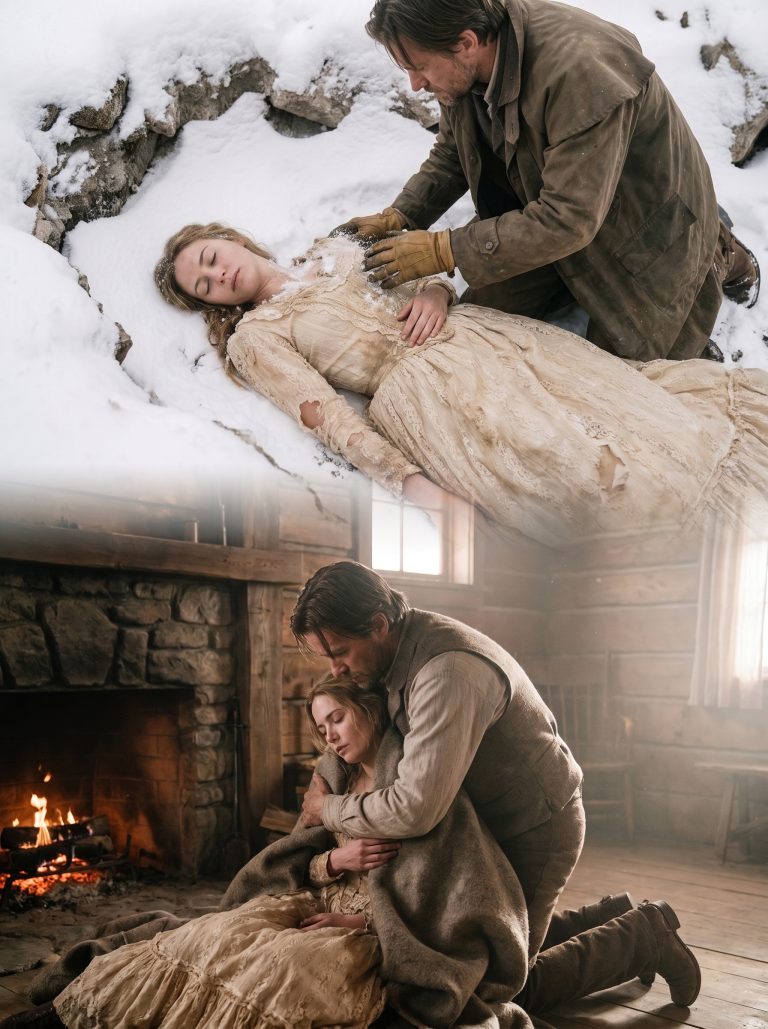
She Thought He Was Just A Poor Cowboy — Until He Took Her To His Secret Estate

Part 1
The gold coin hit the counter like a gunshot.
Not a ring. Not a word of courtship. Just cold metal, spinning once, twice, before settling flat against the wood — and the whole mercantile went so quiet that Elizabeth Carter could hear her own heartbeat over the sound of it.
“Marry me,” the stranger said.
She didn’t look up right away. She looked at the coin first — real gold, the kind most people in Willow Creek never touched more than once in a lifetime — and then, slowly, at the man who’d placed it there. Worn boots, cracked at the left toe. A jacket gone thin at the elbows. Dust still settling off his shoulders from the road. He hadn’t shaved in days, and his hat sat low enough that half his face stayed in shadow.
A drifter. A nobody. And he was asking her to marry him like it was the simplest transaction in the world.
“I don’t know you,” she said.
“No,” he agreed. “You don’t.”
“Then why would you ask?”
“Because I need a wife.” He said it the way a man states a fact he’s turned over a hundred times before speaking it out loud. “And I think you need something, too.”
Elizabeth felt every eye in that store find her at once. Old Mr. Hennessy had stopped pretending to stock his shelves. Martha Puit and her daughter had gone still by the window. Even the stock boy had poked his head around the corner. Willow Creek was watching, and Elizabeth had lived here long enough to know that whatever she said next would be the only thing anyone talked about until spring.
She thought of her brother. Thomas. Sixteen years old, burning up in the bed behind the thin wall of their rented house. Doc Harlan had come that morning, checked the fever, and set the bill down on the table without a word he needed to say out loud — three days, and then no more medicine, no more visits. She thought of seven years of sewing until her fingers bled, of stretching three dollars until it felt like ten, of surviving every single day since their mother died and their father rode out and never came back.
She picked up the coin. It was heavier than she expected.
“One coin doesn’t buy a wife,” she said.
“No,” the stranger answered. “But it tells you I’m serious.” He tipped his hat back just enough to let her see his eyes — steady, dark brown, not the eyes of a desperate man or a fool. “My name is Caleb Whitmore. I have a place north, toward the mountains. I can give you a home. Food. Security. Whatever your family needs.”
“My family,” she repeated carefully.
“Your brother Thomas,” he said, quiet, like he was handling something fragile. “Doc Harlan’s been treating him at your house for two weeks. The bill’s past due.”
Her grip tightened on the coin. “How do you know that?”
“It’s a small town. People talk.”
She studied him a long moment. He didn’t fidget, didn’t fill the silence to make it easier on either of them. He just waited — and that stillness, more than anything, unsettled her.
“You’re a cowboy,” she said finally. “You look like you barely have enough for your own supper.”
Something moved behind his eyes. Not offense. Something quieter.
“I have enough,” he said. “More than enough.”
Martha Puit couldn’t help herself. “Elizabeth,” she said from across the store, not even pretending she hadn’t been listening. “Surely you’re not actually considering—”
“I don’t recall asking, Martha.”
The room went silent again. Elizabeth looked back at Caleb Whitmore.
“Give me until tomorrow morning,” she said.
He nodded once, put his hat back down, and walked out without another word. The bell over the door was still swinging when the whole mercantile erupted into whispers.
She didn’t sleep that night. She sat at her small table with the coin in front of her and her needle untouched beside it, listening through the thin wall to Thomas’s cough — the same deep, rattling cough that had started in September and never let go. Doc Harlan had given her three days to settle the bill. After that, there would be no more medicine and no more visits. She was twenty-six years old. She had been the head of this household since she was nineteen. She had done everything a person was supposed to do to survive, and it still wasn’t enough.
At four in the morning, Thomas called out from the other room. Not in pain — just restless.
“Lizzy.”
She sat on the edge of his bed. Sixteen and looking twelve, whittled down by fever until he seemed made of nothing but sharp eyes and stubbornness.
“A man came into the store today,” she told him. “Asked me to marry him.”
Thomas went very still. “What kind of man?”
“A cowboy. At least that’s what he looks like.” She turned the coin over in her palm. “He gave me this.”
Thomas’s eyes widened. “That’s a twenty-dollar gold piece. Mr. Hennessy showed me one once, behind the counter. Said he’d only ever seen three in his life.”
“I know.”
“What are you going to do?”
Elizabeth closed her fingers around the coin, and for the first time in seven years, she made a decision that had nothing to do with careful math and everything to do with something she couldn’t yet name.
“I think,” she said slowly, “I’m going to say yes.”
She had no way of knowing that by morning, she would agree to marry a man whose name the whole territory would one day know — or that his ragged appearance concealed one of the largest estates in the territory.
Part 2
She found him at the edge of town the next morning, sitting on a fence post, eating an apple like he had nowhere else in the world to be.
“I have conditions,” Elizabeth said before he could even stand.
Something that might have been respect flickered across his face. “All right.”
“My brother comes with me. Whatever you’re offering — it covers him too. Medicine, care, everything, until he’s well.”
“Agreed.”
The speed of it threw her off balance more than any argument could have. “I want the truth about where we’re going,” she said. “I won’t take my brother somewhere unsafe. I won’t find out too late that I’ve made a mistake I can’t undo.”
“You won’t be in danger,” Caleb said. “That much I can promise you plainly. We’ll travel by daylight, make camp in the open where you can see everything I do, and Thomas won’t be out of your sight for a mile of it. If at any point you want to turn back, I’ll take you back myself, no argument. The rest — what it looks like, what it means — I’d rather you see for yourself than hear it from me first.”
“Your word.” She turned the phrase over like a merchant checking for counterfeit. “I don’t know you well enough to know what that’s worth.”
“No,” he admitted. “Not yet. But you’ll find out.”
She studied the cracked leather of his boots, the thinning collar of his coat — the unmistakable look of a man who’d had a hard season. Except there was something underneath it, a gravity that had nothing to do with money and everything to do with a man who knew exactly where he stood in the world.
“One more condition,” she said. “This is a partnership, not a transaction. I’m not furniture in someone’s house. If I come with you, I work, I contribute, I have a voice.”
For the first time, Caleb Whitmore smiled — small, brief, and it changed his whole face.
“Agreed,” he said. “All three.”
She shook his hand. Firm. Direct. The handshake of someone who meant it.
They were married that same morning, in the small chapel at the edge of Willow Creek. Doc Harlan and Thomas stood as witnesses, Thomas propped between two pews with a blanket around his shoulders because he’d refused, flatly, to miss it. Caleb spoke his vows without hesitation, his eyes steady on hers the whole time. Elizabeth held the gold coin closed inside her fist through the entire ceremony, still unsure whether she had just saved her brother’s life or signed away her own.
Doc Harlan pulled her aside afterward, not to congratulate her, but to tell her plainly that Thomas’s fever had finally begun to break overnight — that two days of easy travel, real food, and mountain air might do the boy more good than another week confined to a sickbed in town. It was the only thing that made the timing bearable to her at all.
They left Willow Creek two days later while the town watched from behind curtains, certain they were witnessing a foolish woman throw herself away on a penniless drifter. Nobody waved. Nobody needed to.
The road north climbed for two days through pine cathedral-light and past bridges built far too well for a trail that supposedly led to nowhere — fence lines strung with good wire, professionally set, stretching farther than any poor man’s land should stretch. Elizabeth noticed. She said nothing. Not yet.
On the afternoon of the second day, Caleb reined the wagon to a stop at the crest of a long ridge, and something in his voice made her go still before he’d said a single word.
“Before we go over,” he said, “I need to tell you something.”
Her heart moved in a way that wasn’t fear, exactly. Alertness.
“I wasn’t entirely honest with you in Willow Creek,” he said. “About what I have.”
Below them, she could already hear it — the low, spreading murmur of cattle settling in for evening, hundreds of them, rich and heavy on the wind. Then Caleb clicked the horses forward before she could ask another question, and the wagon crested the ridge, and Elizabeth Carter stopped breathing.
Because what waited on the other side of that mountain was not a poor cowboy’s homestead.
It was a mansion.
Part 3
The valley opened beneath them like something out of a story nobody would have believed if they’d been told it beforehand.
Elizabeth had braced herself, at best, for a comfortable homestead — a proper cabin, maybe a barn in decent repair, thirty or forty head of cattle if the season had been kind. What she saw instead made the breath go out of her chest in one long, silent rush.
The valley floor was green — impossibly green for this late in the year, which meant irrigation, which meant engineering, which meant resources she couldn’t begin to calculate from a wagon seat. The fencing wasn’t the rough wire she’d glimpsed through the trees on the way in. It was proper ranch fencing, mile after mile of it, perfectly maintained, catching the last of the afternoon light like a spider’s web made of silver. Three barns stood in a loose triangle below, enormous, their roofs solid, their timber walls straight as rulers. Beyond them, smaller structures — a bunkhouse, something that might have been a smithy, buildings she couldn’t name from this distance.
And at the center of it all, set back on a small natural rise, the house.
It was not a cabin. It was not even a large farmhouse. It was two full stories of cut stone and honest timber, a covered porch running the entire length of the front, windows that caught the dying sun and threw it back like they had something to prove. It was a house that had taken years to build and more money than most people in Montana Territory would see in a lifetime.
Elizabeth turned, very slowly, to look at the man beside her.
Caleb Whitmore was watching her face the way a man watches weather roll in over open country — careful, and afraid of what it might do.
“Who are you?” she said.
His jaw tightened. “The same man you agreed to marry.”
“That is not a poor cowboy’s home.”
“No,” he said quietly. “It’s not.”
“I want the truth. Right now. Before we go one foot further.”
He set the brake, climbed down, and came around to stand below her — looking up, for the first time since she’d met him, without any of that careful stillness he wore like armor. What she saw instead looked almost like fear.
“My name is Caleb Whitmore,” he said. “My family has owned this valley for twenty years. My father built that house. When he died five years ago, it passed to me. All of it. The land, the cattle, the buildings — everything you’re looking at.”
The wind moved through the pines behind them, and for a long moment that was the only sound.
“Then why,” Elizabeth said, with great and terrible precision, “were you in Willow Creek wearing a coat with holes in the elbows, asking a seamstress to marry you?”
“Because I’ve been looking for someone for three years,” he said. “Someone who would see me — just me — without all of this standing in the way. Every time I told the truth first, all anyone could see was the estate.” He held her gaze like it cost him something to do it. “I needed to know if you would still choose me when there was nothing to gain.”
She looked down at the valley — the mansion, the barns, the herd moving below like a slow, dark river — and then back at him.
“You lied to me,” she said.
“I never said a false word.”
“You let me assume.”
“…Yes.”
“That is still a lie, Caleb. A lie by omission is still a lie.”
He didn’t argue it. He simply took the weight of it the way a man does when he knows exactly what he’s earned.
“You’re right,” he said.
Behind them, in the wagon, Thomas had gone completely silent — sixteen years old and cataloging every word like evidence.
Elizabeth looked at the valley one more time and let everything she’d left behind rush back through her — the thin walls of her rented house, the seven years of just enough, Thomas’s face when he thought she couldn’t see him worrying about money. Then she thought of what Caleb had agreed to at the fence post: a partnership, not a transaction. I have a voice. He’d paid Thomas’s bill before they left. He’d packed real food for the road. He’d told her sick sixteen-year-old brother, without a single second of hesitation, we’ll take care of each other.
None of that had changed. But something else had, and she didn’t yet know what to do with it.
“Take us down,” she said.
He looked at her sharply.
“I didn’t say I forgave you,” she said. “I said take us down. I want to see what else you haven’t told me.”
Relief moved across his face — not triumph, just the particular relief of a man who has braced for the worst and been handed something more complicated instead.
The Estate
A white-bearded foreman named Samuel Cole met them in the yard, and the word he used for Caleb — boss — landed on Elizabeth like a small, quiet confirmation of everything she was still trying to absorb. Samuel’s wife, Mrs. Cole, had a room ready for Thomas within twenty minutes, hot food on the table, willow bark tea steeping before anyone had asked. From the last stage station, two days back, Caleb had sent a rider ahead — not from certainty, he would tell her later, but from a hope he hadn’t quite let himself trust. Twenty-two people worked this estate full-time, and every one of them had been told there was a chance the boss might come home with a wife.
Looking around the yard at the readied room, the warm food, the quiet efficiency of people who’d been given only a little time to prepare, Elizabeth understood that someone here had believed she might come — believed it enough to make ready, without ever being certain of it at all.
“You were very sure of me,” she said to him that first night, standing in the front hallway of a house too large and too lived-in to be what she’d expected — good wood floors scuffed with boot traffic, ledgers stacked next to seed catalogs, a fireplace built because it needed to be big, not because it needed to impress anyone.
“No,” Caleb said. “I was hopeful. There’s a difference.” He told her, then, about a woman named Clara Donovan — three years ago, in Billings, honest from the very first conversation, brought out here with nothing hidden. She had lasted four months. Said the estate felt like a prison, he told her. That I felt like a prison.
Elizabeth understood, in that moment, exactly what the worn coat and the gold coin had really been. Not manipulation. Fear. The particular fear of a man who had been chosen for his wealth once and abandoned for his solitude, and had decided he would rather be chosen for nothing and found worthy, than chosen for everything and found lacking.
“I’m not Clara Donovan,” she said.
“No,” he agreed. “You’re not.”
“And I am still angry with you,” she said. “That’s going to take time before it isn’t.”
“That’s fair,” he said, and meant it.
What the Ledgers Said
She asked to see the account books on the second morning, and the request stopped him cold — as if no one had ever asked before. What she found surprised her, not because the numbers were bad, but because they were good in ways that were unusual for a man of his means: fair wages above the territory standard, heavy spending on medical supplies and winter stores, and three quarterly payments to neighboring families logged simply as agreements, with no further explanation.
“My father made arrangements when he was expanding the land,” Caleb told her. “Let some families sell without a fight. In exchange he promised quarterly payments as long as the estate ran.” One recipient was a widow named Malone, still receiving payments twelve years after her husband sold his land and died.
“You could have found legal grounds to end these when the land transferred,” Elizabeth said.
“They were promised,” Caleb answered, like the sentence explained everything, because to him it did.
She thought about a man who honored his dead father’s promises to people with no legal power to demand it. She thought about the workers moving through the yard with the particular ease of people who trust that the ground under them won’t shift without warning. She was still angry with him — that hadn’t changed. But she was beginning to understand the actual shape of his character, and it was a very different thing from the shape of his fortune.
Richard Holloway
The trouble arrived on the sixth day, riding in from the south road on a good horse, wearing an expression of a man very pleased with something he hadn’t yet revealed.
“That’s Richard Holloway,” Samuel said under his breath before the rider had even dismounted. “Owns the two ranches east of the Getty land. He’s wanted this valley for ten years. What’s stopped him is Caleb.”
Holloway crossed the yard as though he already owned it. When he noticed Elizabeth, calculation flickered behind his polished smile. “Mrs. Whitmore,” he said, all silver-templed charm. “I’d heard Caleb had finally gotten himself a wife. I didn’t believe it.”
She let exactly one beat of silence pass before she answered — enough to make clear she moved on her own timing, not his — and went to find her husband.
Whatever ease had been building in Caleb over the past week vanished the moment she said the name. He crossed the yard to meet Holloway, and Elizabeth watched from the study window as a folded document changed hands, as Caleb refused to take it, as Holloway’s assembled smile tightened at the edges into something closer to a threat wearing a smile’s shape.
“He’s made a legal claim on the south pasture,” Caleb told her afterward, staring at his desk. “Forty acres. Says there’s a boundary dispute going back to my father’s original filing. He’s been building this case for two years. I should have seen it coming.”
“Tell me everything,” Elizabeth said, and pulled up a chair.
“Elizabeth.” His voice had an edge to it she hadn’t heard before. “This is six days into a marriage, and you’re already—”
“Either this is a partnership or it isn’t,” she said. “Tell me everything.”
He opened the desk drawer.
The documents told a simple, ugly story. Caleb’s father’s original land filing was clean — twenty years old, properly witnessed, solid as the stone walls around them. But beside it lay a survey commissioned by Holloway three years earlier, its boundary line sitting a full forty yards inside Whitmore land — and a signed witness statement, allegedly given before his death by a man named Gerald Puit, claiming the original survey had been measured wrong.
Elizabeth went very still. “Puit,” she said. “Martha Puit’s late husband.”
“He died eight years ago,” Caleb said. “Before he died, apparently, he gave a statement to a land agent in Billings.”
“A signed statement from a dead man,” Elizabeth said, “that nobody saw until Holloway produced it two months ago. Why now? Why wait eight years?”
“My father was still alive then,” Caleb said slowly, working it through as he said it. “No territorial judge would have challenged an old man’s own filing while he was standing in front of them. Holloway needed my father gone first.” He looked up. “He waited until the estate passed to me, and until I started spending time away from it.”
Without the south pasture and its creek, the herd would have to be cut by a third. It wasn’t forty acres. It was the beginning of the end of everything this place was.
“He knows exactly what he’s doing,” Elizabeth said. “He’s been building this since before you ever went to Willow Creek. He waited until you were away from the estate for weeks at a time. That’s not luck. That’s a man who watches his neighbors closely.”
Martha Puit’s Parlor
“We need to go back to Willow Creek,” Elizabeth said the next morning, over coffee neither of them had touched. “Martha Puit knows something. Gerald Puit was a man who liked to talk, and if he ever told his wife anything about that south boundary, she knows it.”
“Martha Puit doesn’t like you,” Caleb said carefully.
“Martha Puit doesn’t like anyone who doesn’t need her approval,” Elizabeth said. “That’s a different problem. She’ll talk to you. I’ll stay in the wagon if it gets you further through her door.”
They found Willow Creek smaller than Elizabeth remembered, and the town’s eyes on her changed — not the cold, pitying stares of a poor seamstress who’d thrown herself away, but something closer to grudging curiosity. She had gone north and come back, apparently, not starving.
Martha’s face, when she opened her door, moved through surprise, defensiveness, and something harder to name — the look of a woman who had been waiting years for someone to finally ask her the question sitting in her chest.
“We’ve come,” Elizabeth said, “because we need information about Gerald.”
Something shifted behind Martha’s composure. “Who told you about that?”
“Richard Holloway has a signed statement. He’s using it to claim forty acres of Whitmore land.”
Martha’s jaw tightened, and for a long moment she looked at nothing at all — the past, weighed and measured.
“A man came to the house about six months before Gerald died,” she said finally. “Said he was doing historical research on early territory surveys. Very polite. Gerald liked him. Talked to him for two hours, showed him his record books — he kept a record of every survey he ever witnessed, going back decades. Very precise man, Gerald.” Her voice thinned. “After the man left, Gerald told me he’d been asked to sign a document confirming something about the Whitmore south line that wasn’t what he remembered. He told me he hadn’t signed it. He said, Martha, that line was where old Whitmore put it, and I won’t say otherwise.”
The room went very quiet.
“But there’s a signed statement,” Elizabeth said gently, “with Gerald’s name on it.”
“I know.” Martha’s composure cracked, just slightly. “About a month after Gerald died, the same man came back. Said he wanted to return Gerald’s record books, pay his respects. I let him in. I offered him coffee. He spent an hour helping me sort through everything.”
She stopped. She didn’t need to finish.
“His record books,” Caleb said quietly. “Were they in order, later?”
“One page was missing,” Martha said, and her eyes were bright with an anger she’d apparently been carrying, unnamed, for eight years. “From the entry for the Whitmore south survey. I thought Gerald must have removed it himself.”
“He didn’t,” Elizabeth said.
“No,” Martha said. “I don’t think he did.”
She agreed to testify before either of them asked her twice. “Gerald was a precise man,” she said, straightening in her chair like a woman settling an old debt. “And I am a precise woman. I will not sit in this town and let Richard Holloway use my dead husband’s name to steal fairly bounded land.”
Helena
The field notes from the original 1867 survey — the ones a fire had supposedly destroyed — turned up intact in a storage room the flames never reached. Elizabeth found the sealed box herself, buried in a back corner beneath obsolete tax ledgers nobody had touched in eighteen years. Her hands shook as she lifted the lid; Caleb stood beside her, suddenly unable to speak. The numbers were unambiguous. The boundary of the Whitmore south pasture sat exactly where it had always been filed. Not forty yards north. Not a foot.
“It’s here,” Caleb said, his voice level and his jaw tight with something that was neither anger nor relief and entirely both.
They filed an injunction with a lawyer named Henry Cass that same afternoon, and told the story — carefully, factually — to a newspaper editor named James Whitfield, who had known Caleb’s father and had no patience left for powerful men who thought money could bury the truth. Dead Man’s Name Used in Territorial Land Fraud ran across two columns three days later, and it was the most-read piece the territorial record had printed in two years.
“He’ll come after your reputation,” Cass warned Caleb, before the hearing. “The story about Willow Creek. He’ll call it deceptive character.”
“Let him,” Elizabeth said, before Caleb could answer. “Let the jury hear that a man went from town to town for three years looking for someone who would see him as a person instead of an estate — and found one. That’s not a liability. That’s character.”
The Hearing
The Helena courtroom was full, packed with people who’d read Whitfield’s article and wanted to see the rest for themselves. Holloway sat beside the territory’s most expensive lawyer, a man named Thomas Webb, wearing the strained composure of a man fighting to remain calm. Martha Puit sat alone in the second row in the black dress she’d worn to Gerald’s funeral, and when Elizabeth caught her eye, she gave one small, precise nod. Not warmth. Resolve. It was better than warmth, that day.
Webb was good — good enough to make theft sound like correction, forgery sound like a twenty-year-old error finally being addressed. He cross-examined Martha with careful, surgical respect, trying to dismantle a widow’s memory without looking like that was what he was doing.
“Memory is imperfect, Mrs. Puit, particularly over—”
“Gerald told me on a Tuesday evening in October,” Martha said, cutting through him without raising her voice, “that a man named Peters had asked him to sign a document he refused to sign, because it wasn’t true. I am not misremembering, Mr. Webb. I am a precise woman. Gerald knew it, and I know it.”
Webb had no further questions.
When he turned to Caleb about Willow Creek — about the deception, the concealment, the coat with holes in the elbows — Caleb didn’t flinch.
“I was looking for a wife,” he said. “I’d learned that when people knew the extent of my estate, the estate was what they responded to, rather than me. I chose to give people the opportunity to know me without that information in the way. I’m not ashamed of that choice.” He didn’t look at Elizabeth when he added, “My wife went to Willow Creek and heard Martha Puit’s testimony herself. She traveled two days each way and found the original field notes with her own hands. She is the most clear-eyed person I have ever met. If she’d found reason to doubt my character, she would have told me to my face.”
The room turned to look at her. She held every gaze without flinching.
Judge Douglas Holt took one hour to decide, and delivered his ruling in twelve unhurried minutes: the boundary confirmed exactly as filed in 1867, Holloway’s claim dismissed, and the matter of Gerald Puit’s forged statement referred to the territorial attorney’s office for investigation.
The gavel came down. The room exhaled all at once. Martha Puit closed her eyes and mouthed something that was either a prayer or a private word to a husband eight years gone. And Caleb — steady, careful, armored Caleb — laughed, short and surprised, like a man who’d braced for every outcome except the one he’d needed most.
“We won,” he said.
“We won,” Elizabeth confirmed.
Sundown
They rode home in the good kind of silence — the kind between two people who are learning, slowly, to trust each other. Thomas met them at the gate, read their faces the way he’d been reading hers since he was small enough to need her to survive, and asked, simply, “You won?”
“We won,” Caleb said, and Thomas — sixteen and far too old for it, and doing it anyway — crossed the yard and put his arms around his sister and held on.
That night, standing in the kitchen with tea neither of them could sleep enough to skip, Caleb told her what his father would have said about all of it — that a man who builds something real doesn’t fear a man who builds something false. And then, quieter, the thing he’d apparently been circling for weeks:
“I love you,” he said. “I know it’s too soon. I know you might tell me that, and you’d be right.”
“It is too soon,” Elizabeth said. “I’m not there yet.”
“I know.”
“But,” she said, carefully, “I’m closer than I was yesterday. And yesterday I was closer than the day before.” She held his gaze. “That’s not nothing.”
“No,” he said softly. “That’s not nothing.”
He gave her his father’s old study the next week — three windows, the best light in the house — for her sewing, for the work from Helena she now had the contacts to take on. Not decoration. Not management of a household that ran perfectly well without her. Her own thing.
She stood in the yard of the hidden valley estate the morning they came home for good, the Montana sky enormous overhead, and understood — with the same clear-eyed certainty that had carried her through seven years of just enough — that she was exactly where she was supposed to be. Not because of the stone walls, or the green impossible pastures, or anything Richard Holloway had tried so hard to take.
Because some people build their homes out of timber and inherited acres. And some people build them out of something no lawyer, no forger, and no man with a grudge could ever survey, forge, or steal.
Caleb Whitmore had spent five weeks proving it.
Elizabeth Carter had walked into it with nothing but her own clear eyes, her seamstress’s hands, and the unbreakable knowledge of what it means to build something real.
Love was coming more slowly than either of them had expected, and neither one of them minded the wait. They had built trust, side by side, out of ledgers and long roads and a widow’s testimony — and for a woman who had learned to measure everything carefully before trusting it, trust was never a small beginning.
THE END