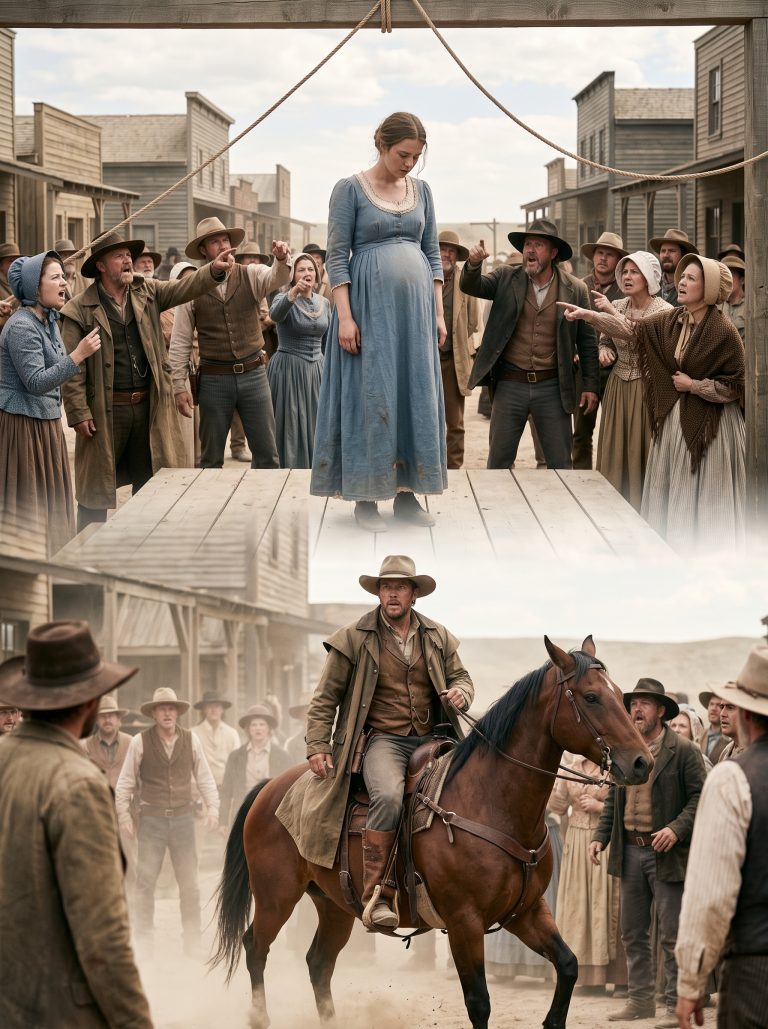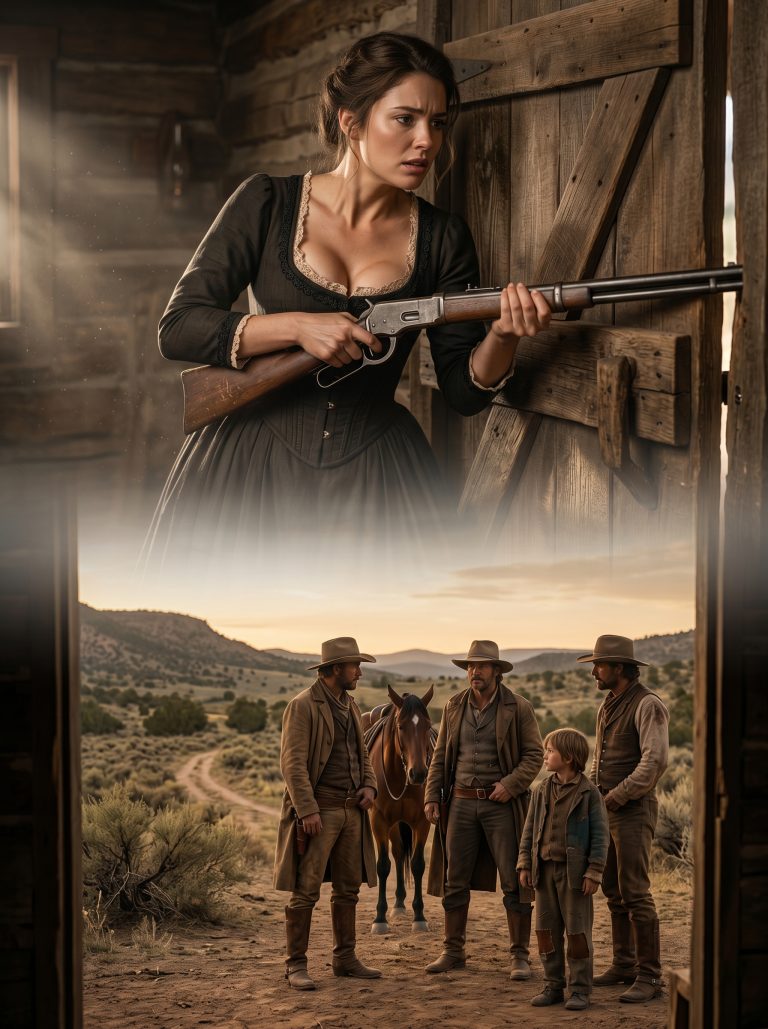
He won her father’s ranch in a poker game… but what the daughter did next changed everything.

PART 1
The first lie people told about Coldwater was that it was a piece of land.
Maya had been seven when her mother explained the truth while planting peach seeds wrapped in cloth beside the south garden. This land, Eliza had said, pressing dark earth over fragile hopes, this is only a home if someone loves it harder than the world wants to break it.
That was eighteen years ago.
Seventeen years ago, her mother died of fever nobody could cure, and her father discovered that grief was a thing that could hollow a man from the inside out, leaving only the shape of a person behind.
Now Levi moved through Coldwater as if surveying property rather than trespassing on a woman’s last stand.
He started with the barn—walked the perimeter, tested support posts with his hand, made quiet assessments she recognized as the kind of thinking done by men who knew how to work. Then the house. Then the creek. He didn’t ask permission. He didn’t touch the blue gate her mother had painted the year of the drought, the year Eliza had looked at a dry season and chosen hope anyway.
That night, Maya left his supper on the barn steps. Cold beans. Hard biscuit. Exactly nothing more.
“I didn’t ask for this,” he said when she came to retrieve the plate.
“My father didn’t ask for the hand of cards he was dealt either. We survive what comes regardless.”
“That’s not what I meant.”
But she was already walking back toward the house, the rifle heavy but familiar in her grip, the weight of defending something alone settling deeper into her shoulders with each passing hour.
Levi slept in the tack room. Maya knew because she didn’t sleep, and the sound of a stranger breathing in what had once been her world became the new rhythm of night. By dawn, he had already repaired a section of fence that had waited weeks for hands strong enough to care about its fixing. By noon, he had reset two corral rails she had been meaning to fix. By sunset, he had cleared debris from the dry wash with the methodical patience of a man who understood that work was the only language some people trusted.
He didn’t ask for gratitude.
That might have been the smartest thing he did.
On the fourth day, her hand trembled when she handed him coffee. Not from fear. From something harder to name—a crack in the wall she had built so carefully around the part of her that wanted to believe a stranger might simply help without counting the debt.
“There’s hay in the east pasture,” she said, not looking at him. “The dun cow won’t bring much, but if we drive the forty-three head down by week’s end, Pritchard might pay cash. Not much, but enough.”
Levi set his cup down carefully. “You’re saying we?”
“I’m saying I have twenty-six days before Rusk comes to collect. I’m saying my father’s drinking created a winter note with a vulture’s terms. I’m saying if you’re going to steal my home, you might as well help me figure out if it’s worth stealing.”
The look he gave her lasted long enough to make her uncomfortable, long enough to suggest he understood what she wasn’t saying: that alone, she would lose. That with help, there was maybe a chance. That asking for help was harder than any physical blow she had ever endured.
“I’ll help,” Levi said.
They worked like two armies in temporary truce.
Days bent into each other—gathering cattle under a sky white with heat, mending harness until Maya’s fingers bled, repairing fence in the evening when the work was most visible to any neighbor who might offer support. Pritchard bought the cattle. The price was less generous than hoped but enough to stop the bleeding temporarily. They bought flour, salt, wire, and seeds. Levi traded spurs no sane rancher would give up for seed grain, and when Maya asked why, he answered simply: “Soil comes before decoration.”
The day before Rusk was supposed to arrive, the windmill broke.
The brake rope was cut clean through. The shaft had been bent with deliberate force. Maya saw it at first light and her entire body went rigid with a fury so pure it scorched.
“That’s him,” she whispered.
“Likely.”
“We ride to town. We show them. We—”
“We fix what’s broken and keep water moving,” Levi said. His voice was quiet in the way that suggested he had seen too much to be shocked by cruelty. “Let him laugh while knowing Coldwater still stands.”
She wanted to argue. Instead, she steadied the ladder while he climbed the tower, and when his bad leg slipped on the third rung, she steadied it harder without comment, without sympathy, with only the fierce determination of someone who had decided, without meaning to, that this stranger might be worth keeping alive.
That night, they sat at the kitchen table with the winter note between them and a lantern burning low.
“We need to know exactly what we’re fighting,” Levi said.
Maya had the ledger memorized, but she walked him through it anyway. The debt was real. The interest was predatory. The timeline was impossible. But somewhere between calculating possible losses and examining Rusk’s signature, something shifted. They weren’t two enemies anymore. They were two people staring at the same enemy, and that made all the difference.
“If we can gather everything sellable,” Maya said slowly, “if we work harder than we’ve ever worked, if the land cooperates and Rusk doesn’t burn us out before the deadline—”
“Then there’s a chance.”
She looked at him. Really looked at him—at the scar along his jaw from a war she hadn’t asked about, at the way his left leg bore his weight differently, at the careful control in his hands as if he had learned decades ago that power could destroy as easily as build.
“Why didn’t you just take the deed and sell it back to him for profit?”
“Because you’re standing here. And somewhere between yesterday and tonight, that became the reason that mattered most.”
The words hung in the lantern light.
Maya’s breath caught in a way that had nothing to do with fear.
PART 2
They had twenty-one days left when Caleb Rusk arrived.
He came down the north road in a black coat that had never known honest work, mounted on a horse expensive enough to feed a family for a season, with hired men behind him and a smile that belonged to a man who had learned to profit from other people’s desperation.
Rusk’s gloves were cream-colored. Clean.
“I see the deed found a steward,” he said, his gaze landing on Levi before sliding toward Maya with a familiarity that made something in her chest go dangerous.
“I see you’re wasting the leather on those gloves,” Levi replied.
Rusk’s smile thinned.
He produced the note—folded, official, written in a hand that made Maya’s father’s handwriting look like a child’s scrawl. The debt was larger than she remembered. The penalties compounded. The claim against the creek—her mother’s creek, filed separate and legal—was listed as collateral.
“That’s not possible,” Maya said.
Rusk’s laugh was soft. “Your father was well past reading when I explained what you were both gambling with. He seemed relieved someone else was making decisions.”
Levi took the paper. His jaw tightened. “We’ll review the claim.”
“You have twenty-one days.”
After Rusk rode out, the ranch seemed to shrink. The house was smaller. The creek more vulnerable. The blue gate—that small, stubborn symbol of her mother’s impossible hope—seemed suddenly fragile enough to break if the wind blew too hard.
That night, Maya discovered the photograph missing from behind the mantel clock.
She found it in Levi’s hands, studied as if he were trying to understand something written in her mother’s face. In the image, Eliza Strand stood near the creek with young Maya at her side, holding a sapling, laughing at the camera as if the world had not yet learned to hurt.
“I’m sorry,” Levi said.
“Don’t be. She wanted to be remembered by someone other than me.”
The words came out broken.
The next morning, before dawn, Levi was gone.
Not permanently gone—his saddle remained in the barn, his bedroll was still in the tack room—but gone as in saddled and riding toward town with the papers tucked inside his coat and a look that suggested he was about to do something reckless.
He returned before sunset with three neighbors, the banker who had filed her mother’s original water claim, and Deputy Ortega, a lean, quiet man whose patience was famous because his temper wasn’t.
“Your mother filed the creek separate,” the banker said, sliding papers across the table. “Caleb Rusk falsified the claim to make it seem like collateral on your father’s note.”
Maya read the filing date with shaking hands.
The creek—her mother’s legacy, her own last defense—had never belonged to Rusk. Had never been his to gamble with. Had never been anything but hers.
Levi was watching her process this, and his face held something that looked like apology, like love, like the knowledge that saving her from one trap had created another: the understanding that she wasn’t alone anymore.
That night, the barn caught fire.
She woke to the smell of smoke and the sound of horses screaming.
PART 3
Winter came early and hard that year.
The rebuilt barn was only half-finished when snow fell in sheets so thick it erased the horizon. The scaffolding froze mid-construction. The feed situation had become critical. The final deadline passed—Rusk’s hold on the estate broken by the truth about the water filing—but the legal fight continued in town, and the mountain of immediate survival had not shrunk.
Maya sat in the kitchen with her hands wrapped around bitter coffee, watching Levi work through the calculations. They were still here. The ranch had not been taken. But taken and destroyed by grief were sometimes closer cousins than victory liked to admit. The barn had nearly burned them both to ash. The horses screamed in her nightmares still. The smoke had singed the hair from her left arm, and Levi’s shoulder would carry a bruise the size of a fist where the panicked mare had struck him while they were pulling animals to safety.
They had saved the horses. They had saved the house. They had lost the entire winter hay supply to flames that moved like something alive and intentional.
“Hay can be brought in,” Levi said, though neither of them believed it would be simple. “We have neighbors. People saw what happened. They’ll help.”
“Neighbors have their own families. Their own problems. And I’ve learned what sympathy costs—it always comes with an expectation of gratitude you can never quite repay.”
“That’s not what they’re offering.”
“How would you know? You’ve been here less than three months.”
The words came out sharper than she intended, but the fear underneath them was real. Fear that accepting help meant owing something. Fear that if she let anyone close enough to see how fragile her hold on Coldwater truly was, they would judge her for fighting so hard. Fear that Levi would realize what most men eventually did—that a woman alone on a difficult piece of land was more burden than romance.
Levi set down the calculations he had been working on. The numbers were brutal. The feed loss meant buying supplies at inflated winter prices. The barn reconstruction would take months longer now, maybe until spring. The cattle they had sold were gone, and Rusk’s men had taken the missing bay mare somewhere she had never been found.
What they had was ash and ashes and the cold knowledge that they were running on borrowed time and borrowed money and borrowed hope.
“I came here with nothing but a deed and a terrible hand of luck,” Levi said, and his voice had changed. It was quieter now. More certain. Less trying to convince her and more simply stating fact. “I was going to sell it. I was going to take whatever Rusk offered and disappear into territory where nobody knew the man I used to be. I was going to return to being a person who drifted through other people’s lives like smoke.”
“Then why didn’t you?”
“Because then I met you.”
She looked at him sharply. They had not acknowledged this out loud—the shift from enemies to allies to something that had no name she was willing to speak. They had worked beside each other in the terrible knowledge that the barn was burning. They had saved the horses by moving as one being, knowing without speaking what the other would do next. They had pulled each other from flames and smoke, and the intimacy of that survival had changed something fundamental.
“You don’t know me,” she said, but the argument felt thin even as she made it.
“I know that you held this place alone for seven years after your mother died. I know that you love something so fiercely that it terrifies you—not the land itself, but what happens if you fail to keep it. I know that you’re more afraid of being saved than of being destroyed, because destruction at least would be a choice you understand.”
“Stop,” she whispered.
“Why? Because if I say it out loud, you have to decide what comes next?”
The cold deepened outside. The creek froze at the edges, leaving the center running dark and determined. The peach trees slept beneath snow, their branches dark against white, waiting for spring that seemed impossibly far away. Somewhere in the yard, ice was forming in places that should have been liquid. Somewhere in the barn, animals they had saved were pressing close for warmth. And somewhere in the kitchen of her house, a man was on his knees asking her to stop being brave enough to say no.
She reached down instead and pulled him to his feet.
They didn’t kiss. Not yet. Not with the barn still smoking in their memories and the weight of impossible choices still sitting on the table between them. But she held his hand. After seven years of holding everything herself, she held someone else’s hand like that single point of contact was enough to change the entire equation.
“If we survive this,” she said, “everything has to change.”
“It already has.”
“No. I mean all of it. The way I am. The way I don’t let anyone close. The way I’ve built a life on the assumption that depending on another person is the same thing as weakness.”
“And if we don’t survive it?”
“Then at least I’ll have known what it felt like for someone to stand beside me instead of only in my way.”
Her father returned on the worst night of winter.
He rode in looking older than Maya remembered—a man who had been worn down by his own choices the way stone is worn by constant water. His beard had gone mostly white. His eyes carried the particular emptiness of someone who had lost the thread of his own narrative. But he was carrying something. Something wrapped in oilcloth. Something that changed everything.
He didn’t enter the house. He stood on the porch in the freezing dark and called out, and his voice sounded like a man asking permission to exist.
“The water filing,” he said, his hands shaking so badly he could barely hold the packet. “I found the copies. Your mother kept them separate. She never trusted Rusk. She never trusted the kind of men who could smile while explaining how they were stealing from you.”
Inside the packet: pages from an old ledger, a receipt from a bank in Santa Fe, and a copy of Eliza Strand’s original water filing. The ink had faded but remained legible. The date was clearly before Silas Harrow’s winter note. The date was clearly before Caleb Rusk had ever come sniffing around Coldwater looking for water rights and profit margins.
The creek—the thing that had made Coldwater worth fighting over, the thing that had driven Rusk into their lives with his expensive gloves and his poisoned charm—had never been collateral on her father’s debt. It had never been his to gamble with. It had always been hers.
“Why now?” Maya asked, and there was no anger in her voice. Only exhaustion. Only the particular tiredness that comes from fighting so long that victory arrives as just another form of battle.
Her father’s eyes filled with tears that froze before they could fully fall. “Because I watched a man with a piece of paper show more honor in a month than I’ve accumulated in a lifetime. Because I realized that my daughter was right—that I’m a coward and a liar and a man who took his grief and decided to pour it out on the person who needed him most. Because I’m dying, and I won’t die with this secret still weighing on my soul.”
“You’re not dying,” Maya said, though she could see the truth of it in the way he held himself. In the way his cough sounded wet and heavy. In the way his fingers trembled with more than cold.
“Not immediately. But soon enough that I need this done. That I need you to know that the thing you’ve been protecting doesn’t belong to Rusk. That your mother—that Eliza—she protected you the way only a woman who knew how men operated could. She made copies. She filed separate. She loved you enough to assume the worst about the men you would someday have to fight.”
Levi appeared in the doorway then, and he took the packet with hands that were steady. He read it slowly. Then he looked at Silas Harrow—at the man who had gambled away his daughter’s inheritance, at the man who was dying, at the man who had finally, finally tried to stand where he should have stood all along.
“We’ll need witnesses,” Levi said simply. “And a lawyer. And Deputy Ortega.”
By morning, the legal machinery was in motion. By afternoon, Caleb Rusk’s false claim had been exposed in front of enough people that no judge in the territory would touch it. The water filing was real. The original date was legal. The creek belonged to Maya—not as collateral, but as legacy. Not as property, but as inheritance.
The next morning, Rusk came with eight men and absolute certainty that the day belonged to him.
He brought horses heavy with ammunition. He brought hired men whose faces had learned to look cruel. He came expecting to collect property and instead found standing on the porch not just a woman with a rifle anymore. Standing there was the banker. Deputy Ortega with three deputies of his own. Neighbors who had watched too long and decided to arrive finally. Silas Harrow, pale and coughing but standing upright for the first time in years. And beside Levi stood Maya, holding the filing in one hand and her mother’s name in the other like a weapon made of truth.
Rusk looked at the documentation and understood that Caleb Rusk—for the first time in a business career built on predation and fraud—had miscalculated fundamentally.
“This is not finished,” he said, turning his horse to leave.
“It is,” Maya replied, her voice clear and certain. “Here it is finished.”
His men followed him without argument. Some men only need to be shown their own failures once to understand that persistence would only make them clearer.
Spring came slowly after that.
The barn rose brick by brick under Levi’s hands and her father’s effort to prove redemption was possible, even for men who had failed their families so completely. The peach trees budded. The creek ran high with snowmelt. Neighbors brought hay and supplies and the complicated grace that comes from community choosing to help in the aftermath of near-disaster.
The legal fight continued in town—Rusk tried twice to return with new lawyers and new claims—but each time, the filing held. Each time, the evidence was clear. Each time, the water rights stayed with Maya.
Silas lived through that winter and into the next, though his cough never fully cleared and his hands never quite stopped shaking. He slept in the bunkhouse at first, and Maya didn’t speak to him beyond necessary instructions.
“Water the stock.”
“Stack that wood.”
“Fix the south gate before the cattle break through.”
He obeyed without complaint. He didn’t ask for forgiveness. He didn’t demand recognition. He simply worked, and over time, the work became a language that neither of them had expected could translate between a father’s shame and a daughter’s anger.
One cold dawn, after six months of this careful distance, Maya made two cups of coffee in the pre-dawn dark. She set one on the porch rail without speaking and went back inside.
Her father found it there. He stood holding the warm cup with both hands as if it were the most precious thing anyone had ever offered him. For a moment, father and daughter looked across seven years of anger and love and abandonment twisted together into something nearly unrecognizable.
He took the cup and said simply, “Thank you.”
Not forgiveness complete.
Not absolution earned.
But evidence that repair was possible. That a man could fail so catastrophically and still earn the right to try again. That a daughter could hold onto her anger and still offer kindness. That some relationships didn’t need to be perfect to be worth maintaining.
He drank the coffee standing on the porch while watching the sun rise over the ranch that had nearly destroyed him and that was now, finally, healing him back toward something resembling human.
Levi found Maya in the half-built barn one afternoon in late spring, standing among new lumber and sunlit dust that moved like living things through the geometric beams. He had been gone since dawn, riding to town on business he hadn’t explained.
“I sold the watch,” he said simply, producing a receipt and the materials list from a supplier in Mesilla.
“The cavalry watch? The one you brought with you?”
“Bad timekeeping anyway. Kept stopping at the worst moments.”
She understood what he wasn’t saying: that he had sold the last piece of his old life—the only thing from his time as a soldier, the only object that connected him to the man he used to be—to buy materials to build her future. That he had no intention of leaving. That the deed he had won in that card game at the Copper Kettle was valueless to him compared to the life they were building by choice.
“Why?” she asked, though she already knew the answer.
“Because you love this place. And I’ve learned that loving what you love is the strongest foundation any house could have.”
He drew the deed from his pocket then—worn soft at the creases from months in his vest, carrying his name in the handwriting of a man who had sold everything while drunk on shame and desperation.
“This should be yours,” Levi said, extending the paper.
Maya stared at the document that had caused so much pain, so much anger, so much work and sacrifice and fear and the kind of terror that comes from fighting a battle alone for so long you forget what having help feels like.
Then she took it, unfolded it slowly, looked at the name that was not hers, and tore it straight down the middle.
The paper came apart with a sound like something breaking and being released simultaneously.
“My mother taught me to keep copies of everything important,” Maya said, holding up a second document—the real filing, the legal one, the one with her name written clear. “She never trusted men who smiled while explaining legal matters. She said that a woman who didn’t keep her own copy of her own property was a woman who deserved to lose it.”
Levi laughed—a sound that filled the half-built barn with something that felt like hope finally becoming real.
“She sounds like someone I would have liked.”
“She would have told you your hat was ugly and your boots were worn through at the heel.”
“She would have been right on both counts.”
“Then she would have fed you biscuits that were deliberately hard to build your character and keep you honest.”
“I would have deserved that kind of woman in my life.”
“So do I,” Maya said quietly. “So did I.”
They married in June beneath the cottonwoods near the creek, with the water running clear and the blue gate newly painted a fresh, confident blue and Silas standing among the witnesses, tears streaming down his weathered face as his daughter passed, pausing only long enough to touch his arm.
Not forgiveness complete.
But evidence that repair was possible, even for families that had been broken in the deepest places.
Deputy Ortega witnessed the license and cried openly without shame. Mrs. Alvarez from downriver brought a borrowed dress and wept louder than the bride. Pritchard brought supplies he pretended he hadn’t. The preacher asked the questions that mattered, and when he asked whether Maya Strand would take Levi in marriage, she looked first at the creek—at her mother’s legacy, at the water that had cost her so much to defend—then at the house she had held alone, then at the gate her mother had painted with impossible hope.
“I do,” she said.
When Levi’s turn came, his voice caught on the words like they were too large for his throat. He had owned almost nothing in life. Lost much. Drifted through war and aftermath and the kind of darkness that makes men believe redemption is only for other people. But standing beneath those cottonwoods, with Maya’s hand in his and her ranch secured and her father attempting to rebuild what he had broken and their community standing witness, Levi finally understood what home meant.
It wasn’t won in a card game.
It wasn’t taken by force.
It was chosen.
Every single day, you chose to stay and build and defend and love the people who loved the land and the land that had made the people.
“I do,” he said, and meant it like a vow that would sustain them both through decades.
The years that followed were not easy, but they were built on the kind of foundation that holds.
Rusk left the territory when he understood that his position had been destroyed. He left behind small cruelties—moved cattle onto disputed land, hired men to harass workers, started rumors about the legitimacy of Maya’s water claim—but each act of spite was met by neighbors who had decided to defend what Levi and Maya were building.
Silas lived long enough to see his daughter happy. Not unmarked by what she had endured, not erased of the anger that would sometimes return in the evening when grief moved through her like a weather pattern. But genuinely happy. The kind of happiness that comes from fighting something and winning not because you were stronger, but because you refused to break.
He worked the ranch until his hands shook too badly for tools, then sat beneath the cottonwoods mending small things and telling Levi stories about Eliza with a tenderness that no longer drowned him. When he finally died—peacefully, in the bunkhouse, with his daughter’s hand in his—Maya buried him beside her mother without anger. She stood at the grave with Levi’s arm around her shoulders and allowed herself to grieve without needing to defend against the grief or prove she was strong enough to carry it alone.
That night, she took her mother’s photograph from behind the clock—the one showing Eliza laughing near the creek with young Maya at her side—and set it openly on the mantel beside a small wedding photograph: herself in a borrowed white dress with a blue ribbon woven through her hair, Levi solemn and uncomfortable in his good vest, both of them standing before the gate that had outlasted sorrow.
The house changed after that, not by losing its ghosts, but by making room for the living.
Their daughter was born during rain—fierce and red-faced and demanding, with her mother’s dark eyes and her father’s stubborn chin. Maya informed Levi with great seriousness that if he ever created such a condition again without building another bedroom first, he would live to regret it.
He did build another room.
Their son came three years later—solemn as Sunday until he learned to laugh, preferring quiet observation to noise. He learned to walk through the blue gate before learning proper caution. He fell into the kitchen garden face-first on his first independent exploration, and Maya declared it a fine beginning for any child of Coldwater.
The children grew with creek mud on their boots and peach juice on their chins and the knowledge that land required more than ownership—it demanded love, work, and the daily choice to defend what mattered even when defending felt impossible.
The cold deepened outside. The creek froze at the edges. The peach trees slept beneath snow, their branches dark against white, waiting for spring that seemed impossibly far away.
Her father returned on the worst night of winter.
He rode in looking older than Maya remembered—a man who had been worn down by his own choices the way stone is worn by constant water. But he was carrying something. Something wrapped in oilcloth. Something that changed everything.
“The water filing,” he said from the porch, still too ashamed to enter the house. “Rusk didn’t know about it. Your mother made copies.”
Inside the packet: proof that Rusk had fabricated a legal claim. Proof that the winter note was real but the water attachment was fraud. Proof that had Maya’s name on it—not as debt, but as owner. As heir. As the person her mother had entrusted with everything that mattered.
“Why now?” Maya asked.
Her father’s eyes filled. “Because I watched a man with a deed show more honor than I’ve had in a decade. Because she’s yours, Eliza, and she deserves to know she always was.”
He called his dead wife’s name like she was standing in the room.
The next morning, Rusk came with eight men and absolute certainty that the day belonged to him. But standing on the porch was not just a woman with a rifle anymore. Standing there was the banker. Deputy Ortega. Neighbors who had watched too long and decided to arrive finally. And beside Levi stood Maya’s father, broken but trying to stand where he should have stood all along.
Rusk looked at the filing and understood that Caleb Rusk, for the first time in his business career, had miscalculated.
“This is not finished,” he said, turning his horse away.
“It is,” Maya replied. “Here it is.”
Spring came slowly after that.
The barn rose brick by brick under Levi’s hands and Silas’s effort to prove redemption was possible, even for men who had failed their families so completely. The peach trees budded. The creek ran high with snowmelt. Neighbors brought hay and supplies and the complicated grace that comes from community choosing to help in the aftermath.
Silas slept in the bunkhouse at first.
But one cold dawn, Maya made two cups of coffee and set one on the porch rail without speaking. Her father saw it. He stopped. For a moment, father and daughter looked across seven years of anger and love and abandonment twisted together into something nearly unrecognizable.
He took the cup with both hands and said, “Thank you.”
Not forgiveness.
But a beginning.
Levi found Maya in the half-built barn one afternoon, standing among new lumber and sunlit dust. He had been gone since dawn, riding to town on business he hadn’t explained.
“I sold the watch,” he said simply.
“The cavalry watch?”
“Bad timekeeping anyway.”
She understood what he wasn’t saying: that he had sold the last piece of his old life to buy materials to build her future. That he had no intention of leaving. That the deed he had won in that card game at the Copper Kettle was worthless to him compared to the life they were building by choice.
“Why?” she asked.
“Because you love this place. And I’ve learned that loving what you love is the strongest foundation any house could have.”
He drew the deed from his pocket then—worn soft at the creases, carrying his name in the handwriting of a man who had sold everything he had while drunk on shame.
“This should be yours,” Levi said.
Maya stared at the paper that had caused so much pain, so much anger, so much work and sacrifice and fear.
Then she took it, unfolded it slowly, looked at the name that was not hers, and tore it straight down the middle.
“My mother taught me to keep copies of everything important,” she said. “She never trusted men who smiled while explaining legal matters.”
Levi laughed—a sound that filled the half-built barn with something that felt like hope.
“She sounds like someone I would have liked.”
“She would have told you your hat was ugly.”
“She would have been right.”
“Then she would have fed you biscuits that were deliberately hard to build your character.”
“I would have deserved that.”
They married in June beneath the cottonwoods, with the creek running clear and the blue gate newly painted and Silas standing among the witnesses, tears streaming down his face as his daughter passed, pausing only to touch his arm.
Not forgiveness complete.
But evidence that repair was possible.
Deputy Ortega witnessed the license. Neighbors gathered in the shade. Pritchard brought supplies he pretended he hadn’t. The preacher asked the questions that mattered, and when he asked whether Maya Strand would take Levi in marriage, she looked first at the creek, then at the house, then at the gate her mother had painted with impossible hope.
“I do,” she said.
When Levi’s turn came, his voice caught. He had owned almost nothing in life. Lost much. Drifted through war and aftermath and the kind of darkness that makes men believe redemption is only for other people. But standing beneath those cottonwoods, with Maya’s hand in his and her property secured and her father attempting to rebuild what he had broken, Levi finally understood what home meant.
It wasn’t won.
It was chosen.
Every single day, you chose to stay and build and defend and love the people who loved the land and the land that had made the people.
“I do,” he said.
The years that followed were not easy, but they were built on the kind of foundation that holds.
Rusk left the territory when he understood that his position had been destroyed. He left behind small cruelties—moved cattle onto disputed land, hired men to harass workers—but each act of spite was met by neighbors who had decided to defend what Maya and Levi were building.
Silas lived long enough to see his daughter happy. Not unmarked by what she had endured. But genuinely happy.
He worked the ranch until his hands shook too badly for tools, then sat beneath the cottonwoods mending small things and telling Levi stories about Eliza with a tenderness that no longer drowned him. When he died, Maya buried him beside her mother without anger. She stood at the grave with Levi’s arm around her shoulders and allowed herself to grieve without needing to defend against the grief.
That night, she took her mother’s photograph from behind the clock and set it openly on the mantel beside a small wedding photograph: herself in a borrowed white dress with a blue ribbon, Levi solemn and uncomfortable in his good vest, both of them standing before the gate that had outlasted sorrow.
Their daughter was born during rain—fierce and red-faced and demanding, and Maya informed Levi with great seriousness that if he ever created such a condition again without building another bedroom first, he would regret it.
He did build another room.
Their son came three years later and learned to walk through the blue gate before learning proper caution. He fell into the kitchen garden, face-first, and Maya declared it a fine beginning for any child of Coldwater.
The children grew with creek mud on their boots and peach juice on their chins and the knowledge that land required more than ownership—it demanded love, work, and the daily choice to defend what mattered.
One autumn evening, years into the kind of peace that comes from surviving together, Maya stood on the porch watching the sunset bleed gold across the ridge. Her hair had silver in it now, bright where the light touched. Beside her, Levi held the weight of the day with the ease of someone who had finally stopped running from his past.
“You’re thinking about that night at the Copper Kettle,” Levi said. It wasn’t a question.
“I was thinking about how angry I was. How certain everything was ending.”
He reached for her hand without looking, and she gave it. After all these years, she still gave it.
“What do you think now?” he asked.
Maya looked at the barn standing straight and true. At the peach orchard heavy with fruit. At the blue gate swinging easy in the evening wind. At the life they had built not by chance but by choosing, over and over, to stay.
“I think a home doesn’t start with paper,” she said. “It starts with people deciding that what they have built together is worth fighting for every single day.”
The children’s laughter drifted from the house. Supper simmered on the stove. The creek murmured under cottonwoods turning gold.
Levi lifted her hand and kissed the old scar there—the one from mending harness in those desperate weeks before Rusk came—and Maya felt the last edge of her resistance finally soften into something that had always been stronger than armor.
“You taught me that,” Levi said.
“We learned it here,” she corrected.
The sun lowered behind the ridge. The first evening star appeared. And on the porch of the ranch that had been fought for and nearly lost and finally kept, a woman and the man she had once nearly killed looked out across land that had cost them everything to understand was always meant to be theirs.
Not because of paper.
But because they chose it.
Every single day, they chose.
And that choice, renewed over years and seasons and the ordinary miracles of survival, had built something that no poker hand and no predatory creditor and no amount of fire could ever burn away.
Coldwater Ranch stood in the gathering dark, lights warming in the windows, the blue gate visible against the last light, and the creek running clear beneath cottonwoods that had seen every kind of loss and learned to bear fruit anyway.
Home had never been won.
But it had been fiercely, perfectly, chosen.