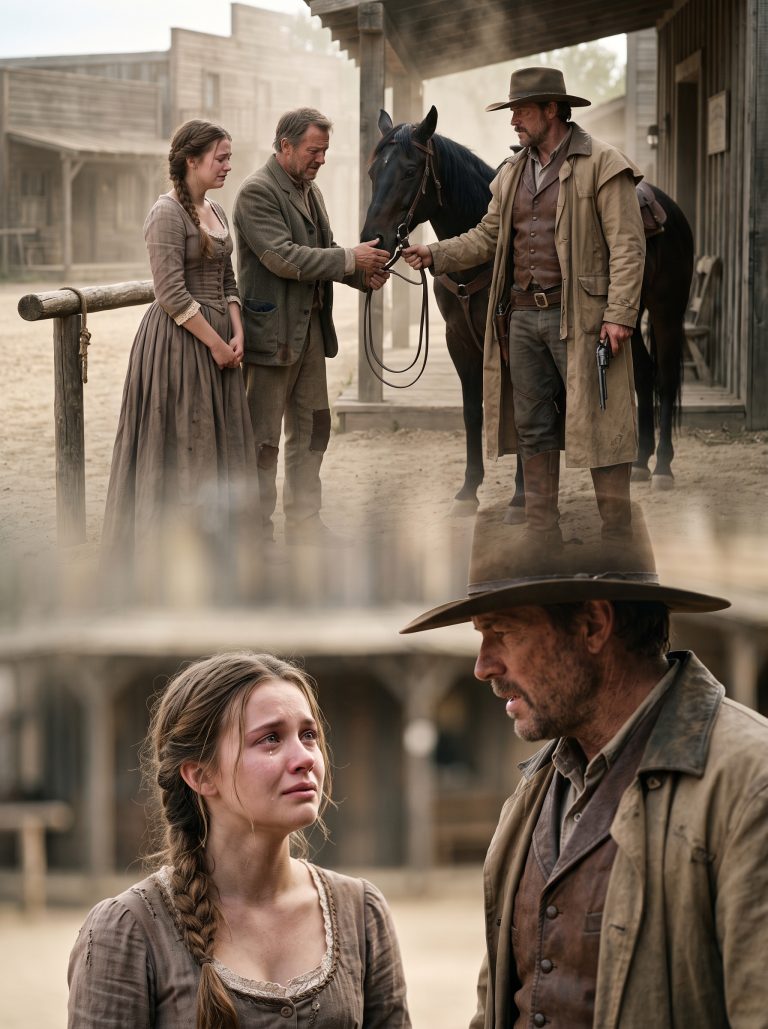
“Pick Any Man,” the Judge Said—She Pointed at the Silent Cowboy No One Noticed

Part 1
The courtroom in Cutter’s Ridge, Nebraska smelled of tobacco, sweat, and dust that never settled. Clara Whitmore stood before the bench with her hands folded so tight her knuckles had gone white, listening to a judge decide whether she’d keep the only home she’d ever known.
Her husband had been dead four months. The farm was buried under debt neither of them had seen coming until it was too late to dig out. And now thirty men were crammed into a room built for twenty, watching her the way men watch livestock before an auction begins.
There was no statute anywhere that said a widow must marry to keep her land. Everyone in that room knew it, including Judge Halloway. But Halloway held this county the way some men hold a fist — and no one present had the money, the standing, or the nerve to remind him that the law didn’t actually say what he was telling Clara it said. He’d simply decided, and decided men didn’t get corrected here.
“Meaning a husband,” Halloway said, like she were too slow to follow her own sentencing. “Marry within the hour, Mrs. Whitmore, and this court grants a thirty-day stay. Refuse, and the farm is forfeit today.”
She’d known something like this was coming. She hadn’t known it would feel like this — like being stripped down in public and told to be grateful for it.
Men stood up one by one. A man with hands like slabs of meat offered to marry her and work the rest of the debt out of her. Laughter rippled through the gallery. An older man offered forty head of cattle that wouldn’t cover half of what she owed. Each offer landed like another small cut, and Clara kept her face still, because that’s what they wanted — to see her break. She’d learned, these past months, how to put fear somewhere she could look at it later, alone, when no one was watching her do it.
Then, from the back of the room, a voice she didn’t recognize.
“I’ll marry her.”
Every head turned. A man stood near the rear door — dust-covered, hat low, like he’d ridden through a storm to get there. He gave his name as Elias Crowe. He said he’d cover the whole debt. Every last dollar of it.
Clara had never laid eyes on him before.
Halloway didn’t trust him any more than the room did. But Elias produced a letter of credit from a bank in Kansas City, signed by a name that made grown men go quiet, and the judge — with nothing better on his table and no patience left for theatrics — brought his gavel down.
“By the power vested in me by the territory of Nebraska, I declare you husband and wife.”
That fast. That final.
Clara didn’t know this man. Didn’t know if he was a thief, a liar, or worse. What she noticed, walking out beside him, wasn’t confidence in him so much as the absence of the thing every other man in that room had shown her — that flicker of appetite, of ownership. He hadn’t looked at her like something he’d acquired. He’d looked at her like a person he’d just made a promise to.
That was enough, for now, to make her climb into his wagon instead of walking home on foot with nothing.
“We ought to go,” he said, low enough that only she could hear. There was something unsteady under it. “Your place. We need to talk.”
She should have asked why the hurry. She should have asked a hundred things. Instead she sat beside a stranger who now owned half her life by law, and let him take the reins, because her own hands were shaking too hard to hold them.
They hadn’t gone a mile past town before the first gunshot cracked through the rain.
The story doesn’t stop there. It gets worse before anything gets better — and what Clara finds locked in her dead husband’s trunk that night is the reason men were already circling her farm before she’d even said “I do.”
Part 2
The mare screamed and bolted before Clara understood what was happening. Elias hauled her down into the wagon bed as the second shot splintered wood inches from where her head had been a heartbeat before.
Four riders. Dark coats, hats pulled low, closing fast.
“Who are they?” she shouted over the wind.
“Later!” Elias twisted in his seat, fired twice without slowing the horse. Both shots missed wide. She saw the flash of something like anger cross his face — not at the riders. At himself.
They lost the men in a ravine as the sky opened and cold rain turned the ground to soup. When the silence finally came, it felt worse than the gunfire had — the kind of quiet that makes a body brace for what’s coming next.
“That,” Elias said, holstering his gun with a hand that wasn’t quite steady, “was a warning.”
“A warning from who?”
He looked at her a long moment, and Clara saw, for the first time, that the calm she’d taken for certainty back in that courtroom had cracks running clean through it. He’d been improvising since the moment he stood up in that gallery.
“Men who believe you’re holding something they want.”
“I’ve got nothing.”
“Your husband did.”
Thomas. Quiet, unremarkable Thomas, who mended fence line and hauled freight into Omaha and never once raised his voice in five years of marriage. She thought suddenly of the winter he’d walked four miles in a snowstorm to fetch the doctor when she’d taken a fever, and how he’d never once brought it up afterward, like it hadn’t cost him anything to nearly freeze doing it. She’d buried him after what everyone called an accident — a snapped well rope, a fall, a neck bent wrong. She’d never once thought to question it.
Now a stranger she’d married that very morning was telling her it hadn’t been an accident at all.
“He was mixed up in something,” Elias said, rain running off the brim of his hat. “Something dangerous. Whatever it was, it got him killed. Men are going to come asking for it. And they’ll believe you know right where it’s hid.”
“How do you know all this?”
“I’ve been chasing the men responsible two years now. Your husband’s name turned up three months back. By the time I traced it here, he was already in the ground.” His jaw worked. “I should’ve warned you sooner. Found a quieter way to do this. Truth is, I don’t have a plan past tonight.”
It wasn’t the answer of a man in command of the situation, and something in Clara steadied, oddly, at hearing him say it plain. At least the fear between them wasn’t hers to carry alone.
Because she did remember something. A locked steamer trunk in the barn. The evening before Thomas died, she’d walked in on him hunched over it, shoving papers into a leather satchel the second he heard her boots on the floorboards. She’d never thought to ask what was inside.
She was about to find out. And so were the men already riding toward her farm.
What was locked in that trunk didn’t just explain why Thomas died — it explained why a total stranger had walked into a courtroom that morning and paid off a debt that wasn’t his, for a woman he’d never met, with no clear notion of what came after.
Part 3
They didn’t make it to the shack Mercer’s men had chosen for the night before Clara learned something about her new husband that unsettled her more than the guns had: he wasn’t half as sure of any of this as he’d sounded in that courtroom.
Bound wrist to wrist, marched two miles through mud in the dark, Clara had time to turn over the shape of the last day. That morning she’d been a widow facing eviction on a judge’s say-so alone. By noon she’d been a wife. By nightfall she was a hostage, back against a rotted wall, watching three armed men pass a bottle by the fire and decide, in low voices, how long they’d wait before hurting her for an answer she didn’t have.
“I’m sorry,” Elias said, quiet enough that it barely disturbed the air between them.
“For what? Marrying me?”
“For making it sound simple back there. It wasn’t. I knew there was risk in it. I didn’t know it’d come calling tonight.” He shifted, testing the rope at his wrists without looking down at it. “Should’ve gotten you somewhere safe first. Sorted the rest after.”
Clara almost laughed. It came out closer to a breath. “You didn’t put me here. Thomas did.” She let her head fall back against the wall, weariness dragging at every part of her. “Or maybe I put myself here, marrying a man I don’t rightly know. Twice now, it seems.”
He didn’t argue that. She noticed it about him — he didn’t rush to smooth things over with confidence he plainly didn’t have.
“What’s this map they’re so hot after?”
“If I had to guess — routes, names, places. Your husband was setting it all down. Building a case against a man called Dalton Mercer.” He said the name like it cost him something to say it. “I’ve been chasing pieces of his operation two years, and I still don’t have the whole of it. Thought I did, walking into that courthouse. Wrong about that too.”
“Then why marry me at all?”
“Because Mercer’s men were already watching that courthouse, and if I hadn’t stepped up, someone worse would’ve married you instead. That much I was sure of.” He looked at her, something near apology in it. “Everything past that, I’ve been working out as I go.”
That was when the horses came back. Voices in the rain, closer than they ought to have been, and then a scarred rider’s boots planted in the mud beside them, and a leather satchel torn from a locked trunk in her own barn the next morning while she watched, hands still bound, praying the papers inside would somehow buy them another hour of breathing.
They weren’t papers anyone could read. Rows of numbers, strange marks, nothing resembling a map at all.
“It’s code,” Elias said, and Clara watched the scarred rider’s patience run clean out.
The man’s name, she would learn later, was Ezra Dunmore — a name that meant nothing to her then, only a face she’d remember the rest of her life. He crouched in front of her, turning one of the pages over in his fingers like it had personally insulted him.
“Your husband was a farmer,” he said, almost conversational. “Farmers don’t write in riddles unless somebody taught them to. Mercer doesn’t like riddles, Mrs. Whitmore. Mercer likes answers. And when he doesn’t get them fast, he starts taking things from people to make the waiting easier.” He let that sit. “I’ve watched him do it. Fingers first, usually. Sometimes he starts somewhere a woman minds more.”
He backhanded her across the face before she’d finished saying she didn’t know. Pressed a knife to her throat before she’d said it twice. Elias strained against the men holding him, shouting something she couldn’t make out over the ringing in her own skull, and for one long moment Clara understood, with total clarity, that he had no way from where he stood to stop any of this. Whatever certainty he’d carried into that courthouse had run dry somewhere on last night’s road.
“Last chance,” Dunmore said, almost gentle now, which was worse than the shouting had been. “Or I start with the small finger and we see how much of that Bible-thumping husband of yours you’d have told him, if he’d asked you plain instead of writing it all down in scratch marks.”
And in the space between one heartbeat and the next — cold steel against her skin, a dead man’s eyes six inches from hers — Clara Whitmore, who’d spent her whole life being underestimated, found something she hadn’t looked for at the end of a blade. Not courage exactly. Just a refusal to hand him the satisfaction of watching her beg.
“Go to hell,” she whispered.
The shot came so close behind her words that for a moment Clara thought her own voice had caused it. Dunmore dropped where he knelt and didn’t move again.
The shot had come from the barn loft — a federal marshal named Frank Mason and an old, gray-bearded informant named Samuel Hayes, men Elias had quietly brought into this days before Clara had even known there was a fight to bring anyone into. What followed was chaos: gunfire from three directions, Clara diving for the root cellar while Elias sawed himself free with a dead man’s knife, the yard outside her kitchen window turning into something she’d carry the rest of her days.
When the smoke settled, two of Mercer’s men lay dead. Samuel had a bullet through his arm. And on Clara’s kitchen table, spread out like a puzzle no living soul could solve, sat forty pages of coded handwriting that had cost her husband his life.
“He never had schooling past the primer,” Clara said, staring at the marks. “How could he build something like this?”
“Maybe he didn’t build it alone,” Samuel said, turning a page toward the light. “These numbers repeat. Every third line, same string. That’s no accident. That’s a pattern.”
It was Samuel who thought to ask after the Bible on Thomas’s nightstand — the one he read from evenings, the one Clara had always taken for plain devotion. She remembered now how he used to trace his finger slow under certain lines, lips moving without sound, and how she’d thought it tenderness toward scripture when it had been something else entirely — a man teaching his own hand to lie steady while his mind built a cage of letters no one else could open. It wasn’t devotion. It was a key. Words underlined through the whole book, not verses, not passages, just words, the first letter of each one spelling out whatever Thomas had needed hidden.
“How long to break it?” Elias asked.
“Days,” Samuel allowed. “Might be weeks.”
“We haven’t got days.” Elias crossed to the window, scanning the tree line, and Clara saw his hands weren’t steady against the frame. Whatever he’d lived through before this hadn’t made him fearless. It had only taught him to keep moving regardless. “Mercer’s men rode here. When they don’t report back, he’ll know just where to look next. I can’t promise you I’ll stop what’s coming, Clara. I mean to try. I won’t lie and tell you I know I can.”
She hadn’t looked for honesty like that from him, not in that moment. She found she trusted it a good deal more than she’d have trusted a promise.
They had minutes, not days. Six riders crested the ridge before the coffee she’d poured Samuel had gone cold, and this time it wasn’t hired hands. This time it was Dalton Mercer himself.
He dismounted slow, in no hurry at all, the way a man moves when he’s never once in his life had reason to rush. Silver hair, a fine coat gone dusty from travel, eyes that took the measure of the whole yard — the dead men, the blood, Samuel bleeding against the fence post — without so much as a change in his breathing.
“Mrs. Whitmore.” His voice was smooth, almost warm, the kind of warmth that made the hair rise on Clara’s arms faster than shouting would have. “I understand my associate was rough with you. That wasn’t my instruction. I find rough men waste time.” He crouched slightly, bringing his face level with hers, unhurried, like he had all the daylight in the world and intended to use every minute of it. “I’ve buried three men this year who thought they could hold out on me. I didn’t enjoy any of it. I want you to understand that, because I think it matters to you whether a man enjoys this part. It doesn’t matter to me either way. I’ll do what’s needed regardless.”
“I don’t have what you want.”
“I believe you don’t understand what you have. That’s different.” He straightened, studying the barn, the house, the child’s toy left forgotten by the well. “Your husband built something that cost me a great deal of money and a great many friends in high places. I intend to have it back, Mrs. Whitmore, and I have found, across a long career, that patience with a widow rarely pays. So.” He drew his pistol, unhurried as everything else about him. “Where.”
“The barn,” Clara said. “Under the floor.”
He sent two men to check. Made her wait through every minute of it, that pistol never wavering from her face, talking softly the whole while about nothing — the weather, the drive from Omaha, a horse he’d lost to colic the winter before — as though her life weren’t balanced on the other side of the conversation. When his men returned with the satchel and the coded pages proved unreadable, something in his manner did not break so much as go very quiet and very cold.
“The key,” he said. No warmth left in it now.
She gave him the Bible rather than watch him shoot anyone else. Mercer studied the marked passages a long moment, and something almost like admiration crossed his face before it hardened again.
“Clever man, your husband. Not clever enough.” He tucked the Bible under one arm and raised the pistol to her head. “You’ve been useful, Mrs. Whitmore. Unfortunately, that’s the whole of your value to me now.”
Elias lunged and was clubbed down before he’d taken two steps — he hadn’t planned for Mercer arriving in the flesh, hadn’t planned for any of this going quite this far wrong, and Clara watched real fear cross his face for the first time since the courthouse. It didn’t make her trust him less. It made the two of them equal, finally, in the same impossible moment.
“Any last words?” Mercer asked, almost politely.
“I hope it kills you,” she said. “Whatever’s written in those pages. I hope it ruins everything you’ve built, every dollar and every man who ever bent a knee to you.”
Something flickered behind his eyes — not fear, not quite, but the nearest thing to it Clara would ever see cross that face.
The explosion that answered her wasn’t a figure of speech. It came from the road — federal marshals, a dozen strong, eighteen months into building a case against Mercer and handed, at last, the excuse they’d needed to move. In the chaos, Elias tackled Mercer clean off his feet, and the two men fought over a gun that fired twice before it went still.
Only one of them stood up after.
Mercer’s death didn’t end it so much as open a door. Inside the coded pages — broken over the weeks that followed, using Thomas’s marked Bible — lay a record of a criminal network reaching across several territories. Shipment routes. Payoff ledgers. Names of local officials paid to look the other way for years.
Thomas hadn’t stumbled into something dangerous. He’d gone looking for it. Hired on as a freight hauler eighteen months back, he’d spent his quiet, unremarkable runs into Omaha gathering evidence, one careful note at a time, meaning to hand it all to a federal prosecutor. Someone had carried word of it back to Mercer before he ever got the chance.
Deputy Marshal Katherine Wells found the letter tucked inside the Bible’s back cover, addressed to Clara in Thomas’s rushed, unfamiliar hand.
Clara, if you’re reading this, I’m already gone. I’m sorry — for the lying, the danger, everything I should have said and didn’t. Thought I could fix it quiet. Keep you safe by keeping you in the dark. I was wrong. You’re stronger than you know, Clara. Stronger than I ever gave you credit for.
She read it twice, folded it careful, and burned it in the yard that same afternoon. Not from anger. From something closer to peace. The apology didn’t bring him back, didn’t undo any of it — but watching the paper curl to ash, she felt the first easing of a grip she hadn’t known she was holding these four months past. She thought of him tracing those Bible lines by lamplight, hiding a whole second life inside the one thing she’d never thought to question, and found she could hold both truths now without either one crowding out the other — that he’d lied to her for months, and that he’d done it, in his own clumsy way, trying to keep her safe.
“What’ll you do?” Elias asked that evening, across the wreckage of her table.
“Don’t know. Start over. Somewhere far from here.”
“You could rebuild. The farm’s still yours.”
“I can’t stay, Elias. Every time I look at that yard I’ll see—” She let it go unfinished. She didn’t need to say it.
“Where to, then?”
“West, maybe. Oregon.”
He was quiet a while. “Unless you’d want company going west,” he said finally, and there was none of the courthouse steadiness left in it — just a man asking, plain, without dressing it up. “I don’t know what kind of husband I’d make. Never stayed anywhere long enough to find out. I’d like the chance to try, if you’ll have me. Or I can go my own way, let you have your fresh start without whatever I’d bring along with it.”
She didn’t answer straight off. She thought of the woman who’d walked into that courthouse a day ago, and the woman sitting at this ruined table now — not fearless, not remade overnight, only a shade less willing to let others decide things for her than she’d been a week before.
“I’d rather face whatever’s coming with a man honest about not having the answers,” she said, “than alone, pretending I do.”
“That’s not much of a yes.”
“It’s what I’ve got.”
He almost smiled. “I’ll take it.”
Clara testified in Omaha three days running, weathering lawyers who called her a liar, a schemer, a grieving woman spinning tales. She was frightened through most of it. Said so plain, once, to Wells during a recess — and found the saying of it cost her nothing. Made the next day’s testimony steadier, not weaker.
They joined a wagon train out of Kearney after — fifteen wagons, families and drifters and folks outrunning their own pasts. The trail didn’t make her brave overnight. She flinched at strange hoofbeats weeks in still, dreaded every river crossing. But she learned to load a rifle with hands that had mostly quit shaking. Learned to drive the wagon alone when Elias took sick with dysentery three days running and there was no one else fit to do it. Learned, in small unglamorous pieces across two thousand miles, that fear and capability could ride in the same body at once.
Past South Pass, Wyoming, Elias stopped the wagon outside a small church without a word of warning.
“What’s this?”
“Marrying you for real this time.” He turned to face her. “Not because I’ve got it figured now. Most days I still don’t. But I know I’m through pretending this is temporary.”
“That’s not much of a proposal.”
“It’s what I’ve got,” he said, handing her own words back to her, and something in Clara’s chest came loose at hearing it.
“Yes,” she said. “It’s enough.”
They married before a local minister with two strangers pulled off the street to witness it. No guests. No ceremony beyond the plain truth of it.
They reached Oregon three weeks ahead of the first snow. Raised a cabin with their own hands through a hard, good summer. By spring Clara was carrying. By winter they had a daughter, small and loud and exactly right in every way that mattered. She named her Sarah, after the friend from the wagon train who’d taught her strength needn’t look like certainty.
Life on the farm ran the way real life does — slow, hard, fine here and there. Elias never became the steady, unshakeable man Clara had first taken him for that morning in court. He still doubted himself. Still woke some nights scanning the dark from old habit. Clara stopped needing him to be anything but what he was — a man who kept turning up, year after year, edges unfiled.
She changed slower than she’d have guessed, too. No single morning where she woke transformed. Just the sum of small things — learning to hold her ground with a grain buyer without her voice shaking, teaching her daughter letters, standing firm once at a town meeting over water rights and realizing after that she hadn’t thought twice before doing it.
On her fortieth birthday, Elias gave her a leather-bound journal. “For your thoughts,” he said. “Whatever needs remembering. Or forgetting.”
She filled it slow, across the year that followed — the courthouse, the ravine, the shack, the trunk in the barn, the cipher hid in her dead husband’s Bible, the uncertain, unfinished man who’d married her to save her life and stayed on, imperfect still, to build one alongside her. She set it down honest, admitting the fear at every turn, having come to understand it was never the opposite of her strength. It had only ever been where the strength started.
Elias died many years on, peaceful, his heart simply stopping one morning in the garden. Clara held him through it and told him he’d been enough exactly as he was, rough edges included. She buried him beneath the oak he’d planted their first year on the land.
She outlived him by a long stretch — long enough to see her daughter Sarah grow into a schoolteacher, to hold grandchildren, to look back, on her own last day, at every part of it without needing to smooth over the places where she’d been afraid, or wrong, or slow in becoming who she was.
Her last words, spoken soft to a daughter leaned close to catch them, were plain.
“You needn’t be fearless. Only don’t let the fear decide for you.”
Generations on, one of Clara’s descendants stood beneath that same oak and read the words cut into the stone below it.
Clara Whitmore Crowe — She kept going anyway.
No hero, in the grand sense of the word. Only a woman who’d been afraid most days of the hardest year of her life, and had done the next right thing regardless, a little steadier each time, until one morning she looked up and found the fear was still there — but it no longer had the running of her.
THE END