Her Father Shut Her Out for Good… Until a Mountain Man Crashed the Door and Took Her Into His Arms

Part 1
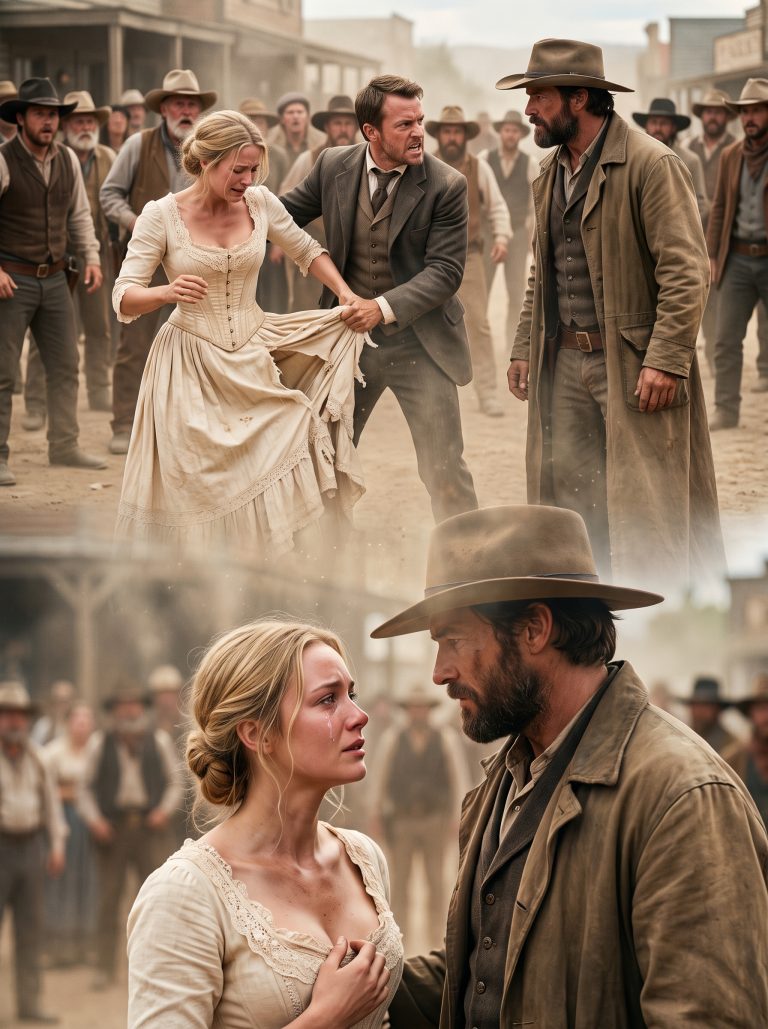
The lock clicked, and Clara Whitfield understood that her father had just decided her whole future in the space of a single turned key.
She stood with her palm flat against the door, listening to the bolt settle into the frame, feeling it travel through the wood like a small earthquake. Downstairs, a bottle uncorked. Reuben Whitfield was already celebrating.
Three mules, a wagon, and forgiveness of a card debt. That was the price Silas Pratt had put on her, and her father had shaken hands on it before supper was even cleared from the table.
She would not marry him. She had said so an hour ago, standing in the kitchen with blood filling her mouth from where her father’s knuckles had caught her cheek. She had said it again after he struck her a second time, quieter, because by then speaking loudly only made her jaw ache worse.
Now her left eye had begun to swell shut, and the little room felt like a kiln in the August heat, the single window nailed closed since the week Reuben found her staring too long toward the mountains.
“Looking at that ridge like it owes you something,” he’d sneered.
Maybe it did. Maybe every acre beyond this house owed her a single breath that didn’t smell of whiskey and boiled cabbage and fear.
She sat on the edge of her cornhusk mattress, twenty-two years old and feeling every year twice over. Three days earlier, at the trading post, she had dropped a heavy flour sack and a stranger’s hand had lifted it before she could try again. She’d looked up into a face weathered like driftwood, a beard shot through with gray, eyes the pale, exact blue of creek ice in January.
He was the man the town called wild — the trapper who came down from the high country twice a year to trade pelts and ax handles for coffee and lead shot. Children stared at him. Grown men mocked him behind his back and went quiet in front of him.
He had seen the bruise circling her wrist.
“Your husband do this?” he’d asked, in a voice with no pity in it, only calculation, the way a man might study a wounded animal to see how deep the wire had cut.
“My father,” she’d whispered, and he had said nothing more, only carried her flour to the wagon and walked away.
That should have ended it. Men did not return for girls like her.
She was still thinking of his eyes when the front door slammed open below.
“We’re closed!” her father bellowed. “Get off my porch or I’ll fetch the scattergun!”
A second voice answered — low, flat, and unhurried, the words swallowed by the floorboards but the tone unmistakable.
Clara’s pulse began to hammer.
“I said get!” Reuben roared.
Something crashed. A chair, maybe a table. Then came a sound she would hear in her sleep for years afterward — a hard, wet crack, glass breaking, a body striking the floor.
Silence rushed in behind it like water filling a hole.
Clara scrambled backward, searching the room with wild eyes, and her hand closed on the rusted iron hook she’d once used to latch the shutters before her father sealed the window shut for good. It wasn’t sharp. It was heavy. It would have to be enough.
The stairs groaned. Once. A pause. Again — not her father’s drunken stumble, not Silas Pratt’s oily shuffle, but a deliberate, even climb that never hesitated.
She wedged herself between the wardrobe and the wall, the hook shaking in both fists. Lamplight bled beneath the door. A shadow filled the gap.
The knob turned. The bolt held.
“Clara.” The voice was rough, and it was the voice from the trading post.
“Who’s there?” Her own voice cracked in half.
“Gideon Marsh. Stand clear of the door.”
She didn’t move.
“Girl.” Iron entered his tone without ever rising in volume. “Stand clear.”
Something in the command cut straight through her fear. She threw herself sideways against the wall as the first blow struck the door and the whole frame groaned like a living thing.
Part 2
The door surrendered on the fourth blow, hinges tearing loose in a spray of splinters and dust. Gideon Marsh ducked through the wreckage, filling the small room like a boulder rolled into a chapel. Plaster dust whitened one shoulder. His knuckles were split and bleeding, and he didn’t spare them a glance.
He lifted the lantern. Its light crawled over her split lip, her swollen eye, her shaking hands — and something in his jaw tightened, though his face gave away nothing else.
He scooped her wool coat off the chair and dropped it at her feet.
“Put that on.”
“It’s August.”
“It’s cold where we’re headed.”
“Where?”
“Anywhere but here.”
“My father—”
“Breathing,” Gideon said. “He’ll wake with a sore skull and less pride than he walked in with. More mercy than he showed you.”
Clara looked past him to the broken door, the dark stairwell, the house she had never once been allowed to leave.
“You can’t just take me.”
“No,” he said. “I can break a door. I can saddle a horse. I can’t drag you over a threshold you won’t cross yourself.” He stepped aside, clearing the path. “You walk, or you stay.”
Downstairs, her father made a furious, choking sound.
Clara flinched. Gideon shifted his body between her and the stairwell without ever touching her.
“Marry that butcher tomorrow,” he said quietly, “and every door after this one gets harder to open.”
The words landed harder than any blow could have.
She bent, dragged the coat over trembling arms, and forced her boots on with fingers that wouldn’t cooperate. When she swayed on her feet, Gideon’s hand shot out instinctively — then stopped the instant she flinched, and he drew it back without a word.
“I won’t pull you,” he said. “But you have to walk.”
So she walked, past her father slumped bleeding against the overturned table, his glassy eyes finding hers, one shaking finger lifting to point.
“Look at my back,” Gideon said. “Keep walking.”
She fixed her eyes on his canvas duster and followed him into the cold night air, where an enormous black draft horse stood stamping at the porch rail, breathing steam into the dark.
“Can you mount?”
She looked at the saddle, too high for her shaking legs. “No.”
“I’ll lift you.”
His hands closed at her waist, impersonal and sure, and then she was airborne, set sideways before the horn like she weighed nothing at all. He swung up behind her and turned the horse not toward town, but straight toward the black wall of the mountains — and Clara Whitfield, with no money, no plan, and nothing but the clothes on her back, drew the first full breath she’d taken in years.
Part 3
The trail climbed without mercy, indifferent to bruises or exhaustion. Dark timber swallowed them first, then loose shale that sparked under the horse’s shoes, then narrow cuts where cold poured downhill like invisible water. Clara held herself upright for the first hour out of sheer stubbornness. Pride, she was discovering, was easier to carry behind a locked door than on a mountainside at midnight.
By the second hour it had abandoned her entirely, and she sagged back against Gideon’s chest. He didn’t tighten his arms around her — they only braced where the reins required — but he was warm and solid through wool and canvas, his breath steady against her spine.
“Lean left,” he said once, and she obeyed just as the horse scrambled over slick stone beside a drop she couldn’t see the bottom of.
At a stream he dismounted and filled a canteen, handing it up to her numb fingers.
“Drink slow.”
She drank too fast. He pulled it back.
“Slow. You’ll bring it up.”
She glared at him with her one good eye. “Who are you to give orders?”
“Man with the water,” he said, and it was such a blunt answer that under any other circumstance she might have laughed.
“Why did you come for me?” she asked instead.
He checked the girth, maybe stalling, maybe just careful. “I saw your wrist.”
“That was reason enough?”
“I know what a trap looks like. Some have teeth. Some have fathers.”
She looked away first.
Dawn found his cabin tucked against a granite shoulder of the range, squat and windowless-looking beneath a steep cedar roof, frost silvering the grass around it. To Clara it looked less like rescue than exile. Her legs buckled the moment she slid from the saddle, and Gideon caught her by the coat — not gently, but effectively — until her boots found solid ground.
“Walk,” he said.
“I’m trying.”
“Try toward the door.”
Inside, the cabin smelled of cold ash and cured hide and pine pitch. He built a fire from dry moss and kindling while she sat frozen in a heavy chair, then cleaned his split knuckles at the washstand without making a sound, wrapping them in linen before finally pouring hot pine-needle tea into a dented cup and setting it in her hands.
“Am I your prisoner?” she asked.
He looked, for the first time, more tired than dangerous. “Door doesn’t lock.”
She turned. It was true — a wooden bar rested on pegs, but no bolt, no outside latch, nothing that could seal her in.
“You want to walk back down, walk,” he said. “I won’t stop you. You’ll freeze before you find the low road, but that’s your right.”
“My right to freeze.”
“Your right to choose wrong.”
It was, she realized, the first choice anyone had offered her in years.
“And if I stay?”
“You work. Haul water, split kindling, learn what keeps a body alive up here. I don’t need a wife. I don’t need a daughter. I could use a pair of hands.”
The words were plain, almost harsh. They were also, she thought, the cleanest thing anyone had said to her in a long while.
“Show me the water bucket,” she said.
Life in that cabin began, unglamorously, with blisters. Water hauled from the creek in buckets that bit into her palms. Wood split smaller than she’d thought necessary, because the stove demanded obedience. Snares checked in a cold that ached in her lungs. Rabbits skinned, fish cleaned, ash hauled, bedding aired whenever the sun showed itself. Gideon taught without cruelty and without flattery.
“No,” he said, the first time she swung the axe wrong. “You’ll split your own shin that way.” He stepped behind her, then stopped himself. “May I?”
The question startled her more than his size ever had. She nodded, and he adjusted her grip with quick, impersonal touches before stepping back.
“Let the weight fall. Don’t muscle it.”
The log split clean on the second try, and a small, bright satisfaction moved through her chest. Gideon grunted his approval and went to check the horse — that was how his praise arrived, not in words, but in the absence of correction.
For the first week she braced for danger from him at every hour. She slept in the narrow bed because he insisted, and woke often to find him on the floor near the door, one hand never far from his rifle. He never approached without need, and when he cleaned the cut on her lip, he narrated every motion first.
“I’m going to touch your cheek.”
She nodded.
“This will sting.”
It did. He watched her face, and the instant she flinched, his hand stilled completely.
“Keep going,” she whispered, ashamed of her own fear.
“Fear’s nothing to be ashamed of,” he said, and something in the way he said it told her he’d learned that the hard way himself.
Slowly, the cabin began to change. Not much — Gideon owned little beyond what he needed — but Clara scrubbed the soot from the hearthstones and hung the old quilt out to air in the sun. She found a chipped blue jar under a shelf and filled it with pinecones because she had nothing else to put there. Gideon eyed that jar for two full days like it might bite him. On the third, he set three late wildflowers beside it and said nothing at all.
A packer named Otis Finch brought word up the ridge near the end of September, the first outsider Clara had seen since the night the door came down. Her stomach twisted at the sight of him, but Gideon stood beside her, not in front of her.
“Town’s talking,” Otis said. “Reuben Whitfield claims you stole his girl.”
“Town breathes,” Gideon said. “Same thing.”
“He leaves out the part where he sold her to Silas Pratt for three mules and a card debt,” Clara said, surprising herself with the steadiness in her voice.
Otis spat into the dirt. “I believe you. Marshal may ride up once the weather breaks, though. Just so you’re not caught flat.”
After he left, Clara stood at the chopping block with her hands trembling.
“He’ll come,” she said.
“Likely.”
“What if the marshal believes my father instead of me?”
Gideon gathered an armload of split wood. “Then you tell the truth anyway.”
“They won’t listen to me.”
“I will,” he said, and though the words weren’t tender, they reached somewhere tenderness might never have found.
Rain came hard that night, hissing against the firewood stacked under the eaves. Clara sat mending a tear in his shirt while he worked a trap spring back into shape.
“Why do you live up here alone?” she asked.
“People ask too much.”
“I’m people.”
“You ask less.”
She looked down at her needle. “I used to ask more. Before my mother died. Fever, when I was thirteen. My father changed after — or maybe he’d always been hard and she’d stood between us. I stopped asking because asking made him remember I existed, and that wasn’t always safe.”
The fire popped. “My father was hard too,” Gideon said — the first piece of himself he’d ever handed her outright. “Trapped these ridges his whole life. Drank when the snow kept him housebound too long. My mother left when I was ten and took my sister with her. Not me. He said a boy needed toughening. Mostly he meant silence.”
“Were you? Silent?”
“Still am.”
“No,” Clara said softly. “You speak when it costs you something.”
His eyes lifted to hers, and for a moment the cabin didn’t feel like four walls at all, but like two hands cupped carefully around a flame.
October brought the first snow, thin but enough to whiten the ground by morning. Clara’s arms had hardened, her blisters turned to calluses; she could haul a full bucket now without stopping twice along the path. She learned to read clouds that threatened from clouds that only postured, learned Gideon’s silences too — the listening silence of a man reading weather, the irritated silence of a dull blade, the far-off silence when his fingers found the old scar along his jaw, and the gentle one, though he’d have denied the word, when he found her sitting under the pines and simply left her be.
One afternoon she caught him building something under the lean-to, and he threw a canvas over it the moment she came near.
“What’s that?”
“Nothing.”
“You’re a terrible liar.”
The next morning a small pine bench sat beside the cabin door, its back curved just enough to lean against.
“You sit on the step,” he said behind her, gruff. “Stone’s cold.”
“You built me a place to sit.”
“Built a bench.”
“No,” she said. “You built me a place.”
He shifted his weight, plainly uncomfortable. “Use it or don’t.”
She used it every clear morning after that.
One evening before the marshal’s visit, snow fell for the first time that season, fine and silent, dusting the pines outside the window like sugar sifted through cloth. Clara stood at the door with a blanket around her shoulders, watching it settle over the bench Gideon had built her, and felt something unfamiliar loosen in her chest — not happiness exactly, not yet, but the shape happiness might eventually fill.
“First snow always makes me think of my mother,” she said without turning. “She used to say it was the sky forgiving the summer for being so hard on everybody.”
Gideon came to stand in the doorway behind her, not touching, just present. “Sounds like a kind woman.”
“She was. My father wasn’t always what he became. I used to think losing her broke something in him that never mended right.” Clara pulled the blanket tighter. “I used to blame myself for not being enough to fix it.”
“Wasn’t yours to fix,” Gideon said. “A man chooses what he does with his grief. Some build something out of it. Some just let it rot and call the rot somebody else’s fault.”
“Which did you do?”
He was quiet long enough that she thought he wouldn’t answer. “Built a cabin. Built a life small enough that nothing else could get in and hurt it.” His eyes found hers in the dark. “Didn’t account for a stubborn woman climbing over the wall.”
She laughed, surprised, and it was the first time she’d laughed since the night the door came down. Gideon looked at her like a man hearing music he’d forgotten the words to.
They stood together in the doorway until the cold finally drove them back to the fire, and neither of them mentioned it again, though something between them had shifted, quiet and permanent as the snow settling outside.
The marshal rode up in late October, with Reuben Whitfield and Silas Pratt trailing behind him through the timber. Clara saw them coming from her bench, three dark shapes against the white slope, and her whole body went cold before her mind caught up.
Gideon set down the axe he’d been carrying and came to stand beside her. He didn’t look surprised.
“Inside, if you want,” he offered.
“No.” Her voice shook, then steadied. “Not inside.”
Her father looked smaller than she remembered, meaner for it, one side of his jaw still swollen. Silas Pratt sat heavy and red-faced in his saddle. Marshal Callum Dobbs, a tired man with a drooping mustache, looked like he wished he were anywhere else on earth.
“There,” Reuben snarled, jabbing a finger at her. “Stolen. Kept up here like some kind of mountain—”
Gideon shifted half a step forward. Clara caught his sleeve. “Don’t.”
He stopped.
“My father claims Mr. Marsh took me against my will,” she said to the marshal, before anyone else could speak for her. “That isn’t true. He locked me in my room to force me into marrying Mr. Pratt in exchange for livestock and a canceled debt. He struck me twice. Mr. Marsh broke the door. I chose, on my own feet, to walk through it.”
“She’s lying,” Reuben spat. “He’s put the words in her mouth.”
“You nailed my window shut,” Clara said, drawing herself taller. “You bolted me into that room. You sold me like stock at auction.”
Silas shifted uneasily in his saddle. “Now that ain’t fair talk. A father’s got rights.”
“Not those,” Gideon said. Just two words, but they cracked across the clearing like a rifle shot.
Marshal Dobbs pulled off his hat and rubbed the back of his neck. “Can’t rightly settle a family matter on a mountainside.”
“It isn’t a family matter,” Clara said. “My mother’s sister lives in Bannack. Margaret Poole. I want notice sent to her. I want it on record that I left by my own choice, and that if my father comes near me again, I will swear a complaint before a judge.”
The words startled even her. They plainly startled everyone else too.
Dobbs studied her face for a long moment, then nodded slowly. “I’ll see the notice sent.”
Reuben cursed, but the marshal cut him off. “You’ll ride down now, Whitfield, before I start asking why half the town’s heard Pratt bragging about his new mules.”
Silas paled. Reuben’s fury turned purple, but a coward lived beneath it, and he wheeled his horse without another word — though the look he threw Clara before he vanished into the timber was sharp enough to cut skin.
This time she didn’t step behind Gideon. She stood beside him until the riders disappeared, and only then did the shaking finally reach her hands. Gideon reached for her, hesitated, and lowered his arm — until she closed the distance herself and took his hand in both of hers.
Winter sealed the mountain after that, burying the low trail, then the creek path, then the woodpile to its knees. Down in the valley people still gossiped, her father still cursed her name, but the snow had closed its fist around the whole range, and for the first time in her life, none of it could reach her.
Only the work could, and Gideon.
Their days found a rhythm: him rising before light to check the snares, her feeding the fire and mixing ash cakes, both of them stretching hides and mending leather and reading by firelight while he carved. Wanting, she was learning, could frighten a person worse than fear ever had. Fear told you exactly where the danger stood. Wanting blurred every edge she’d built her whole life to keep straight.
It came to her the night he returned from the lean-to with frost in his beard and blood soaking through his sleeve — a trap chain had snapped and caught him deep along the forearm.
“Sit,” she told him, and he obeyed, which told her more than the wound did.
She boiled water, threaded a needle, and set her jaw. “I need to stitch this.”
“You’ve done it before?”
“No.”
“I’ll hold still, then.”
She worked slow and careful while his hand clenched white-knuckled on the chair arm, though he made no sound at all. Somewhere in the middle of drawing that thread through his skin, one word rose up in her chest so suddenly it nearly stopped her hands.
Loved.
“You all right?” he asked, watching her face.
“No,” she whispered. “That’s the trouble. I’m not afraid of you. I don’t know what to do with that — with wanting a man near me, and believing he wouldn’t hurt me even though he could.”
Something in his face shifted slowly, like sunrise finding snow.
“My father taught me wanting was weakness,” he said. “That anything you wanted could be used to break you. Took me years alone up here to stop wanting even the sound of another voice in the room.”
“And now?”
“Now there’s one I can’t stop wanting to hear.”
She crossed the cabin and lifted his bandaged hand to her cheek. His breath caught.
“Tell me yes,” he said, rougher than she’d ever heard him, “or step back.”
“Yes.”
The kiss that followed asked before it took, patient as a man approaching a wild thing with open hands. When it deepened, she felt it reach every cold, hidden place inside her that had gone unwarmed for years.
“You’re not safe with me because I’m strong,” he murmured against her forehead.
“I’m safe,” she said, “because I can say no, and you’d stop.”
Spring sent a letter before it sent a single flower. Otis Finch carried it up the half-thawed trail in March — Margaret Poole’s fierce, affectionate hand offering Clara a room, honest work, and help bringing formal complaint against her father if she wanted it. Her aunt wrote that Clara’s mother had been brave once too, and that bravery sometimes looked exactly like leaving.
Clara read it twice on her bench, then handed it to Gideon. He read slower, his mouth tightening — not with anger.
“You should go,” he said.
The words landed like a dropped stone. “You think so?”
“I think you should have somewhere to choose besides here.”
“And if I choose here?”
“Then it ought to be after you’ve known you could leave.”
The pain in him was plain, and so was the honesty of it. He had broken a locked door once; he wasn’t about to build her another.
They rode to Bannack a week later, Clara on a steady little mare Gideon had traded for. Margaret Poole met them at her boardinghouse door with flour on her apron and tears standing in her eyes.
“You look just like her,” she said, cupping Clara’s face.
Clara wept — not from being broken, but from finally reaching someone who remembered exactly where she’d come from and welcomed her in anyway.
Gideon stayed three nights in the stable loft, paid his own way, and made no claim on her at all. On the fourth morning she found him saddling his horse to leave without a word.
“You were going to ride off without goodbye?”
“Was going to say it before I left.”
“From the road?”
“You’re safe here,” he said, tightening the girth with more attention than it needed. “Your aunt’s good people. You could have work, company, a church, women to talk to. That’s a life.”
“It is,” Clara agreed, stepping closer. “But not because you’ve decided the mountain’s too hard for me, or because you think loneliness is nobler than asking for what you want.”
He looked away. “I won’t cage you.”
“No. But you’re trying to disappear before I get the chance to choose.” That stopped him cold. She drew her aunt’s letter from her pocket, a list penciled on the back — boardinghouse work, wages, a room, a complaint filed against her father, the cabin with the bad roof and the bench by the door.
“I’ve weighed it honestly,” she said. “I may stay here a while. I may bring charges against my father. I may do all of it. And when I’m done, I want the right to ride back to that rough cabin on the ridge.” Her voice wavered but held. “Not because I’m your prisoner, or your burden, or something you carried out of a burning house. Because I’m a woman choosing where she breathes best.”
“And where’s that?” he asked, low.
“With you,” she said. “If you’ll have me as a partner and not a rescue.”
He closed his eyes. For one terrible second she thought old habit might win out over hope. Then he reached into his coat and drew out a small object wrapped in cloth — a ring carved from dark antler, simple and smooth.
“Made it back in January,” he admitted. “Didn’t mean to ask until you’d had another door to walk through first.”
“You have poor timing,” she said, touching it.
“I know.”
“Ask anyway.”
The man who’d faced her father, a marshal, a winter, and his own solitude without flinching looked, for one unguarded moment, entirely unsure of a single woman’s answer.
“Clara Whitfield,” he said, “will you marry me and keep the door unbarred?”
She laughed through tears. “Yes.”
They married in Bannack on a bright, wind-scoured afternoon, with Margaret standing witness in her best gray dress and Otis Finch grinning from the back row loud enough to embarrass them both. Clara wore blue, not white, because Margaret said white was for girls who hadn’t yet learned what they wanted, and Clara had learned the hard way. When the preacher asked if anyone objected, the room stayed silent, and Clara realized with something like wonder that for the first time in her life, no one in it had the power to take her choice away from her.
She stayed through the spring, not out of doubt, but because Gideon had been right about one thing — a choice made with room to breathe felt entirely different from a choice made while running. She worked mornings at her aunt’s boardinghouse, learned to keep account books, and found she had a quiet talent for calming frightened women who came through Margaret’s door with bruises they tried to explain away. She never told them what to do. She only told them a locked door wasn’t the only kind there was.
She filed her complaint against Reuben Whitfield. The marshal didn’t become a hero overnight, but the law grew harder for her father to bend once Margaret and a solicitor stood at her side. Silas Pratt withdrew his old claim and found urgent business two counties away. Reuben kept his house, his whiskey, and his bitterness, but he never rode up that mountain again.
In June, Clara returned to the cabin as Gideon’s wife — not seated in front of him on the saddle this time, but riding beside him on her own mare.
The cabin looked different in summer light. Still rough, still small, but sun touched the roof now, and wildflowers grew wild along the creek, and the bench waited faithfully under the eaves. Clara hung blue cotton curtains her aunt had sent. Gideon built a second shelf for her books. Together they mended the roof, widened the garden, and hung a new door on true hinges.
It still had no lock.
On evenings when the work was done, Clara sat on that bench and watched shadow climb the pines, and often Gideon sat beside her, his shoulder warm against hers, his old silence no longer a wall between them but a shelter they shared.
She thought sometimes of the nailed window, the deadbolt, the wet crack of a fist against a jaw — and of the sound of splintering oak that had ended one life and begun another. People down in the valley told it as a story about a man who’d stolen a woman off a porch in the dark.
Clara knew the truer version.
He broke the door.
She walked through it herself.
And every single day after, in a rough cabin high above the valley with no lock on any door, she chose, freely, to stay.