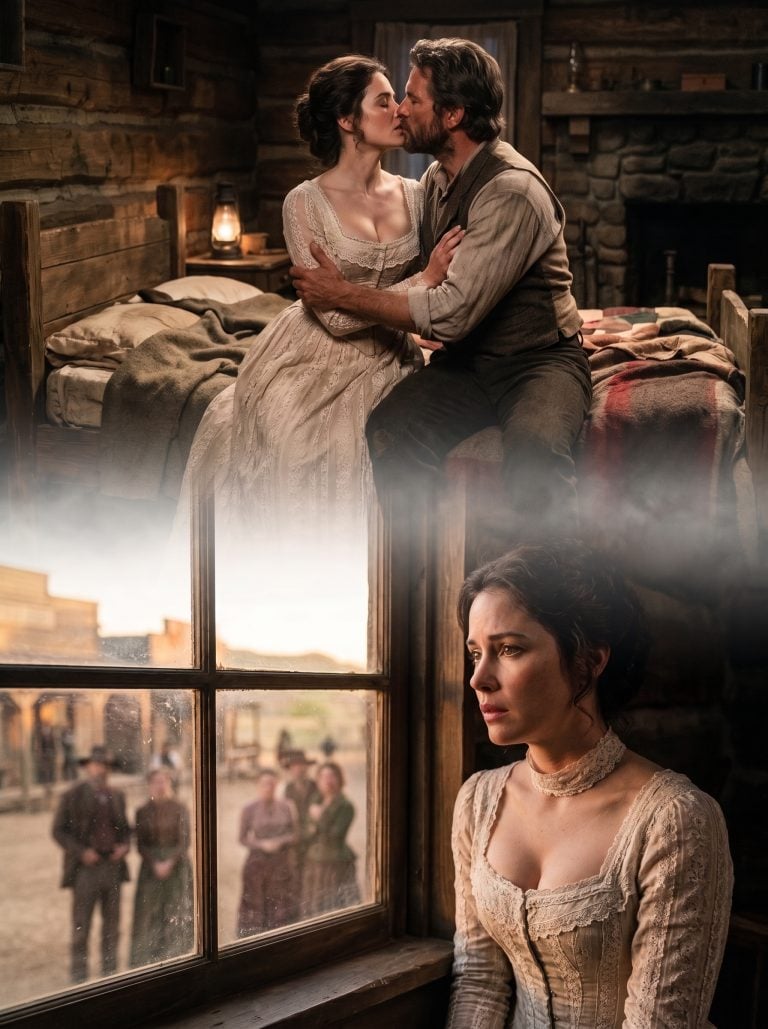
“That’s Not How You Treat a Lady,” the Mountain Man Said—After Her Groom Humiliated Her in Public

PART 1
Anna Ramsay had traveled three days by coach on the strength of letters from a man she had never met. She had sold her mother’s chair to afford the fare. She had told herself, the whole way, that a stranger’s handwriting could not lie to her twice.
She was wrong before her boots even touched the boardwalk.
Tobias McKenna was waiting at the edge of the street, arms crossed, hat low, already looking at her the way a man looks at a crate that arrived with the wrong markings stamped on the side. He didn’t wait for her to set her bag down.
“You’re not what the letters suggested.”
Loud. Loud enough for the dry goods store to hear, for the boy with the water bucket to freeze mid-step, for the woman at the milliner’s window to turn her head. Loud enough that Anna understood, in the space of one sentence, that this was not a slip of temper. This was a decision he wanted witnessed.
“I had a picture,” Tobias said, tipping his chin at her. “This isn’t it.”
Anna set her bag at her feet. Her hands didn’t shake, though something in her chest went still, the way it always did when a room decided she wasn’t worth the trouble of kindness. She had learned, over enough of these rooms, that arguing only cost her more.
Tobias kept talking — about the letters, about what he’d been promised, about what a man was owed for the cost of writing them. The street held its breath and did nothing.
Then boots came down off the hardware store steps.
The man who crossed the street was built like the work he did — broad through the shoulders, unhurried, a week of stubble on a jaw that looked unaccustomed to apologizing. He stepped between Tobias and Anna.
“That’s not how you treat a lady.”
No heat in it. Just fact, laid down like a plank across a gap.
Tobias’s chin came up. “This is my business.”
“You put it in the street,” the stranger said. “Whatever you had to say, you’ve said it. You’re done now.”
Tobias looked at the size of him. He looked at the boardwalk full of eyes. He looked at Anna once more, then straightened his coat, mounted his horse, and rode out without looking back.
The stranger turned to her. He looked at her bag. He looked at her face, which was holding together on an arrangement she’d made with herself somewhere around the second day of the road.
“You have people here?”
She didn’t. Not since her mother died and the house went to a cousin who had never much liked her, and the last engagement she’d counted on had ended the same way this one just had: a man deciding, out loud, in front of witnesses, that she wasn’t what he’d pictured. She wasn’t going to say that part.
“No,” she said.
He picked up her bag like the matter was settled.
“Einar Holmstrom. Cabin up the ridge. Back room’s empty.” He said it the way another man might report the weather. “Yours until you’ve worked out what’s next.”
She studied him. Not a polished man. Not a gentle one, not in the way the word usually got used. A man who had seen something wrong happening in the street and crossed it without being asked twice.
“Anna Ramsay,” she said. “I cook well.”
“Good,” he said. “Larder’s been thin since October.”
They walked to the end of the street together, and the town watched them go, already deciding what it meant.
What she didn’t know yet was that Tobias McKenna had not ridden off because the matter was closed for him. Three counties over, a cattle contract he’d been counting on was about to fall through — and the man holding the money had heard, before Tobias ever did, exactly how he’d behaved on a public street to a woman who’d come three days on his word.