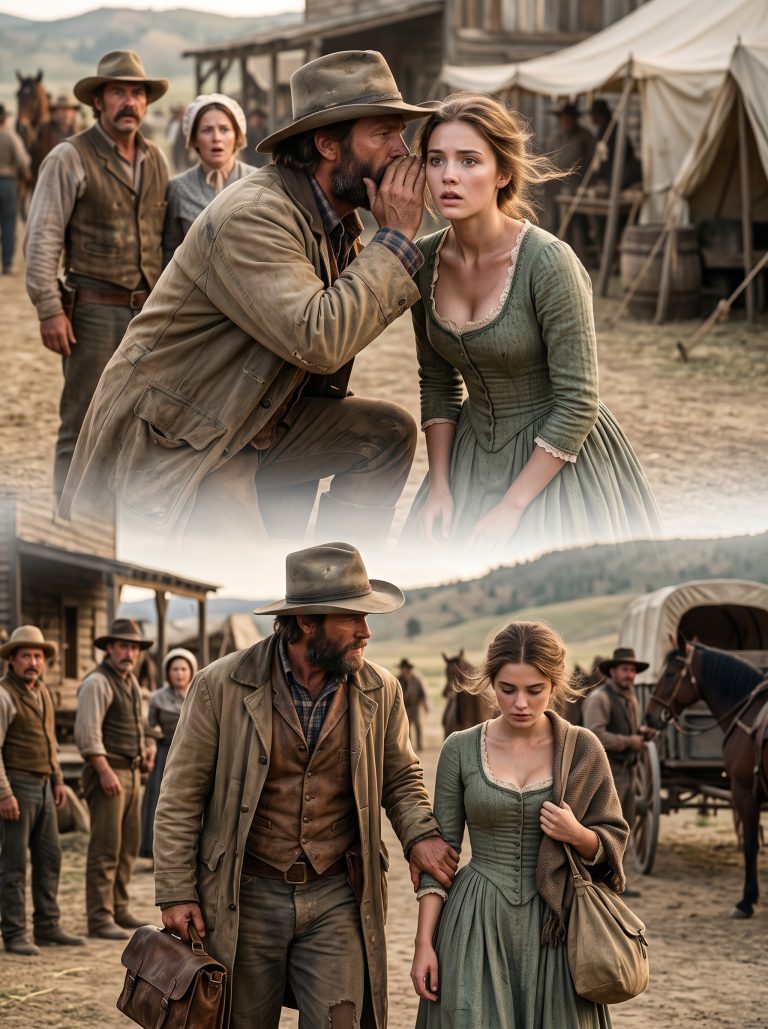
“Just sleep next to me tonight,” he whispered—she agreed, never expecting her life to change forever.

Vera Ashworth had crossed four states with a medical bag, a hidden knife, and a certificate from a Boston nursing school that opened doors in sickrooms and closed them everywhere else. The storm that hit Thistle Creek the night she arrived turned the street to a river and every innkeeper’s face to stone. She had already been refused three times before she found herself huddled beneath a rotting shed roof with water climbing toward her boots. Then a man limped out of the rain, laid his coat across her trunk, and said something that made no sense from a stranger. He said the house had gotten too quiet.
PART 1
Every door in Thistle Creek had a different way of saying no, and by the third one Vera Ashworth had learned to hear it coming before the words arrived.
The stagecoach driver had dropped her trunk in the mud with a grunt and not much ceremony, muttering an apology to the town itself rather than to her, and rattled off toward shelter before the rain could catch him too. Vera stood alone on a street turning to river, twenty-eight years old, soaked through, carrying a weariness that had stopped living in her body years ago and settled somewhere deeper.
She dragged her trunk toward the nearest lit window, which belonged to an inn with a crooked sign and yellow glass. Inside, talk died the moment she crossed the threshold. Men turned from their cups to study the mud on her hem, the plain bonnet flattened by rain, the absence of a ring or an escort or any explanation a small town found comfortable.
“I need a room,” Vera told the innkeeper, a broad woman with iron in her hair and her arms. “Just for the night.”
“Full up.” Half the tables sat empty behind her.
“I can pay.”
“Don’t matter. We don’t keep women alone after dark.”
She had heard that rule recited in a dozen towns between here and the Missouri line, always in the same tone, as if hospitality were a coin that only men and married women were trusted to spend. “I was told Mrs. Fenwick’s boardinghouse might take me.”
“Then you were told wrong.” Someone laughed into his cup behind her.
“I’m a trained nurse. I have letters of reference. I only need shelter until morning.”
“Try the church.”
“Locked.”
“Then there’s nothing I can do for you.”
Vera held the woman’s eyes long enough to make sure she understood exactly what kind of cruelty this was, then turned back into the storm.
The mercantile owner’s wife answered through a crack in the door and said the same, apologetic and final. The livery boy, young and clearly ashamed of himself, said his employer wouldn’t allow it. By the time she’d exhausted every lit window on the street, Vera dragged her trunk beneath the collapsing overhang of an abandoned freight shed at the town’s ragged edge, where rats and old straw had made a home nobody would fight her for.
She sat with her back against the wall, medical bag pulled close, rain hammering tin somewhere above her.
It was not the worst place she’d slept. That was the particular bitterness of it. She’d slept in church lofts and empty barns and once behind a graveyard fence after a marshal suggested she move along before decent people woke and noticed her. Her certificate from the Whitmore Institute in Boston opened hospital doors and closed nearly every other kind. Men wanted a capable woman in a sickroom and distrusted her the moment she stepped outside of one.
Water crept toward her boots. She slid one hand down toward the knife hidden in her boot top and went still at the sound of footsteps splashing through the mud.
A man emerged from the rain, tall, broad through the shoulder, favoring his left leg with a hitch that looked old rather than fresh. Water ran off his hat brim. In the gloom she made out a weathered face, dark hair silvered at the temple, eyes that carried more sorrow in them than curiosity.
“Ma’am.”
“I’m not looking for trouble.”
“Didn’t say you were.” His voice came low and rough, careful rather than careless, which made her trust it less rather than more. “Heard Ogden turned you out.”
Her chin came up. “Then you heard enough already.”
“Name’s Ezra Holt. Forge is down the street. House attached.”
“I saw it burning through the rain.”
“You can’t stay under this roof. Creek rises with a storm like this, and this shed floods first.”
She said nothing. He shrugged out of his coat and laid it over her trunk instead of offering it to her hands, which she noted and did not entirely trust either.
“What do you want?” she asked.
He paused long enough that she believed, for one unguarded second, he might actually consider the question honestly.
“Nothing,” he said. “I want not to leave a woman sitting in floodwater when I’ve a dry room and a fire going. That’s the whole of it.”
“That’s rarely the whole of anything.”
“No,” he admitted. “Suppose it isn’t.” He shifted his weight off the bad leg. “You can bar the door from the inside. Keep your knife. Keep your bag. I’ll take the front room by the hearth.”
Her hand tightened near her boot. “Why would you offer that to a stranger?”
Rain filled the space where his answer should have come quickly.
“Because I know what it is to be cold and turned away and alone,” he said finally. “Because Ogden’s wrong about you. Because the house gets too quiet, and I’m tired of listening to it.”
He stepped back into the dark. “Red door. Three buildings past the forge. Offer stands whether you take it tonight or not.”
Then he was gone, his coat still spread across her trunk, and Vera sat alone with the choice in front of her and the water climbing steadily toward her boots.
PART 2
One week became a month, because Thistle Creek needed a nurse and Ezra Holt’s house had a room going empty. Pride had told Vera to stay under the shed roof that first night. Sense reminded her pride had never once kept anyone dry. When water finally touched the sole of her boot, she’d stood, gathered her trunk, and walked toward the red door three buildings past the forge.
It had opened before she knocked twice, as though he’d been listening for her steps.
“Come in.”
The house was small, neat, and spare — a fire in the hearth, a scarred table, a shelf of tools, little else. It smelled of coal smoke, bread, and a loneliness settled into the walls the way damp settles into stone. Ezra had set her trunk down without commenting on its weight and pointed toward a narrow doorway.
“Room’s through there. Bed’s made. Lock works.”
“Whose room?”
His face had closed like a door swinging shut. “Someone who’s gone.”
She’d known better than to press. Inside, women’s dresses still hung in the wardrobe, kept with care that had nothing to do with forgetting. She changed into a plain gray wool dress that nearly fit and tested the lock twice before trusting it.
When she came back out, he’d laid warm water and clean cloths on the table and made himself a bed of blankets by the hearth, back turned toward her door.
“Thank you,” she’d said.
“Good night, Miss Ashworth.” He hadn’t asked her name.
“Ogden said it when she turned you away,” he’d added, as if he’d heard the question unspoken.
She’d locked her door, laid down with the knife beneath her pillow, and for the first time in months slept warm straight through a storm.
Morning came gray and quiet, coffee waiting on the stove. Ezra sliced bread with sleeves rolled to the forearm, looking younger and older at once — younger for the clarity in his eyes, older for whatever grief had carved its home there.
A knock interrupted the silence. A sharp-eyed older woman pushed past the door with a covered basket, gaze going straight to Vera.
“Heard you had company, Ezra.”
“Mrs. Prescott. Miss Ashworth. A trained nurse.”
“Trained where?”
“Whitmore Institute, Boston.”
“My grandson’s been poorly,” Mrs. Prescott said, weighing Boston like a coin she wasn’t sure was genuine. “Fever, sore mouth. Doctor Finch’s tonic isn’t helping.”
“I can look at him.”
“Bring your letters. White house, blue shutters. This afternoon.” She turned to Ezra on her way out. “People will talk.”
“They always have.”
After she left, Ezra put the preserves away with the same careful method he brought to everything.
“You could stay the week,” he said, quietly. “Until you’ve decided where you’re headed.”
“What rent?”
“Help with meals. Teach me not to burn the eggs.”
“That isn’t rent.”
“It’s mercy,” he said, and Vera nearly smiled — until she remembered mercy, offered too gently, had a way of asking for more than it admitted wanting.
PART 3
One week became a month, because Thistle Creek needed a nurse and Ezra Holt’s house had a room going empty.
Vera cured Wesley Prescott of a mouth infection that Doctor Finch had mistaken for ordinary fever, using boiled water, gentian violet, patience, and a firm refusal to let his grandmother frighten him with her worry. Within three days he was taking broth. Within a week, Mrs. Prescott stood in the mercantile announcing to anyone who’d listen that Miss Ashworth might be city-bred and far too proud for her own good, but she understood a child’s throat better than Doctor Finch understood his own medical bag.
That was how Vera earned her first true place in town.
The second came through a silent boy named Wendell Doss, brought to her by a mother who wanted a miracle and had been told by nearly everyone else that her son was simply slow. His father called him stubborn instead, which Vera privately thought was the crueler word of the two, since it at least implied a will worth fighting rather than an absence worth pitying. Vera watched his hands move in quick, urgent patterns and recognized intelligence trapped behind other people’s impatience rather than any lack of his own.
“Show me again,” she told him.
He froze, then repeated the motion. She copied it clumsily, and his face lit like a struck match. Within weeks he had signs for bread, water, mother, tired, and yes. The first full sentence he gave her took ten patient minutes of gesture and pointing, and when she finally understood it, her throat closed around the words: Thank you for seeing me.
After that, people came for fevers and burns and birthing pains and grief that had settled into the body because it had nowhere else to live. Word of her spread the way word does in small places — slowly at first, then all at once, carried by mothers grateful enough to forget their earlier suspicion and by patients who found, somewhat to their own surprise, that a woman’s hands could be every bit as steady as a man’s. Vera took coins when families had them and chickens, firewood, or quiet promises when they didn’t. Ezra never once asked what she earned. He only kept adding shelves — one for her bottles, one for her bandages, a wooden box with compartments for her instruments, built while she was out on rounds and left for her to discover without a word of announcement.
“You made these.”
“Needed somewhere to put them.”
“I didn’t ask.”
“No,” he agreed, and the plainness of it warmed her more than any speech of generosity could have. He noticed what she needed and met it without demanding thanks in return.
Their mornings settled into a rhythm — coffee, bread, eggs he fried badly until she corrected his technique and he declared eggs simply ungrateful creatures. He left for the forge before full light; she made her rounds and came home windburned with stories of who was healing and who wasn’t and who had tried dosing a child with turpentine on a neighbor’s advice. Evenings were quiet, him at leatherwork by the fire, her mending or mixing salves, each of them watching the other more than either admitted.
Ezra Holt was not handsome in any polished way. War and grief and years at the forge had left their marks plainly on him — a hitch in his stride that never fully left, hands scarred pale in places where sparks had caught him young and careless before he learned better. But there was something restful in his steadiness — he didn’t fill silence to prove he owned it, didn’t crowd her, never asked for pieces of herself she hadn’t already offered. A demanding man could be resisted easily enough. A quietly kind one seeped into the cracks before a person noticed the wall had opened at all.
One rainy evening in the barn, she found him holding a faded Union coat, one sleeve torn at the shoulder.
“I thought I’d burned this,” he said.
“You were in the war.”
“Most men my age were.”
“Not all of them kept the coat.”
“Wore it the day I first asked Charlotte’s father if I could court her. He told me a broken soldier on a blacksmith’s wage had no business looking at his daughter.”
“And Charlotte?”
“Said he was wrong.” He folded the coat with careful hands. “Stayed away three years after the war anyway. Wrote her I was done with memory, done with trying to be the man who’d left, told her not to wait. She waited regardless. Her father wrote when she took sick with consumption. I came, but too late for anything except watching her go.”
Rain struck the barn roof steadily overhead while Vera turned all of that over in her mind, absorbing it slowly, the way she absorbed most difficult things.
“I was engaged once,” she offered. “A doctor at my hospital in Boston. Handsome, respectable, my parents announced it in the papers before I’d fully agreed to it myself. At my own birthday dinner I found him with my younger sister in my father’s study.”
Ezra’s jaw tightened.
“I left the next morning. Iris married him three months later. My mother still writes that I ought to forgive them both, because family is family.”
“Have you?”
“No. I want not to think of them at all. That’s a different thing entirely.”
“Yes,” he said, with sad recognition. “It is.”
“Do you ever wonder,” he asked after a while, “whether people like us get more than one chance at anything?”
“I wonder whether the first chance was even what we believed it to be at the time.”
“Broken things can still be useful,” he said. “Just rarely in the shape they were before.”
“You sound like a blacksmith.”
“I am one.”
She smiled, and he looked so startled by the sight of it, then so plainly pleased, that Vera understood in that instant she was already in some quiet, serious trouble.
The town noticed before either of them would admit anything aloud. In December, Ezra forged a bracket and painted a board in plain black letters — ASHWORTH & HOLT, MENDING AND METALWORK — because patients needed to know where to find her and customers shouldn’t mistake sickroom business for horseshoes. Whispers followed her at the well and the church steps she visited only when patients required it. Some called her brave for sitting with the dying and saving children others had given up on. Others said no decent woman lived under an unmarried man’s roof, sign or no sign. Ogden, perhaps ashamed of turning her out that first night, spread word that Vera had trapped Ezra through pity and nursing alone.
Reverend Colby came one cold evening, hat in his hands, embarrassment plain on his face. “The church board is concerned. Appearance matters in a small town.”
“I rent a room,” Vera said. “We share expenses. Nothing improper has happened here.”
“I believe you,” he said, which somehow made it worse. “But perception—”
“Perception,” Ezra said from the hearth, jaw tight, “left her in a flooding shed during a storm.”
“No one wishes her harmed.”
“No. Just homeless enough to keep everyone comfortable.”
After the reverend left, Vera stood at the window watching hard grains of snow fall. “Maybe I should go.”
“No.” The word landed like hammer on anvil.
“This touches your reputation.”
“My reputation survived a war, a grief, and five years of this town calling me a ghost that happened to still forge horseshoes.” He crossed the room, stopping short of her. “I won’t ask you to marry me to quiet gossiping tongues, and I won’t ask you to leave to spare myself trouble. But I’ll say this plainly — I’m glad you’re here. Not only because the house is less quiet, though it is. Because you are you.”
She couldn’t answer that. It wasn’t the whole truth between them yet, and they both knew it.
The fire at Widow Renner’s house came two weeks later. Vera woke to bells and the orange pulse of flame against her window and was in the street before her boots were properly laced, cloak thrown over her nightdress, medical bag in hand, the whole town already gathering in the kind of useless, frightened knot that forms whenever a house burns and nobody quite knows where to put their hands.
“My Sadie!” the widow screamed. “She’s still inside!”
Nobody moved. Vera did — soaking her cloak in the trough, wrapping it over her head, running through the door before fear could catch her first. Smoke stole her sight; heat struck like a hand. She found the child curled and frozen near the stairs, wrapped her in the wet cloak, smashed a window by touch, and shoved her through to waiting arms before crawling out herself, coughing until she was sick in the snow.
Then the widow screamed again. “Scout! The dog!”
Someone shouted to leave it. Ezra ran in anyway. Of course he did.
Vera tried to stand and her legs failed her. She watched him disappear into the burning kitchen and felt her heart turn to ash along with the house. Seconds passed. Too many of them. Then he staggered out with a bundle of singed fur just as a burning beam dropped across his shoulder and drove him to the ground. Men dragged him clear. The dog wriggled free to Sadie, who clutched it sobbing.
“Damn fool,” Vera whispered, hands already working over his burns.
“Dog lived,” he managed.
“I may kill you myself for this.”
“Wait till I’m useful again, then.”
For three days she barely left his side, cleaning the burns with honey and calendula, forcing broth past his lips, cursing him quietly whenever fear grew too large to hold silently. On the second night his fever broke, and he woke to find her asleep in the chair, still gripping his hand.
“You’re here,” he said.
“Where else would I be.”
“When you went into that fire,” he said slowly, each word costing him some visible effort, “I thought I might lose you. I knew then this had stopped being convenience a long while back.”
“I am your nurse,” she said, retreating into the safety of the list, counting the roles off almost like an incantation meant to keep something larger at bay. “Your tenant. Your business partner.”
“Yes. Yes. Yes.” He held her eyes, wounded and hopeful in equal measure. “And if you’re more than that?”
“Then I’d count myself fortunate,” he said. “But only if you choose it. Not the town. Not pity. You.”
Vera could face fever and blood and birth and burns without flinching. Hope frightened her more than any of it.
Her past found her in January, sealed in an envelope from Boston in her sister’s handwriting. Their father had died. He’d called for her at the end; Iris had told him Vera had forgiven them both. She hadn’t.
“You should go,” Ezra said gently, once she’d told him.
“So they can smooth it all over? So Iris can weep and Julian can look remorseful and everyone pretends I was the unreasonable one?”
“So you don’t spend ten years wondering whether staying away was worth what it cost you.” He knew that particular cost. He’d paid it once with Charlotte.
“I can’t face them alone.”
“You won’t have to. I’d go farther than Boston for you, if it came to that.”
Three days later they boarded the eastbound train, Mrs. Prescott promising to fetch Doctor Finch if anyone grew desperate and warning Ezra that if he failed to bring Vera home again, she’d see him shod like a stubborn mule herself.
Boston was smoke and wet stone and old memory, the kind of city that seemed to remember every version of a person it had ever held, whether or not that person cared to be reminded. Iris answered the door herself, thinner than Vera remembered, tired in a way that spoke of disappointment lived daily rather than survived once. “You came,” she whispered.
“You asked.”
Inside, mourners whispered and old acquaintances stared, and Vera felt herself becoming the scandal all over again — the daughter who ran, the woman who chose nursing work out west instead of forgiving prettily. Ezra stood beside her without touching, steady as iron the whole time.
In their father’s study, Iris finally said what she’d apparently wanted to say for three years. “I’m sorry. For breaking you. For being jealous enough to mistake being chosen by him for being worth anything at all.”
“Do you love him?” Vera asked.
Iris’s mouth trembled. “I thought I did. He barely comes home now. Our children know him as a visitor. He wanted a wife who made him look settled, not one who needed tenderness.” She swallowed hard. “You escaped.”
The irony was too bitter for either of them to smile at. “I can’t forgive you because you’re miserable now,” Vera said.
“I know.”
“But I don’t hate you quite as much as I did.”
It wasn’t forgiveness. It was a beginning.
Their father had left Vera his medical books, his instruments, and a sealed letter: To my daughter, the doctor. She carried it to the garden, where Ezra stood among winter-bare rosebushes, and when she couldn’t speak, he simply opened his arms and let her come into them.
That evening she saw Julian Sterling at the hospital where she’d once trained. Prosperity had softened him; seeing him again broke nothing in her that she could find. “You look well,” he said.
“I am.”
“I owe you an apology.”
“You do. I didn’t come to collect it, though. I came to thank you — for showing me who you were before I married you. For freeing me, though I didn’t understand that at the time.”
“Do you hate me?”
“No,” she said, and meant it fully. “I feel nothing for you at all.”
She left him standing in the hallway. Outside, Ezra waited by a carriage with snow gathering on his shoulders. “Ready to go home?” he asked.
Not Thistle Creek. Not his house. Not the forge.
Home.
“Yes,” she said. “More than ready.”
On the train west, their mother’s plain gold wedding band sat in Vera’s palm, Iris’s parting gift. “Will you wear it?” Ezra asked.
“Ask me properly once we’re home.”
“I will.”
Life, as it usually does, declined to wait for proper timing. In March, Iris arrived in Thistle Creek with two small children and a face stripped bare of pride. Julian had brought another woman into their house and told Iris that a wife with no fortune and two children had no grounds to complain. She’d left him. Their family in Boston had turned her away. She came west because desperation remembered the only sister who might understand what it was to be cast aside.
Vera stood on the porch looking at Iris and at the hungry children clinging to her skirt. Part of her wanted justice. The better part saw only two frightened children.
“Come inside,” she said. “We’ll feed them first.”
Mercy, she discovered, felt nothing like the noble thing people described. It felt inconvenient and painful and entirely necessary anyway.
Iris stayed a week in the house, then moved into the room above the forge once Ezra repaired the stove and added a second window for light. She took in mending. Her children, Nathan and Bea, filled the yard with noise — Bea followed Vera on rounds carrying bandages with grave importance, Nathan haunted the forge worshiping Ezra with the plain admiration of a boy who needed a steady man nearby.
“You regret it?” Ezra asked one evening, watching Iris tuck her children in through the lit window above the forge.
“No.”
“Still hurts?”
“Yes.”
“Both things can be true,” he said, wrapping his arms around her from behind, and she leaned back into him and let that be enough.
That night, brushing out her hair, she finally said his name. He looked up from unbuttoning his cuffs.
“You never did ask me properly.”
He went still, then opened the drawer, drew out her mother’s ring, and knelt beside her chair.
“Vera Ashworth,” he said, voice rough with feeling, “you came to my door in a storm and made a home out of a house I thought had already died with everything in it. You healed this town, and my leg, and my pride, and places in me I’d stopped believing could be reached at all. I don’t ask because the town’s been talking. I ask because I love you, and because every morning without your voice in that kitchen would be poorer than I could stand to bear. Will you marry me?”
“Yes,” she said, before fear could dress itself up as caution. “Yes, Ezra.”
The ring fit as though her life had simply been waiting to catch up to it.
They married that spring at the forge rather than the church, Vera in her blue work dress and the silver locket Widow Renner had given her after the fire, refusing any spectacle for the benefit of the same town that had once tried to shame her out the door. It felt, she thought, like the only honest way to be married — surrounded by the very tools and soot and iron that had actually built the life she was agreeing to keep. Bea carried prairie flowers. Nathan stood beside Ezra as a solemn best man twice his age in seriousness. Iris cried quietly at the back. Mrs. Prescott claimed she’d only come to make certain the reverend said the words correctly.
Ezra had forged their rings himself — plain iron, polished dark and strong. Vera wore hers beside her mother’s gold. Two metals. Two histories. One hand.
“Do you, Vera Ashworth, take this man?”
“I do.” She’d already chosen him a hundred quiet ways — in coffee, in bandages, in storms, in coming home from Boston, in letting him stand beside her without ever letting him stand in her place.
“Do you, Ezra Holt, take this woman?”
“Every day I’m given,” he said, which set Mrs. Prescott crying and immediately denying it, loudly enough that half the small gathering laughed instead of reaching for handkerchiefs of their own.
Marriage changed less than the town expected and more than either of them could have explained. Vera kept making her rounds, in every kind of weather Thistle Creek cared to throw at her, and Ezra kept the forge running from before dawn until well past when most other men had gone home to supper. The sign stayed up, though someone eventually painted MENDING DONE HERE in smaller letters beneath it, a joke that never quite stopped being true. Iris’s mending trade grew steadily through that first year and into the next. Wendell Doss learned enough signs to begin teaching other children in town, patiently, the way Vera had once taught him. Bea announced, with the total confidence particular to children who have not yet been told no very often, that she meant to be a doctor. Nathan learned to work the bellows properly, then insisted on doing it every single evening whether the forge needed him or not. Thistle Creek grew slowly, imperfectly kinder, because Vera refused to let suffering go unnamed within it, and because Ezra had built, out of grief and iron, a house that finally knew how to hold more than one kind of quiet.
On the anniversary of the night she’d first come to the red door, rain returned — not a storm this time, only a gentle autumn rain, soft on the roof and silver in the street. Vera and Ezra sat at the kitchen table with coffee and bread exactly as they had that first gray morning, the fire warm, her medical bag by the door, his hammer on its peg, Iris’s children asleep upstairs after a day spent running wild through puddles.
“Did you know?” she asked. “That first night.”
“I knew I didn’t want you to leave.”
“You only asked me to sleep beside you that once.”
“I meant under the same roof.”
“I know what you meant.”
He looked at her, and she smiled. “And I never left.”
“No,” he said softly. “You didn’t.”
Outside, Thistle Creek glimmered through the rain. Ogden’s inn stood dark, closed since she’d moved east to live with a daughter. The old freight shed had come down before the spring floods that year. The red door remained, freshly painted by Nathan and badly enough that Ezra swore it had character now it hadn’t had before.
Vera reached across the table and took her husband’s scarred hand in hers, turning it over once the way she might have examined any patient’s, though this particular examination had nothing to do with medicine at all. She had come to Thistle Creek with a trunk, a hidden knife, a medical bag, and a heart trained to run before it could be betrayed again. He had opened a door, offered fire, and asked only for the comfort of one more soul breathing in the dark beside his own.
From that small mercy, they had built an entire life together — not grand, not flawless, not untouched anywhere by grief, but warm all the way through, in every room that mattered.
Outside, rain kept softening the street where she had once stood entirely unwanted. Inside, bread steamed on the table, coffee darkened in their cups, and the house that had once been far too quiet now held the steady breathing of everyone they had chosen, deliberately and completely, to love.