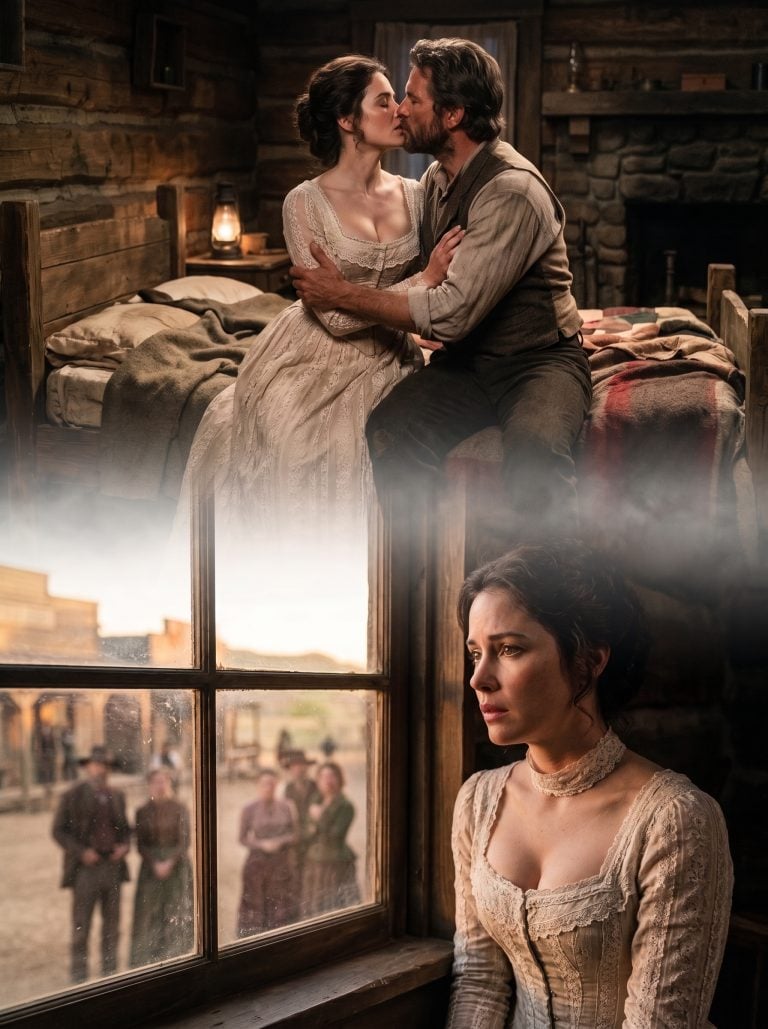
“Get your things. You’re mine now,” the mountain man said—and she froze before realizing he meant forever, not captivity.

Part 1
The first time Wade Calloway saw Eleanor Ashford in eight years, she was buying quinine at the Iron Creek apothecary with a torn cuff pinned shut and a voice pitched too carefully calm.
He knew that calm. He had taught himself the same one, once, in a cell in Independence, Missouri, waiting to hang for a robbery he had not committed.
Outside, the Colorado wind came down off the Sawtooth ridge smelling of coming snow. Iron Creek was a silver camp two years old and already tired of itself — plank sidewalks warping in the wet, a bank with a marble face and a mud floor behind it, a mine office that never seemed to close. Wade came down from his cattle lease in the high meadows once a month, sold beef to the mine commissary, and left before anyone asked his history. Men called him quiet. A few called him lucky, since no one that careful with a rifle should also be that careful with his words.
No one called him Caleb Whitfield anymore. That man was still wanted in three counties for a stagecoach robbery and a guard’s death, eight years old and never solved, because Wade Calloway had spent those eight years being someone the law had never met.
He had not planned to be in the apothecary at the same hour as Eleanor.
He told himself that twice, watching her count coins with hands that shook slightly, though her voice did not.
She looked up.
The room did the thing rooms do when two people who once mattered to each other stop pretending not to notice. The clerk vanished. The quinine bottles vanished. Wade saw the girl who had waited on the porch of her father’s house in Independence, nineteen and certain the world would let them keep each other. Eleanor saw the man the newspapers had called dangerous and the years had made only heavier and quieter.
“Mr. Calloway,” she said, careful with the alias the way a person is careful with a wound.
“Mrs. Ashford.”
Her mouth flinched at the name as if it cost her something to hear it in his voice.
Then the bell over the door rang, and Simon Ashford walked in shaking rain from his hat, and Wade understood, in the particular stillness that comes before a bad hand is played, that he had walked into something that had been arranged.
Ashford was Iron Creek’s principal investor — the bank, the mine office, half the freight line. He was also, Wade now recalled with the cold clarity of a man reassembling a puzzle he’d refused to look at for eight years, the same Simon Ashford who had testified in Independence that he’d seen Caleb Whitfield riding away from the robbery with saddlebags full of strongbox silver.
“Calloway,” Ashford said, pleasant as poison. “I didn’t realize you knew my wife.”
“I don’t,” Wade said.
“Funny. You’re looking at her like a man remembering something.”
Eleanor’s knuckles went white around her coin purse.
“I knew a family named Whitfield once,” Wade said, choosing each word the way he chose foot-holds on ice. “Long time back. Different territory.”
Ashford’s eyes did not believe him, and did not need to. He smiled instead, the smile of a man who has already won and is only deciding how loudly to say so.
“Small world,” he said, and steered Eleanor out by the elbow, not roughly — never roughly, in public, Wade would learn — but with the particular grip of ownership disguised as courtesy.
At the door, Eleanor looked back once.
Not at Wade.
At the shelf behind him, where a small tin of salve sat beside the quinine — the same brand, he would later realize, that healed cracked hands, the kind a woman got from wringing wet laundry too often for a man too careful to leave visible bruises anywhere but her wrists.
She was warning him. Not asking to be rescued. Warning him that Ashford already knew who he was.
Wade rode back to the high meadow that night turning eight years over in his mind like a coin he’d never been permitted to spend. He had told himself, all this time, that Eleanor’s father had married her off out of simple cowardice before a debt, and that the false testimony against Caleb Whitfield had come from a stranger with poor eyesight and a reward on his mind.
He had never once let himself ask why that stranger’s name was Ashford, or why Ashford’s mining fortune had begun, suspiciously, the same season the county paid out a reward for information on the stagecoach robbers — a robbery that, now Wade thought of it plainly for the first time in eight years, Ashford himself had also had cause to commit.
He had spent eight years being a fugitive from a crime he hadn’t done.
He had never once considered that the man who framed him might have done it not to punish a thief, but to remove a rival — and that the woman he’d loved had been the prize all along.
The wind came harder that night, carrying the first real snow of the season down off the Sawtooth. Wade Calloway cleaned his rifle by lamplight and did not sleep, because for the first time in eight years, waiting no longer felt like patience.
It felt like a debt coming due.
Part 2
Eleanor did not sleep either.
She sat at her writing desk in the Ashford house — a house with velvet drapes and a floor that never once creaked, because Simon had every board inspected for exactly that reason — and opened the false bottom of her sewing box, where a small bundle of paper had lived, folded flat, for six years.
Not love letters. She had learned early that love letters were a weakness Simon searched for.
Ledgers. Copied in her own hand from the mine office books she was permitted to organize because Simon believed a wife too occupied with numbers had no room left for schemes. Names of men paid, the same year as the Independence robbery, for “surveying services” that matched no survey Iron Creek’s predecessor camp had ever recorded. A letter in Simon’s own script, addressed to a lawyer, discussing “the Whitfield matter” and “ensuring the witness testimony holds,” dated three weeks before the trial that had sent Caleb Whitfield running for his life.
She had found the letter by accident, in the lining of an old trunk, the second year of her marriage. She had understood, reading it, three things at once: that her husband had built his fortune on a robbery, that he had let an innocent man be hunted for it, and that he had married her not from admiration but as a trophy taken from a rival he had already destroyed.
She had also understood that if she ever tried to use what she knew without proof enough to convince a judge, Simon would simply say she had gone hysterical, and have her committed, or worse, and no one in three territories would question a grieving husband’s decision.
So she had waited. Copied. Hidden. Learned the names of every man who might one day be willing to testify against Simon Ashford if the day ever came that the evidence was strong enough, and the risk small enough, and someone willing to stand beside her instead of only in front of her.
She had not known that man would walk into an apothecary eight years later wearing another name and the same careful eyes.
She refolded the papers and pressed them flat beneath her Bible, where a single pressed wildflower had once marked a page about patience, and where now it marked something closer to a plan.
Outside, snow gathered on the windowsill.
Somewhere up in the Sawtooth meadows, she hoped, a man who had every reason to ride down and shoot her husband dead was instead, please God, doing something smarter.
Part 3
He was.
Barely.
For three days Wade did nothing but watch Iron Creek from the tree line above the mine road, the old law-instinct in him — the part of Caleb Whitfield that had once worn a deputy’s star before poverty and pride sent him west chasing a cattle lease instead of a salary — recognizing the shape of a trap being built. Ashford’s foreman rode to the county seat and back twice. A telegram came for Ashford from a marshal’s office in Missouri. A man Wade didn’t recognize took a room at the Iron Creek Hotel and spent his afternoons watching the mercantile with the patient boredom of a hired gun waiting on instructions.
They were building a case to hang him, legally this time, on the old warrant, and they wanted a public provocation to make his arrest look righteous instead of convenient — wanted Wade to do something violent, in front of witnesses, so that when the old Missouri warrant surfaced, no jury west of the Mississippi would blink at hanging a man who’d also just assaulted a respected banker.
Which meant the worst thing Wade could possibly do was exactly what every instinct in him wanted: ride down and put a bullet in Simon Ashford.
On the second night of watching, one of Ashford’s hired men rode up the mine road toward the meadow trail, alone, in the dark, which was either carelessness or bait. Wade let him pass within thirty feet of the tree line without moving, rifle across his knees, and understood, watching the man’s lantern bob away up a trail that led nowhere but Wade’s own line cabin, that it was bait. Someone wanted him provoked into shooting a man in the dark on his own land — a killing that could be dressed up afterward as an ambush, or a murder, depending on which story reached the county seat first.
He did not take the bait. He rode instead, before dawn, to an old friend from his marshal days — a blacksmith named Otis Freeling who had followed rumors of silver west and found instead a forge business steady enough to keep him fed, and who remembered Caleb Whitfield well enough to still call him that when no one else was listening.
“You look like a man deciding whether to hang for a killing or a killing he didn’t do,” Otis said, not looking up from the horseshoe in his tongs.
“Might be both, depending how this week goes.”
“Ashford’s been talking you up to the marshal’s office for a month,” Otis said. “Told the assay clerk you were casing the mine payroll. Told the preacher’s wife you’d threatened his household. Man’s been building you a reputation like he’s laying brick.”
“He’s laying more than that.” Wade told him what he suspected — the old testimony, the reward money, the shape of a decade-old frame stretching all the way from Independence to a silver camp two years old. Otis listened without interrupting, the way a man listens when he already half believes something and is only waiting to hear it said plain.
“If it’s true,” Otis said finally, “you’ll need more than my word for it. I never left Missouri with proof. Just a bad feeling about a witness who couldn’t keep his story straight in the saloon after he’d told it straight in the courtroom.”
“Bragg,” Wade said. “Hollis Bragg.”
“Man’s been on Ashford’s payroll here under the name Harmon for four years,” Otis said, and something in Wade’s chest went very still and very cold, the way it did before a shot he knew would land. “Drinks himself sick most nights. Owes the company store more than he’ll ever pay back honest.”
It was the second piece of a case Wade hadn’t yet realized he was building, and it told him, more clearly than anything Ashford himself had done, that he needed Eleanor. Not to rescue. To ask.
He found the opening on a Sunday, when Ashford rode to the county seat for a bank meeting and Eleanor walked, as she did every week, to leave flowers at the small chapel plot where her mother’s memorial stone stood, alone, unguarded for the one hour Simon permitted her out of his sight because grief, he’d decided, was harmless.
Wade was waiting behind the chapel, hat in hand, feeling more exposed than he had in any gunfight.
“They’re building a case,” he said, without preamble, because there wasn’t time for anything gentler. “Old warrant out of Missouri. Your husband wants me to hang for something I never did, and he wants a reason a jury will like.”
“I know,” Eleanor said.
That stopped him harder than a physical blow.
“You know.”
“I’ve known what he did to you for six years,” she said, and her voice, for the first time since the mercantile, was not careful at all — it was tired, and furious, and entirely her own. “I have letters in his own hand, Caleb. Ledgers. Names of men he paid to put you on that stage road testimony. I have had it hidden since before I knew your face again, waiting for a version of this moment where using it wouldn’t simply get me committed to an asylum by a husband everyone in three territories trusts.”
Wade stood very still, the way a man stands when the ground he’d been steadying himself against turns out to be a bridge instead of a wall.
“You knew,” he said again, softer. “All this time. And you never—”
“Never what?” Her chin came up, old defiance surfacing through years of careful calm. “Never rode out to save you myself? I had no rifle worth the name and no fortune of my own, only proof that would be worthless the moment I was declared unwell for having it. You waited eight years to be sure the law had forgotten your face. I have waited six to be sure the law would believe mine. We are not so different, Wade Calloway.”
He almost laughed, the way a man laughs when grief and relief arrive in the same breath.
“Then we don’t need a gunfight,” he said slowly, thinking it through even as he said it. “We need a courtroom. Or as close to one as Iron Creek’s got.”
“The circuit judge sits Thursday,” Eleanor said. “For the mine boundary disputes. Half the county will be in that room already — men Simon owes money to, men who’d love an excuse to stop owing it.”
“And the marshal from Missouri?”
“Arrives Wednesday night, according to the telegram Simon didn’t know I read.”
Wade looked at her — really looked, the way he hadn’t let himself in the apothecary, in the mercantile, in eight years of building a cabin’s worth of a life around the shape of a girl who might have needed rescuing.
She did not need rescuing.
She needed a witness who could stand beside her and not flinch when Simon Ashford turned his fury on them both.
“Thursday, then,” he said. “But you’ll need more than a letter and a ledger to stop a marshal with a warrant already in his coat pocket.”
“I have one more thing,” Eleanor said, and for the first time, something like grim satisfaction crossed her face. “The false witness. The man who testified he saw Caleb Whitfield riding from the robbery. His name is Hollis Bragg, and he’s been working Simon’s mine payroll under a different name for four years, drinking himself into debts Simon quietly forgives — because a forgiven debt is a leash, and Simon likes his leashes long enough that the dog forgets it’s on one. I think, given the right offer, Hollis Bragg would rather tell the truth to a judge than keep being owned by the man who paid him to lie.”
“You’ve done this alone,” Wade said, “for six years.”
“I have done what a woman does,” Eleanor said, “when the men around her assume waiting means doing nothing.”
He looked at her a long moment, the wind moving the chapel’s cedar shingles overhead, and felt something shift in him that had nothing to do with rifles or warrants.
“I built a cabin,” he said slowly, “for eight years, thinking that was the bravest thing a man could do while he waited. Logs and floorboards and a chair I carved to fit a woman’s shoulders. I never once thought to ask what a woman does with her hands while she’s waiting on a man to come back and finish deciding he loves her.”
“She keeps records,” Eleanor said, dry despite everything, “and hides them better than her husband hides his ledgers.”
“How do we get Bragg to talk without Ashford’s man in the hotel window seeing us do it?”
“Sunday night,” Eleanor said. “Simon takes his supper with the mine investors every Sunday, three hours, no exceptions, because a man like Simon believes his own routines are proof of his own respectability. The hired watcher follows him, not me. I can get you five minutes alone with Hollis Bragg behind the saloon without anyone counting them.”
“And if Bragg tells Ashford the moment we leave?”
“Then we’ve lost nothing we hadn’t already lost,” Eleanor said. “But I don’t think we will. I’ve watched that man drink himself sick for two years feeling guilty about something he’s never once told anyone. Guilt like that is a debt too, Caleb. Sometimes it just needs someone to name the amount before a man will pay it.”
She was right, though it took until Wednesday night to prove it.
Sunday night, while Simon Ashford sat three tables deep in cigar smoke discussing assay yields with men who would, within the month, be demanding their investments back with interest, Wade found Hollis Bragg exactly where Eleanor said he would be — slumped in the alley behind the saloon, a bottle balanced on his knee, a man who had clearly been trying for years to drink his way past a memory that wouldn’t drown.
Wade sat down on an overturned crate without being asked, close enough to talk, far enough not to loom.
“Caleb Whitfield,” Bragg said, not even startled, as if some part of him had been waiting eight years for this exact conversation to finally arrive. “Figured you’d come looking eventually. Figured you’d come with a gun.”
“Figured that too, for a while,” Wade admitted. “Man I used to be would have. I’ve had eight years to get better at figuring out which parts of a debt a bullet actually pays off, and which parts it just makes worse.”
“I saw you,” Bragg said, staring at the bottle instead of at Wade. “That morning of the robbery. Saw you plain as anything, riding the Independence road with your saddlebags full.”
“No you didn’t.”
“No,” Bragg agreed, and something in him seemed to loosen, like a knot finally worked free after years of pulling tighter. “I saw a man about your height on a bay gelding two miles from where the robbery happened, at an hour that didn’t square with the time the guard was shot, and Simon Ashford paid me forty dollars and a job for life to swear it was you close enough and soon enough.”
“Why me?”
“Because you were courting the girl he wanted,” Bragg said simply, “and because you were poor enough that no lawyer in three counties would take your case for free, and because Ashford already had the real silver from that robbery buried somewhere he’s never told a living soul, and needed a name on a warrant that wasn’t his own. You were convenient, Whitfield. That’s the whole ugly truth of it. Not guilty. Convenient.”
Wade sat with that for a long moment, the alley cold and quiet around them, eight years of running finally collapsing down into four plain sentences from a man too tired to keep carrying the lie.
“There’s a court sitting Thursday,” Wade said finally. “Circuit judge, boundary disputes mostly, but a judge all the same, and a marshal in town already looking for me on the old warrant. If you told the truth in that room — the whole of it, not just enough to save your own conscience — it might be the only chance either of us gets to stop being a convenient story for Simon Ashford.”
Bragg was quiet long enough that Wade thought he’d lost him.
“He’ll ruin me,” Bragg said finally. “Take my job, my debts’ll come due all at once, I’ll have nothing.”
“Mrs. Ashford’s prepared to see your debts forgiven from her own dower money the day her husband’s business comes apart,” Wade said, which was true, because Eleanor had said exactly that on the ride down from the meadow, matter-of-fact as a woman balancing a ledger. “And I expect a rancher up in the Sawtooth meadows could use an honest blacksmith’s helper who isn’t afraid of hard winters, if a fresh start out from under Ashford’s shadow is what you’re after.”
Bragg looked up at him then, and Wade watched eight years of another man’s careful lie start, finally, to come apart into something like relief.
“Forty dollars,” Bragg said, and laughed, though there was no humor in it. “Man sold your whole life for forty dollars and a bad job. I’ve hated myself so long I forgot what it felt like before I did it.”
“Then Thursday,” Wade said, “you get to remember.”
Thursday morning, the circuit court convened in the back room of the Iron Creek assay office, crowded with mine claim disputes nobody outside the county cared about, and Simon Ashford arrived expecting to watch a stranger get arrested for public assault on a respected citizen — an assault Wade had been careful, all week, never to give him.
Instead, Eleanor Ashford stood, in front of the judge, the marshal, half the mining claims of Iron Creek, and her husband, and read aloud from a letter written eight years earlier in Simon Ashford’s own hand.
The room did not gasp the way rooms do in stories. It went instead into the particular silence of men recalculating, very quickly, who they owed money to and whether that debt was about to become worthless.
Simon Ashford’s face did the thing faces do when a decade of careful architecture collapses at once — not rage first, but a kind of blank arithmetic, as if he were still trying to find the version of events where this didn’t end with him in irons.
Hollis Bragg testified next, sober for the first time in a year, and named the payroll ledger, the false testimony, the reward money split three ways eight years ago in a hotel room in Independence.
The marshal, to his credit, listened to all of it before he looked at Wade.
“Caleb Whitfield,” he said slowly, testing the old name like a coin he wasn’t sure was counterfeit. “You understand I still have a warrant with your name on it.”
“I understand a case can be reopened,” Wade said, “same as it can be closed. I’d rather stand trial with real evidence in the room than keep running from one without it.”
It took eleven weeks — eleven weeks of depositions, of Eleanor testifying twice, of Simon Ashford’s lawyers trying three different strategies before the last of his mine investors withdrew their money and his own defense collapsed under the weight of his own ledgers — before the Missouri warrant against Caleb Whitfield was formally vacated, and a new one, considerably longer, was issued for Simon Ashford instead.
Ashford did not go quietly. In the second week, he tried to have Eleanor declared unfit to testify, producing a physician willing to swear to nervous exhaustion for a fee; the judge, who had by then read enough of Ashford’s own correspondence to distrust anything with his signature on it, dismissed the motion inside an hour. In the fifth week, the hired watcher from the hotel — the same patient man who had spent a summer counting Wade’s movements from a window — tried instead to burn the assay office records overnight, and was caught by Otis Freeling, who had taken to sleeping across the street with a shotgun once he understood what was at stake. In the ninth week, Ashford himself came to the meadow ranch at dusk, alone, no longer pretending at courtesy, and stood in the yard shouting that Eleanor belonged to him by law and always would, until Wade stepped onto the porch with a rifle he did not raise and a voice that did not need to.
“She belongs to whoever she chooses,” Wade said. “Same as I do. That’s the whole of the law that matters out here, Ashford, and you’re the only man in this territory who never learned it.”
Ashford left without another word, and was arrested nine days later trying to cross into the next territory with a strongbox no manifest could account for — the same silver, it would later be proven, that had never been reported stolen from a stagecoach eight years and four hundred miles away.
Eleanor did not wait for the paperwork to file for a divorce. Iron Creek’s judge, unusually sympathetic once the whole territory had watched Simon Ashford’s empire dissolve in open court, granted it inside a month, citing fraud, cruelty, and abandonment of the truth so thorough that even the newspapers, usually kind to a man of Ashford’s former stature, ran the story under the headline THE BANKER WHO BOUGHT A WITNESS.
Wade rebuilt his cattle lease into a proper ranch that spring, no longer needing to hide from a name that no longer hunted him. Eleanor came up from Iron Creek in June, not carried, not rescued, but riding her own borrowed mare up the meadow trail with a small trunk of her own belongings strapped behind the saddle, because she had asked to come, and he had answered by building a second room onto the cabin instead of assuming she’d want to share the first.
“You could have just asked me to marry you,” she said, standing in the doorway of the new room, amused despite herself.
“I did that once already,” Wade said. “Assumed a woman’s yes before she’d had the room to give it freely. Cost us eight years and nearly cost you your whole life. I’d rather ask twice and wait longer than assume once and lose everything again.”
She crossed the threshold on her own.
“Then ask,” she said.
He did, in October, when the aspen turned gold along the creek and the pressed wildflower she’d carried out of Iron Creek in the lining of her Bible found a permanent home on the cabin’s mantel instead of hidden beneath scripture where it had had to survive for six frightened years.
They married in November, in a ceremony small enough that no banker’s fortune could have bought a better one and no warrant could touch it. Otis Freeling stood witness, having by then moved his forge up to the meadow at Wade’s invitation, and Hollis Bragg came too, sober four months running, and cried harder at the vows than anyone else in the room, which no one had the heart to tease him for.
Hollis stayed on through that first winter, splitting his time between the new forge and a growing herd, and by spring he had built himself a small cabin of his own a half mile down the creek — not hiding from anything anymore, just a man learning slowly what it felt like to live somewhere without owing his silence to another man’s convenience.
Eleanor’s dower money, once Simon’s estate was finally settled and divided by a judge with little patience left for his excuses, went first to Bragg’s old debts and then, in modest shares, to two other former mine hands who had quietly given depositions once they saw the first man survive the telling. She kept back only enough to buy the ranch its first proper herd of breeding stock, which she managed with the same careful ledgers she’d once kept hidden beneath a Bible, except now the numbers were only ever hers.
Years later, when ranch hands and neighboring families told the story of Iron Creek’s collapsed silver fortune and the fugitive rancher who’d once hidden in the Sawtooth meadows, they usually told it as a rescue — a dangerous man riding down to save a suffering wife from a cruel husband, guns blazing, justice served at the barrel of a rifle.
Eleanor Whitfield let them tell it that way, mostly, because it made a better story around a fire than the truth, and because she had learned, those six careful years with Simon Ashford, that some truths are better kept for the people who actually need them.
The truth was quieter, and harder won, and — she thought, watching her husband teach their daughter to read storm signs in the cloud line the same way he’d once taught a girl on a porch in Independence — considerably more honest about what had actually saved them both.
Not a gun.
Not a rescue.
Six years of careful evidence gathered by a woman everyone assumed was only enduring, and eight years of a man learning, the hard way, that patience without truth is just a longer kind of running.
Justice, when it finally came to Iron Creek, hadn’t arrived on horseback.
It had arrived in a letter, read aloud, in a woman’s own steady voice, in a room full of men who had spent years assuming her silence meant she had nothing to say.