Twins Found a Homeless Widow Collapsing in the Snow—Their Uncle Saved Her, Then Her “Dead” Husband’s Secret Put Them All in Danger

Part 1
Eleanor Hayes did not scream when they dragged her through the snow.
That was what made the whole street go quiet.
Not the rope biting her wrists. Not the blood freckling the white powder beneath her bare feet. Not the way Cole Riggins had lashed the other end of that rope to his saddle horn, as though she were a mule too stubborn to walk on her own.
It was her silence. The kind that made horses stamp and women turn from frosted windows. The kind that said a person had already begged the world once, and learned the world enjoyed refusing.
“Keep moving,” Riggins snapped.
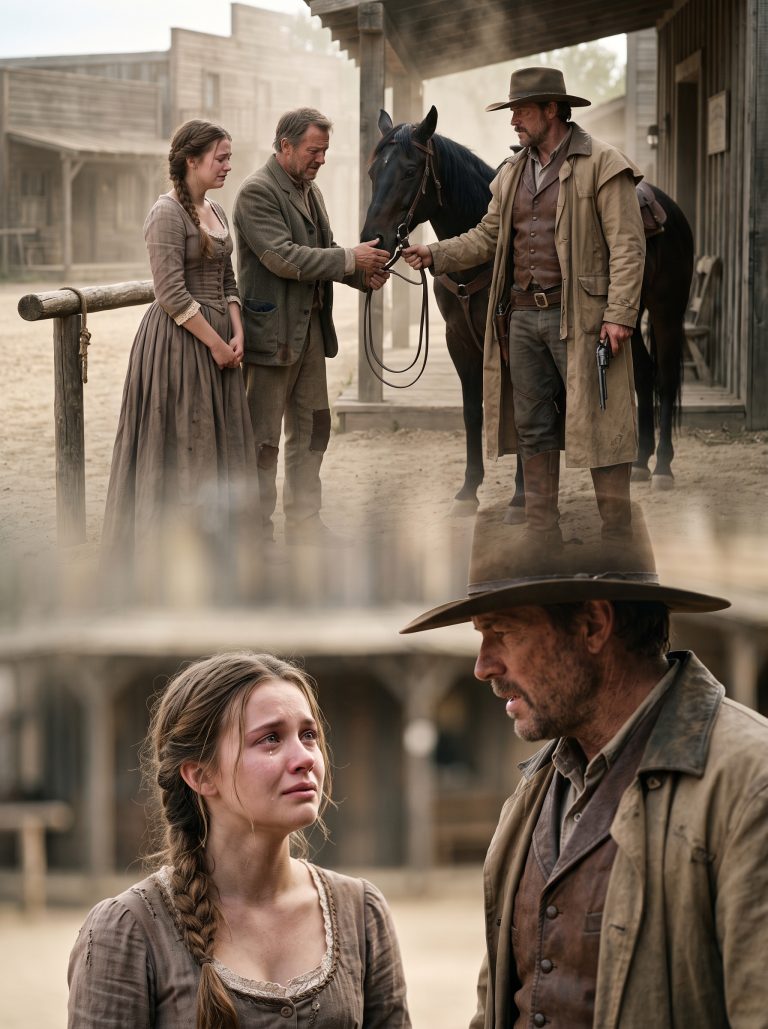
Eleanor stumbled and struck the frozen street of Willow Hollow, Montana Territory, on both knees. She forced herself up again, her thin dress stiff with ice, her hair frozen at the ends into small brown icicles.
From the mercantile porch, a man called out, “Where are you taking her?”
“Edge of town,” Riggins answered without slowing. “Let winter finish what the judge started.”
A few men laughed. Reverend Whitfield, standing beneath the church eaves, lowered his eyes and said nothing — the same man who had baptized her son Micah years ago, before the flood at Miller’s Fork swept the boy away and swallowed her marriage whole. The county had ruled it a drowning, though no search party had ever pulled a body from that water.
That hurt worse than the rope.
“Please,” Eleanor whispered. “Give me until morning. I’ll walk to the next county. I won’t come back.”
Riggins glanced over his shoulder. “You had your chance to leave, Mrs. Hayes. Should’ve gone when your husband did.”
Nathaniel. Gone eight months, taking the last of their savings and leaving behind debt, whispers, and a woman too broken for anyone to pity for long. Willow Hollow had called her unfortunate first, then strange, then — by the time the wells soured and the cattle sickened — cursed.
Judge Elias Thorne had made it official that morning, in a courtroom where Eleanor stood in the back with her scarred hands folded, listening to men who had never once fed her declare that she had taken too much from them.
Then Riggins came with the rope.
At the edge of town, Sheriff Amos Kane rode up and lifted one hand, and for one foolish second Eleanor felt hope.
“Sheriff — please.”
Kane didn’t look at her. He looked at Riggins. “You sure about this?”
“Judge’s order.”
“Winter’s harsh. She won’t last the night.”
“That’s the idea.”
Kane nodded slowly, as though they were discussing a fence line, and something in Eleanor went very still. Not dead. Worse. Resigned.
They left her past the last buildings, where the town gave way to open prairie and the mountains stood black against a graying sky. Riggins cut the rope from his saddle horn but not from her wrists.
“You’re free to go,” he said, smiling. “Anywhere but back.”
“My hands,” she begged. “Please.”
“Should’ve thought of that before you cursed this town.”
Then they were gone, laughter fading into wind, and Eleanor was alone. Her feet had stopped hurting, which frightened her more than pain would have — she knew enough of cold to know that numbness was the body’s way of giving up politely.
She took one step. Her knees folded. The snow received her almost gently.
“I’m sorry,” she whispered — not to Riggins, not to the town. To Micah. Her boy with solemn eyes, slipping from her torn hands into the floodwater while she screamed until her throat gave out.
She closed her eyes.
Then a small voice cut through the wind. “June, look!”
Another, sharper, closer: “I see her.”
Two girls came running through the storm, seven or eight years old, wrapped in coats too big for them. June dropped to her knees beside Eleanor first.
“Ma’am? Can you hear me?”
The girl’s eyes were dark and fierce.
Wren knelt beside her a breath later. “She’s freezing. Her hands—”
“I know.” June hauled at Eleanor’s arm. “Help me lift her.”
They couldn’t. Eleanor’s body had become a distant, disobedient thing.
“She’s too heavy,” Wren cried, panic rising.
“We are not leaving her.” June looked toward the road, made a decision no child should have to make, and ordered, “Stay with her. Keep her awake.” Then she ran.
Wren knelt and patted Eleanor’s cheek with mittened hands. “Hey. Lady. Stay awake. June’s getting help.”
“Why,” Eleanor managed, “would you—”
Wren’s face changed. Not childish now. Knowing.
“Because June said you were coming,” she said. “She dreamed you three nights ago. A lady with sad eyes and burned hands, who’d need us.”
The world tilted.
“My son,” Eleanor whispered. “I had a son.”
“I know,” Wren said softly. “June says he isn’t angry at you anymore.”
Before Eleanor could ask how a child could possibly know something so deeply personal, hoofbeats thundered through the storm. A rider came over the rise at a hard run, one arm holding June steady behind him. He dismounted before the horse had fully stopped — tall, broad-shouldered, weathered by sun and old grief.
He knelt beside her. “Ma’am. I’m going to pick you up now.”
She managed a nod. His arms slid beneath her, and the pain of being lifted tore the first honest sound from her throat all day.
“I know,” he murmured. “Hold on.”
“What’s your name?” he asked, mounting with her held to his chest.
“Eleanor,” she breathed. “Eleanor Hayes.”
The man went still. Only for a second. Then his arms tightened.
“Gideon Marsh,” he said. “These are my nieces. June and Wren.”
Behind them, Eleanor heard June say, “We found her, Uncle Gideon. Just like I told you.”
Gideon didn’t answer. But Eleanor felt the change move through him — recognition, fear, a memory waking where no memory should have been.
When his cabin appeared through the snow, smoke threading up from the chimney like a rope tying earth to heaven, Eleanor thought she had died after all. No place that warm could belong to the world that had just tried to bury her.
Inside, the girls moved with practiced urgency — water heated, quilts piled by the hearth. Gideon laid her on a narrow bed and stepped back with a restraint she noticed even through the pain.
“You’re safe here,” he said. “Whatever happened out there, it can’t follow you inside this house.”
Then his eyes fell to her hands. Not the fresh rope burns.
The old scars beneath them.
His face went the color of the snow outside.
No one in Willow Hollow had ever asked where those older scars came from. No one but Nathaniel had ever cared to.
“Miller’s Fork,” Gideon said quietly. “Gray eyes. You were the woman in the river.”
Eleanor stared at him as the past rose up between them, black and roaring — because the man who had just carried her out of the snow had once tried, and failed, to carry her out of drowning.
Part 2
Gideon’s hand found the back of a chair, as though the floor had tilted.
“You were there,” Eleanor whispered.
He didn’t deny it. “Five years ago. The dam broke without warning. I saw a woman in the water, holding a boy above her head. I went in for you first — you were closest. By the time I turned back for him—”
“Stop.”
He stopped instantly, and that small mercy mattered more than she could explain.
June came to the bedside, solemn beyond her years. “He says you’ve been carrying the wrong stone.”
“He was three,” Eleanor said, shaking. “I held him until my hands tore.”
“The water didn’t take him because you failed,” Gideon said. “It took him because a dam breaks without asking who’s in the way.”
“They never found him,” Eleanor said, the way she’d said it to herself a thousand nights. “Not downstream. Not for two miles either bank, in a week of men wading and dragging hooks through the shallows. The county wrote it down as drowned because that was a shorter word than lost — but there was never a body, Mr. Marsh. Not for either of us to bury.”
Something moved behind Gideon’s eyes, quick and unreadable, gone before she could name it.
For three days, Eleanor healed in Gideon Marsh’s home. She learned June dreamed things before they happened, and that Wren felt other people’s grief like weather moving through a room. She learned their mother had died bringing them into the world, and their father had run from gifts he’d called curses, leaving Gideon to raise them alone. She learned Gideon slept in the chair by the hearth with his rifle across his knees, and never once asked what the town had said about her.
On the fourth morning, Nathaniel Hayes rode into the yard.
“Eleanor,” he called, smiling his old false smile. “I’ve been looking everywhere for you.”
“You have not,” Eleanor said, before Gideon could speak.
“We’re still married in the eyes of the law,” Nathaniel said. “Judge Thorne is concerned for your welfare. He believes you need proper care.”
Gideon’s rifle lifted an inch. Eleanor felt the name Thorne land like a stone on the porch boards — the same judge who’d ordered her dragged from town, the same judge who wanted Gideon’s land for its water rights.
June stepped from behind Eleanor’s skirt, pale but steady. “He’s lying. I dreamed it. He and the judge, laughing — they said once they had the land, they wouldn’t need her or Uncle Gideon anymore.”
Nathaniel’s mask slipped. Only for a second. Long enough.
And in that second, Eleanor understood the truth was larger than her grief, larger than the town, larger even than the flood that had taken her son.
Nathaniel hadn’t come to bring her home.
He’d come because she was starting to remember.
Part 3
Nathaniel left before Gideon could give himself a reason to make him bleed in the snow — but the threat stayed in the yard long after his hoofprints faded.
Eleanor stood at the window, both hands freshly bandaged, watching the road as if it might open and swallow her again. At the table, Wren sat with June’s hand folded between both of hers, whispering something Eleanor couldn’t hear.
Gideon crossed the cabin once, then stopped. “If Nathaniel’s working with Thorne, this was never just about you.”
“What do you mean?”
“Thorne’s wanted this land two years. Doubled my taxes. Challenged my water rights. Then started asking whether a bachelor ought to be raising two little girls at all.” His jaw tightened. “He wants leverage.”
“He wants June and Wren?”
“He wants me signing papers to keep them.”
A knock sounded before Eleanor could answer. Gideon had the rifle up before she could breathe.
“Gideon Marsh,” a woman’s voice called, dry as kindling, “point that thing at me and I’ll tell the whole county you’re rude to old women.”
Beatrice Hollis swept in, shook snow from her shawl, and took one look at Eleanor. “So you’re the abandoned wife June dreamed about.” She didn’t wait for an answer — just unwrapped Eleanor’s wrists, inspected the burns, and rewrapped them. “Healing. But that isn’t why I came.”
Gideon’s jaw was iron. “You said you had something on Thorne.”
“I have the truth, finally written down.” Beatrice sat, took June’s hand a moment, then looked hard at Eleanor. “Miller’s Fork was no accident.”
The room tilted.
“They said the dam failed from rain,” Eleanor whispered.
“That was the story Thorne paid men to tell.” Beatrice’s face darkened. “There were witnesses. Men up at the dam the night before, with tools, weakening the gate. Men paid by someone who already knew which flooded land he meant to buy for pennies once the families were ruined or dead.”
“Thorne,” Gideon said flatly.
“Yes. And your husband ran two days before, Eleanor, and came back with mud on his boots though it hadn’t rained where he claimed to be. He knew the water was coming. He just didn’t know you’d come home from market in time to hear your son crying — and he didn’t wait to find out if you’d both get out.”
The sound that left Eleanor did not feel human. Gideon caught her before her knees hit the floor, and this time she let him.
Then Wren gasped, one hand pressed to her chest, staring at the window. “June — they’re coming.”
June had gone pale. “The judge. Nathaniel. Men with guns. They mean to take all of us.”
Beatrice was already reaching for her coat. “I’ll ride for Silas Whitcombe. He’ll bring men.”
“There isn’t time,” Gideon said.
“Then make time. Thorne likes to pretend he’s lawful — make him prove it. Ask for warrants. Stall him.”
She vanished into the snow.
Gideon turned to Eleanor. “Take the girls to the root cellar.”
“No.” The word surprised them both. “Nathaniel wants me. Thorne fears what I know. If I hide, they’ll tear this house apart looking. If I stand with you, maybe we make them speak the truth out loud, in front of witnesses.”
“That’s dangerous.”
“So was being dragged through snow with no one willing to say no.”
June lifted her chin. “I’m standing too.”
“Absolutely not,” Gideon said.
“Mama died having us. You nearly died pulling that river apart for a stranger. Eleanor nearly died in the snow. Everything is dangerous, Uncle Gideon. We’re still here.”
Wren began to cry, quietly. June turned and took her sister’s face in both hands. “You hide. Keep your heart calm. I’ll come get you when it’s done.” Wren nodded, trembling, and slipped down into the root cellar, pulling the door shut above her — close enough to hear, safe enough to breathe.
A little while later, seven riders came through the snow. Judge Thorne rode at the center in a black coat, Nathaniel just behind him, five armed men fanned out like wolves.
“Mr. Marsh,” Thorne called. “Official business.”
“Official business requires a warrant.”
“I have authority.”
“Not on my land.”
Nathaniel’s eyes found Eleanor. “Please. This has gone on long enough. Come home.”
“I have no home with you.”
“You’re confused,” he said, and June’s voice rang out, clear as a struck bell:
“She’s not confused. You’re lying. You dream about him — the little boy, crying for his mama. You hear the water and you can’t make it stop.”
Nathaniel’s composure cracked wide open, and in front of five witnesses, his hand went to his pistol.
Gideon’s rifle came up smooth as breath. “Draw on a child. Go ahead. Give me the reason.”
Thorne shouted. Chaos broke across the yard — a shot into the air, horses screaming, two riders thrown. In the scramble, Nathaniel seized Eleanor from behind, a hand clamped over her throat, and Gideon could not fire without hitting her.
“Here’s what happens,” Thorne said, dismounting, smiling now with open cruelty. “Marsh signs over the land. Mrs. Hayes goes to the territorial asylum. The children go into proper custody.”
“You murdered our son,” Eleanor rasped against Nathaniel’s grip.
“If anyone murdered him,” Nathaniel hissed in her ear, “it was you, standing in that flooding house arguing with the water instead of running when I called for you to.”
The gunshot that answered him did not come from Gideon.
Nathaniel’s hand fell from her throat. Eleanor dropped to her knees, choking, certain for one terrible second that Gideon had fired — until she saw Nathaniel on the ground behind her, a hand clamped over his bleeding shoulder.
Standing above him, smoking pistol steady in one weathered hand, was Beatrice Hollis.
“Always knew you were rotten, Nathaniel Hayes,” she said. “Just needed you to prove it in front of witnesses.”
Behind her thundered a dozen riders — ranchers, farmers, rifles held level — with Silas Whitcombe at the front. He took in the whole yard: Eleanor gasping in the snow, June wrenched in a stranger’s grip, Gideon’s rifle swinging between three directions at once, Nathaniel bleeding where he’d tried to choke his wife silent.
“Meaning seems plain enough,” Whitcombe said. “Mrs. Hollis told some interesting stories on the ride over. Miller’s Fork. The dam. Now here you are, threatening women and children.”
“This is county business,” Thorne snapped.
“County business doesn’t include choking a woman half to death. Let the girl go.” The man holding June hesitated until Whitcombe’s voice cracked like a whip — “Now.” — and she ran straight into Gideon’s arm.
Eleanor rose on legs that barely held her, and faced Nathaniel where he lay in the reddening snow.
“You left him,” she said. “Micah was crying for us, and you ran.”
“You can’t prove anything.”
“No,” Beatrice said, drawing a sealed, oilcloth-wrapped letter from her coat. “But this can. Written by one of the men paid to weaken the Miller’s Fork gate. Names. Dates. Payments — yours, Judge. And yours, Nathaniel.”
Thorne’s face changed, just enough. “A dead man’s letter won’t stand in court.”
“No,” Whitcombe agreed. “But it’ll bring marshals. And when folk learn thirty-one souls died so you could buy ruined land cheap, I expect a great many tongues will loosen.”
They left with Nathaniel wounded and Thorne’s authority bleeding far more heavily than his shoulder. Only after the riders vanished over the rise did Eleanor’s legs finally give out for good — and Gideon caught her.
“I’ve got you,” he murmured, and those three words undid her more completely than the whole terrible day had. She cried for Micah, for the flood, for the woman she’d been before Nathaniel taught her to carry his guilt as her own.
June’s small hand found her back. “Let it out. You’ve been carrying it too long.”
There was still the matter of the law. A heart could decide things in an afternoon, but a marriage could not simply be wished away, and Gideon would not have her name questioned in front of a preacher while it still belonged, on paper, to another man. So it was Whitcombe who rode to the territorial magistrate with Beatrice’s sworn statement and the county sheriff’s own record of Nathaniel’s desertion — proof enough, and worse, proof of his hand in the conspiracy that had orphaned half the valley. The magistrate did not deliberate long. On grounds of abandonment, fraud, and the attempted murder half the yard had witnessed with their own eyes, he granted Eleanor an expedited divorce, and said plainly that no court in the territory would fault a woman for wanting Nathaniel Hayes’s name off her life as quickly as the law could manage it.
Eleanor was free, in the law’s eyes and her own, before anyone spoke of a wedding at all.
That night the cabin held them like a palm around a flame. Wren slept curled against June, one hand pressed over her own heart as if to keep it steady. Gideon sat close to Eleanor beneath a shared blanket, his arm near but never trapping her.
“There’s a preacher in the next county,” he said finally. “Reverend Whitfield rides the circuit through there now. If you were willing, he could marry us.”
Eleanor’s heart stopped.
“Not only because you’re free to choose now,” Gideon said, “though I won’t pretend I’m not glad of that. It isn’t why I’m asking. In these few days, you became family. To June. To Wren. To me. I’ve seen what ordinary people did to you in Willow Hollow, and I don’t trust ordinary rules much tonight.”
Eleanor looked at the sleeping twins — children who had run into a blizzard because a dream told them to, who had given her broth and a place by the fire and, without meaning to, a reason to want tomorrow.
“If I married you,” she said slowly, “would the girls be mine too?”
“If you wanted them.”
“Yes,” she whispered. “Not because I’m afraid. Because you stood beside me when you could have handed me over. Because you didn’t run.”
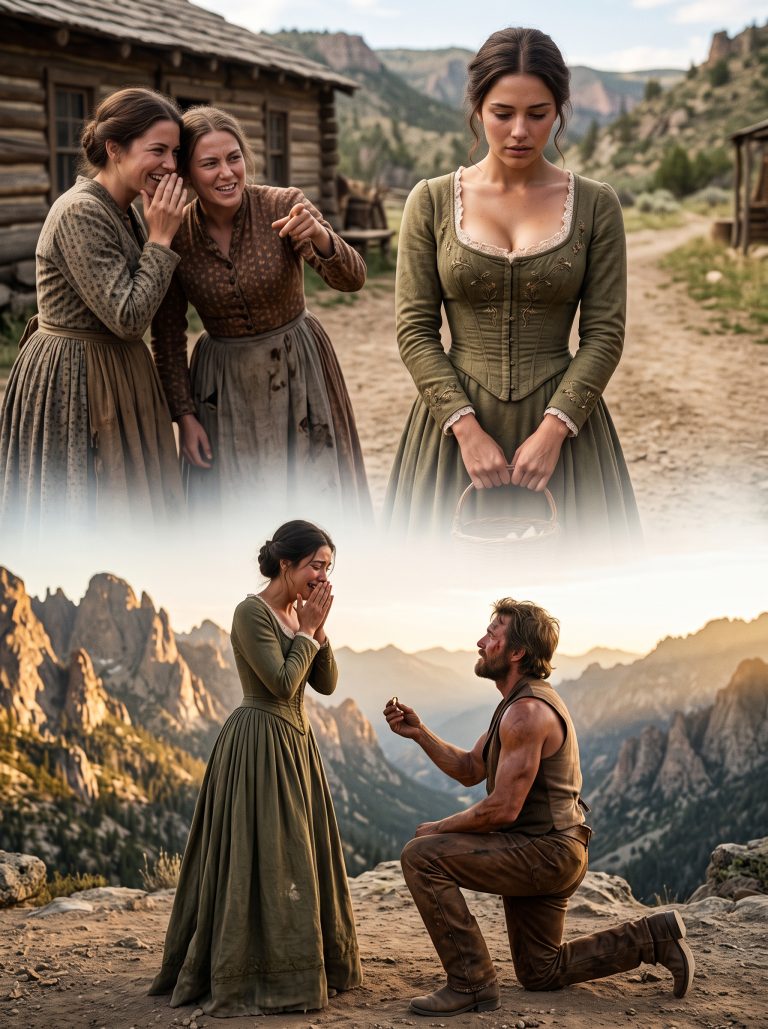
A month later, once the divorce decree was signed and sealed, Reverend Whitfield married them in the cabin that had saved her life, asking no questions about the fading bruises at her throat or the rifles still posted at the tree line. June and Wren stood as witnesses in dresses that had once belonged to their mother.
“Does this mean you’re our mama now?” Wren asked, when it was done.
Eleanor knelt and opened her arms. “For real, and forever.”
Truth rarely entered a county gently, and it hadn’t waited for the wedding to start moving.
Marshals had arrived within days of the confrontation, summoned by Beatrice’s letter, only to find Thorne and Nathaniel already fled Willow Hollow in the night. Nathaniel didn’t get far. Cornered near the Wyoming line, he went for his pistol rather than surrender, and the marshals fired first. He lingered two days and then was gone. Eleanor waited to feel triumph. Instead she felt a door close on a version of herself she no longer recognized.
“I keep thinking I loved a man who never existed,” she told Gideon, on the porch, watching spring soften the last snow.
“Then love the life that does,” he said.
Thorne was caught a month later hiding in a mining camp and, unlike Nathaniel, lived to stand trial. Eleanor took the stand as Mrs. Marsh — not cursed woman, not madwoman, not vagrant — and told the courtroom everything: the dam, the flood, her little boy calling for her from the house, the town that had dragged her to the edge of winter and left her to freeze for the crime of grieving too visibly. When she finished, even the stone-faced territorial judge had to clear his throat.
Thorne was convicted on every count and sentenced to hang. His hired men went to prison. Stolen land was returned where the courts could still trace it. Miller’s Fork was struck from the record as an accident and re-entered as what it had always been.
Willow Hollow changed, slowly, the way thaw comes — uneven, leaving mud behind rather than any clean miracle. Riggins left before anyone could ask too many questions about the rope he’d used. Sheriff Kane lost his badge. Reverend Whitfield rode out to the Marsh cabin one Sunday and stood awkward on the porch until Eleanor invited him in for coffee, and something old and unspoken passed between them, and was, if not forgiven, at least set down.
By early summer, the meadow behind the cabin was thick with wildflowers, and June and Wren chased each other through grass that had been snow four months before.
Then, on a warm morning near the end of June, a letter came by the territorial post — forwarded three times, addressed in an unfamiliar hand to Mrs. Eleanor Hayes, last known Willow Hollow. Gideon watched her open it on the porch steps and go very still, the way he had the night he first saw her scars.
It was from Sarah Larkin, a trapper’s wife two valleys over, near the lower run of Miller’s Fork — a woman who had read, in a month-old newspaper passed hand to hand through the territory, the account of Judge Thorne’s trial and the flood that had finally been named a crime. My husband Abel and I took in a boy from the wreckage that spring, the letter said, half-drowned, too small to tell us his name, caught in driftwood two miles downstream where the water slowed. We had buried two babies of our own and thought God had sent us this one instead. We raised him as ours, believing his people gone, and have loved him every day since without once meaning to steal him from anybody. He is eight now, dark-haired, with a scar along his collarbone from the timber that near took his life. He asks, some nights, about a mother who held him above the water. We did not know until we read your name in the paper that there might be someone left to ask — and we would rather lose him to a mother’s arms than keep a truth from either of you a day longer than we already have.
Eleanor could not speak. She could not breathe. Gideon read it over her shoulder and his hand found her back, steadying, the way it had in the snow.
It took eleven days to reach the valley. Eleven days in which Eleanor did not sleep, did not quite believe, did not quite dare to hope, because hope had cost her so much before. June rode the whole way holding her hand and saying nothing, which was its own kind of answer — the girl who dreamed things before they happened had dreamed nothing at all about this, and later admitted, quietly, that some things were too large and too fragile for dreams to touch; some things had to simply be walked toward and found.
Sarah and Abel Larkin stood in their own doorway holding onto each other, not certain whether they were about to lose a son or simply gain a family none of them had asked for. Sarah’s eyes were red before anyone had said a word.
The boy who came out behind them was taller than the child in Eleanor’s memory, and thinner, and had a wariness in his dark eyes that broke her heart before she’d said a single word. But his eyes were Micah’s eyes. And when she said his name — just his name, nothing else, because she could not trust her voice with more — something in his face opened like a door long swollen shut, and he said, so quietly she nearly missed it:
“You let go because the water was pulling us both under. Not because you wanted to.”
He had carried that same wrong stone, alone, for five years, in a house full of people who loved him but did not know the weight of what he was carrying.
Eleanor knelt in the Larkins’ dooryard and put her arms around her son, and this time when she cried, it was not for a door closing. It was for one swinging open onto a life she had stopped letting herself imagine.
When she could speak again, she rose and took Sarah Larkin’s hands in both of hers. “You kept him alive. You kept him loved. I will never be able to repay that, and I would never ask you to disappear because of it.” She looked between the trappers and her son. “He doesn’t have to lose two more parents to find his first ones. Not if none of us wants that.”
Sarah wept openly then, and Abel gripped Eleanor’s shoulder with a rough, wordless nod, and Micah — still not quite believing any of it was real — stood between two families that had, without meaning to, just agreed to share him.
They rode home together — Eleanor, Gideon, June, Wren, and Micah, five instead of four, the cabin somehow large enough for all of it. Sarah and Abel Larkin promised to write, and did, every month without fail, and twice that first year loaded their wagon and made the two-valley journey themselves so Micah wouldn’t have to choose which supper table was his — a boy, it turned out, could belong to more than one family, if the grown-ups around him were willing to be generous enough to allow it. That autumn, Beatrice Hollis pronounced Wren’s fragile heart stronger than it had been in years, and said, not quite hiding her smile, that she suspected joy was better medicine than anything in her bag. June still dreamed things sometimes, though less often and less darkly, as though the house had finally run out of storms that needed foretelling. Micah was quiet for a long while, and then, slowly, was not — he taught Wren to skip stones on the creek where the ice had broken apart, and let June boss him exactly as much as an older sister should.
One evening, Eleanor stood again at the place where the creek ran clear over stone, the same water that had once been the shape of her worst nightmare.
“Does it still frighten you?” Gideon asked, coming up beside her.
She watched the current a long moment — watched Micah crouched at the bank showing his youngest sister how to find the flattest stones, watched June laughing at something only she and the wind seemed to share.
“Sometimes,” Eleanor admitted. “But not the way it used to.”
Gideon’s arm slid around her waist. “And now?”
“Now I think water only ever took what it took. It was never the water that decided I was cursed, or unworthy, or too broken to be loved. That was people — people who found it easier to name a grieving woman a curse than to sit with their own failure to help her.” She leaned into him. “I spent five years believing I’d earned everything that happened to me. I hadn’t earned any of it. Not the flood. Not the rope. Not even, in the end, this.”
“You earned this,” Gideon said quietly. “Every bit of it. Standing up when it would have been easier to lie down — that’s not luck. That’s who you are.”
Eleanor watched her children in the last gold light of the day, and thought of Willow Hollow, and the rope, and the snow that should have been the end of her and had instead, impossibly, been the beginning.
She had never been walking toward death that afternoon, whatever Willow Hollow had intended — she understood that now, the way June had always seemed to understand it, long before anyone else could.
She had been walking home all along. Home had simply taken the longest road to find her.
THE END