Rancher Forced His Son To Pick A Bride—He Chose The Orphan Stable Girl In Rags

Part 3
Tobias returned from Cheyenne twenty-nine hours later, dust-caked and grim, with more than Caleb had bargained for. The Union Pacific offer was real, and better than rumor suggested — the spur line needed the eastern grazing land badly enough that the railroad was prepared to pay more than double the Ironwood’s outstanding debt. And the holding company behind the reassigned note, the recorder confirmed, traced back through two shell layers to a single name: Josiah Calder.
“He’s been buying every scrap of paper against this ranch he can find,” Tobias said. “Quietly, through men who don’t use his name. If your father doesn’t marry you into that family by the time the notes come due, Calder calls them all at once. Your father won’t have it. Not with the drought.”
Caleb sat with that for a long moment before he went looking for Eleanor.
He found her alone in the garden behind the house, and when he asked her, carefully, whether she knew anything about her father’s business with the Ironwood’s debt, something in her face crumpled before she caught it. “I’ve heard him talking to his clerks,” she admitted. “Numbers I wasn’t supposed to understand. I told myself it wasn’t my business.” She looked up at him, eyes bright and furious — not at Caleb, he realized, but at the whole shape of the week. “Do you know what it’s like, Mr. Hartley, to be someone’s best offer in a negotiation you never agreed to? I didn’t come here because I wanted a husband. I came because my father told me this was how I’d prove myself useful to the family.” Her voice cracked. “If what you’re saying is true, I want no part of it. And I’ll say so, whatever it costs me.”
It was the first time all week anyone had looked less like a suitor and more like a person, and Caleb found himself grateful for it in a way that had nothing to do with love.
That night, Jo and Ruth ended up talking long past midnight on the porch steps, and though Caleb only heard pieces of it later, he understood enough. Ruth spoke of a father who couldn’t imagine a daughter running cattle without a husband’s name on the deed, no matter how many seasons she’d already managed the books herself. Jo spoke of nine years of proving her worth one stall at a time to people who still called her the stable girl behind her back. Neither of them cried, Ruth told him afterward, matter-of-fact. “We’re not the type. But I think we understood each other better by sunrise than most people manage in a lifetime.”
The confrontation came the following evening, in the ranch’s main hall, with all five families gathered at Caleb’s request and Augustus presiding from the head of the table like a man who did not yet know he was about to lose control of the room.
Caleb laid the railroad contract on the table first. “This ranch does not need a marriage to survive,” he said. “It needs this.” Then he laid the recorder’s documents beside it. “And it needs everyone here to understand why Mr. Calder has spent two months secretly buying up every note of debt against my family.”
The room went silent. Josiah Calder’s face didn’t pale the way Caleb had expected — it hardened instead, the practiced calm of a man used to winning arguments in rooms exactly like this one.
“This is a serious accusation to make with so little understanding of banking,” Calder said evenly. “Debt is bought and sold every day, Hartley. There’s no law against it, and no shame in a bank protecting its interests during a drought. If you’re implying malice, I’ll remind you that malice doesn’t hold up in a courtroom — but slander does.”
“Then explain why it was done through three shell companies instead of your own name,” Caleb said.
“Prudent business practice. Nothing more.” Calder turned to Augustus, his voice softening into something almost paternal. “Augustus, we’ve known each other twenty years. I have never once called a note due before its time, and I’m not calling one now. Your son is dressing up a coincidence as a conspiracy because he doesn’t want to marry my daughter. I’d have thought you’d see through that.”
For a long, terrible moment, Augustus said nothing, and Caleb watched his father’s face with a kind of dread he hadn’t expected. Augustus had built the Ironwood on handshake deals and hard trust; he had also survived thirty years in this territory by knowing exactly how dangerous it was to make an enemy of a man who held your paper. “Josiah,” Augustus said slowly, “give me a reason not to believe you.”
“I don’t need to give you a reason,” Calder said. “I need you to remember which of us has never lied to you before.”
It might have ended there — might have tipped, as Caleb feared it would, toward caution and old loyalty — if Eleanor hadn’t stood.
“He’s lying,” she said, and her voice, though it shook, carried to every corner of the hall. “Father, I heard you with Mr. Ridley three weeks ago, talking about leverage and the Hartley boy’s stubbornness. I didn’t understand it then. I understand it now.” She turned to Augustus. “I would rather lose every chance at this marriage than watch my father force it on someone who deserves better than to be bought.”
Calder’s composure finally broke. “Eleanor—”
“No,” she said. “I’m done being your best offer.”
Augustus looked between Calder’s fury and his daughter’s white-faced honesty, and something in the old man’s expression settled, the way a scale settles once enough weight has finally landed on the true side of it. “I built this ranch out of nothing, Josiah,” he said quietly. “I did not build it to be strong-armed by a man who taught his own daughter to be ashamed of the truth.” He rose. “You’ll have every note repaid within the month, in full, through legitimate channels only. And you are no longer welcome at Ironwood Crossing.”
Calder left the hall white with rage and empty-handed. One by one, the other families followed — Adelaide Whitmore with cool dignity intact, Margot Sinclair’s uncle-the-senator visibly relieved to be spared the arrangement, Celeste Farraday already composing, Caleb suspected, the story she’d tell in San Francisco. Only Ruth lingered at the door, grinning.
“Well,” she said. “I suppose this settles who isn’t getting a wedding this week.” She looked to Caleb, not unkindly. “For what it’s worth, I withdraw my interest gladly. I never wanted a husband. I want my father to see I can run Silver Creek myself — and this whole disaster proves a Hartley can survive without leaning on anyone. Maybe it’ll prove the same about a Dunmore, if I tell it right.”
Augustus did not embrace Jo that night, or the next, and Caleb had known his father long enough not to expect it.
For the first week after Calder’s exposure, Augustus was civil to her and nothing more — polite at the table, distant in the yard, watching her the way he watched a new colt he hadn’t yet decided was worth the feed. He did not forbid Caleb from courting her properly now that the matter of marriage was, in every practical sense, settled by elimination; but he did not bless it either.
The turn began, in small pieces, over the following month. Augustus caught Jo in the study late one evening, teaching herself his late wife’s old household ledgers by lamplight without being asked, and said nothing about it, though Caleb noticed the books were left out, unlocked, from then on. A week later, when a sudden illness swept through the breeding stock and two hired veterinarians from town gave up on a prize mare, it was Jo who sat with the animal three nights running and brought her back from the edge of death; Augustus stood in the barn doorway on the third morning and watched her work without a word, then walked away before she noticed him.
The real turning point came when Ruth Dunmore, true to her promise, sent word that her father had finally agreed to let her manage Silver Creek in her own name — and enclosed a letter thanking Jo for a conversation that had given her the nerve to demand it. Augustus read the letter over Jo’s shoulder, uninvited, and when he straightened, something in his face had eased.
“You did that,” he said. “Not with land or money. With plain talk to another woman who needed to hear it.”
“She’d have found her own way eventually,” Jo said. “I just didn’t let her wait as long as I did.”
“How long did you wait?”
“Nine years,” she said, “to believe I was allowed to want something for myself instead of just being grateful I had a place at all.”
Augustus was quiet for a long moment — the longest silence Caleb had ever witnessed pass over his father’s face. “My whole life,” the old man said finally, “I believed what a person could offer this ranch was measured in acres and connections and gold. It seems I was wrong. It was measured in loyalty, and you had more of that than anyone I invited under this roof on purpose.” He held out his hand, an old man’s formal, careful gesture. “Marry my son, Miss Calloway. Properly. With my blessing this time, not just my surrender.”
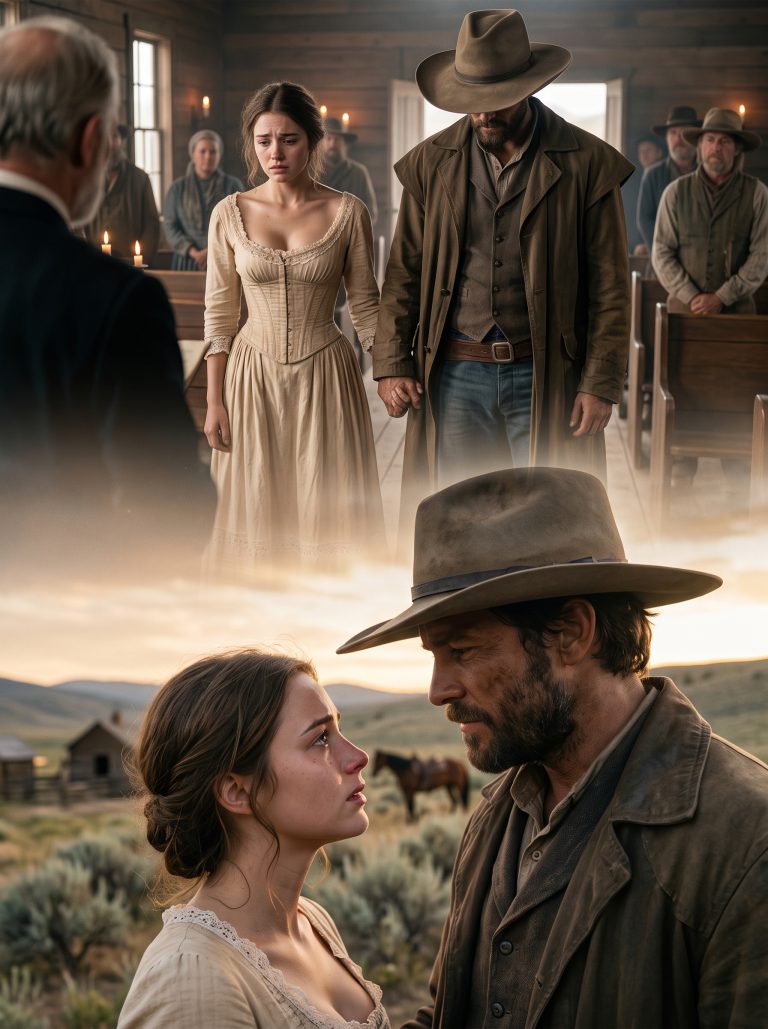
They were married in November, in the small whitewashed chapel on the rise above the valley, with a modest crowd of ranch hands and townsfolk who had never once cared whether Jo Calloway had a dowry. Ruth Dunmore came, wearing sage green and grinning like she’d won a war of her own — which, in every way that mattered, she had. Eleanor Calder came too, quietly, without her father, and told Jo before the ceremony that she’d taken a position keeping books for a shipping firm in Denver, on her own name and her own terms; it was, she said, the first job she’d ever chosen instead of been assigned. Augustus walked Jo down the aisle himself, an unplanned gesture that left Mrs. Alvarez, the housekeeper, weeping into her handkerchief.
Standing on the porch that evening, watching the last light burn gold over the eastern grazing land — where survey crews would begin laying track come spring — Caleb turned to his wife.
“Any regrets?” he asked.
“None,” Jo said. “Though I still think you should have let me be the one to tell Calder off myself.”
He laughed, and pulled her closer, and understood at last the lesson his father had spent a lifetime failing to learn and had only just, at the very end, managed to teach him anyway: that an empire built only on advantageous marriages and quiet leverage was a fragile thing, however many acres it claimed — but a partnership built on trust, tested honestly and chosen freely, could weather anything the land or the banks or the world decided to throw at it.
The Ironwood stood exactly as it always had, unmoved by any of it, waiting for the next sunrise. But the people standing on its porch were not the same people who had stood there a week before, and that, Caleb thought, was the only inheritance that had ever really mattered.
— THE END —