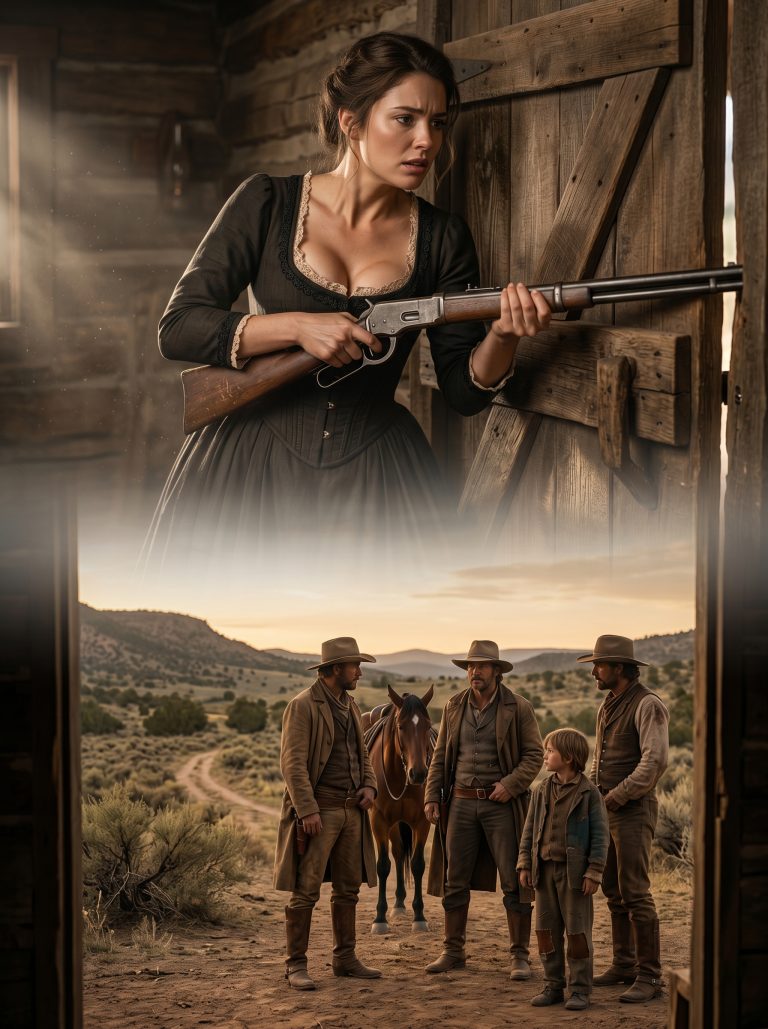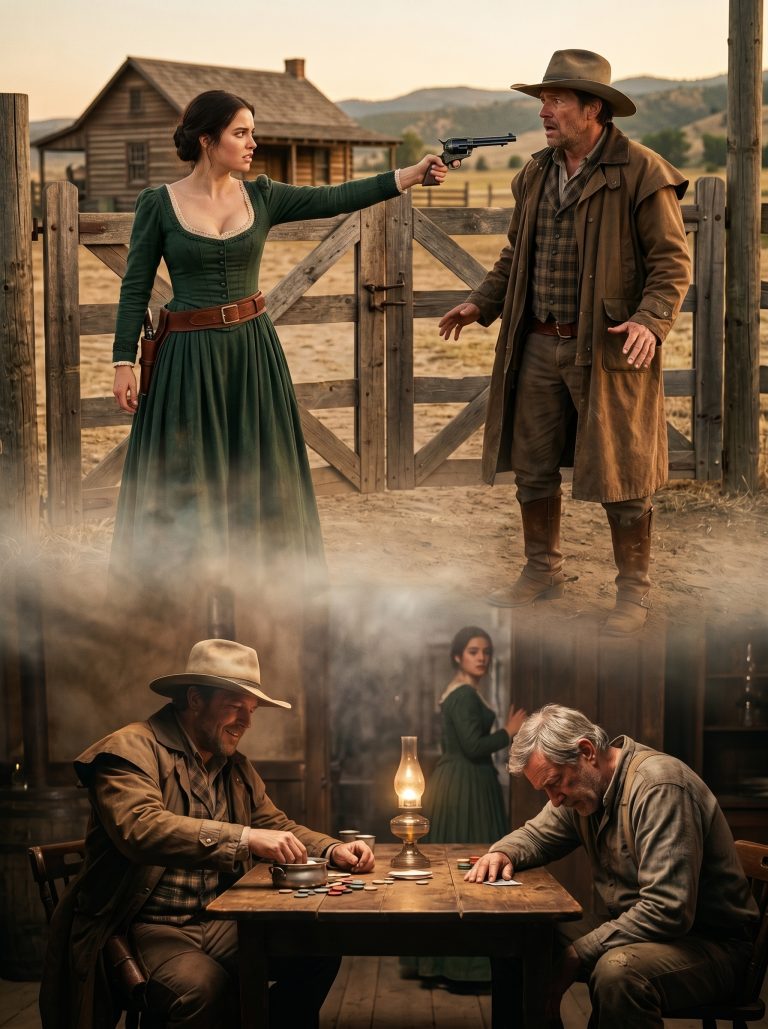
“Sell the Pregnant Fat Girl to the Mountain Man,” Her Father Laughed—Then One Hidden Truth Turned the Entire Valley Against Him

PART 1
The cellar floor was frozen, and Clara Whitmore had stopped expecting anything else.
Three weeks. Three weeks sleeping under the house that used to be hers, coat wrapped around a belly that had ended her old life the moment it started showing. Above her, footsteps. Her father’s footsteps. She knew the sound of them the way she knew her own heartbeat — heavy, deliberate, never in a hurry to reach her.
She was nineteen. Eight months along. And she had nowhere else in the world to go.
“Get up,” William Whitmore said from the top of the stairs. No warmth. No hello. Just the voice he used on children who’d failed to learn their lessons. “We’re going to town.”
Clara pushed herself up against the wall, one hand cradling the weight she carried. “Why?”
“You’ll see.”
He didn’t wait for her. He never did anymore.
Outside, the wind off the Montana plains cut through everything. Old Jonas stood hitched to the wagon, breath steaming in the January cold. Clara climbed up beside her father with hands that wouldn’t stop shaking — not from the temperature, but from something in his silence that felt like the calm before a door slams shut for good.
“Father. Please. What’s happening?”
“I can’t feed two mouths I’m not responsible for. That’s what’s happening.”
The words hit harder than a slap. She turned to look at him, searching his face for some trace of the man who’d taught her to read, who’d walked her to church every Sunday of her childhood. She found nothing. Just a jaw set like it had been carved from the same frozen ground she’d been sleeping on.
Then the town square came into view, and Clara’s whole body went cold in a way the winter air had nothing to do with.
A crowd. Thirty, maybe forty people. And in the center of them, where the produce sellers usually set up on market days — a single wooden post, driven into the platform like a nail into a coffin.
An auction block.
“No,” she whispered. “Father, no.”
“I’ve already made the arrangements,” he said, pulling the wagon to a stop like this was any other errand. “Posted the notice three days ago.”
“You can’t do this. It isn’t legal.”
“It is perfectly legal.” He climbed down, came around, and his hand closed around her arm — not gentle, not her father’s hand anymore, just a grip. “You are an unmarried woman without means, living under my roof. I have every right to recover my losses.”
He marched her toward the platform while the whole town watched. Mrs. Chen from the general store. The Rawlings brothers. Sarah Mitchell, who used to pass Clara notes in the schoolhouse before either of them had anything worth confessing.
Nobody moved. Nobody spoke. Nobody stepped forward.
“Ladies and gentlemen,” William announced, using the voice that had commanded classrooms for fifteen years, “my daughter has proven herself incapable of decent conduct. I am offering her labor contract to anyone willing to take on her maintenance. Fifty dollars.”
Fifty dollars. The price of a horse.
The father of the child had never stood on any platform to answer for it. Thomas Ferris, the merchant’s son who’d promised her marriage in every letter he ever wrote, had vanished east the moment her condition became impossible to hide — his father’s money in his pocket, no goodbye left behind for either of them.
Clara’s coat fell open on the platform, and the crowd saw exactly what she’d been hiding for months. Someone laughed. Someone else muttered a word she refused to let herself hear.
Abraham Fletcher squinted at her like livestock. “She looks sickly. How do I know she’ll survive the birthing?”
“That’s your risk to take,” her father answered, without even glancing at her.
Two bids came and went — forty dollars, forty-five — both withdrawn the moment William held firm at fifty. Even the closest thing to sympathy in that square had a ceiling, and it was cheaper than her life.
“Anyone else?” her father called out, and something in his voice almost sounded pleased.
Then, from the back of the crowd, a voice that made every other sound in the square go still.
“I’ll take her.”
Clara looked up. A man was walking through the crowd like it wasn’t there — tall, broad-shouldered, a face weathered enough that she couldn’t guess if he was thirty-five or fifty. Pale gray eyes. Eyes like ice water, and just as unreadable.
Everyone in Bitterroot knew that face, even if nobody claimed to really know the man behind it.
Elias Crow.
The mountain man who came down from the high country twice a year, traded furs, bought supplies, and vanished again into a life nobody could explain. Soldier, some said. Killer, others whispered. Simply mad, according to the rest.
He stopped at the base of the platform and looked up at her — not at her belly, not at the spectacle. At her face.
“Fifty dollars?” he asked William.
“That’s right.”
“I asked the price. That means I’m interested.”
William’s confidence cracked for the first time all morning. “You live up in the mountains alone. That’s no place for a woman in her condition.”
“Then you shouldn’t be selling her.”
Six words. Quiet ones. And they cut through the square sharper than anything William had said all morning.
Elias reached into his coat, pulled out a leather pouch, and counted gold coins onto the platform’s edge without waiting for permission.
“Fifty dollars. Contract’s mine.” He looked up at Clara. “Get your things.”
“I don’t have things,” she said, and her voice came out steadier than she expected. “Everything I own is what I’m wearing.”
Something moved behind those pale gray eyes. Not at her. At the number fifty dollars sitting on the wood between them, and everything it represented.
“Then come down.”
Her father grabbed her arm one last time. “Wait. I need to know where you’re taking her—”
“There won’t be questions,” Elias said, and something in the stillness of him made even William Whitmore go quiet. “You sold her. Transaction complete.”
He helped her onto his gray gelding — careful hands, impersonal, like a man handling something he intended to protect rather than own. Then he swung up behind her.
“Hold on,” he said.
And Bitterroot shrank into the distance behind them: the church steeple, the smoke rising from chimneys, the life Clara had known for nineteen years — gone.
She should have been terrified. Riding into the mountains with a stranger who’d just bought her like a plow horse.
Instead, she felt nothing at all. As if something inside her had broken clean through, and left no room left over for fear.
An hour into the ride, the first contraction hit.
PART 2
“How often?” Elias asked, his voice suddenly sharp behind her.
“Every hour, maybe. Sometimes less.”
“How long has this been happening?”
“A few days. The midwife said it was normal.”
“When did you last see the midwife?”
Clara hesitated. “Three weeks ago.”
He cursed under his breath — the first real emotion she’d heard from him — and urged the horse faster along the icy trail. “Might be nothing. Might be early labor. Either way I’d rather not find out two hours from shelter.”
By the time his cabin appeared through the falling snow, Clara was gripping the saddle horn, breathing through pain that no longer waited politely between contractions. He half-carried her through the door into a warmth that struck her like mercy after weeks of frozen earth.
One room. A sleeping loft. Shelves crowded with more books than the Bitterroot schoolhouse owned. A man who was supposed to be dangerous, who instead disappeared and came back with blankets, water, bread, cheese, dried meat, and hands that didn’t shake even once.
“Why are you helping me?” Clara finally asked, between one wave of pain and the next. “You don’t know me.”
Elias fell quiet in a way that told her the answer mattered more than he wanted it to.
“I knew your mother.”
Clara’s head snapped up. “What?”
“Catherine Whitmore. Before she married your father.” His jaw tightened, like the words cost him something to spend. “We grew up in the same town back east. Pennsylvania. She was kind. Funny. Full of life.” A pause. “You look like her.”
“Why didn’t you write? Visit?”
“Because I wasn’t welcome. Your father made that clear.” He checked the water heating over the fire, not looking at her. “When I saw you on that block today — looking just like her — I couldn’t walk away. Not again.”
That night, as a storm buried the cabin in snow, labor took hold in earnest. Elias stayed beside her through every hour of it, steady where she was breaking, calm where she was terrified.
“You’re not alone in this,” he told her, when she whispered she couldn’t go on. “Whatever happens, you’re not alone.”
He had delivered foals in worse cold than this, and once talked a trapper’s wife through a breech birth by lamplight with nothing but a knife and a prayer to work with — but none of that experience made him feel ready now, and Clara could see it in the careful, deliberate way his hands never once let on.
Something in her chest came loose — grief or relief, she couldn’t tell which.
Dawn came gray and slow. And when Elias finally placed a small, furious, red-faced infant on Clara’s chest, she understood that the girl who’d stood shivering on that auction block the day before no longer fully existed.
“It’s a girl,” Elias said, his voice rough in a way she hadn’t heard from him yet.
Clara named her Catherine. Cat, for short.
For a few weeks, that was the whole story — a mother, a daughter, a stranger who turned out to be something else entirely, and a cabin buried in snow far from anyone who’d ever hurt her.
Then the trail cleared. Then they rode back into Bitterroot for supplies. Then a man named Jennings arrived from the Continental Pacific Railroad, holding a folio of papers with William Whitmore’s signature on it — an affidavit swearing that Clara had abandoned her child, unfit and unmarried, and that as the infant’s nearest lawful kin, William had signed her over to the company’s guardianship program.
Two hundred dollars for the paperwork. A place waiting at one of the company’s orphan homes for children with no father to claim them — a polite name, everyone in Bitterroot knew by now, for a work camp with a schoolroom bolted onto the front of it.
The affidavit was a lie built on one exploitable truth: Cat had no father who’d step forward to contest it, and Clara, unmarried, had no stronger legal standing than the man who’d already proven he’d sign away anything for money.
After hours spent working through the territorial statutes by lamplight, Elias found the counter to it, and looked up at Clara with an expression she’d never seen on him before.
“If you were married,” he said, “you’d have a husband to stand beside your claim to her. A judge won’t hand a child over on a grandfather’s say-so once there’s a father in the room contesting it.”
Clara stared at him.
“I mean,” he said, “we get married before Friday.”
PART 3
They rode out before sunrise, three days ahead of the deadline, toward a mining camp far enough from Bitterroot’s gossip to matter and close enough to reach in time. Cat rode bundled against Clara’s chest, swaddled in wool that still smelled like the cabin’s woodsmoke. Elias said almost nothing the entire way, and Clara had learned enough about him by now to know that his silence wasn’t coldness. It was concentration. A man doing arithmetic with his own life and refusing to let anyone see him show his work.
Judge Morton received them in a canvas administration tent that smelled of kerosene and cold coffee, spectacles perched low on his nose, a stack of mining claims filed at his elbow like this was the strangest but not the first unusual request of his week.
“Married,” he repeated, looking between them. “Today.”
“We need you to marry us,” Elias said. Plainly. No ceremony in the request itself, just fact laid on a table.
Morton’s eyes went to Clara — to the baby in her arms, to the exhaustion carved into her face, to the age gap standing in front of him like a held breath. “Is she being coerced?”
“No,” Clara said, before Elias could answer for her. “I’m nineteen. I’m here because I want to be.”
“And him?”
“Thirty-six.”
Morton frowned at the math of it, the way half of Bitterroot probably would too, once word got out. “Why the hurry?”
Clara didn’t flinch. She’d spent three weeks in a cellar, and every day since, learning that softening the truth had never once protected her. “My father swore a false affidavit saying I’d abandoned my daughter — so the railroad could sign her over to one of their company homes. They’re bringing her before a judge in three days. If I have a husband standing beside my claim to her by then, they’ll have a far harder time taking her.”
Something in Morton’s face changed. He knew William Whitmore’s name — schoolmaster, churchgoer, a man with a reputation for righteousness that had apparently never extended past his own front door. He’d also heard the talk about Continental Pacific paying for affidavits like this one — signed by relatives eager for money and short on scruples, then used to walk unmarried mothers into court with nothing to stand on but their own word against a signed document.
He agreed. But he wanted the marriage airtight — no room for anyone to call it a legal fiction later.
When he asked for a ring, Elias had none to give. He hesitated — a full three seconds of stillness that told Clara more than any speech could have — then reached into his coat and drew out a small carved wooden bird, wings spread mid-flight, the detail so fine it looked like it might lift off his palm on its own.
“This was my mother’s favorite,” he said quietly, pressing it into Clara’s hand. “She’s gone now. She would’ve approved of it being used this way.”
It weighed almost nothing. It felt like the heaviest thing Clara had ever held.
There was no church. No flowers. No family standing witness — just two miners pulled in off the claim to sign as witnesses, a baby fussing softly against her mother’s shoulder, and a man Clara had known scarcely a month promising, under territorial law, to spend the rest of his life protecting her.
“Do you take Elias Crow as your lawful husband?”
Clara looked at him — really looked, past the beard and the mountain silence and the reputation the whole town had built for him out of rumor and fear — and found something steadier underneath all of it than anything Thomas Ferris had ever offered her with a whole church full of witnesses.
“I do.”
“I do,” Elias said, just as firm, and something behind his pale eyes flickered like a door opening a crack for the first time in years.
The certificate was dated April 17th, 1883. Clara Crow. The name felt strange and heavy on her tongue, like a coat that hadn’t been broken in yet, but might fit eventually.
The Railroad Comes Anyway
Jennings returned on schedule — marshal in tow, William trailing behind him with his chin held high like a man arriving to collect a debt rather than a man about to be publicly humiliated, and a young company lawyer named Daniel Pierce carrying a leather folio thick with paperwork.
Clara met them at the cabin window, Cat held against her chest, and didn’t wait for them to speak first.
“She’s not property,” Clara said. “And I’m not Clara Whitmore anymore. I’m Clara Crow. My father has no authority over me or my daughter.”
Pierce declared the marriage a fraud before he’d even finished dismounting, insisting it had been staged purely to undercut a lawful guardianship arrangement. William raged that the marriage was a sham, cobbled together out of desperation and nothing else. But the marshal had seen Judge Morton’s seal before, and a signature was a signature until a court said otherwise.
Elias came out of the tree line with his rifle held loose and easy in one arm — not raised, not threatening, just present, the way a locked door is present.
“That’s my wife you’re threatening,” he said. “My daughter you’re trying to steal.”
“Your daughter,” William spat, “belongs to the railroad. Under contract.”
“A contract you had no authority to make.” Elias’s voice didn’t rise. It didn’t need to. “If you want to challenge the marriage, file your papers. Hire your lawyers. Spend all the railroad’s money you like. But you’ll do it off my land.”
The marshal, reading the room correctly for the first time all afternoon, escorted the three of them back down the trail. William turned back only once, and the look he gave Clara carried no fatherly grief in it at all — only the particular hatred of a man who’d just watched something he considered his own walk out of reach for good.
“You were a mistake from the moment you were born,” he said. “And that thing you’re holding is proof mistakes breed mistakes.”
Then he was gone. And Clara found, standing in the doorway of a cabin that had somehow become home in only a few weeks, that his words didn’t land the way they once would have. They just bounced off something that had already healed harder than before.
Making It Real
The threat didn’t end there. Ten days later, Pierce returned with news of an expedited annulment hearing scheduled in Helena — Continental Pacific bringing three lawyers and a parade of Bitterroot witnesses ready to swear that Clara and Elias had barely known each other before the wedding, which was, strictly speaking, true.
“The strongest defense,” Elias told her that night, not quite meeting her eyes, “is to make the marriage real beyond dispute.”
Clara understood what he meant without him spelling it out further, and the understanding frightened her more than the railroad lawyers did. Her only experience with intimacy had ended in a man vanishing east with his father’s money and not so much as a goodbye. She didn’t know how to want something without bracing for it to be taken.
Elias didn’t push. That night, and every night after, he lay beside her fully clothed, hands to himself, and told her plainly: “I will not hurt you. Or push you into anything you don’t want. This is whatever you’re comfortable with.”
“I don’t know what I’m comfortable with.”
“Then we figure it out together.”
Weeks passed that way. They shared a bed, a table, the endless small labor of raising Cat and keeping a mountain cabin fed through the tail end of winter. Clara started noticing him in ways she hadn’t let herself before — the way he hummed low under his breath while splitting wood, the rare unguarded smile when Cat did something new, the careful, unhurried way he read aloud by the fire like the words themselves deserved patience.
One night she woke from a nightmare where William had come back for Cat, and pressed herself against Elias’s side before she’d fully decided to. He didn’t ask questions. He just held her, steady, protective without a trace of ownership in it.
“Whatever happens,” he murmured against her hair, “you and Cat are safe.”
“The marriage is real,” he added, quieter still. “However you want it to be.”
By the time they reached Helena in mid-June for the hearing, Clara no longer felt like a stranger sharing a stranger’s bed. Their lawyer, a sharp-eyed woman named Margaret Davis who had a reputation for dismantling railroad attorneys in open court, was blunt about their odds.
“If the marriage hasn’t been consummated,” Davis warned them, “they will use that. If it has, it will make their fraud argument far harder to prove.”
Clara made her choice the night before the hearing — not out of fear, not only for Cat’s sake, but because Elias had waited. Because in weeks of proximity he had never once made her feel owned, only chosen. Because trust, she was starting to understand, could be offered instead of stolen.
Afterward, in the dark, he asked if she was all right.
“Better than all right,” she said, surprised to mean it.
“No regrets?”
“No.” She found his hand in the dark. “Thank you for waiting until I was ready.”
“You’re my wife,” he said simply. “That’s what it means. Caring more about your comfort than my own wanting.”
“I think I could love you,” she whispered. “If you give me time.”
“We have nothing but time.”
The Hearing
The courtroom in Helena was exactly as hostile as Davis had promised. Railroad attorneys painted Clara as a manipulator and Elias as a recluse maneuvered into marriage purely to defeat a legitimate guardianship claim. Witnesses from Bitterroot confirmed, under oath, that the two had barely exchanged a word before the wedding.
Davis didn’t fight the timeline. She turned it into a weapon instead — laying out for the court a woman sold by her own father, a newborn threatened by a company affidavit built on a lie, and a man who’d stepped forward when an entire town chose to look away.
Then came the question that had shadowed the whole hearing.
“Was the marriage consummated?”
Clara looked the attorney in the eye. “Yes.”
Elias confirmed it without hesitation. Davis let the answer stand and moved on — evidence the marriage was genuine, not evidence of anything owed to the men across the room.
William took the stand and called his own daughter a liar, until Davis’s cross-examination turned to the affidavit itself: the claim that Clara had abandoned her child, when she had never once been out of that child’s reach. Under questioning, William could not produce a single witness to the abandonment he’d sworn to. Something in his composure finally gave out in front of the bench.
The judge’s ruling came three days later, in writing, with no jury required. Annulment denied — the marriage was lawful, entered into by two competent adults, and the couple’s conduct since only reinforced that finding. William’s affidavit was found fraudulent on its face, and Continental Pacific’s guardianship claim was struck down for having no lawful basis to begin with.
Cat would stay.
William left the courthouse without a backward glance, and Clara discovered, watching him go, that she felt nothing where she’d once expected grief. Just a door closing quietly on something that had already been over for a long time.
What Was Built From It
The seasons turned. Summer filled the high meadows with wildflowers; Clara learned to shoot, to trap, to read weather rolling in off the peaks. Cat grew loud and curious and impossible to contain. In August, Elias mentioned a small settlement twenty miles south — families, a church, a general store — and admitted, quietly, that he wasn’t trying to hide from the world anymore. Not since the day he’d seen her on that auction block.
“We chose each other,” he told her, on a porch full of late-summer light. “That’s what matters.”
In Bitterroot, the town’s memory shifted the way small towns’ memories eventually do — not into forgiveness exactly, but into a kind of quiet reckoning. Word had spread about the hearing, about what William had tried to do, about the railroad’s public defeat. Sarah Mitchell invited Clara to the quilting circle. Mrs. Chen asked after Cat by name. Even Abraham Fletcher managed a stiff nod in passing. William, stripped of his teaching post once the details became too public to ignore, left for the east and was never spoken of by either of them again.
In April, kneeling together in the dirt of a half-planted kitchen garden, Clara told Elias she was pregnant a second time. He drew a slow breath, the way he always did with things that mattered too much to trust his voice with right away.
“How do you feel about it?”
“Scared,” Clara admitted. “But excited too. This time, this child will have a father who already wants it. A real family.”
Their son, James Elias Crow, was born that October during the season’s first snow — named for Elias’s own father, a man from the Pennsylvania years Elias almost never spoke of, and for the man Elias had since become.
Final Image
One December night, snow falling soft and silent past the windows, Clara sat nursing James while Elias read by the fire, Cat curled against his side demanding he not skip a single page. The cabin held the particular chaos of a family that had chosen each other on purpose — laundry piled in corners, too little sleep, warmth enough to outlast any winter Montana could throw at it.
Two years earlier, she had stood on a wooden platform in the town square, coat torn open in the cold, certain her life was already over before it had properly begun.
“What are you thinking?” Elias asked, catching her watching him.
“That I’d do it all again,” Clara said. “Every painful step of it. If it ended here.”
“Even the auction block?”
“Even that.” She looked down at her sleeping son, then across the fire at her daughter, then at the man who had once been a stranger with fifty dollars and eyes like ice water. “Because it brought me to you.”
Outside, the wind moved through the pines the way it always did, indifferent to everything except its own passing. Inside, the fire held, and the family it warmed had nowhere left they needed to run to.
She was Clara Crow now.
Wife. Mother. Survivor.
And finally — truly — home.
THE END