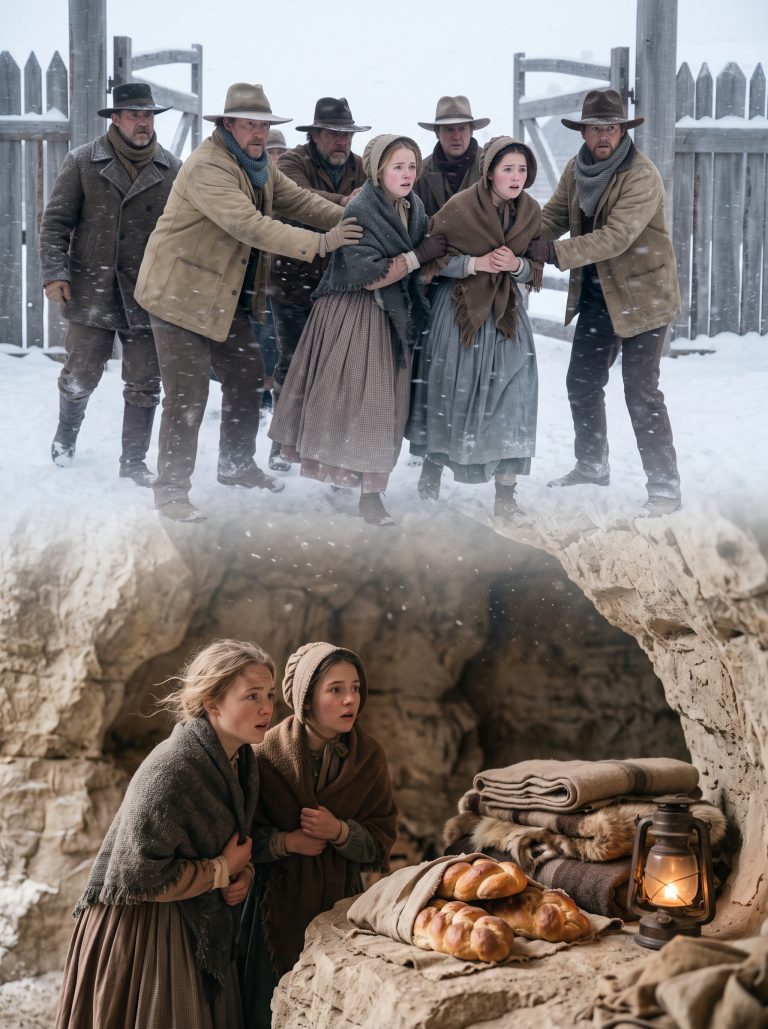
She Stepped Off the Train as a “Mail-Order Bride”… Then Broke Down When the Cowboy Said One Unexpected Line

Part One
The letter in her pocket was signed with a name that wasn’t hers.
Clara Whitfield watched the Montana plains roll past the train window, flat and gold and endless, and pressed her hand against her coat where the folded paper sat like a stone. Dearest Mr. Calloway, I am pleased to accept your proposal of marriage. Signed: Nora Hale.
She had chosen the name off a gravestone in a Kansas City churchyard, a woman who had died at nineteen and would never know her name had been borrowed to save a stranger’s life.
Three months ago, Clara had watched her brother Daniel dragged out of the First Merchant Bank in handcuffs, accused of embezzling funds he had never touched. She knew who had really taken the money — she had seen the ledgers herself, in Simon Ashworth’s handwriting, the man she had once agreed to marry. When she tried to say so, Simon had smiled at her with the same tenderness he’d once used to court her and told her, quite calmly, that accidents happened to women who talked too much.
So she had stopped being Clara Whitfield. She had become Nora Hale, schoolteacher, and answered an advertisement from a rancher in the Montana Territory who needed a wife and, from the sound of his letters, a mother more than anything else.
My daughter is six, he had written. She does not remember her mother’s face, and it troubles her more than she says. I would not ask any woman to love a child overnight. I only ask that you be patient and honest with her, and with me.
Honest. Clara had read that word until it blurred.
Thaddeus Calloway was waiting at the depot in Miles Landing with his hat pushed back and a small girl’s hand gripped tight in his own. He was younger than his letters had made him sound — thirty, maybe — with the kind of weathered calm that came from a man used to solving problems with his hands instead of his mouth.
“Miss Hale?” His eyes found her trunk before they found her face, as if he expected to have to prove himself useful before he was allowed to look at her directly.
“Mr. Calloway.” She held out her gloved hand. His grip was careful, like he was afraid of his own strength.
The girl beside him — Sadie, thin and solemn, in a dress clearly let out at the hem more than once — studied Clara with open suspicion.
“You don’t look like a teacher,” Sadie said.
“Sadie.” Thad’s voice carried a warning, but no real heat.
“It’s all right,” Clara said, crouching so she was eye level with the child. “What does a teacher look like?”
Sadie considered this with great seriousness. “Meaner.”
Thad made a sound that might have been a laugh, quickly swallowed.
The ranch sat two hours out from town, a low timber house against a rise of cottonwood and pine, with the Bitterroot range shouldering up blue and jagged behind it.
“I lost my wife two winters back,” Thad said, as they unloaded the wagon. He did not look at her when he said it. “Fever. It took her fast. Sadie doesn’t talk about her much. I don’t rightly know if that’s healing or hiding.”
“Perhaps both,” Clara said. “Grief isn’t tidy.”
He glanced up at that, something in his face shifting — surprise, maybe, that she hadn’t offered comfort instead of truth.
That night, after Sadie had been coaxed to bed, Thad sat across from her at the kitchen table.
“I’ll say this plain, since plain is how I live,” he said. “I don’t need a wife to keep house. I could hire that done. I need someone who’ll stay when it’s hard, and tell me true things even when they’re not easy to hear. My first marriage had a lot of love in it. It didn’t have enough truth. I found out things at the end I should’ve known at the beginning, and I’ve regretted it every day since.”
Clara’s hand tightened around her cup.
“I’ll try to be worth the asking,” she said.
It wasn’t a lie. But it wasn’t the whole truth either, and she felt the gap between them like a held breath.
Later, alone in the small room off the kitchen, Clara unpacked her trunk by lamplight. At the bottom, wrapped in a stocking, sat the one thing she hadn’t been able to leave behind — a silver locket, engraved on the back in her mother’s hand: C.W., beloved.
She was still holding it, turning it over in the lamp’s glow, when she heard footsteps outside her door — and realized, too late, that she’d left it open a crack, and that Thad Calloway was standing in the hallway, looking straight at the initials catching the light in her palm.
Part Two
Neither of them moved for a long moment.
“That’s not the name on your letters,” Thad said quietly.
Clara closed her fist around the locket. “It was my mother’s.”
“Your mother’s name was Whitfield?”
The lie sat on her tongue, ready and practiced. But something about the stillness in his face — not anger, just a terrible patience, like a man bracing for a wound he already half-expected — made the lie curdle before she could speak it.
“I need time,” she said instead. “Please. I will tell you everything. Just not tonight, standing in a hallway with your daughter asleep down the hall.”
He studied her for a long moment. “Tomorrow, then,” he said, and walked away without another word.
She didn’t sleep.
Word traveled fast in a town the size of Miles Landing, and it worked against her faster than she expected.
Three days later, Thad came back from town with his jaw set tight and a folded newspaper under his arm — three weeks old, arrived by mail from Helena.
He set it on the table in front of her without a word.
BANK CLERK’S SISTER SOUGHT IN CONNECTION WITH EMBEZZLEMENT CASE — WHITFIELD WOMAN BELIEVED TO HAVE FLED WEST.
Clara’s stomach dropped through the floor.
“There’s a man been asking after you in town,” Thad said, his voice very controlled. “Calls himself an insurance investigator. Showed folks a photograph.”
Clara’s hands had gone cold. “Simon.”
“Who’s Simon?”
Before she could answer, a horse and buggy turned up the long track toward the house — too clean, too city-bright against the mud of the yard — and a man in a gray coat stepped down, already calling out her name. Not Nora.
Clara.
Part Three
For one terrible moment, no one moved. Sadie, playing near the porch steps with a length of twine and a stick horse, looked up at the stranger with the frank curiosity of a child who had not yet learned to be afraid of well-dressed men.
“Inside, Sadie,” Thad said quietly, and something in his tone sent her scurrying without protest.
The man came no closer than the edge of the yard, as though he already sensed he wasn’t welcome past it. He was neat in a way that didn’t belong on a cattle ranch — polished boots, a coat too fine for the dust, a leather case tucked under one arm.
“Miss Whitfield,” he said. “My name is Coyle. I’ve been retained to locate you on behalf of a concerned party back East.”
“Concerned party,” Clara repeated, and heard the bitterness sharpen her own voice more than she meant to allow. “Is that what Simon Ashworth calls himself now?”
Coyle’s smile didn’t waver. “There’s a reward posted for information leading to your whereabouts. Your brother’s trial raised… complications. Certain parties would prefer those complications resolved quietly.”
“You mean Simon would prefer I disappear before anyone asks why his handwriting is all over ledgers my brother never touched.”
Thad had gone very still beside her — the particular stillness of a man deciding, in real time, what kind of man he intended to be.
“There’s a woman living in my house,” he said, stepping half in front of Clara without seeming to notice he’d done it. “Goes by Nora Hale. Soon to be Nora Calloway, if that’s any of your business, which it isn’t.”
“I have a photograph, Mr. Calloway,” Coyle said. “A very good likeness.”
“Then I expect you’ll want to speak with my wife’s lawyer before you speak to her,” Thad said. “I sent for one from Helena the morning I heard a stranger was asking after a woman fitting my fiancée’s description. Man by the name of Pruitt. Handles fraud cases before the territorial court. He tells me a sworn deposition from an eyewitness to embezzlement carries a great deal of weight — enough, perhaps, to reopen a case that convicted the wrong man entirely.”
Clara turned to stare at him. She hadn’t known. He hadn’t told her.
Coyle’s confidence flickered, just slightly, like a lamp catching a draft. “That’s not why I’m here.”
“Then you’ve nothing to fear from a deposition,” Thad said evenly. “Unless your employer does.”
For a long moment the two men simply looked at each other across the mud and the cold morning air. Then Coyle climbed back into his buggy without another word and drove off toward town.
He did not come back that day. But word of the confrontation did — carried, as everything was in Miles Landing, by the mercantile owner’s wife, who had seen the gray-coated stranger asking his questions all week and had not liked the look of him. By supper, half the town seemed to know that Thad Calloway had stood in his own yard and told a city investigator to go through a lawyer, and that his intended, whatever name she went by, had not so much as flinched while he did it.
“They’ll talk,” Clara said that evening, watching the last light fade over the pasture. “About all of it. About who I really am, and why I came here under someone else’s name.”
“Let them,” Thad said. “Folks around here judge a person by what they do with their hands and their word, not by what some newspaper printed three states away. You’ll find most of them have a chapter or two in their own history they’d rather not see set in type.”
That evening, once Sadie was finally asleep and the house had settled into its familiar creaks and silences, Clara sat across from Thad at the same table where he’d first asked her to be honest with him.
“You could have told me,” she said. “About the lawyer. About Pruitt. I thought I’d have to run again. I nearly packed my trunk this afternoon while you were out at the fence line.”
“I know,” Thad said. “I saw it half-packed when I came in for supper.”
“Then why didn’t you say something sooner?”
“Because I wanted you to choose to stay,” he said, “before you knew I’d already fought for you. I didn’t want gratitude standing in the way of the truth. You asked me once for time to tell your own story in your own way. I thought you deserved the same courtesy back.”
She let out a breath that had been sitting in her chest for three months. “My name is Clara Whitfield,” she said, as if saying it plainly, at last, in her own kitchen, might finally make it feel safe to carry. “My brother Daniel is innocent. I saw the real ledgers in Simon Ashworth’s own hand before I ever left Kansas City — transfers moved out of client accounts and back into his personal ones, dressed up to look like clerical errors. When I told him I meant to go to the bank’s board with what I’d seen, he laughed at me. Told me accidents happened to women who talked too much. Two weeks later Daniel was arrested instead of him, and I understood exactly what kind of accident he’d meant.”
“Why not go to the law yourself?”
“Simon’s father sits on the very board that would have heard the complaint. In that city, his name opens doors mine could never get through. I copied what pages of the ledger I could before I fled — sewed them into the lining of my trunk — but a stack of paper from a runaway woman isn’t proof. It’s just one more thing for people to disbelieve.” Her voice caught. “I took a dead woman’s name because I did not know any other way to stay alive long enough to find a way to fix it.”
Thad was quiet for a long moment, turning his coffee cup slowly on the table.
“You lied to me in every letter,” he said finally.
“Yes.”
“Even the part about wanting a home. Wanting Sadie.”
“No.” Her voice broke on the word. “That part was never a lie. That was the only true thing I had left to offer you.”
He looked at her the way a man looks at a fence line after a storm, trying to see what still stood and what had to be rebuilt from nothing.
“I built this ranch by not running from hard things,” he said slowly. “I’m not about to start teaching my daughter different — and I’m not about to start now, with you.”
It took nearly two months for the lawyer’s letters to cross the country. Pruitt turned out to be a careful, unhurried man who wrote in a small, exact hand and asked more questions than Clara had answers for at first — the dates of each transfer, the exact wording Simon had used, whether anyone else had seen the ledgers before they vanished from the bank’s records. Clara spent three long evenings at the kitchen table reconstructing everything from memory. The first transfer had been dated the fourteenth of March, disguised as a clerical correction to a widow’s trust account. The second, in April, moved almost twice as much, folded into a column of “administrative fees” no auditor had thought to question because Simon Ashworth had, after all, been the one training the auditors. She wrote until her hand cramped and the numbers began to blur, and each time she faltered, Thad was there across the table — not offering opinions on figures he didn’t understand, but refilling her coffee, trimming the lamp wick when it smoked, once simply resting his hand over hers until the shaking stopped enough for her to keep writing.
“You don’t have to stay up with me for this,” she told him once, well past midnight.
“I know,” he said, and stayed anyway.
“It isn’t your fight.”
He looked at her then with an expression she was only beginning to learn to read — steady, unhurried, entirely certain. “Anything that keeps you from sleeping easy in my house is my fight now,” he said. “That was rather the point of the ring I mean to put on your hand, once all this is settled.”
It was the closest either of them had come to saying, plainly, what had grown up quietly between the fear and the waiting. Clara didn’t trust her voice to answer him. She simply turned her hand over beneath his, so their fingers laced instead of merely touching, and went back to the ledgers with a steadier grip than she’d had all night.
The deposition itself was taken by a visiting circuit judge in Miles Landing’s small courthouse — a plain room with a wood stove and a single dusty window — and notarized alongside copies of the ledger pages Clara had carried west sewn into her trunk lining. Pruitt sent it all east by registered post with a covering letter to a territorial attorney he knew personally, a man with no particular love for banking families who threw their weight around courtrooms that weren’t theirs.
Pruitt warned them from the start not to expect swift justice. “The wheels of a territorial court turn slow enough on their own,” he wrote, “and slower still when the man they’re meant to grind belongs to a family accustomed to greasing them.” He was, as it turned out, exactly right. Word came back in pieces, weeks apart: that the deposition had been received; that a second clerk at the bank, emboldened by the sudden existence of real evidence, had come forward with his own account of altered transfers; that Simon Ashworth’s father had hired three lawyers of his own and intended to fight the reopening of the case at every turn the law allowed him.
Then came the waiting.
It was, in its own way, harder than the running had been. Running had at least kept her hands busy. Waiting left her standing at the window some evenings watching the road for a buggy that wasn’t Coyle’s, wasn’t anyone’s, was only ever the wind moving grass.
Thad kept busy too, in his own way. He rode into town more often than the ranch strictly required, and came home each time with some small excuse — a spool of thread Clara hadn’t asked for, a book of arithmetic for Sadie, news of the weather three counties over — until Clara realized, with a warmth she hadn’t expected, that he was checking on the temperature of the town’s opinion each time, standing quiet guard over her without ever once making a show of it.
“You don’t have to keep riding in on my account,” she told him one evening, watching him hang his coat by the door.
“I know,” he said, in the same tone he’d used about staying up late over the deposition. “I like the ride.”
She didn’t believe him, and loved him a little more for the lie.
Sadie, oddly, was the one who made the waiting bearable in the quieter hours. The girl had taken to trailing after Clara through the chores of the day — gathering eggs, kneading bread, mending harness by the fire — asking blunt six-year-old questions Clara had learned not to flinch from.
“Are you going to have to leave?” Sadie asked one afternoon, apropos of nothing, while they shelled peas on the porch steps.
“I don’t know,” Clara admitted. “I hope not.”
“I don’t want you to.”
“Why not?”
Sadie considered this with the same gravity she’d once used to judge whether Clara looked sufficiently mean to be a teacher. “Because you don’t make me talk about my mama unless I want to. And you don’t pretend she didn’t exist, either.”
Clara had to look away, out over the pasture, until she trusted her voice again.
Word came in November, in a letter forwarded through Pruitt’s Helena office, written in Daniel’s own unsteady hand for the first time in nearly a year.
Clara — they let me out three days ago. Ashworth’s been remanded pending trial; seems your ledger pages did more good than either of us dared hope, and two other clerks came forward once they saw someone finally had proof enough to be believed. I owe you a debt I don’t know how to repay except by telling you: come home whenever you’re ready, or don’t, if you’ve found something out there worth staying for. Either way, you saved my life, and I mean to spend a good deal of the rest of mine making sure you never regret it.
Clara read it twice on the porch, Sadie leaning against her shoulder trying to sound out the longer words, while Thad stood in the doorway watching her with the particular stillness of a man who has been waiting, without quite admitting it, to see which way she’d turn.
“You could go back,” he said, when she finally looked up. “Now that it’s safe. Now that your name is your own again.”
Thad was quiet a moment, looking out at the darkening pasture rather than at her, as though it were easier to say what came next without her eyes on him.
“When Mary died,” he said finally, “I spent a long while believing I’d failed her by not seeing what was wrong in time. Took me the better part of two winters to understand she’d hidden it from me on purpose, out of some notion of sparing me. I didn’t want sparing. I wanted the truth, even the hard kind, so I could stand beside her through it instead of finding out too late I never got the chance.” He turned to look at Clara then. “You gave me the hard truth the moment I asked for it, even knowing what it might cost you. That’s not the same thing as a lie, whatever name was signed at the bottom of those letters.”
“I know I could.” She folded the letter carefully, the way she’d once folded a stranger’s borrowed name into her coat pocket. “I’ve thought about it every day for two months, if I’m honest. But I find I don’t want to go back to being Clara Whitfield of Kansas City. I think I’d rather find out who Clara Calloway might be, if the man in question is still asking.”
Something in Thad’s face came loose, like a held breath finally let go.
“He’s still asking,” he said. “He’s been asking since about the third night you were here, if you want the plain truth of it — he just didn’t think it was fair to say so while you still had a stranger hunting you across two territories.”
“That,” Clara said, “is a very roundabout way of proposing a second time.”
“I’m a cattleman,” Thad said. “I’m better with fences than words. Take what romance you can get.”
They married in early December, in the small church at Miles Landing, with Sadie scattering the last of the season’s dried wildflowers down the aisle and half the town in attendance out of a curiosity that had, somewhere in the long weeks of waiting, quietly turned into goodwill. Clara wore no veil. She had spent enough of her life hidden behind one kind of covering or another; she wanted, for once, to be seen entering a room exactly as herself, under her own name, in full daylight.
Daniel could not make the journey in time for the wedding itself, but he sent a telegram that arrived the morning of, which Thad read aloud at the small reception afterward to general laughter: TELL THE GROOM I’VE ALREADY CHECKED HIS LEDGERS. HE’S HONEST. APPROVED.
He did come in the spring, when the roads thawed enough for travel — a thinner, quieter version of the brother Clara remembered, with new lines around his eyes that a year in a cell and a courtroom had put there, but with the same steady warmth underneath. He stood in the ranch yard turning slowly in place, taking in the barn, the corrals, the mountains standing blue at the edge of everything, and then looked at his sister as if he were only now allowing himself to believe she’d truly landed somewhere safe.
“You built a whole life out here,” he said. “While I was busy being angry at the world for the one that got taken from us.”
“We both did what we had to,” Clara said. “I only got the better end of the bargain.”
Daniel’s gaze drifted to where Thad stood at the fence line with Sadie perched on the top rail, the two of them arguing cheerfully over whether a calf newly born that morning ought to be named Buttons or General Grant.
“I can see that,” Daniel said, and for the first time since his arrest, he looked like a man who might, eventually, learn to be at peace.
That winter, the first true snow came early and settled soft and unbroken over the cottonwoods. Clara stood at the kitchen window with the silver locket at her throat — no longer hidden at the bottom of a trunk, no longer a secret worth flinching over — and watched Thad teach Sadie to build a crooked, lopsided snowman in the last blue light of evening, the two of them laughing at its uneven arms in a way that had nothing careful or grieving in it at all.
She thought of the gravestone in the Kansas City churchyard, of the name she’d borrowed to survive the worst months of her life, of all the time she had spent measuring her own worth by how well she could disappear.
She did not have to disappear anymore.
When Thad came in, stamping snow from his boots, he found her smiling at nothing in particular.
“What is it?” he asked.
“Nothing,” she said. Then, catching herself, she laughed. “Everything. I was only thinking that I finally like the sound of my own name again.”
He crossed the room and took her hand — the one that had once closed around a stranger’s name like a shield, and now held nothing but his — and drew her close.
“Clara Calloway,” he said, testing the shape of it the way a man tests a plank before he trusts his weight to it. “Sounds like it was always going to end up that way.”
Sadie came stamping in behind him a moment later, cheeks red from the cold, dragging a lopsided second snowman she insisted was the first one’s little sister.
“Papa says I can name her,” she announced, “and I’m naming her Clara, because she’s the prettiest one in the yard.”
“Is that so,” Clara said, crouching to look the snow-sister in her crooked pebble eyes. “I’m honored.”
“You’re staying though,” Sadie said, suddenly serious again in the way she sometimes was, as though the question had been sitting unspoken under all her chatter. “Not just visiting like Uncle Daniel.”
“I’m staying,” Clara said, and found, to her own quiet surprise, that the words came without any of the old caution she’d once wrapped around every promise she made. “For good, this time. No borrowed names, no trunks half-packed by the door. Just us.”
Sadie seemed satisfied with that. She turned and ran back out into the snow to add a crooked scarf to her small namesake, leaving the door open behind her just long enough to let in a gust of cold, clean air.
Thad closed it, then came to stand beside Clara at the window, his shoulder warm against hers.
“Regrets?” he asked, echoing, without quite meaning to, the same question she’d once put to him about a bride who’d arrived on his doorstep already carrying a stranger’s name.
“None,” Clara said. “Only a great deal of gratitude that a plain-spoken rancher in Montana Territory was patient enough to wait for the truth instead of settling for a comfortable lie.”
“I’m a cattleman,” Thad said again, drawing her closer. “Waiting’s most of the job.”
Outside, the snow kept falling, quiet and clean, over the ranch he had built alone and the family they had built, at last, together — out of two truths finally spoken instead of one long, careful silence, and a love that had needed only honesty, not perfection, to take root.