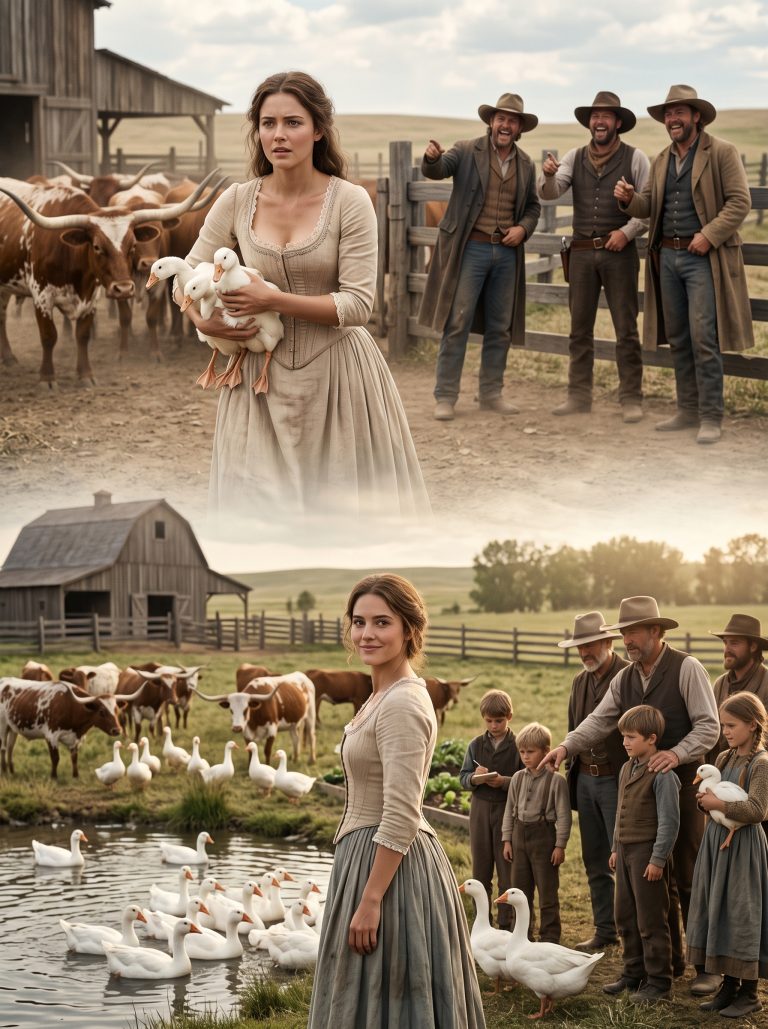
She Was Turned Down Seven Times — Then the Wealthiest Cowboy in Town Stopped, Looked at Her, and Changed Everything

Part 1
Margaret Doyle held her youngest against her hip as the fifth man of the afternoon turned his back without a word.
Snow fell over the platform at Silver Hollow, settling on the shoulders of eight children huddled around her worn skirts. The baby, not yet two, buried her face in Margaret’s collar, too small to understand that every man who walked past her mother was rejecting a family, not just a woman.
Eight children. Eight reasons, the town seemed to think, that no man in his right mind would want Margaret Doyle.
She was thirty-six, once widowed, and she had crossed three hundred miles of frozen prairie for this chance. Thomas, her eldest at eighteen, stood a half-step in front of her, jaw set against the cold. Behind him came Eliza, sixteen, holding the toddler while keeping a steadying hand on her younger sister’s shoulder. Then Caleb, fourteen, arms crossed, anger doing the work grief could no longer do. Then five more, down to the baby, each one a small soldier in a war none of them had chosen to fight.
“That’s the widow with all the children,” a woman in the crowd said, not troubling to lower her voice. “Imagine the appetite on that household.”
Thomas’s shoulders went rigid. Margaret touched his sleeve.
“Don’t,” she murmured. “Let them talk.”
“It matters, Mama.”
“It matters more that we eat this winter.”
Mrs. Pruitt, the platform coordinator, approached at last with her clipboard held like a shield, pity poorly hidden behind her spectacles.
“Mrs. Doyle, the gentlemen have made their selections for today. The coach back to town leaves at four.”
“We paid the same fee as everyone else,” Thomas said before his mother could answer. “The listing said selection continues until sunset.”
Mrs. Pruitt’s mouth thinned, but she nodded. “Until sunset, then. Though I’ll tell you plainly, Mrs. Doyle — in eleven years I have never placed a widow with more than three children.”
“Then perhaps,” Margaret said quietly, “you’ve never met the right man yet.”
She did not believe her own words. But she had learned that belief was a luxury; showing up was not.
The cold deepened. Ruth, twelve, had stopped shivering in a way that frightened Margaret more than the shivering had. She was unwinding her own shawl to wrap around the girl when hoofbeats broke through the wind — hard, fast, reckless.
A man rode into the yard as if the storm owed him nothing. He swung down before his horse had fully stopped, snow thick on his shoulders, a leather satchel strapped across his chest like a man who had ridden a long way in a hurry and meant to arrive whether the weather agreed or not.
“Elias Caldwell,” Mrs. Pruitt said, startled into straightening her spine. “We feared the pass had closed on you.”
“Pass tried.” He didn’t smile. “I gave my word I’d be here before sunset. Weather doesn’t get a vote.”
He was younger than Margaret expected of a man wealthy enough to make the whole platform go quiet — perhaps thirty-two, tall, weather-hardened, with the kind of stillness that made people stop talking without him raising his voice. His eyes swept the remaining women: two young sisters too shy to have caught earlier notice, and Margaret, standing behind a wall of children.
“You’re the one with eight,” he said. Not a question.
“I am.”
“Why do you keep standing here? Five men have already said no.”
“Because sitting down and giving up has never once fed my children, Mr. Caldwell.”
Something shifted behind his eyes — not amusement, something closer to recognition.
“Tell me about them,” he said. “All of them. Names, ages, what they’re good for.”
One by one, the children answered him — Thomas and his horsemanship, Eliza and her steady hands, Caleb’s guarded pride in his arithmetic, down to little Grace, who studied Elias with open suspicion and asked whether he was unkind to children. He answered every one of them seriously, as if their answers were the only ones on the platform that mattered.
Then he turned back to Margaret.
“Why should I choose you?”
She could have made herself small to be chosen. She had done it twice before, in two marriages that asked nothing of her but obedience.
“You shouldn’t,” she said. “I come with eight mouths, a boy who trusts no man, and a girl who hasn’t spoken above a whisper since her father died. I have no dowry and no patience left for men who need convincing.”
“So why should I choose you?”
“You shouldn’t choose me to carry your household, Mr. Caldwell. You should choose me because I’ve already proven I can carry a family alone through worse than anything Wyoming can throw at us. If that’s not worth something to you, I’m not the bargain you’re looking for.”
Elias Caldwell looked at her for a long moment, then at the eight children standing in the snow with their chins raised despite everything.
“I own land, cattle, and a house with too many empty rooms,” he said. “And I have thirty days to fill this ranch with a family, or I lose every acre of it to a man who has never once earned it. I came here today looking for a convenient arrangement, Mrs. Doyle.”
He paused.
“I don’t think that’s what I’ve found.”
He offered his hand.
“One week’s courtship, so your children can judge me honestly. After that — a real choice, made with open eyes on both sides. Agreed?”
Margaret looked at eight cold, hopeful faces, then at the stranger’s outstretched hand.
“Agreed,” she said, and took it.
Part 2
The wagon rocked over frozen ruts as Elias rode alongside, tossing back easy answers to Caleb’s suspicious questions and passing wool blankets around without ceremony.
“How much farther?” Caleb asked, testing him.
“Four miles. House sits low in the valley — blocks the worst of the wind.”
“Convenient.”
“Smart of you to wonder if I’m lying,” Elias said. “Keeps a man safe.”
Thomas rode close enough to ask what no one else dared. “You said thirty days. Thirty days for what?”
Elias’s jaw tightened, but he didn’t deflect. “My father’s will. I inherit the ranch outright only if I’m married with a family under my roof before the month turns. If not, it passes to my uncle Cyrus, who has been waiting six years for exactly that failure.”
“So we’re — what — solving a legal problem for you?”
“You’re the reason I stopped thinking of it as a problem,” Elias said. “That part happened on the platform, not in my father’s will.”
Thomas said nothing, but he didn’t argue either.
They crested a rise, and Eliza gasped. Blackwood — no, Caldwell Ranch — spread below like a small kingdom: a broad timber house with smoke rising from three chimneys, barns and corrals stretching toward the tree line.
A stout foreman named Walsh met them in the yard, eyebrows climbing at the sight of eight children climbing down from the wagon.
“Boss. You found one, then.”
“Found a family, Walsh. Introduce yourself properly.”
Inside, a cook named Mr. Lin took one look at the shivering children and set the whole kitchen in motion without being asked twice, ladling stew into bowls before coats were even off.
“Eat slow,” he told them. “Cold stomachs punish fast eaters.”
Margaret watched her children eat a hot meal without rationing it for the first time in months, and something in her chest — clenched tight for three hundred miles — loosened just slightly.
Thirty days, she thought. Not much time to build a family.
But she had built one out of far less.
Part 3
The first days passed in careful discovery. Elias put Thomas and Caleb to work with the hands — purpose, he said, cured fear faster than comfort did. Eliza took over the household books alongside the housekeeper, Clara. Ruth found the library and did not come out of it for two days. Grace, silent since her father’s death, began following Elias at a careful distance, saying nothing, watching everything.
On the fourth day, Elias took Margaret into town for supplies, and they were met at the general store by Priscilla Ashford, the self-appointed judge of the town’s moral character, and her niece Vivian, who had waited years for Elias to notice her.
“A widow with eight children,” Priscilla said, not troubling to lower her voice. “How fortunate for you that desperation lowers a man’s standards.”
“I birthed them, ma’am,” Margaret said evenly. “It’s the traditional method.”
Caleb, who had followed them in unnoticed, stepped forward with his fists already curling. Elias caught his shoulder before words could turn to something worse.
“Not like that,” he said quietly. “There are better ways to fight for your mother than losing your temper in a dry goods store.”
“Like what?”
“Like proving her right, every day, until people like Mrs. Ashford run out of things to say.”
It was the first crack in the wall Caleb had built since his father’s death, and Margaret saw it happen.
That night a blizzard sealed the house shut for two days. On the second night, five-year-old Joel — Margaret’s youngest boy — spiked a fever that climbed past anything cool cloths could touch. By midnight he was barely conscious.
“He needs Doc Warren,” Eliza said, voice tight. “Mama, he’s getting worse.”
“The storm—”
“I’ll go,” Elias said, already pulling on his coat.
“You’ll die out there.”
“I know this land better than I know my own hands.” He was gone before she could argue further.
The hours that followed were the longest of Margaret’s life. Near midnight, as Joel’s fever spiked and his small body shook, Grace — silent for two years — climbed onto the bed and took her brother’s hand.
“Joey,” she said, her voice rusty from disuse, “you can’t break a promise. Mr. Caldwell said you could count the horses. Wake up.”
His eyelids flickered.
The front door crashed open downstairs an hour later. Elias returned half-frozen with Doc Warren behind him, having ridden through a storm that should have killed a less stubborn man. By dawn, the fever broke.
“I care for all of them,” Elias admitted to Margaret afterward, exhausted and frost-bitten. “More than I planned to. More than the will requires.”
The courtship week ended, and true to his word, Elias asked her plainly — not on a platform, not for the sake of a deadline, but in front of all eight children, on one knee, with his late mother’s ring in his hand. Grace was the one who answered first, walking forward to take his hand and declare, in her rusty, reclaimed voice, that they should keep him. Margaret said yes — not because thirty days demanded it, but because somewhere in that week she had remembered how to want something for herself.
They married quietly two days before the deadline, Reverend Whitfield presiding in the parlor beneath a portrait of Elias’s late mother.
The twist arrived nine days later, in the shape of a black carriage and a man who smiled the way wolves are said to smile.
Cyrus Caldwell strode into the ranch house unannounced, papers in hand, contesting the marriage before the ink on the county register had dried.
“A convenient arrangement,” Cyrus said to the county judge who’d traveled out to hear the challenge, “entered into eight days before a legal deadline, with a woman who conveniently arrived with eight children to satisfy a ‘family’ clause. I put it to the court that this marriage is a transparent fraud, designed to rob me of what my brother intended for his true blood.”
The judge turned to Elias. “Is it true you proposed within days of a legal deadline, Mr. Caldwell?”
“It’s true,” Elias said, and did not look away. “I won’t pretend otherwise. I went to that platform because of my father’s will. I’ll say that plainly, because I’d rather lose this ranch honestly than keep it on a lie.”
Cyrus smiled wider.
“But,” Elias continued, “a deadline is what brought me to that platform. It is not what married me to my wife.” He looked at Margaret. “If the court finds against us, I will sign every acre over to my uncle tomorrow morning — and I will still be married to this woman, in this house or in a rented room in town, because that part was never about the will.”
It was Caleb who spoke next, stepping forward though no one had asked him to.
“Your Honor, I hated him the day we arrived. I trusted him less than anyone I’d ever met. I watched him for weeks looking for the trick, because tricks are all I’ve ever gotten from men who wanted something from my mother.” His voice caught, but he pushed through it. “There wasn’t one. I watched him ride through a blizzard for my brother, who wasn’t even his son yet by any law you can write down. You can’t fake that at midnight when nobody’s counting.”
Grace, still and quiet Grace, walked to the front of the room and looked up at the judge.
“He kept his promise,” she said simply. “That’s how you know.”
The judge studied the row of children — Thomas with his working man’s hands, Eliza with the household ledgers she’d balanced herself, Grace who had not spoken to a stranger in two years and now would not stop — and set down Cyrus’s papers.
“Mr. Caldwell,” the judge said, “your uncle is correct that convenience brought you to that platform. He is wrong about what he thinks that proves. A contract can be written in thirty days. What I’ve heard testified to in this room took considerably longer to build, and no will could have manufactured it. The petition is denied.”
Cyrus left without another word. He did not return.
Spring came slowly to the valley that year, snow giving way to mud and then to green. Priscilla Ashford arrived one afternoon with seedlings by way of apology, admitting that her niece Vivian had confessed relief at not being chosen — she had never wanted the weight of eight children and a dead woman’s shoes to fill, and watching Margaret carry both with steadiness had taught Priscilla something about the difference between duty and choice.
By summer, Joel had appointed himself official counter of horses, a job he took with tremendous, uncorrectable inaccuracy. Grace spoke more each week, though she remained careful about who earned it. Caleb spent his afternoons in Elias’s office, learning the ranch’s books, no longer looking for the trick because he had finally stopped expecting one.
On a quiet evening in late summer, Margaret sat on the north hill beside the grave of the woman who had loved this house before her. Elias found her there, as he often did now.
“I keep thinking about what your uncle said,” Margaret admitted. “That we started as a convenient arrangement.”
“We did,” Elias said, sitting beside her. “I won’t pretend we didn’t. A will started this. But a will can only ever get two people into the same room. It can’t make a boy trust a stranger enough to shake his hand, and it can’t ride through a blizzard for a child that isn’t legally its own yet. That part, we built ourselves.”
Margaret looked down at the valley — at Thomas breaking a young horse with his father’s old patience, at Eliza laughing with Clara over the wash line, at Grace teaching the baby to stack blocks on the porch steps.
“I spent years believing that eight children made me too much for any man to want,” she said. “I thought survival was the best I could hope to offer anyone.”
“And now?”
“Now I think the men who turned me away weren’t rejecting a burden. They were admitting they weren’t equal to it.” She smiled, finally, without effort. “You were smart enough to know a blessing when a deadline handed you one.”
Elias laughed — a rare, unguarded sound — and pulled her closer.
“Best contract I ever signed,” he said, “and the only clause that mattered wasn’t written down anywhere.”
Below them, Joel shouted that he’d counted three hundred and twelve horses, which was almost certainly wrong, and nobody minded correcting him, because there would be tomorrow to count again, and the day after that, and every ordinary day a family gets to keep choosing each other long after the reason they started stops mattering at all.
The End