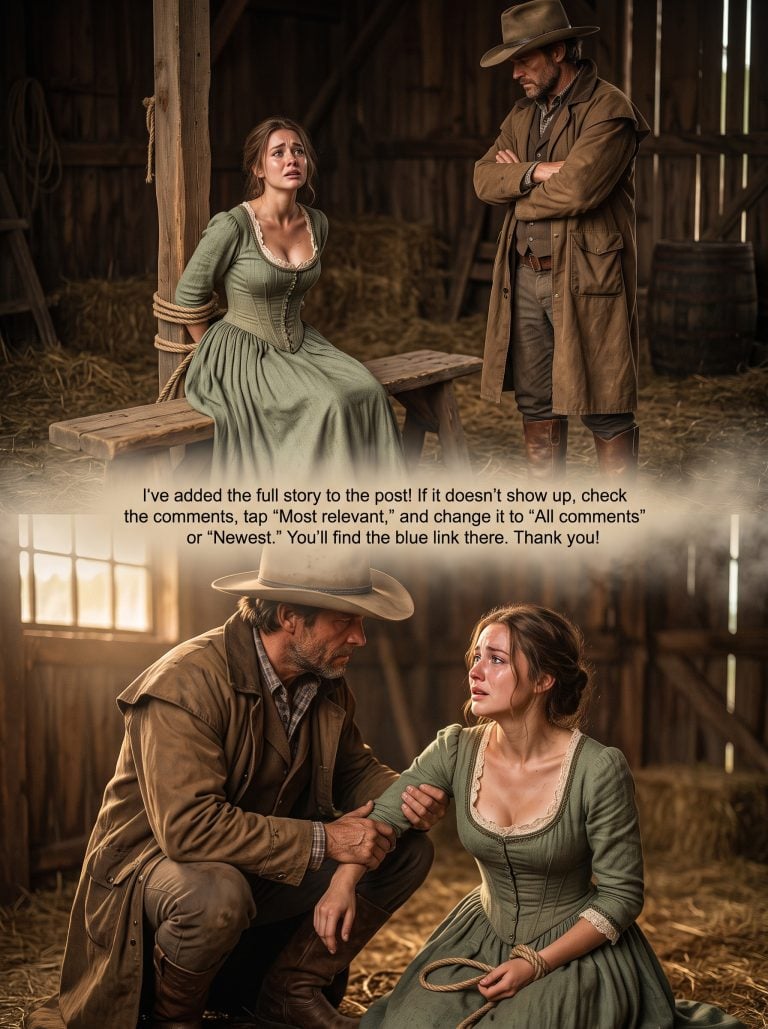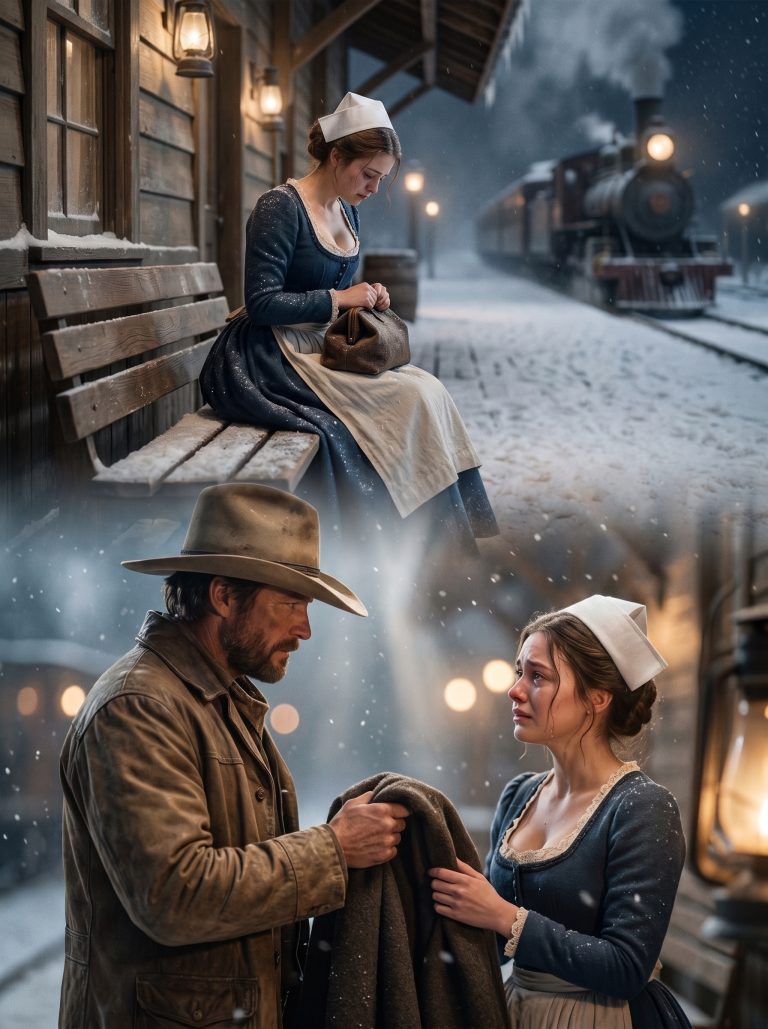
She Refused One Dance in the Saloon—Minutes Later, The Gunslingers Had Already Drawn Blood… Then The Stranger Locked the Doors

PART 1
Grace Hartley was finishing her third dance of the evening when Nathaniel Hastings decided her refusal meant something other than what she had said.
She saw it coming before it happened—the way his hand tightened on her wrist, the flush in his face, the rage of a man unaccustomed to hearing no from anyone who could not afford to walk away. She had been working at the Silver Lining for four years. She had learned to read violence like other women read ledgers. Grace knew the shape of it, the weight of it, the particular ugliness it wore when money decided it could purchase everything, including a woman’s right to choose.
“Dance,” Nathaniel said, his grip tightening.
Grace kept her voice level. “I have danced with you twice. My feet are tired.”
“Your feet will dance until I say otherwise.”
“No.”
The word came out small and certain.
Nathaniel’s face went dark.
The piano player saw before anyone else did. He fumbled the keys, missing a beat, as if the music itself sensed the shift. Across the saloon, Frank Carson, who owned the establishment and who had learned early that women who worked for him were not to be damaged like barroom stools, began moving from behind the bar.
He was too far away.
Nathaniel Hastings was the younger son of the territory’s most powerful family—a man whose wealth had never encountered the word no and did not know how to translate it. His father, Colonel Victor Hastings, owned silver claims, timber, political favors, and most of the sheriffs. Nathaniel had inherited entitlement and was still waiting to inherit sense.
He drew his revolver and fired.
The sound deafened the room. The bullet caught Grace across her left side, high and terrible. Her blue dress bloomed red. The piano stopped. The silence that followed was the silence of men pretending they had seen nothing because that was how one survived in Dry Creek.
Grace fell to her knees.
Then to the floor, where sawdust clung to her cheek and the taste of blood filled her mouth. She heard Nathaniel laugh—a sharp, brittle sound like something breaking. She heard Frank curse, heard boots scrambling, heard the particular helplessness of men deciding that a woman’s body was not worth their lives.
A chair scraped in the corner.
The man had been there for three days, and Grace had noticed him because he was the only person in Dry Creek who knew how to disappear while sitting in plain sight. He wore old canvas and leather worn down to softness. His hat shadowed his face. His hands, when he wrapped them around a glass of water, carried scars like someone had tried to sand him away and failed.
Now he stood.
He did not rush. He moved with a deliberation that made every step sound like a choice. When he reached the heavy oak doors, he dropped the iron bar into place with a sound that cut through the room like a judge’s gavel.
“What in God’s name—” Nathaniel started.
The stranger turned, and lamplight caught his face for the first time. Older than Nathaniel by decades, scarred down one side, with eyes the color of winter sky.
“The girl stays,” he said.
His voice came low, roughened by someone who had learned that silence was safer than words.
Nathaniel’s hand lifted the revolver again. “You have no authority here.”
“No. But I have a particular intolerance for cowardice.”
“I own this town.”
“No.” The stranger’s hand rested near his own weapon, but he did not draw. “Your father leases fear month by month. That is not ownership. That is mere rental.”
Frank had reached Grace by then. He pressed both hands over the wound, and his face went the color of old paper.
The stranger looked at Grace, and something changed in his eyes. Not softness. Not mercy. Something more dangerous to a man like Nathaniel: absolute attention.
“What is your name?” he asked her.
“Grace,” she whispered.
“Grace said no.”
Nathaniel laughed, but it cracked under the weight. “You intend to die over this?”
“I intend to see her live.”
Boone and Jared, Nathaniel’s hired men, shifted. The stranger moved before anyone inhaled, drawing with a speed that seemed to come from somewhere beyond thought. Two shots, so close they cracked like a single board splitting. Boone’s hand opened, bleeding. Jared’s revolver flew across the room.
Frank surged up with his shotgun. The miners, who had been standing frozen, suddenly remembered they had spines.
“She will bleed out,” Nathaniel said, panic rising. “Unless you get her to the doctor.”
The stranger did not blink. “Then you will fetch him. You will run across the street in front of every witness here. You will bring Doc Miller back if you have to drag him.”
“And if I refuse?”
“Then I will come to your father’s house before dawn and tell him what sort of heir he raised.”
The name fell differently then. Not as money. As history.
Nathaniel stared at him. “You know my father.”
“Yes.”
“Who are you?”
“Someone who has spent a long time wondering if Harrison Hastings still needs reminding that not everything a man takes belongs to him.”
The blood drained from Nathaniel’s face.
He stumbled toward the door, mumbling for someone to release it. Frank lifted the bar. Three miners followed Nathaniel into the storm, not as guards but as witnesses. The stranger knelt beside Grace, and his hands were steady as he pressed fabric against her wound.
“Stay awake,” he said.
“Are you always this commanding?”
His mouth almost moved. “Much worse.”
“Is worse better?”
“Not usually.”
She kept her eyes on his face because looking anywhere else meant seeing how much blood was spreading. “What is your name?”
“Samuel Cross.”
“Samuel, I am very cold.”
He removed his coat and spread it over her. The weight of it, still warm from his body, anchored her to the world when everything else seemed to be drifting.
Doc Miller arrived within thirty minutes, cursing Nathaniel, the weather, and every fool in Wyoming who thought firearms improved conversation. They carried Grace through the blizzard on a door, Samuel walking beside her the entire way, one hand gripping the edge, his coat still covering her body.
At the clinic, Doc Miller made everyone leave except Frank and a widow named Ruth Rourke who knew how to assist without fainting. Samuel stood outside in snow that rose past his boots, hat in his hands, while the blizzard buried Dry Creek.
When Frank emerged near dawn, his shirt sleeves were dark with blood.
“She is breathing,” he said.
Samuel nodded.
“You bought her time.”
Samuel looked toward the shuttered window. “Time is only useful if a person gets to choose what happens next.”
PART 2
Grace woke to pain, carbolic, and the sound of a man reading badly from a newspaper.
It was Frank, not Samuel. He sat by her bed with his scarred nose almost touching the page, squinting at words like they were personal insults.
“Frank,” she whispered.
His head came up so quickly the newspaper fell. He lurched for water with panic that spilled half of it before reaching her mouth. She swallowed twice and sank back, exhausted.
“Annie?” she asked.
“Money order sent last week. Your letter too. She knows nothing.”
Grace closed her eyes.
Doc Miller appeared, narrow and gray-bearded, with the tired eyes of someone who had opened too many bodies in too few years.
“You were lucky,” he said.
“Luck with help?” Grace opened one eye.
“Bullet missed your heart, cracked a rib, lodged shallow. You will hurt like the devil but live if fever does not set in.” He paused. “Your gunman has been sitting in my front room since you arrived.”
“Samuel?”
“Cade,” Frank corrected. “Samuel Cross Cade. That is the name that made your shooter’s face go white.”
Grace frowned. “How long?”
“Two days.”
“Has he spoken?”
“Asks every six hours if you are still breathing.”
A shadow moved in the doorway.
Samuel did not enter until Doc Miller nodded permission. He had shaved, but trail dust still clung to him. In daylight, he seemed less ghost and more like a man surprised to find himself alive.
Grace studied him. “You stayed.”
“For now.”
“That means you planned to leave.”
“Before you asked who I was.”
“I do not remember inviting you to rearrange your life.”
“You did not.”
She watched his jaw work. “Are you always this talkative?”
Frank coughed into his hand.
Samuel’s eyes warmed by the smallest degree. “No.”
“Good. Less talk is better.”
Doc Miller pointed at her. “No laughing. No sharp breathing. No cleverness if it pulls stitches.”
Grace smiled. “You might as well shoot me again.”
Samuel went absolutely still.
The room changed. His face shut like a door.
“I did not mean—” she started.
“I know.”
He stepped back.
That was how Grace first learned that Samuel Cade carried his guilt close enough to touch, regardless of how deep he buried it.
Recovery narrowed her world to a small room, closed curtains, and pain that came in waves. Some mornings she felt almost strong; by noon, a cup defeated her. Samuel came every day. He never sat unless she asked. Never touched her without permission, except once when she dropped a spoon and his hand caught it before it fell. Even then he looked startled by his own reflex.
On the fourth day, she found him repairing the clinic’s loose window latch.
“Did Doc ask?”
“No.”
“Then why?”
“Wind was worrying the frame.”
She watched his hands work. Strange, how the same fingers that had drawn a revolver so fast could move patiently over a stubborn screw.
“Frank says people call you a ghost,” she said.
“Colorado ghost. I heard.”
“Is it true?”
“Half of it.”
She waited.
Samuel set down the screwdriver. “I had a claim here. Before town. Before copper got interesting. A man named Victor Hastings took it. Shot me in the back, left me in a wash, stole the papers. Spent twenty years proving what everyone already knew and no court would hear.”
Grace’s breath caught. “The father.”
“Yes.”
“You came to kill him.”
“Yes.”
“And now?”
His jaw tightened. “Now I am uncertain whether killing him returns anything worth having.”
The words settled in her like a stone thrown into still water. She had known men who lived for revenge. Bitter Creek—Dry Creek—was full of them. But Samuel spoke of it like a fever beginning to break.
“What changed?” she asked.
He looked at her, and his eyes held something so careful it nearly broke her.
“I will tell you,” he said, “once you are standing.”
By Christmas, Grace could sit in a chair. By New Year’s, she could cross the room with one hand on the wall. Samuel walked nearby without touching unless she asked. Doc Miller called her stubborn. Frank called her miraculous. Ruth called her ruthless and meant it kindly.
Dry Creek came by in fragments. Women brought broth. Miners left coins in jars for Annie. The piano player sent sheet music. A boy from the livery delivered a carved bird because the clinic needed something that was not ugly.
Not everyone came kindly. Some came to stare. Some came to measure how ruined she was. Grace learned to send them away.
Samuel never did it for her unless she asked.
One afternoon Nathaniel arrived in a sleigh, pale and moving like pain was a permanent companion. His injury—according to the town—had come from his horse striking him after the shooting. Bitter Creek decided God had delivered justice with hooves.
Sheriff Denton stood behind him.
Arthur rose from the stove.
Grace said, “Sit down.”
He sat.
Nathaniel’s eyes flicked to Samuel, then back. “My father says I should apologize.”
“And do you?”
“I was drunk.”
“Yes.”
“I did not mean to kill you.”
Grace stared. “You were willing to risk it.”
His face flushed. “You humiliated me.”
“No. I refused you. Your humiliation was your own invention.”
The words were small. Ugly. True.
“I want you to say what happened,” she continued. “Without your father’s wording.”
His jaw worked. “I shot you.”
“Why?”
“Because you said no.”
Grace nodded. “That will do for today.”
When Nathaniel left, Samuel crossed to the window and stood rigid with his back to her.
“You are angry,” Grace said.
“Yes.”
“Because I let him leave?”
“Because he could still walk out.”
She understood. Beneath the scar and the quiet, he carried the weight of twenty years. But she also understood that anger shaped into weapons only created more damage.
“I am alive,” she said. “I am angry. I want him punished. But I do not intend to arrange my life around Nathaniel Hastings.”
Samuel’s hand moved slightly.
“Come here,” she said.
He came and let her take his hand.
“The meadow,” he said after a while. “The one my claim covered, before they stole it. The government may yet return it. There is a creek bend. Cottonwoods. Good soil. I thought—”
He stopped.
“What?” she asked.
“A schoolhouse. For children like your Annie. Girls who understand numbers better than men think they should.”
Grace could not speak.
“It is only a thought,” he said, uncomfortable.
“No,” she whispered. “It is not.”
Outside, snow began falling soft and clean.
PART 3
The federal marshals arrived in February under a hard blue sky.
They came with warrants, ledgers, affidavits, claim documents, and a cold-eyed deputy out of Cheyenne who appeared unimpressed by Colonel Hastings’s house, money, or authority. Samuel had sent the papers weeks before Grace was shot: copies of the original claim deed, testimony from two dying men who had served with Hastings, records of bribes paid to Sheriff Denton, payroll thefts from miners, illegal seizures of cabins, and names of men beaten for speaking of unions.
Grace watched from the clinic porch wrapped in Ruth’s shawl as marshals walked up the hill to the Hastings estate.
Samuel stood beside her, close enough to steady her if the cold weakened her, far enough that she remained standing under her own power.
“Will they take him?” she asked.
“Yes.”
“You sound certain.”
“I spent twenty years learning not to be certain until a thing was done.” He looked toward the hill. “But yes.”
By noon, Victor Hastings came down his own front steps without his cane because one marshal carried it and did not seem inclined to return it quickly. Nathaniel followed, pale and shaken, under separate guard. Sheriff Denton had already locked himself in his office, then surrendered when Frank Carter threatened to remove the door with an axe he had borrowed from the livery.
No shots were fired.
Dry Creek did not know what to do with justice arriving without gun smoke. Men stood in doorways. Women watched from windows. Children, quicker than adults to understand when a tyrant had become merely an old man in a coat, followed the procession at a distance.
Victor saw Samuel outside the clinic and stopped.
For a moment the years between them vanished. Grace saw the younger story in both faces: a valley not yet stolen, a gunshot in a wash, a man left for dead, another building an empire over the grave he assumed had held.
“You,” Victor said.
Samuel stepped down from the porch.
Grace’s hand tightened on the railing, but she did not call him back.
He stopped in front of Victor. No gun drawn. No threat. Only the stillness that had first silenced the Silver Lining.
“I thought killing you would be the end of it,” Samuel said.
Victor’s mouth curled. “Lost your nerve?”
“No.” Samuel looked toward the miners lining the street, toward Frank, toward Grace on the porch. “Found something better for my hands to do.”
The marshal tugged Victor forward.
As he passed, Victor spat, “You will not keep that land. Men like you do not know how to own anything.”
Samuel’s face did not change. “Maybe that is why I will know how to share it.”
The whole street heard.
So did Grace.
By March, Grace moved back into her small room above the Silver Lining, though Frank insisted she was not returning to work. He had kept her trunk exactly as it was, except for placing a new lock on the door and a small vase of dried flowers on the washstand. Her blue dress, the one Nathaniel had ruined, hung clean and mended across the chair.
Grace touched the repaired bodice.
Frank stood awkwardly in the doorway. “Woman at the laundry saved it. I paid.”
“It seemed wrong to throw it away because he marked it.”
Grace crossed the room slowly and kissed his scarred cheek.
The big man turned red to his ears. “Don’t start weeping on me. I run a saloon.”
“Not a very wicked one.”
“I do my best.”
Samuel came later with a parcel under one arm.
Grace sat by the window, tired from the stairs but unwilling to admit it. “If that is broth, I shall throw it.”
“It is not broth.”
“Good. I am nearly certain broth was invented by people who feared joy.”
He handed her the parcel.
Inside lay a pair of sturdy boots, brown leather, plain but beautifully made. Not dancing slippers. Not the thin-soled shoes she wore in the saloon. Walking boots. Working boots. Boots meant for mud, grass, roads, and choices.
Grace ran her hand over one.
“Samuel.”
“They may not fit.”
“They will.”
“You have not tried them.”
“I know.”
His voice roughened. “I asked Ruth.”
Her eyes burned. She blinked the tears back because he looked alarmed by them.
“Thank you,” she said.
“I thought, when you are stronger, you might want to see the meadow.”
The meadow.
He had spoken of it often enough now that she could picture it: the creek bend, the cottonwoods, the ruined survey stakes, the hill scarred where Hastings’s men had begun cutting roads toward the copper seam. The government had seized the mine works pending review, but the lower claim, the original homestead portion, had been restored to Samuel Cade.
He had not asked Grace to come there permanently.
That restraint had begun to irritate her.
“Are you inviting me for an afternoon,” she asked, “or a life?”
Samuel went very still.
Grace lifted her gaze from the boots. “You have been careful with me for months. I value it. But there is a kind of careful that begins to feel like being kept on a shelf.”
His face tightened. “I never meant—”
“I know what you meant.” Her voice softened. “That is why I am telling you before I grow cross enough to be unfair.”
He removed his hat and held it in both hands. “I do not want gratitude mistaken for love.”
“There speaks a man who thinks women cannot tell the difference.”
His eyes met hers, startled.
Grace stood slowly. Pain pulled, but it no longer ruled. She crossed to him, one hand on the table only once.
“I am grateful,” she said. “To Frank. To Doc Miller. To Ruth. To the miners who finally remembered courage. To you. But I do not lie awake thinking of Frank’s hands on a window latch. I do not wait for Doc Miller’s footsteps on the stairs. I do not imagine Ruth building a schoolhouse in a meadow and get angry because she has not asked whether I want curtains there.”
Samuel stared at her.
A laugh escaped her, shaky and half-embarrassed. “There. I have said it so plainly even a gunman should follow.”
He took one step closer. “Grace.”
“Do you love me?”
“Yes.”
No hesitation. No ornament. The word landed solid as a post driven deep.
Her breath caught.
“Do you want me beside you on that land?”
“Yes.”
“As what?”
His throat moved. “As my wife, if you would choose it. As my partner whether you marry me or not. As the woman whose name should be on the school deed because it was yours before it was mine in every way that matters.”
Tears came then, and she let them.
“I will not be hidden away because I was shot in a saloon,” she said.
“No.”
“I will send for Annie.”
“Yes.”
“I will help build that school, and girls will learn arithmetic before boys convince them numbers are unfeminine.”
His mouth softened. “Yes.”
“I may still dance when music is good.”
“I would be honored to watch.”
“You may even ask, if you can survive being refused now and then.”
Something almost boyish moved through his face. “I will practice.”
She smiled. “Good.”
He reached for her, then stopped before touching.
“May I kiss you?”
Grace stepped into him and answered by lifting her face.
The kiss was careful only for a moment. Then it deepened, not with haste, but with the long-held ache of two people who had met in violence and somehow walked, step by step, toward peace. Samuel’s hand rested at her back above the wound, steady and warm. Grace gripped his coat and felt him tremble once, as if being wanted frightened him more than facing down guns.
When she drew back, she rested her forehead against his chest.
“You smell like snow,” she murmured.
“And horse.”
“Yes, but I was being romantic.”
His laugh moved through her cheek.
They married in May at the meadow below the cottonwoods.
Not in the church, because Grace had no wish to walk beneath the eyes of people deciding whether she looked pure enough for whitewashed walls. Reverend Bell came to the meadow instead, carrying his Bible and pretending not to notice when Frank cried before the vows even began.
Annie arrived from St. Louis two weeks before the wedding, small for twelve, bright-eyed, and fierce in the way of children who have learned to protect hope by pretending they do not need it. She stepped down from the stagecoach wearing the new boots Grace had sent and carrying a carpetbag nearly as large as herself.
Grace held her so long the stage driver unloaded everyone else around them.
Samuel stood back, hat in hand.
Annie looked him over afterward with grave suspicion. “Are you the gunman?”
Samuel glanced at Grace. “I have been.”
“Are you going to keep being?”
“No.”
“What will you be instead?”
He considered her as solemnly as she had considered him. “Your sister says I may be useful.”
Annie nodded. “That is better.”
From then on, she followed him everywhere.
The schoolhouse frame went up before the wedding because Grace insisted marriage should not delay education. Miners came on Sundays to raise walls. Women brought nails, curtains, slates, and opinions. Frank donated the Silver Lining’s old piano after declaring that if music had survived Nathaniel Hastings, it deserved better surroundings. The instrument was badly out of tune, but Annie loved it at once.
On the morning of the wedding, Grace stood inside the unfinished schoolhouse wearing a simple cream dress Ruth had sewn, with blue ribbon at the waist because Grace said she had not survived Dry Creek to look like a bowl of oatmeal. Her scar pulled when she breathed deeply. She touched it through the fabric, not with shame but with recognition.
Annie watched from the doorway. “Does it hurt?”
“Sometimes.”
“Will it always?”
“Maybe.”
Annie came to her side. “I hate him.”
Grace smoothed her sister’s hair. “I know.”
“Do you?”
“Yes.”
“Does marrying Mr. Cade make you not hate him?”
Grace looked through the open schoolhouse door. Samuel stood under the cottonwoods with Frank, wearing a dark coat and an expression of such solemn terror that she nearly laughed.
“No,” she said. “It gives me something better to do with my heart.”
Annie considered that. “Like sums?”
“Exactly like sums.”
“I am good at sums.”
“You will be better than every boy here.”
“I know.”
Grace kissed her forehead. “Come walk with me.”
Samuel cried when he saw her.
Only a little. Only enough that Frank leaned down and whispered something that made him straighten quickly. But Grace saw, and the sight settled the last unsteady place inside her.
This man, who had locked the saloon doors not to trap her fate but to hold back cowardice, who had come to Dry Creek carrying twenty years of revenge and chosen a schoolhouse over blood, looked at her as if her walking toward him were the bravest thing he had ever witnessed.
The vows were plain.
Grace promised not obedience but faithfulness, honesty, partnership, and the courage to speak when silence would be easier. Samuel promised shelter without ownership, protection without command, labor, truth, and love freely given. Reverend Bell paused once at the unusual wording, then glanced at Grace’s face and wisely continued.
When Samuel placed the ring on her finger, his hand shook.
Grace whispered, “Stand still.”
He whispered back, “Trying.”
“You are failing.”
“Gladly.”
She smiled through tears.
After the vows, the meadow filled with food, music, laughter, and children running where copper wagons had once scarred the grass. The old saloon piano wheezed under Annie’s determined hands. Frank danced with Ruth and looked scandalized by his own happiness. Miners who had once lowered their eyes before Hastings now argued over where to plant the schoolhouse garden.
As evening came, Grace slipped away to the creek bend.
Samuel found her there, as she had known he would, though he stopped several paces back.
“May I join you?”
She turned. “Husband, if you ask that every time, we shall grow old before supper.”
“I expect to grow old asking.”
Her heart filled.
“Then yes,” she said. “You may.”
He came to stand beside her.
The creek moved gold in the late light. Cottonwood leaves shivered overhead. Beyond the meadow, Dry Creek looked smaller than it had when Grace lived inside its fear. The Hastings house on the hill stood shuttered, awaiting court seizure. The Silver Lining, repaired and quieter now, no longer permitted men to lay hands on its workers. Doc Miller had a new roof. Sheriff Denton was gone. Nathaniel awaited trial in Cheyenne, and Victor’s empire had become ledgers in federal hands.
But Grace did not want to spend her wedding evening counting ruins.
She leaned her shoulder against Samuel’s arm.
“What will we call the school?” he asked.
She smiled. “Annie says it should be Hartley Academy for Extremely Clever Girls and Boys Who Can Behave.”
“A fine name.”
“A little long for a sign.”
“I can build a wide sign.”
She laughed, and though the laugh pulled faintly at her scar, it no longer frightened her.
Samuel took her hand. “Are you happy?”
The question was so humble, so careful, that Grace turned fully toward him.
“I am free,” she said. “I am loved. My sister is safe. Tomorrow there will be work that belongs to us. Yes, Samuel. I am happy.”
His eyes closed briefly.
She touched the scar along his jaw. “Are you?”
“I am learning.”
“From me?”
“From you. From Annie. From a meadow that does not need blood to make it valuable.”
“And what have you learned today?”
He opened his eyes. “That a man can spend twenty years chasing justice and still be surprised when mercy lets him rest.”
Grace rose on her toes and kissed him beneath the cottonwoods.
When they returned to the celebration, Annie had begun teaching three miners to sing a hymn badly, Frank was pretending not to know the words, and Ruth was wrapping leftover cake in cloth for every child present.
Later, after the lanterns were lit and the first stars appeared, Grace stood on the unfinished schoolhouse steps with Samuel beside her. Through the open doorway she saw the old piano, stacks of slates, a chalkboard waiting on the wall, and the first row of benches Samuel had built with his own hands.
Once, a gunshot had silenced a piano and dropped her to a saloon floor.
Now music rose again in a meadow no Hastings owned.
Samuel’s hand found hers, not claiming, only asking.
Grace laced their fingers together.
Tomorrow they would hang curtains. Next week they would plant beans. In summer, children would learn letters with the windows open. In winter, Samuel would see that the stove drew clean, and Grace would teach sums beside it while Annie read aloud in her clear, proud voice.
The town that had watched her fall would watch her build.
The nameless rider had a name now. The saloon girl had a school. The meadow had laughter. And in the soft Wyoming dark, with the creek running steady beneath the cottonwoods, Grace understood that saying no had nearly cost her life, but it had also marked the place where her life finally became her own.