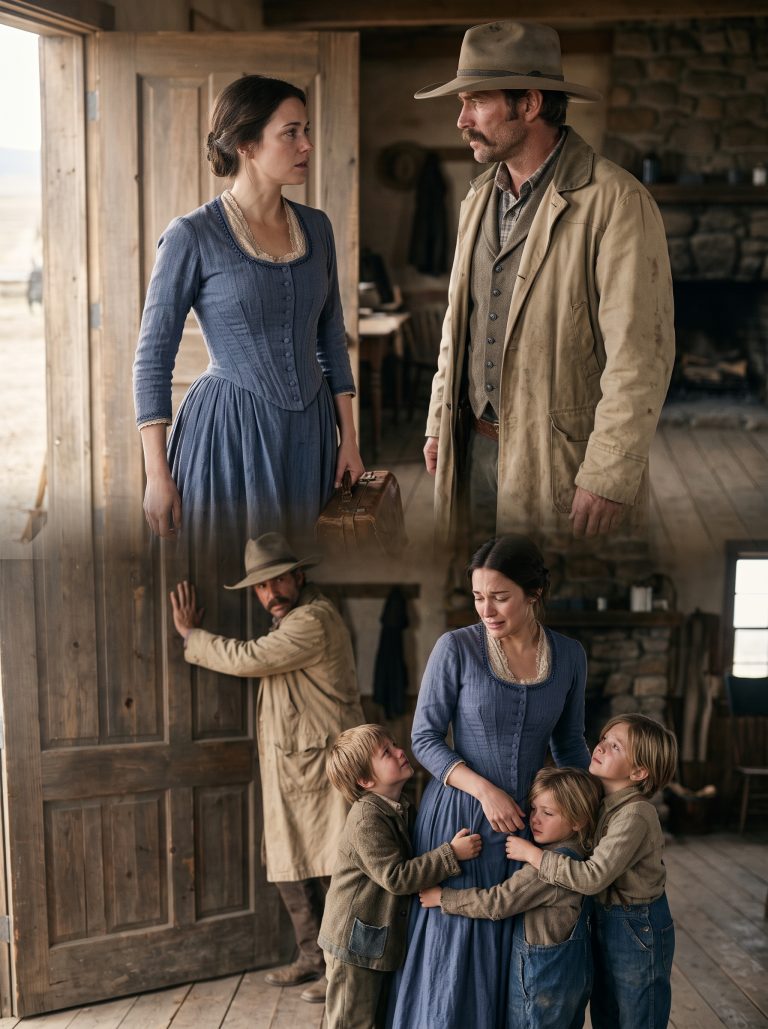
The Mother Stole Rotten Apples to Feed Her Girls—Then the Cowboy Saw Her

PART 1
The lantern came around the corner of the barn before the man did — a small, swinging square of gold light cutting through snow so thick it swallowed everything past ten feet.
Abigail Morgan saw it first. Froze with her hand still buried in a heap of frozen garbage, fingers closed around something she hadn’t looked at yet.
There was no time to run. Six-year-old Lily couldn’t run — she could barely stand, wrapped in a doll-thin coat, shivering against the barn wall. There was nowhere to hide, either, not with the light already sweeping close enough to catch the three of them huddled in the dark like something the barn owner had been meaning to trap for weeks.
So Abigail did the only thing left. She stood. Pulled both her daughters behind her narrow body. And waited to find out what the light belonged to.
What she was holding, she realized only then, was an apple — black with rot on one side, frozen solid on the other. She didn’t cry when she’d found it in the garbage a moment earlier. She hadn’t cried in weeks. She’d simply scraped the mold against her torn skirt and handed it to eight-year-old Maggie, who ate it without a word of complaint, the way she did everything now — quietly, efficiently, like someone who had stopped expecting better.
That silence was the part Abigail couldn’t forgive herself for. Not the hunger. The silence.
Three months earlier, she’d had a home. A kitchen. Curtains she’d sewn with her own hands. A husband who’d kissed her on the porch of a Pennsylvania farm the bank was already circling and told her the Montana silver camps would fix everything.
Six months, Abby. I’ll write. I’ll send for you.
Six months had come and gone with no word at all. By the time the bank finally took what was left of the land, there had been nothing left to wait for. So she’d packed what her daughters could carry on their backs and started walking toward a man who might not even want to be found anymore.
Three months on foot had brought them here — to a stranger’s barn in Wyoming Territory, stealing rotten fruit out of frozen garbage in the dark.
“Mama.” Lily’s whisper barely carried over the wind. “My hands hurt.”
Abigail wrapped her own numb fingers around her daughter’s and tried to will warmth into them that no longer existed anywhere in her body.
The lantern stopped ten feet away. The man holding it was tall, broad-shouldered, wrapped in a heavy sheepskin coat, his hat throwing his face into shadow above the light. For a long moment neither of them moved, and Abigail braced herself for whatever came next — the law, the dogs, the order to get off his land before he made her.
She lifted her chin anyway and found some last scrap of dignity buried under the exhaustion.
“Please, sir, we weren’t—”
“How long since you ate?”
The question landed sideways. Nothing like what people said when they’d caught you stealing.
“Ma’am,” he said again, quieter. “I asked how long since you and those girls had a real meal.”
“Three days,” Maggie answered for her, flat, matter-of-fact. “A lady at a church gave us bread. Before that, longer.”
Something moved across the man’s jaw. He set the lantern down in the snow, and the light spread wide and warm across all four of them.
“You’ve been sleeping rough.”
“We found a cave two nights back. It kept the wind off.”
“A cave.” He said it like he was testing whether it could possibly be true, then pulled the coat off his own back. “Put this on the little one.”
“We can’t—”
“I’m not asking.”
His voice wasn’t hard. It was the opposite of hard, which was somehow more disarming than if he’d shouted. Abigail’s hands moved on their own, taking the coat, wrapping it around Lily, who disappeared into the warmth of it like she’d been swallowed whole.
“Mama,” Lily breathed. “It’s so warm.”
He picked the lantern back up and tipped it toward a house glowing gold in the near distance.
“You’re all coming inside. I’ve got stew and a fire. You’ll eat, get warm — then we’ll figure out what comes next.”
“We can’t accept—”
“You keep saying what you can’t do.” He cut her off, not unkindly. “How about you focus on what you can do. You can walk fifty yards. You can sit by a fire. You can eat some food.” He paused. “The question is — will you?”
“Why?” The word tore out of her, raw. “Why would you help us? We’re nothing to you.”
He was quiet long enough that she thought he wouldn’t answer at all.
“Because somebody helped me once,” he said finally, “when I needed it badly. And I swore that if I ever got the chance, I’d do the same.” He tipped his hat toward the lantern light still pooled around them in the snow. “Looks like tonight’s that chance.”