She Whispered, “I Have Nowhere Left to Go”…And I Said, “Funny, I Have an Empty House”

Part 1
The letters smelled of cedar and lamp oil, though Eleanor Hale liked to imagine they carried the scent of Wyoming pine instead. She kept all eleven of them in a hatbox, tied with kitchen string because she had never owned a ribbon fine enough for something so important.
Samuel Ashford wrote like a man counting his words for value. My family runs three hundred head of cattle in the shadow of the Wind River range, he’d told her in his second letter. The house has a porch that catches the whole evening sky. You would never again be cold in winter, Miss Hale, not under my roof.
It was the porch that undid her. Eleanor had spent twenty-two years in a Lawrence, Massachusetts boardinghouse that smelled of wet wool and machine grease, working a loom until her hands ached in a rhythm she still heard in her sleep. Her mother had died of the mill cough; her father had simply stopped coming home one winter and was never mentioned again. When the newspaper advertisement caught her eye — Rancher of good standing and honest character seeks a wife of sense and industry — she answered it the way a drowning woman answers a rope.
Samuel’s letters were plain, unhurried, entirely without the perfume of a man trying too hard. That was what convinced her. A liar reaches for poetry. An honest man reaches for a porch.
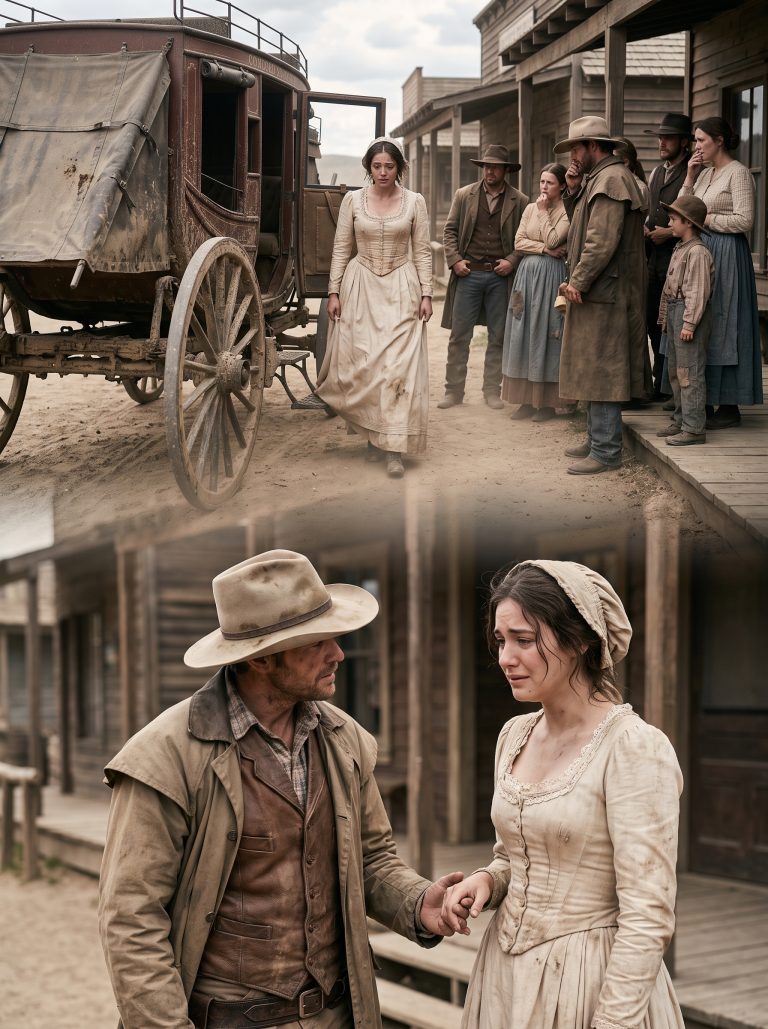
The train dropped her at Cedar Hollow on the afternoon of the fourteenth of September, exactly as arranged. She stepped down onto a platform of silvered wood with her trunk, her hatbox, and a hope so carefully rationed it had lasted her the whole way across half a continent.
Samuel was not there.
She waited through the gold hour of late afternoon, then the long grey one that followed. She waited while the station agent locked his door and touched his hat to her without a word — the particular courtesy men extend to women they feel sorry for. She waited until the first stars came out hard and close over the mountains, and understood, with a coldness that had nothing to do with the falling temperature, that no one was coming.
It was full dark when she heard hooves. A rider came out of the black tree line leading a second horse loaded with flour sacks and a coil of fencing wire. He drew up at the edge of the platform and sat looking at her for a long moment before he swung down.
He was younger than she’d expected — perhaps thirty — broad through the shoulders, dressed for work rather than company, his face weathered from years spent outdoors. He looked at her single trunk, at the way she held her spine like a woman refusing to give the county the satisfaction of watching her break, and seemed to already know most of what mattered.
“Train’s long gone,” he said.
“I’m aware.”
“From back East?”
“Lawrence, Massachusetts.” She heard how thin her own voice sounded. “I was to be met.”
“Meeting someone?”
“Samuel Ashford,” she said, and the name came out smaller than she’d meant it to, worn thin from a whole afternoon of waiting. “He was to meet the train.”
Something moved across his face at that — brief, contained, gone almost before she registered it, a muscle drawing tight along his jaw the way a man’s does when he bites down on a word he has decided not to say. It was enough for Jonah to understand.
“Boardinghouse in town’ll take you in. Mrs. Higgins runs it and the post office too, so she’ll have opinions — but she keeps a clean bed and a closed mouth when it’s asked of her.” He was already lifting her trunk onto the second horse before she’d agreed to anything. “Name’s Jonah Marsh.”
She told him hers. He said nothing to it — no pleased to meet you — only a short nod, as though he had more urgent things on his mind than pleasantries.
They walked the mile into town together, the horses trailing behind, neither of them speaking. Cedar Hollow revealed itself in pieces: a mercantile with its shutters up, a saloon leaking piano music into the cold, a scatter of houses with lamps lit gold in their windows. Mrs. Higgins met them at her gate in an apron and an expression that missed nothing.
“Well,” she said, taking in the trunk, the tired horses, the strange late hour. “This isn’t like you, Jonah Marsh, riding in with company.”
“She’s not company. She’s stranded.” He set the trunk on the porch. “Put her on my account for the week.”
“I couldn’t possibly—” Eleanor began.
“You can and you will,” he said, not unkindly, but in the tone of a man who did not enjoy repeating himself. Then, to Mrs. Higgins: “Evening.” And he was gone into the dark before Eleanor had thought of a way to properly thank him, the sound of the horses fading down the road like something she had imagined.
Mrs. Higgins showed her to a small clean room with a quilt the color of dried apples and a window that looked out on nothing but night.
“Who were you meeting, dear?” the older woman asked, not unkindly, in the doorway.
Eleanor’s throat closed around the name. “Samuel Ashford,” she managed. “He wrote that he raises cattle near here. Under the Wind River range.”
Something moved behind Mrs. Higgins’s sharp eyes — recognition, quickly hidden, the particular stillness of a woman deciding not to say a thing tonight that would keep until morning.
“Get some sleep,” was all she said. “Cedar Hollow looks kinder by daylight. Mostly.”
She closed the door. Eleanor sat alone with her hatbox of letters and, for the first time since Lawrence, allowed herself to cry.
Part 2
She did not cry again. By the second morning she had made a decision she’d made once before, in a mill town, over a mother’s grave: she would not be a woman things merely happened to.
Mrs. Higgins, it turned out, kept the boardinghouse ledgers the way most people kept a junk drawer — a hopeful jumble that hadn’t balanced since spring. Eleanor asked to help, mostly to keep her hands from shaking, and by the end of a week had the numbers marching in straight columns for the first time in a year.
Word of it reached Jonah Marsh before she saw him again. He arrived on the seventh day in his good coat, hat in hand, and stood in the parlor like a man who had rehearsed a short speech and intended to deliver it without embellishment.
“Mrs. Higgins says you’ve a talent with figures.”
“I do.”
“My own books haven’t been touched in three years. It’s a disaster of receipts and bad arithmetic.” He said this the way another man might confess a sin. “I’ve a room off the kitchen you could use. Fair wage, plus your board here stays paid. It’s honest work, Miss Hale. That’s all I can offer you.”
She thought of the alternative — a return ticket she couldn’t afford, a mill town waiting to swallow her back whole — and thought, too, of how carefully he had said that’s all I can offer, as though he believed it were less than it was.
“Yes,” she said. “I’ll take it.”
She did not ask him why his jaw had tightened at the sound of Samuel’s name on the platform. Not yet. There would be time, she told herself, to understand this quiet, careful man who paid a stranger’s debts and flinched at the mention of a name she’d crossed half a continent to hear.
She only knew, walking the five miles out to his ranch the following dawn with the mountains going pink above her, that some door had opened that had nothing to do with Samuel Ashford at all, and that she meant to walk through it with her eyes open this time.
She made that walk exactly six times. On the seventh morning a gentle bay mare stood tied at Mrs. Higgins’s gate, saddled and waiting, with no note and no explanation, and was there again every morning after. Jonah never once mentioned arranging it, and Eleanor never once asked him to confirm what she already knew.
Part 3
The ranch sat in a green fold of land with a creek running clear along its northern edge, and the house — log-built, sturdy, entirely unsentimental — had a kitchen window that faced due east.
Eleanor noticed it the first morning and said nothing. It felt like a coincidence too strange to speak aloud, the kind of thing that, spoken, might curdle into something crueler than silence.
The ledgers were exactly as promised: a slow-motion catastrophe of stuffed receipts and abandoned columns, evidence of a man who could read a brand mark from four hundred yards but had no patience for numbers that didn’t move. Eleanor set herself to the work with a fierce, grateful concentration. It was the first task in years that belonged entirely to her, that she could solve with nothing but attention and a steady hand, and she gave herself to it the way she had once given herself to hope.
Jonah was gone most days, out with the herd or mending fence line that the last hard winter had thrown down. She came to know him first by absence and small evidence: a fire already lit when she arrived at dawn, a tin cup of coffee left on the corner of her desk without comment, the particular economy of a man who did nothing that wasn’t necessary and yet somehow made sure she never once went cold in that house.
He was not a man who explained himself, and for a long while she let that be enough.
By October the ledgers were finished, and still she found reasons to stay. There was mending, she told him. There was a pantry that wanted organizing, a garden bed that needed turning before frost. He accepted each reason with a gravity that suggested he understood perfectly well what was really being negotiated, and never once pointed out that a bookkeeper had no natural business darning a rancher’s shirts.
They fell into a rhythm that felt, to Eleanor, dangerously close to a marriage already being lived. Sunday afternoons he took her along the creek and named things for her without being asked — the yellow flare of arrowleaf balsamroot, the print of elk in soft mud, the particular scolding note of a meadowlark that he swore, with a rare flash of humor, was the bird complaining about its neighbors. She told him, in pieces, about Lawrence: the mill’s iron rhythm that she still heard behind her eyes some nights, her mother’s cough that never once in four years sounded like it was getting better, the father who had simply stopped existing one January and left her to explain his absence to landlords for the rest of her life.
He did not offer comfort so much as attention, which she came to understand were the same thing in his hands. He listened the way he mended fence — thoroughly, without hurry, making sure the thing would hold.
In late October a storm came down off the mountains faster than the sky had promised, and Jonah was caught out repairing a break in the corral fence when it struck. He came in an hour after dark, soaked through, with a gash along his forearm from a post that had given way under him in the wind, and said nothing about it until Eleanor saw the blood at his cuff and nearly dropped the coffee pot.
“It’s nothing,” he said, which was, she was beginning to learn, what he said about everything that cost him something.
She did not accept it. She had stitched cuts before, back in the mill years, when girls caught an arm on a broken shuttle and no doctor could be sent for in time and someone with a steady hand simply had to do it. She sat him at the kitchen table by lamplight, cleaned the wound herself with hands that shook only a little, and stitched it closed with the same small, even stitches she used on his shirts, while he watched her face instead of his own arm.
“You didn’t have to do this,” he said quietly, when it was done.
“I know,” she said. “I wanted to.”
Something passed between them in the lamplight that neither of them named, though both would remember it later as the night the arrangement between them had quietly, irreversibly, become something else. Walking back to Mrs. Higgins’s under a sky scoured clean by the storm, she thought she had not felt this steady in years — not since before the mill, before her mother’s cough, before a boy named Samuel Ashford had ever put pen to paper.
It was Mrs. Higgins, less than a week later, who finally gave her the piece she hadn’t asked for.
Eleanor had come into town for thread, and found the postmistress sorting a bundle of mail with her lips pressed thin.
“Sad business, this,” Mrs. Higgins said, half to herself, holding up an envelope addressed in a careful, familiar hand. “Samuel writing to his aunt again, and not one line to his brother in it, I’d wager, going by the way things stand between them.”
Eleanor’s hands went still over the thread spools. “Samuel Ashford has a brother?”
Mrs. Higgins looked up, and in her face Eleanor saw the particular alarm of a woman realizing, half a beat too late, that she has said something that was never hers to say. “Oh, child. You truly don’t know.”
“Know what?”
The older woman set down the letters, came around the counter, and took both of Eleanor’s hands in her own, which was answer enough before a single word was spoken.
“Samuel Ashford is Jonah Marsh’s younger brother. Different fathers, same mother, God rest her — she remarried after Jonah’s father passed, then died herself a few winters back. They were raised on that very ranch you’re keeping books for now, though it’s Jonah’s alone these days. Samuel signed away his share of it when he left for railroad work two years back — wanted the cash more than the cattle, if you ask me — and left Jonah holding the mortgage and every debt their mother had carried besides. Good riddance to him, if you want my honest opinion, because that boy never did an honest day’s work he could talk his way out of instead.” She hesitated. “He used to sit on that porch as a boy, dreaming up the kind of letters that would make a girl fall in love with a place she’d never seen. I always thought it a harmless thing, a lonely boy’s daydream. I didn’t know until you arrived that he’d gone and used it, long after he’d given up any claim to it at all. Used a home that wasn’t even his to speak of anymore, to build a lie.”
Eleanor felt the ground of the last month tilt beneath her. Every kindness — the coffee, the wage, the room off the kitchen, even the rescue on that dark platform — reassembled itself in her mind into something with a second meaning underneath the first.
“Jonah knew,” she said slowly. “That night at the station. He knew exactly whose ranch Samuel had described in those letters, because it was his own house. He recognized the name and said nothing.”
“I expect,” Mrs. Higgins said gently, “he was ashamed. And I expect, knowing that man, he was more concerned with a stranded woman on a dark platform than with settling scores with a brother long since gone.”
Eleanor walked back to the ranch that evening in a fury she did not entirely understand — not only at Samuel, whose fraud now had a shape and a face and a family, but at Jonah, who had let her live for a month inside a secret that was, in its own way, another kind of withholding. She had crossed a continent because she was tired of men who let her discover the truth alone, in the dark, after it was too late to matter.
She found him at the corral, running a hand along a mare’s foreleg. He looked up, and whatever he saw in her face made him set the hoof down slowly and straighten.
“You knew,” she said. “That first night. You knew it was Samuel’s letters that brought me here, and you knew he was your brother, and you said nothing. Not that night. Not in a month of mornings.”
He didn’t flinch from it, which she would think about later — how he took the accusation the way he took everything, standing still and looking straight at the thing that was hard.
“I did.”
The mare shifted behind him, and for a moment neither of them spoke, the only sound the creek running on somewhere below the corral, indifferent to the two of them and everything they were about to say.
“How long have you known?” Eleanor asked. “Not just that night. All of it — that it was your porch, your window, your mother’s kitchen he was describing to strange women he never meant to meet.”
“Since the second I heard you say his name on that platform.” His voice was steady, but there was something under it now, something that had been held very still for a long time and was tired of holding. “I’d suspected he was up to something like it before he ever left for the railroad. Found half-finished letters once, practicing lines, like a boy rehearsing for a part in a play he never intended to act in front of anyone. I burned them and told myself it was a foolish habit he’d grow out of. I was wrong. He didn’t grow out of it. He just got better at it, and further away, where I couldn’t stop him.”
“Why?”
“Because the first night, you’d been humiliated enough for one evening, and I wasn’t going to add my family’s shame to it on top of your own.” His voice was low, steady, entirely without excuse-making. “And after that — ” He stopped, started again. “After that, every week that passed, it got harder to say, not easier. I told myself I was protecting you from more hurt. That was true, some. But if I’m honest with you the way you deserve, some of it was plain fear. I didn’t want you looking at me and seeing my brother’s face instead of mine.”
“You should have told me.”
“I should have,” he agreed. “I’ve known it every day since the night you spoke his name on that platform and I couldn’t make myself tell you the rest.”
She had come across the yard ready for a fight, and found instead a man not defending himself but simply standing in the wreckage of his own silence, refusing to make it prettier than it was. It was, she realized, exactly the difference between the two brothers: Samuel had built an entire fiction rather than risk being seen plainly, while Jonah, given the chance to hide behind that same fiction, had instead spent a month quietly earning, coffee cup by coffee cup, the right to be known for exactly what he was.
She turned from him and walked a slow circle around the corral rail, needing the distance, needing a moment where he was not watching her decide what to feel. The anger was still there, but it had begun, against her will, to separate itself from him and settle more squarely where it belonged — on a boy far away who had never once had to watch the results of his own lying land in another person’s chest.
“You could have told me on the porch, the night you brought the ledgers back,” she said. “You could have told me any of a hundred evenings since. Instead I heard it from Mrs. Higgins over a spool of thread, like town gossip, like I was the last to know something that belonged to me more than anyone.”
“You’re right to be angry about that part,” he said. “I won’t argue you out of it. I only ask you to believe that it was never contempt for you that kept my mouth shut. It was contempt for myself, for what my own family had done, and a coward’s hope that if I was steady enough, patient enough, it might come to matter less by the time I finally said it.”
“It matters,” she said. “It will always matter that you let me learn it sideways.”
“I know it. I’m not asking you to un-know that. I’m only telling you it stops here. No more of it kept back for a better day that never comes.” He held her gaze without flinching, the way he held everything. “If you want Samuel called to account for it, I’ll ride to Sweetwater County with you myself and see the sheriff hears every word. It’s your right to ask for that, and I won’t stand in your way. I’ll ride beside you if that’s your choice.”
“I don’t want the sheriff involved,” she said finally. “Not for Samuel. I’ve thought about it, and I find I don’t want my name dragged through Sweetwater County as the fool who fell for a boy’s daydream. I’d rather it end here, with the people who know the whole truth of it.”
“Fair enough.” He hesitated, and for the first time since she’d known him, he looked less than certain of himself. “There’s one more truth in this, though, and I won’t let it wait a month like the last one did.”
“Say it, then.”
“The porch he described to you, the creek, the window that catches the morning — that was never his to promise. It was mine. I built the addition on that kitchen with my own hands the summer I turned nineteen, because my mother wanted the morning light for her bread, and she enjoyed it for a good many years before she passed, God be thanked.” He drew a breath. “Everything he wrote you was a boy’s theft of a man’s work. I’m not offering you his ranch, Eleanor. I’m offering you the one I actually built. And I’m asking, plainly, without any borrowed poetry in it, if you’d stay in it as my wife, not my bookkeeper.”
The creek ran on behind him, indifferent and clear, exactly as promised in a letter written by a man who had never once turned a shovel of that earth. Eleanor thought of Lawrence, of the mill’s endless clatter, of eleven letters kept in a hatbox because she had believed that words alone could build a life. She thought of a month of silent coffee cups, and a debt quietly paid to a stranger, and a jaw gone tight around a name he refused to hide behind.
“I need a day,” she said. “Not because I doubt what you’ve told me. Because I’ve made the mistake before of answering a good offer with my heart still racing, and I won’t do that again, not even for you.”
He nodded, and did not argue it, which told her more than any argument could have. He did not follow her into town. He sent no note by way of Mrs. Higgins, made no case for himself beyond the one he had already made. The bay mare was tied at the gate the next morning exactly as it had been every morning before, unhurried and unchanged, as if he had decided that the surest way to prove he meant what he’d said was simply to keep doing what he’d always done. She rode the mare back to town alone that evening and sat up late in her small room with the hatbox of letters open on the quilt, reading each one through by lamplight — not for Samuel’s sake, but for her own, to be certain she understood exactly what she was choosing to leave behind. By morning she knew. She tied the familiar kitchen string around the bundle one final time, left it in the bottom of her trunk, and rode back out to the ranch before the frost had burned off the grass.
He was at the corral when she came up the lane, and something in his face — hope held very carefully in check — told her he had spent the night uncertain of her answer.
“I came half a continent chasing a lie,” she said, dismounting. “I think I’d like to stay for the truth, if it’s still on offer.”
He crossed the yard and took her hand, and his was rough with real work in a way no letter had ever been able to counterfeit.
They married in early December, in the small clapboard church at Cedar Hollow, with the first hard frost long since silvering the fields outside and Mrs. Higgins weeping openly from the front pew, dabbing at her eyes with a handkerchief she kept refolding as though the previous fold hadn’t held enough grief in it. Half the town turned out — ranch hands and shopkeepers, the schoolteacher, the blacksmith’s whole loud family. They came to see the end of a story they had all half-heard in pieces over the fall, traded across counters and fence lines the way a small town trades everything. By December the truth of it had become something the whole valley owned a little of.
Eleanor wore blue — a dress she had begun for herself back in October, on a whim she hadn’t examined too closely at the time, and quietly remade after Jonah’s proposal. Jonah wore a suit that fit him like an apology — stiff at the shoulders, unfamiliar at the collar, entirely sincere in every line of it — and stood at the front of that small church looking, Mrs. Higgins would say for years afterward, like a man who had finally set down a weight he’d carried so long he’d forgotten it wasn’t simply part of his own shape.
He took Eleanor’s hand at the altar with the same quiet certainty he had shown that first dark night at the station, and his rough fingers closed around hers like the truest vow spoken all afternoon.
Samuel never came back to Cedar Hollow. A letter arrived the following spring, addressed to his brother in that same careful hand Eleanor had once mistaken for honesty, thin with excuses and thinner still with any real remorse. Jonah read it once on the porch in the last light of a Sunday evening, his face giving away nothing, folded it along its old creases, and fed it to the stove without a word of explanation. Whatever debt still existed between the two brothers, Eleanor understood, belonged to Jonah to settle in his own time and his own silence, and she did not ask again. Some ledgers, she had come to learn, a person keeps closed on purpose, and there was a kind of respect in letting him.
When they settled into the ranch house that winter, the old hatbox found a new home in the bottom drawer of the kitchen dresser, tucked beneath the good linens, close enough to reach and far enough not to need to.
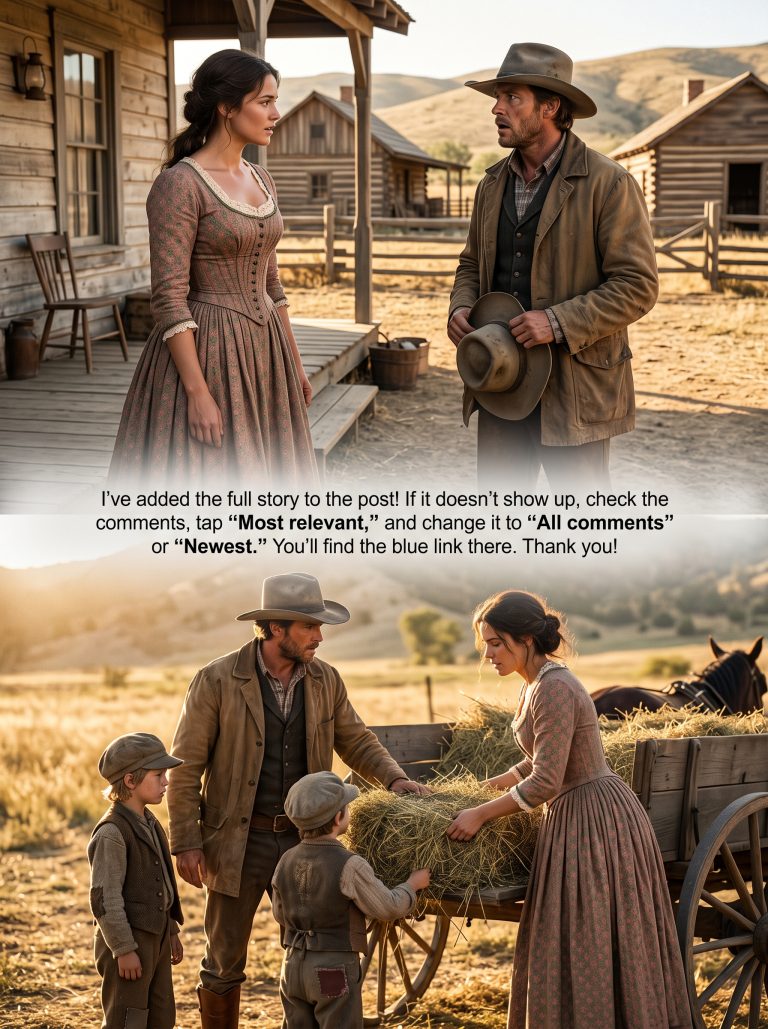
Five years on, the kitchen window still faced east, exactly as an idle, lying boy had once promised a stranger he had never intended to meet, in words stolen wholesale from a life that was never his to offer. Eleanor stood at it most mornings now with flour on her hands and the sun coming warm and low across the worn plank floor, filling the kitchen with a light that owed nothing to any letter and everything to the man who had built the window frame with his own two hands the summer he turned nineteen.
In the yard beyond the glass, her husband — greyer at the temple now, no less steady — taught their five-year-old son to whistle for the mare, and argued, with the same great and practiced patience he’d once brought to a stranger’s ruined ledgers, that the chickens were not, in fact, playthings, no matter what their daughter believed. The girl, three and fierce-eyed, sat in the dust lining up smooth creek stones in a row only she understood, entirely unbothered by either argument.
Eleanor had learned, in the end, that a promise written on paper cost a man nothing but ink and a little nerve, and that the promises worth trusting were the kind that showed up quietly every single morning in a tin cup on the corner of a desk, long before they were ever spoken aloud, and kept showing up long after there was any need left to prove anything at all. The eleven letters that had brought her west still sat in that dresser drawer — not because she was ashamed of the girl who had once trusted them with her whole life, but because she no longer needed paper to remember what a home actually was, or what it had cost a good man to quietly build one.
She had the east-facing window, exactly as promised. But she understood now, watching the morning light cross her husband’s bent shoulders as he crouched to inspect a line of pebbles with the gravity of a man surveying good grazing land, that it had never truly been the window that mattered. It was never the porch, or the creek, or any single fine word chosen to make a lonely woman believe in a place she’d never seen.
A liar reaches for poetry. It had taken her a long way to learn that an honest man simply reaches for a hammer, and keeps reaching for it, every morning, for the rest of his life.
— End —