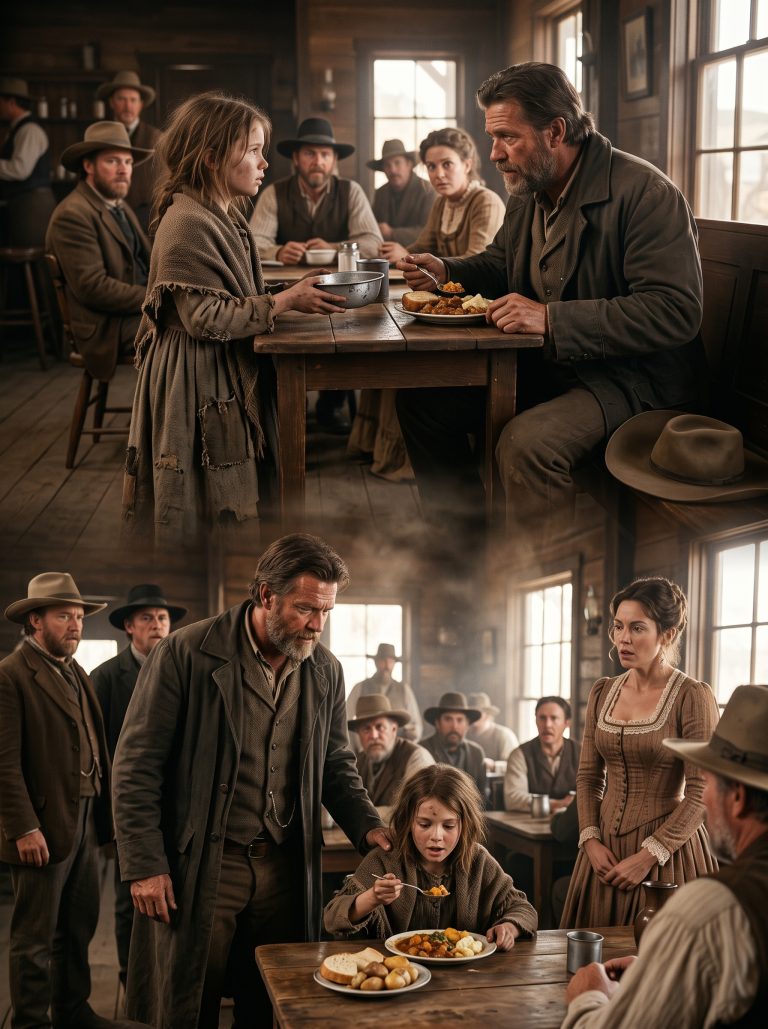
“She won’t last three days out here,” the ranch hands laughed—then the snowstorm hit, and they begged her not to leave.

Part 1
Mira Doyle arrived at Harborview on the noon ferry, a trunk in one hand and her daughter’s fingers wrapped around the other. The dock smelled of tar and herring. Gulls screamed over the fish stalls. She had written ahead to the Gull’s Rest Inn about the cook’s position, and Captain Ezra Calloway had written back three words: Come. We’re hungry.
She had not expected the foreman to look at her the way he did.
“You’re the cook,” Judd Cray said. It wasn’t a question. His eyes moved from her face to her hands to the width of her hips, doing arithmetic she had watched men do her whole life.
“I am.”
“Last one lasted six weeks. Crew’s rough. Season’s rougher.” He glanced at Nell, who was studying a crab shell on the dock. “You sure you’re up to it?”
“I’ve fed harder rooms than this one, Mr. Cray.”
He didn’t answer that. He picked up her trunk instead, which she took as either respect or dismissal — with men like Judd Cray, it was often both at once.
The Gull’s Rest sat at the end of the pier, a long timber building that fed forty fishermen three times a day during the herring run. The kitchen had a cracked hearth, a stove with one working burner, and shelves gone soft with damp. Mira looked at the mess the way another woman might look at a garden gone to weeds — not with despair, but with a plan already forming.
She met Ezra Calloway that evening. He was a tall man, gray at the temples, with the kind of quiet that came from long practice at carrying things alone. His wife, Rosalind, had died two winters back, and the inn had run on inertia since.
“Mrs. Doyle,” he said. “I hope the kitchen isn’t beyond saving.”
“Nothing is beyond saving, Captain. It just takes longer than people want to give it.”
He almost smiled. It didn’t quite arrive.
Within a week, the kitchen had order it hadn’t known in months. Mira scrubbed the hearth, mended the stovepipe herself with wire and patience, and reorganized the pantry so that flour did not sit beside lamp oil, a discovery that explained a great deal about the previous cook’s bread.
The men noticed the food before they noticed her.
They noticed her soon enough anyway.
“Careful, boys,” she heard one of the younger hands mutter near the smokehouse, not troubling to lower his voice. “Woman that size, she’ll eat through the stores faster than we haul fish.”
Laughter. Not unkind exactly — the lazy, careless kind that men produced without thinking, the kind that cost them nothing and cost her something every time.
She did not turn around. She had learned long ago that turning around gave the comment more life than it deserved.
Judd Cray was worse, in his way, because he never laughed. He simply watched her with the flat patience of a man waiting to be proven right.
“Storm season’s in six weeks,” he told her one morning, watching her portion out oats. “Boats get caught out past the point sometimes. When that happens, this inn is the only shelter for eight miles. You understand what that means?”
“It means I’d best learn how deep the flour barrel goes.”
“It means it takes more than a steady hand with a ladle.”
“I’ve buried a husband, Mr. Cray, and raised a daughter alone on a fishing wage. I know what more than a steady hand looks like.”
He said nothing to that. But he watched her longer than usual before he walked away.
That night, lying beside Nell in the small room off the kitchen, Mira listened to the wind pick up outside and thought, not for the first time, that men saw her body before they saw her work, and decided the whole of her from the first glance. It never stopped stinging exactly. It only became something she carried more quietly, folded into the same place where she kept the memory of her mother’s hands, chapped from decades of dock work, and the sound of her mother’s voice saying, Let them think what they like. Feed them anyway. The proof is always in the eating.
She had believed that her whole life without knowing exactly what it would someday cost her to prove.
Morning came, as it always did, smelling of salt and woodsmoke.
By the fourth week, small things had begun to shift. Pete Ansel, the youngest hand, started hauling water from the well without being told. Old Silas Thorne, who spoke rarely and watched everything, left a jar of pickled onions on her counter and said nothing about it, as though the gift might embarrass them both if named aloud. Nell had taken to drawing chalk pictures of boats on the kitchen floorboards, and the men had taken to stepping carefully around them rather than asking her to stop.
Judd Cray remained unmoved. Ezra remained hard to read, though he came to the kitchen most mornings now, ostensibly for coffee, and stayed longer than coffee required.
“Storm’s building somewhere out past the banks,” he said one gray morning, looking at the sky through the window glass. “Can feel it in my knee before I feel it in the wind.”
“I can smell it,” Mira said. “Two days out, maybe three. There’s a wet edge on this cold that wasn’t here yesterday.”
He studied her.
“You read weather like my wife used to.”
It was the first time he had spoken of Rosalind without visible effort, and Mira understood it for the offering it was.
“Then I hope I’m as right as she was,” she said, and went back to her bread.
Part 2
The storm arrived two days later, exactly as she had said it would.
It came in off the water black and low, the kind of storm the old hands called a widow-maker without irony, because it had earned the name honestly over the decades. By noon the wind had teeth. By two o’clock, rain turned to sleet, and the harbor swells rose high enough to swallow the breakwater whole.
Six boats were still out past the point.
Mira did not wait for instructions. She moved through the pantry like a general reviewing troops, counting sacks of flour, barrels of salt fish, jars of preserves, cords of firewood stacked under the eaves. Forty men lived and worked within reach of the Gull’s Rest. If the boats came in — when the boats came in — this kitchen would be the only warm, dry, fed place for miles.
“How long can you feed them?” Ezra asked, finding her mid-count.
“Four days if I’m careful. Five if I’m clever.”
“The storm won’t last five.”
“You hope.”
“I hope,” he agreed, and for the first time she saw real fear behind his composure — not for himself, but for men who were, in every way that mattered, his family.
“Then I’ll plan for five,” Mira said, “and pray you’re right about four.”
By nightfall, the wind was screaming through the rigging of boats tied at dock, and the ones still at sea were nowhere to be seen. Judd Cray came into the kitchen soaked to the bone and said nothing about doubts or size or six weeks. He simply asked, “What do you need?”
“Every hand you can spare, and the smokehouse door propped so the smell of stew carries down to the pier. Frightened men follow their noses home.”
He went to get the hands.
Outside, the storm had begun in earnest.
Inside, Mira built up the fire and did not let it fail.
Part 3
The first boat limped in near midnight, its mast snapped, three men aboard nearly frozen through. Mira had stew ready before their boots hit the dock. She wrapped their hands in warm cloth, forced hot broth into them in careful sips, and sent Nell — bundled to the eyes — to fetch dry blankets from the loft while she worked.
By dawn, four boats had returned. Two were still missing.
The kitchen had become the center of the storm’s aftermath — men crowded at every table, wet coats steaming near the hearth, voices low with the particular exhaustion of people who had stared at death and were still deciding how to feel about having survived it. Mira did not stop moving. Oatmeal at dawn. Soup by midday, thinned with cornmeal to stretch it further than it wanted to go. Bread sliced before it had properly cooled, because timing was a luxury the storm had taken from her.
Judd Cray hauled water and stacked wood without being asked twice. Pete Ansel kept the coffee going. Ezra moved between the dock and the kitchen, watching the gray horizon for two boats that did not come.
They came in on the second afternoon, battered but whole, and the relief that moved through the room was its own kind of weather.
By the third morning, the wind had finally dropped, leaving the harbor scoured and silver under a hard blue sky. Forty-two men — the inn’s own hands plus the extra crew pulled off the missing boats — crowded into the dining room for a breakfast that felt, after two days of crisis rations, like a feast.
That was when Silas Thorne spoke.
He had said almost nothing through the whole ordeal, which Mira had come to understand was simply his nature — a man who watched instead of talked. But he set down his coffee cup with a deliberateness that drew eyes.
“I know you,” he said, looking at Mira. “Took me two days to place it. The Pemberton wreck. Winter of sixty-one.”
The room went quiet in the particular way rooms do when an old man says something that sounds like the start of a story worth hearing.
“Thirty years back,” Silas went on. “I was a boy on my uncle’s boat. We went down off Widow’s Point in a storm worse than this one — a real widow-maker, the kind that earned the name. Forty of us made it to shore, half-frozen, no food, no shelter but a fisherman’s shack meant for six. And a woman came down from the bluff with her own stores and her own hands and fed every one of us for nine days until the roads cleared.” His eyes did not leave Mira’s face. “Same face. Same way of standing at a stove like the world had already agreed to behave. I’d swear on anything you’re her.”
Mira felt the floor tilt beneath the moment.
Every eye in the room had turned to her. She saw Ezra’s face, open with something like wonder. She saw Judd Cray, for once, entirely without his flat, waiting patience — replaced instead by plain astonishment.
She could have let it stand. It would have been easy. The legend was already forming around her, warm and flattering, exactly the kind of story that would silence every unkind word ever said about her size or her worth in one clean stroke.
She set down the coffee pot instead.
“That wasn’t me, Mr. Thorne.”
The room did not move.
“I was four years old in the winter of sixty-one. I couldn’t have fed a cat, let alone forty men.” She drew a breath. “The woman you remember was my mother. Constance Doyle. She kept a cottage on that bluff, and she went down to that wreck the same way she went to every disaster within walking distance her whole life — because someone had to, and she had decided long before that it might as well be her.”
Silas stared at her, working it through.
“You’ve her face,” he said finally. “Near exact.”
“I’ve her recipes, too. And her stubbornness, my husband used to say, though he meant it kindly.” Mira’s hands had gone still on the counter, an unusual thing for her. “She died two years after that storm. Fever, the same as took half the crew she saved that winter, though nobody made a song about that part. I grew up hearing the story of the Pemberton wreck the way other children hear fairy tales — except it was true, and it was my mother, and I spent twenty years feeling like a smaller copy of a woman I could never quite catch up to.”
She looked around the room — at Pete, at Walt, at Judd Cray, at Ezra standing very still near the door.
“I didn’t correct you sooner because some part of me liked being mistaken for her. It felt like proof I was worth something, if only by resemblance. But it isn’t true, and I won’t build what happens next in this kitchen on a story that isn’t mine. What I did these last two days — the stew, the fire, the hands I wrapped, the boats I watched for — that was me. Just me. Mira Doyle, thirty-four years old, no legend, no rescue thirty years back. Only a woman who knows how to keep a fire fed and a room fed and refuses to apologize for the size of the body that does it.”
For a long moment, nobody spoke.
Then Silas Thorne began, slowly, to nod.
“Better story anyway,” he said. “Your mother did it once, in a crisis, and folks built a myth from it because myths are easier to carry than the plain truth. You did it for two straight days on no sleep, and you’re fixing to do it again tomorrow, because that’s simply what you do. I’ll take a woman who shows up every morning over a legend who showed up once.”
Walt — no, it was Pete this time, near tears and denying it immediately — knocked his mug against the table in something like applause. Others joined him. Judd Cray did not applaud. But he crossed the room, and in front of forty-two men, he said the thing Mira had least expected to hear from him.
“Mrs. Doyle, I owe you an apology. I judged what you could carry by looking at how much of you there was to look at. I was wrong before this storm, and I was worse than wrong to keep believing it after. I’m sorry.”
“You don’t have to be, Mr. Cray.”
“I do. Say I’m forgiven anyway, if it isn’t too much trouble.”
“It isn’t.”
He nodded once, the way men like him nodded when a debt had been paid, and went to get more firewood, because the fire, as ever, still needed feeding.
Later, Ezra found her at the counter, hands braced against the warming shelf, the trembling of exhaustion finally allowed to show now that the room had emptied.
“You could have let the story stand,” he said. “It would have made things easier.”
“Easier isn’t the same as true. I spent half my life measuring myself against my mother’s shadow. I wasn’t going to spend the rest of it standing inside a myth that wasn’t even mine to begin with.” She looked at him. “I’d rather be known for what I actually did than admired for what someone else did.”
“I understand that better than you might think.” He was quiet a moment. “Rosalind used to say something close to it. That she’d rather be loved for the truth of her than admired for a story people had decided to believe about her instead.”
“She sounds like she was worth listening to.”
“She was.” He looked at Mira for a long moment. “So are you.”
The days that followed were quieter, but changed in the way water changes the shape of a stone — slowly, and then completely. Judd Cray stopped watching her for failure and started simply working beside her. Pete left the woodbox full without being asked. Silas Thorne, before he shipped out again, left her a small carved gull, weathered smooth by years in his coat pocket, and said only, “For the kitchen. Something to look at besides the stove.”
Nell planted marigolds along the fence that spring, an idea she’d gotten from Ezra, who told her his late wife had always said a garden gave the gulls something better to look at than fish guts. Mira watched her daughter press seeds into the thin coastal soil and thought of two women now — her mother, gone thirty years, and Rosalind, gone two — both of whom had left behind small practical kindnesses for whoever came next to find. A cottage on a bluff. A cold pantry with a floor vent. Recipes in a drawer. Seeds in the ground. Lives did that, she thought. They stayed behind in the ordinary, useful things, waiting for the next set of hands.
In April, on a morning bright enough to make the harbor look freshly painted, Ezra found her kneading dough and said, without any of his usual careful indirection, “I don’t want you here as my cook anymore.”
Her hands stilled.
“I want you here because this is your home, and Nell’s home, and because I would like, very plainly, to stop pretending my reasons for lingering in this kitchen every morning have anything to do with the coffee.” He took a breath. “Will you marry me, Mira?”
She wiped the flour from her hands, slowly, the way she did everything that mattered.
“Yes.”
No decoration. No performance. Only the truth, spoken in the kitchen that had become, in every way that counted, entirely her own.
They married in May, before the herring run began in earnest. Judd Cray and Silas Thorne — back for the wedding on his way north — stood as witnesses. Nell wore a good dress and scattered marigold petals with the gravity of a girl who understood exactly how important her job was.
That evening, after the crew had gone and Nell slept, Mira sat with Ezra on the porch, watching the last light burn gold along the water. The gulls had gone quiet. The tide was coming in, slow and certain.
“Word’s gotten round the coast,” Ezra said. “About the storm. About what you told Silas.”
“I imagine it has.”
“Some folks are already turning it into its own kind of story. The cook who refused to keep a legend that wasn’t hers.”
Mira watched the water for a while before she answered.
“Let them tell it,” she said. “As long as they tell it true. My mother earned her story fair, once, in a crisis nobody chose. I’d rather earn mine every ordinary morning, one meal at a time, for as long as I’m given to do it. That’s a smaller story. But it’s mine, and I don’t have to borrow anyone else’s shadow to stand in it.”
Ezra took her hand.
“Worth more than the myth, I’d say.”
“Worth waiting thirty years to learn,” she agreed, and watched the tide keep coming in, steady and unhurried, exactly the way good things tended to arrive — not all at once, but built, patiently, out of everything that came before.
THE END