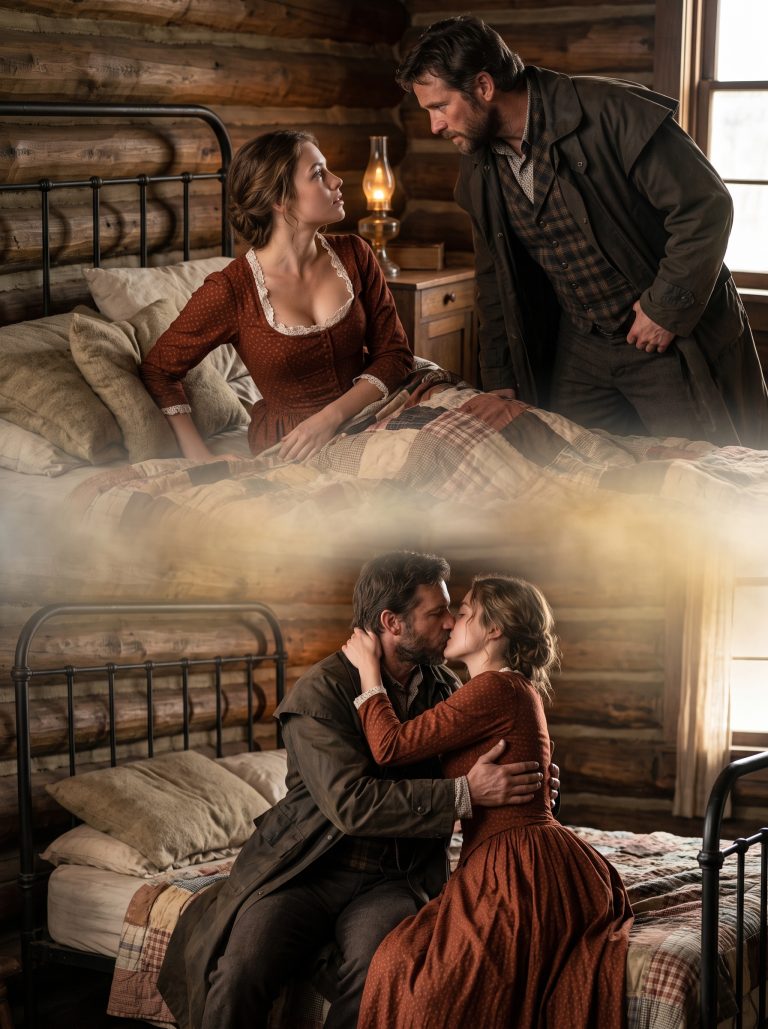
She Took the Punishment Meant for a Native Girl—By Morning, Five Powerful Brothers Were on Their Knees Before Her

Part 1
They told her to step back, that it wasn’t her place to speak for the girl caught stealing. Rosalind Hale did not move.
She had lived in Cedar Bend for four months — a quiet widow with no family, a small room above the dry-goods store, and a reputation for fine needlework. She kept to herself. She asked nothing of anyone. The only regular she’d come to half-know was a soft-spoken traveling agent named Whitfield, who bought thread every few weeks and always seemed to linger a beat longer than the purchase required, asking mild, pleasant questions about who came and went in town. She’d taken it, at the time, for a lonely man’s habit of small talk.
When she saw the girl dragged across the square by her wrist for taking a bruised apple off a cart, something in her refused to stay quiet.
“She didn’t steal it,” Rosalind said, stepping between the girl and the whipping post. “I saw the whole thing. The cart tipped. The apple fell. She picked it up off the ground.”
Marshal Colt Ashby’s face hardened. “Doesn’t matter what you saw,” he said. “She’s Sahewa. Her people don’t take what’s given. They take what they want.”
The crowd watched, uneasy but unmoving. The girl couldn’t have been older than fifteen. Barefoot, a bruise blooming on her cheekbone, she clutched the half-eaten apple like it might still shield her. Near the back of the crowd, Whitfield stood very still, arms folded, watching with none of the discomfort the rest of the town wore on its face — as though he already knew, in some general way, how a scene like this was supposed to end.
When Ashby raised the whip and said someone had to answer for it, Rosalind didn’t look at the crowd for help. She turned her back to the square and began unfastening the collar of her dress.
“She’s a child,” Rosalind said. “I’m a grown woman. Give it to me instead.”
A murmur rippled through the onlookers. Ashby hesitated — but only for a moment. He was not a man who enjoyed being watched not acting.
The first strike cracked across her shoulders. Then a second. A third. By the tenth, blood had soaked through her dress and into the dust at her feet. She did not scream. Her spine stayed straight until the very last lash, and only then did her knees give.
The girl — Neva was her name, though no one in Cedar Bend had bothered to learn it — rushed forward and pressed her face into Rosalind’s lap, sobbing.
Ashby muttered something about lessons learned and walked off. No one else stepped forward.
“You’re safe now,” Rosalind whispered, though her voice shook more than she wanted it to.
They limped back to Rosalind’s room together as the sun went down.
That night, Rosalind lay on her side by a dying fire while Neva slept curled at her feet, one small hand still holding hers. The pain across her back was a live thing, but she didn’t cry. She had chosen it. That mattered, somehow, more than the pain itself.
She didn’t sleep much. Just before dawn, she heard horses.
Five riders came into Cedar Bend without announcing themselves, their mounts marked with painted stripes down the flank. They dismounted in the empty street and walked toward the dry-goods store as if they already knew exactly which door to find.
They stopped outside Rosalind’s window.
Inside, she woke to the smell of burning sage and the sound of careful, deliberate breathing. When she opened her eyes, five men in traveling gear knelt in a loose half-circle just inside her doorway, having let themselves in without a sound.
She reached instinctively for the girl — but Neva was already awake, her hand now clasped in the palm of the eldest of the five.
“She is Neva,” the man said, his voice low and even. “My sister’s daughter.”
Rosalind’s breath caught. Niece. Not a stranger’s child. Family.
“I didn’t know,” she said.
“No one bled for her before,” the man answered. “Only us. Until last night.”
One by one, the five men lowered their heads until their foreheads nearly touched the floorboards.
Rosalind tried to sit up and found she couldn’t. The eldest — a broad-shouldered man with a long scar along one forearm — came forward with a clay bowl of something dark and herbal.
“May I?” he asked, nodding toward her back.
She hesitated, then nodded. He peeled back the torn fabric of her dress with careful fingers and began working the paste into her wounds. It stung, then cooled.
“You don’t owe me anything,” she said, though she wasn’t sure why she said it. It felt important to say.
“We are not here to repay a debt,” he said. “We’re here because of what it means when someone bleeds for a person who isn’t theirs to protect. That means something in every language.”
Outside, the sky had begun to lighten. Rosalind realized, watching the five men settle in around her small room like they intended to stay, that this was not a visit.
It was the beginning of something she hadn’t asked for and didn’t yet understand.
Part 2
By midmorning, all of Cedar Bend knew. Five Sahewa men had taken up quiet positions around the dry-goods store — not threatening, not armed for a fight, just present. Marshal Ashby walked past once, trying for a casual pace, and faltered when he saw the eldest of them calmly sharpening a blade on the front step.
Rosalind tried to stand and insist she didn’t need guarding. Her legs wouldn’t hold her yet, and in any case Tokala hadn’t asked her opinion before setting his brothers around the store — he’d simply done it, the way she would come to learn he did most things, deciding first and explaining, if he explained at all, after the fact. It irritated her more than she let show.
Neva wrapped both arms around her waist. “Please,” she said. “Let them do this.”
Rosalind sat back down, though she promised herself she’d say something to him about it once she had the strength to make the point properly.
That evening, with four brothers keeping watch outside and the fire relit, the eldest stayed beside her.
“I am Tokala,” he said.
“I’m very tired,” she admitted.
“Then rest,” he said. “You’ve earned it.”
She wanted to ask him more — why five men had ridden through the night for a niece he hadn’t seen in weeks, why Ashby’s hands had shaken at the sight of a sharpened blade — but sleep pulled her under before she could shape the questions. In the last moment before it took her, she thought she heard low voices near the door — Tokala and one of his brothers, talking of the marshal, of a man from somewhere downriver — but the words slipped away from her before she could hold them. By morning she couldn’t have said whether she’d heard anything at all, or only dreamed it.
Part 3
Rosalind woke to gray morning light and the smell of woodsmoke. Her back ached in a dull, steady way that told her the herbs had done their work. Neva was already up, sitting cross-legged by the hearth.
“I thought I heard voices last night,” Rosalind said. “You and Tokala. Something about the marshal.”
Neva’s expression shifted — not evasive, exactly, but careful. “He should be the one to tell you,” she said. “It isn’t a small thing.”
Tokala came in an hour later with mud on his boots and a scrap of paper folded small, its creases soft from handling. He sat across from Rosalind at the table and, for a while, didn’t open it.
“Three weeks before you stood in that square,” he said, “a man rode into our camp along the river. His name is Beauchamp — half Sahewa, half French, and loyal to neither side, only to whoever pays him. He trades news the way some men trade furs. He told my brother Sona that a group calling itself the Cedar Company had been meeting with Marshal Ashby at the land office in Millbrook, forty miles east.”
“I’ve heard of the Company,” Rosalind said slowly. “Water rights, mostly. Timber.”
“Water, mostly,” Tokala agreed. “Elkhorn Creek runs through our land before it reaches the town — the only clean, year-round water within two days’ ride. The territory has a rule the Company can’t get around on paper: land already settled by a peaceful tribe can’t simply be purchased out from under them. But land belonging to people found guilty of violence against settlers — that can be seized under the Frontier Safety statute and reassigned within the year. Beauchamp saw the paperwork himself, sitting open on a desk in Millbrook. A seizure petition, already drafted, missing only one thing: an incident.”
Rosalind felt the cold settle into her chest before her mind had even finished the thought. “The apple.”
“Ashby has taken Company money for fourteen months — Beauchamp copied the ledger entries by hand before he left Millbrook, dates and amounts both, and brought them to us folded inside a tobacco pouch.” Tokala set the folded paper on the table. “This is that copy. We believe Ashby was told to manufacture a public incident — something the whole town would see, something loud enough to reach the territory office as proof the Sahewa couldn’t be trusted to keep the peace. A girl, caught stealing, publicly whipped, her family arriving to protest — that would have been enough. A story simple enough for men two hundred miles away to believe without ever riding out here to check it.”
“But I stopped it,” Rosalind said. “I took her place.”
“You did.” Tokala’s mouth moved, not quite a smile. “And you turned the story upside down without meaning to. A white woman bled in the square instead of a Sahewa child. That isn’t a story about savages needing removal. That’s a story about a marshal who whips women in the street for telling the truth. It made the town look at him.”
Rosalind sat with that for a long moment, the ache in her back suddenly feeling less like an injury and more like evidence. “You didn’t come because of a debt at all,” she said. “You came because you needed to see what kind of woman had just broken your enemy’s plan without knowing it.”
“We came because Neva was hurt and you bled for her,” Tokala said, and there was no give in his voice at all. “That much was never a calculation. But yes — once we arrived, once we saw how Ashby’s hands shook at a blade being sharpened on your step, we understood we’d also found a witness the territory office might actually hear. We won’t pretend those two things arrived separately in our minds for long. We only ask you to decide, now that you know both.”
He tapped the folded paper. “Beauchamp’s copy alone won’t move anyone in Millbrook. Sahewa testimony rarely does. But a settler — a widow, whipped publicly for telling the truth, willing to carry this the last forty miles — they’ll open the door for you before they’ve finished reading the first page.”
“You’ve already decided I’ll go,” Rosalind said. It came out sharper than she meant it to, but she didn’t take it back. “You brought the letter here. You laid out exactly why it has to be me. You didn’t ask.”
Something crossed Tokala’s face — not quite shame, but close enough to it that she saw him choose his next words more carefully than he had any of the ones before. “No,” he admitted. “I didn’t. I am used to deciding what needs doing and doing it. It has kept people alive. It has also, more than once, made me forget to ask them first.” He paused. “I am asking now. Badly, and later than I should have. Will you carry it?”
It wasn’t a perfect apology, and she told him so later — but it was enough, that evening, for her to hear the difference between a man certain of his plan and a man beginning to notice he’d need her consent for it, not just her cooperation.
Rosalind looked at Neva, who watched her with the same unreadable patience Tokala carried, and then at the letter — proof that could end quietly in a drawer, or unravel a marshal’s arrangement with men who wanted clean water badly enough to have a child whipped for it.
“I didn’t step into that square to make a point,” Rosalind said finally. “I did it because no one else would. This isn’t so different.”
She picked up the letter.
Tokala rode with her as far as the ridge above Millbrook and no farther — a Sahewa man riding into a land office would only give the clerks a reason to dismiss the whole matter before she’d said a word. He and Sona made camp there and waited, though it was the better part of a week before Rosalind came back down that ridge road, and by then she had learned things about waiting she hadn’t expected to learn about herself.
Alone in a rented room above a Millbrook saddlery that first night, she found she couldn’t stop turning the letter over in her hands, checking and rechecking that it was still folded the way Tokala had folded it, as if the crease itself might come undone and take the whole plan with it. She was no one here — not a widow with a reputation for fine needlework, just a woman with a healing back and a stranger’s handwriting in her satchel, asking men who owed her nothing to believe her over a marshal they’d never met but instinctively trusted more than they trusted her. She thought, more than once, of simply not going back to the land office at all — of riding home, letting the Company have its creek, letting Ashby have his money, and telling herself she’d done enough already by taking the whip in the square. It would have been easier. She hated, a little, how clearly she could see the easier path, and how long she let herself look down it before she got up the second morning and dressed anyway.
The land office was slower and more careful than she’d hoped. The first clerk she spoke to barely glanced at the ledger copy before sliding it back across the desk — a widow’s word against a sworn marshal’s, he said, wasn’t much to build a federal inquiry on. He suggested, not unkindly, that she go home and let the matter rest. She stood in the doorway afterward longer than she needed to, furious at how easily he’d said it, and furious at herself for the moment she’d almost believed him. It was only when she went back in, unfastened the top of her collar, and asked him to look, really look, at what still hadn’t finished healing beneath it, that his manner changed. He didn’t send her away again. He sent for a magistrate that same afternoon.
The magistrate, a tired man named Perrin who had clearly seen every kind of settler grievance Millbrook had to offer, read the ledger copy twice by lamplight before saying much of anything. Then he sent a rider for a federal land agent stationed three towns over — a man named Halloway, who arrived a day later looking like he’d rather be anywhere else.
Halloway was not warm, and he was not quick to believe her. He read the ledger copy once, set it aside, and asked her plainly whether she had any reason to want the marshal removed — a grudge, a debt, a man she’d once been sweet on and lost to someone else. She hadn’t expected the question to sting the way it did, and it took her a moment to answer evenly. He read the ledger a second and third time after that, holding it at angles to the light as though the ink itself might confess to being forged. He asked her to repeat her account three separate times, on three separate days, checking each telling against the last for anything that didn’t match — a date shifted, a detail softened, a name remembered differently. On the second day he told her, without much apology in it, that he intended to send his own rider to Cedar Bend to ask around before he committed anything to paper; if the town told a different story than she had, he said, he’d have wasted a week he didn’t have to spare. She spent that day certain the rider would come back with a version of events that made her sound like a woman with a grievance and a good memory for detail, nothing more. She understood, watching him, that he wasn’t looking to help her. He was looking for the crack that would let him send her home and close the file — and for two more days, waiting on his rider’s return, she wasn’t at all certain he wouldn’t find one.
The rider came back on the fourth day with nothing that contradicted her — no one in Cedar Bend, it turned out, had wanted to be quoted saying Ashby was innocent, whatever they’d been willing to say about the Sahewa the week before. It was the ledger’s dates, in the end, that Halloway couldn’t argue past: fourteen consecutive monthly payments from a Cedar Company account to C. Ashby, each one recorded two days before a Company survey crew had been seen near Elkhorn Creek. Dates a widow with no access to Millbrook’s land office could not have invented, arranged in a pattern too consistent to be coincidence.
“If this is real,” Halloway said at last, setting the paper down like it had grown heavier in his hands, “it isn’t just a marshal taking bribes. It’s a seizure petition being built on evidence that doesn’t exist yet. That’s fraud against the territory itself, not only against your Sahewa neighbors.”
“They’re not just my neighbors,” Rosalind said. It was the first time she’d said it aloud, and hearing it in her own voice, she realized how completely it had stopped being a figure of speech.
Halloway rode for Cedar Bend himself two days later, with two deputies and a warrant broad enough to search both the marshal’s office and the Cedar Company’s local agent — a soft-spoken man named Whitfield, who had sold Rosalind thread at the dry-goods store more than once, and who, she realized only now, had been standing in that same watchful stillness at the back of the crowd the day she’d stepped in front of the whip.
Ashby was gone before Halloway’s party reached the town limits. His horse was missing from the livery, his office stripped of anything useful — though he’d left the seizure petition itself behind in a locked drawer, unsigned and dated three weeks in the future, as though he’d simply run out of time to make the lie true before the truth caught up to him.
Whitfield was not so fast. He was arrested at the boarding house with the second half of the Company’s ledger still in his traveling case — the half that named investors as far away as the territorial capital, men who had never once set foot near Elkhorn Creek but had signed their names to what it was worth.
The inquiry that followed took the better part of a season. Cedar Bend’s town council, most of whom had said nothing while Rosalind bled in the square, found themselves suddenly eager to say they’d always doubted Ashby. The Cedar Company’s claim on Elkhorn Creek died formally in a Millbrook filing cabinet, struck from the record with a single line noting the petition had been “improperly predicated.” Ashby was never caught. Rosalind sometimes wondered, without much feeling one way or another, whether he was still riding, or whether the men who’d paid him had decided a loose end was worth more trouble than it was worth keeping.
It was during the long, uncertain weeks of waiting for Halloway’s inquiry to finish that Rosalind and Tokala found the shape of what they’d become to each other.
He came to her door most evenings that autumn — not to guard her any longer, since the immediate danger had passed with Ashby’s flight, but because, as he put it once without any particular ceremony, “I find I want to.” She had laughed at that, the first real laugh since the whip, and he’d looked so startled by the sound that she’d laughed again.
One evening he found her struggling one-handed with a length of muslin, her shoulder still too stiff to work a needle properly, and instead of offering to help, he simply sat and threaded it for her without a word, the way she imagined he might mend a bowstring — patient, exact, uninterested in being thanked. She watched his hands and thought, not for the first time, that she had spent four months in Cedar Bend learning to need no one, and here was a man undoing that lesson thread by thread without seeming to notice he was doing it.
It took her three more evenings to notice he would not let her return the favor. When she offered to clean the cut on his knuckles after he’d split them splitting firewood too fast and too angry about something he wouldn’t name, he waved her off and wrapped it himself, badly, until she took his hand without asking permission this time and did it properly. “You’ll let a stranger’s arrow through your side before you’ll let me near a scraped knuckle,” she said, not entirely joking. He didn’t answer that one for a long time.
Another evening, walking the bank of Elkhorn Creek while Neva ran ahead skipping stones, Rosalind asked him what he had meant, that first morning, about carrying ghosts.
“My son,” Tokala said, after a silence long enough that she thought he might not answer at all. “Four winters gone. Fever, same as takes so many.” He looked at her sideways. “You never asked how I knew to recognize what you’d done when you stepped in front of that whip.”
“How did you?”
“Because I once stood in a doorway and did nothing, when doing something might have saved him,” Tokala said. “I have measured every choice since against that morning. Yours was the first I’d seen in a long while that came out the other way.”
She didn’t have an answer for that — only reached over and took his hand, the way he had taken Neva’s on that first morning, and he let her, and neither of them let go for a long while as the creek moved past them, clean and unclaimed.
A third evening, much closer to winter, she caught him watching her mend a torn hem by firelight, and asked, half-teasing, why he always seemed to be looking at her hands.
“Because they are steady,” he said, without a trace of humor, “for a woman who has every reason not to be.” Then, quieter: “I would like to keep watching them, if you’ll let me. Not because you need guarding. Because I want to be near what steadiness looks like.”
She set the mending down and didn’t pick it back up again that night.
On a cold evening the following winter, Rosalind sat on the step of the home she and Neva now shared at the edge of Sahewa land near Elkhorn Creek — water that still ran free, no seizure petition ever refiled against it. Tokala sat beside her, mending a bowstring, while Neva braided sweetgrass by the fire behind them.
“You never finished telling me,” Rosalind said, “what would have happened if I hadn’t stepped in front of that whip.”
“I’ve thought about that,” Tokala admitted. “Neva would have been beaten publicly. The story the Company needed would have written itself by morning. And this creek would belong to men who’ve never once knelt beside it.” He set the bowstring down. “You didn’t just save my niece that day. You broke a lie before it had the chance to become the official record.”
Rosalind looked at the creek, dark and moving in the last light. “I didn’t kneel to be honored,” she said quietly.
“That’s exactly why you were,” Tokala said.
Snow began to fall, soft and unhurried. Neva came and sat between them, and after a moment she reached into the fold of her shawl and drew out something small, setting it in Rosalind’s open palm before either of them could ask what it was.
It was an apple — small, a little bruised along one side, picked that afternoon from the last tree still bearing fruit near the creek.
“For you,” Neva said. “So it means something better now.”
Rosalind turned it over once in her hand — the same small imperfection, the same bruised skin that had once been enough to condemn a child to a whipping post — and bit into it. It was, simply, an apple: nothing but ordinary sweetness. Not evidence. Not bait in someone else’s design. Just fruit, from a tree that belonged, at last, to no one but the people who tended it.
She had chosen, once, not to be silent, over something as small as a piece of fruit and as large as a lie a whole territory had been ready to believe. Everything since — the letter carried forty miles, the creek still running free, Tokala’s hand finding hers by the fire, Neva’s careful gift — had grown from that single refusal to look away.
Some silences cost nothing to keep. It was the other kind — the silence of a town watching and doing nothing — that a person paid for long after the moment had passed.
She had learned, finally, which kind she would carry.
She finished the apple down to the core, and for the first time since the square, that felt like the whole of the ending — not a scar, not a warning, just a piece of fruit eaten slowly by a fire that was hers to sit beside.
— END —