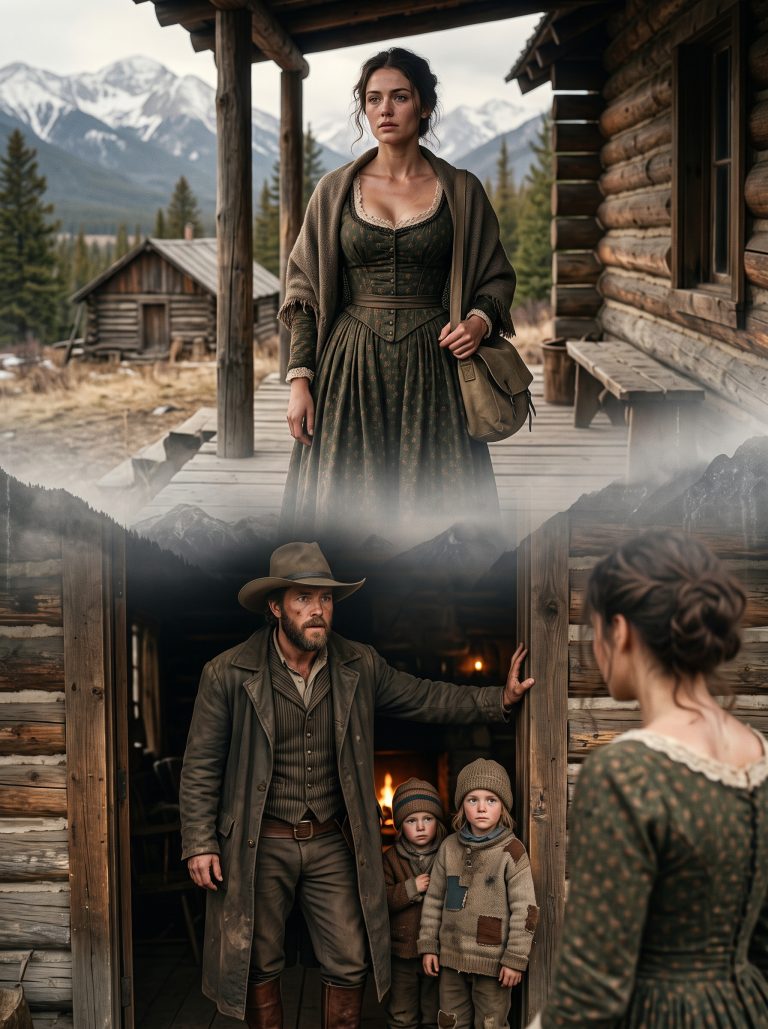
One Bite Made the Rancher Ask, “Who Made This?”—The Answer Led Him to a Forgotten Woman Underground

Part 1
Nathaniel Colton walked into Whitlock’s Mercantile with half a loaf of bread under his arm and the expression of a man who had just discovered a debt he didn’t know he owed.
The bell above the door rattled thin and tinny. Outside, the Nebraska wind combed dust down Millbrook’s one real street. Inside, the store smelled of coffee, lamp oil, and the particular sweetness of a candy jar nobody had refilled since spring.
Nate set the bread on the counter like it might run off.
“Whitlock. Who baked this?”
Otis Whitlock looked up from his ledger, unhurried. “Something the matter with it?”
Nate had eaten camp bread, army bread, biscuits that could double as horseshoes. He had never eaten anything like this — dark crust, honeyed crumb, a smoke behind the sweetness that tasted like somebody had put real hours into it and hadn’t minded.
“Nothing’s the matter. I want to know who made it.”
Whitlock’s eyes flicked toward the window, toward the flats east of town. “Wren Ashford. Brings loaves in Mondays and Thursdays. Lives out past Salt Fork, in the old dugout on her father’s claim.”
“Alone?”
“Since the fever took her folks, yes.” Something careful crossed Whitlock’s face — there and gone, like a man remembering a lie he’d told himself so often it had started to feel true. “I handled the filing on that claim myself, back before the county sent a proper agent out this way. Still the one folks bring their land papers to, mostly. Keeps to herself. I wouldn’t go bothering her, Colton.”
“I’m not aiming to bother anybody. I’m aiming to buy bread.”
He rode out that afternoon with the loaf tied behind his saddle and a feeling in his chest he hadn’t had since before his father died — since before the Colton Ridge house had gone quiet enough that he’d stopped noticing the quiet, the way a man stops noticing a wound once it’s old.
Smoke marked the dugout before the dugout itself did — a gray thread over a grass-covered rise, a clay oven steaming under a lean-to roof, a chicken pen listing sideways against a fence post.
The woman who came to the door had flour to her elbows and a streak of it across one cheekbone like a brand she didn’t know she wore. She was small enough that he’d have guessed her younger than she was, except for her eyes — gray, level, unsurprised by much.
“Yes?”
“I bought this in town.” He held up the loaf. “I came to ask who made it.”
“I did. If something’s wrong, I’ll return the money.”
“Nothing’s wrong. I’d like to buy the rest of what you’ve baked today.”
Wren Ashford studied him the way a woman studies weather — trying to guess whether it meant to pass through or settle in. “How many men do you feed at that ranch of yours, Mr. Colton?”
“Six regular. More at roundup.”
“And you rode two miles for bread.”
“I rode two miles for the best bread I ever ate. The rest was just geography.”
That earned him something close to a smile, gone as quick as it came.
She sold him three loaves at Whitlock’s price, and he told her, plainly, that the price was too low — not because he was generous, but because it was what she’d been taught her work was worth, and those were two different numbers.
Color rose in her face. “That is my business, Mr. Colton.”
“You’re right. I beg your pardon.” He counted out coin — her price, plus one for the loaf he’d already cut into. “I’d like to come back Thursday, if you’re selling.”
“I sell bread. That’s my trade.”
“Then Thursday.”
He tipped his hat and rode off, and Wren stood in the doorway until the dust settled, surprised to find her hands unsteady.
She told herself it was nothing. A rancher wanted supper. That was safer to believe than the alternative — that a man might ride out for something more than appetite, and that she might want him to.
By the second visit he’d brought flour sacks stamped with his own brand, thinking ahead to when she might need them. By the third, he’d noticed her oven’s crooked draft and asked, with a rancher’s plain curiosity, whether she’d mixed the clay with straw and sand herself.
“My mother taught me,” she said, and wished immediately she hadn’t. Her mother was not a subject she handed to strangers.
“Then she taught you well.”
“You can’t know that from bread.”
“I know more from bread than most men know from sermons.”
She looked up at that, caught by something steady in his face that wasn’t teasing at all.
By August’s end, he’d offered her a standing order — twelve loaves twice weekly, his flour, her price, paid the day he rode out to collect it. She wrote up terms on paper saved from her father’s old accounts, certain he’d laugh at a dugout baker presenting contracts like a banker.
He read every line twice, added a clause about winter fuel costs she’d forgotten to charge for, and signed his name beneath hers without asking to keep a copy.
“You don’t want proof of what you agreed to?” she asked.
“I know what I signed.”
Wren believed him. That frightened her more than anything he could have said.
Part 2
By October, Millbrook had decided what it meant that Nate Colton rode east twice a week. The town didn’t lie, exactly. It just arranged small truths into shapes that entertained it.
Mrs. Doyle, round and kind and occasionally smothering, arrived at the dugout with a basket and a warning wrapped in lace. “Folks are talking, Wren.”
“Folks are often idle.”
“Reputation matters. Especially for a woman alone.”
Wren kept kneading. “I’ve done nothing to be ashamed of.”
“I didn’t say you had.”
That same week, a stranger in a city coat came asking after her creek frontage — how far it ran, whether it had been surveyed, whether she’d sell the low bend. Wren answered plainly and thought little more of it, until she noticed two fresh survey stakes driven into the bank below her oven shed, string strung taut between them.
Then Whitlock cornered her near the church steps in November, smile not reaching his eyes. “You’d do well to remember, girl, ranch contracts can vanish overnight. Town trade lasts longer than a rancher’s fancy. And that claim of yours was never so settled as you like to think.”
Wren filed the threat away, uneasy without knowing why it sat so wrong — Whitlock had never cared enough about her business to threaten it before, and he’d never once mentioned her claim being unsettled until now.
Then, in December, a letter came from her cousin Vera in Omaha, offering steady work in a bakery, proper rooms, a life without dugout walls or wagging tongues. Men with means often enjoy what they don’t intend to honor, Vera warned.
Wren didn’t answer it. She also didn’t burn it, which felt like its own kind of answer.
She burned the bread instead, the next Monday, standing over blackened crusts when Nate arrived.
“Not every loaf is a revelation,” she snapped, before he’d said a word. “Some are just burned.”
He didn’t flinch. “What happened?”
She told him about Vera’s letter. About Omaha.
“Would you tell me not to go?” she asked.
He was quiet a long moment. “No. I won’t tell you not to take a good chance.”
The refusal to hold her back struck her harder than any pleading could have. She turned toward the window so he wouldn’t see her face.
It was only weeks later, going through her father’s old strongbox for the deed to show a surveyor who’d come asking odd questions about the creek bend, that Wren noticed something wrong — a filing date on her father’s homestead claim that didn’t match what Whitlock had once told her about the land office records.
A small thing. A single number.
She set it aside, told herself it was nothing, and went back to her flour.
She was wrong, and the winter had not finished with either of them yet.
Part 3
The blizzard came on a Thursday that started deceptively mild — low sky, restless wind, nothing more. By noon the world had gone white and screaming.
Wren had spent the morning half-listening for hoofbeats and hating herself for it. Nate wasn’t expected until late afternoon, when he usually rode out to collect the ranch’s order, and any sensible man would read a sky like this and stay put. She told herself that twice, then a third time, then stopped believing it somewhere around the second hour of watching snow bury the track east of her door.
By the time she’d banked both fires and dragged the last of the dry wood under the shed roof, the wind had a voice in it she didn’t like — a long, tearing note that made the chickens go silent and the dugout’s earth walls feel, for the first time in years, thin.
She thought of her father’s last winter. How the cough had started small enough to ignore and ended in a silence that filled the whole soddy. Grief had a way of returning uninvited in weather like this, dressed up as ordinary worry.
He is not your father, she told herself. He is a grown man on a good horse who knows this land.
It didn’t help.
Wren barred her door, banked her fires, and told herself Nate Colton had sense enough to stay home. Then she remembered how he kept his word even when weather argued against it, and dread opened cold in her chest.
He arrived at dusk half-frozen, hat lost somewhere on the road, lips blued with cold, the gelding trembling and white-crusted behind him. He had been out along the eastern line since morning, chasing a dozen head of cattle that had drifted toward Salt Fork ahead of the weather, and by the time the sky closed in around him, her dugout stood less than a mile off — far closer than the long ride back to Colton Ridge. Wren fought the horse into the lean-to first, then dragged Nate inside with a strength she didn’t know she had, stripped his gloves, wrapped his feet in cloths warmed at the stove, and pressed sweetened water to his shaking mouth until his hands could hold the cup themselves.
“Fool,” she said, furious with relief, working a blanket tighter around his shoulders. “You could have died out there.”
“Wasn’t riding out for bread, if that’s what you’re thinking.” His voice scraped, barely a voice at all. “Was chasing strays off the line when the sky turned. Yours was the nearest roof by a long stretch.”
“That is not comforting arithmetic.”
“Didn’t say it was comforting. Said it was true.”
She sat back on her heels, hands still busy with the blanket, and found she couldn’t quite look at him. “You frightened me.”
“I know.”
“I don’t frighten easily anymore. I made sure of that, years ago.”
His eyes found hers, clearer now despite the cold still working out of him. “You were afraid.”
“Of course I was afraid. A man I care for nearly froze chasing another man’s cattle, and I stood at that door shouting his name into weather that swallowed it whole.”
The words hung in the small, snow-battered room, louder than she’d meant them. She hadn’t planned to say care for so plainly, hadn’t planned to say it at all — but once loose, she found she didn’t want it back.
“I care for you too,” Nate said, and took her hand in his cold one, and held it like something he intended to keep holding.
“I don’t want Omaha,” she told him, and meant it the way a person means a thing they’ve been circling for months. “I want my oven. I want the shed with the yellow curtain Mrs. Doyle gave me. I want to argue with you over ledger figures until we’re both old and disagreeable. But I will not be kept, Nate Colton. I will not be moved to a ranch house and folded away like linen.”
“I wouldn’t want you folded away,” he said. “I’d want you loud about flour prices at my own supper table.”
She laughed despite the cold, despite everything, and when he kissed her it was slow and asking, and she answered it without reservation.
The storm held them three days. On the second, with nothing else to do but wait out the wind, Wren told Nate about the stranger in the city coat, and the stakes she’d found driven into the creek bank below her oven shed. He went still in a way that made her uneasy.
“Stakes,” he said. “Strung with line?”
“Yes.”
“That’s a railroad man’s marking, not a farmer’s.” He looked at her, something working behind his eyes. “Wren. Where’s your father’s old filing papers?”
She went to the strongbox then, not for kindling but because his question had put a cold thought in her that wouldn’t leave until she’d checked it, and pulled out the survey letter again — the one with the filing date that didn’t match what Whitlock had always told her about the county records. This time she didn’t set it aside.
“Nate. Look at this.”
He scanned it once, then slower, his mouth going tight. “Your father’s proof-of-claim. Filed the spring before he died.”
“Whitlock told me years ago the claim had lapsed. He’s the one who filed it for Father in the first place, back before the county sent its own man out — so I never had cause to doubt him. Father took ill only weeks after, and by the time he died that winter, I was too young and too grieved to make sense of any papers myself. Whitlock said Father died before the paperwork was finished, that the land was never truly mine outright, and that I ought to be grateful he’d let me stay on without pressing the county about it.”
Nate’s jaw went hard in a way she hadn’t seen before. “This says filed and received. Stamped.”
“Then why would he tell me otherwise?”
Neither of them had an answer yet, but the question sat between them like a struck match, waiting for air.
When the roads cleared, Nate saddled up before Wren had finished her coffee.
“I’m coming,” she said.
“It’s two days there, two back, and the roads are half drift.”
“It’s my father’s name on that filing. I’ll be the one asking after it.”
They rode together, then, trading the lead when snow narrowed the trail to one horse’s width, pushing until dark both days and resting only a few hours each night in a line shack that smelled of mice and old smoke before setting out again at first light.
“That fellow in the city coat,” Nate said on the second morning, breath fogging in the cold. “The one who came asking after your creek frontage back in November. You said he was staying at the depot hotel in Kearney.”
“I said no such thing. Henderson said it, in passing, months back.”
“Same thing, coming from you telling me now.” Nate’s jaw was set. “I want to talk to him before we talk to the land agent. If a railroad man’s been walking your creek bank, I want to know it from him directly, not guess at it.”
They found the surveyor at the hotel that same afternoon, a tired man named Prescott who turned out to have no love for secrecy once he understood what was at stake for the woman standing in front of him. He said plainly that he’d taken jobs from worse men than Whitlock and regretted most of them, and that a storekeeper trying to starve a woman off her own claim for a railroad’s benefit was exactly the kind of regret he’d rather not carry twice. He confirmed that he’d been hired the previous autumn to walk the Salt Fork bend, and that Whitlock himself had paid for the survey and asked to see the results before anyone else did. For two dollars and the trouble of copying it out by hand that evening, Prescott gave them a plain drawing of the proposed depot site — the same bend where Wren’s oven shed stood.
Only then did they go on to the land office, arguing companionably along the way over whether the land agent would even see them without an appointment. He would, it turned out, once Nate mentioned the Colton Ridge account the bank carried and Wren laid her father’s name on the counter like a hand of cards she’d been holding a long time.
The clerk who pulled the file was younger than either of them, and nervous in a way that told Wren before he’d said a word that something in the drawer wasn’t going to sit easy. He found the original proof-of-claim first — filed, stamped, received, dated the spring before her father’s death, exactly as the copy in her strongbox said.
Then he found what Whitlock had filed against her.
Otis Whitlock had filed, on three separate occasions, to have the Ashford claim declared abandoned, citing what he called a clerical oversight in the county’s own bookkeeping — an oversight that, on inspection, existed nowhere except in Whitlock’s own letters, resting on the very proof he’d assumed had gone missing along with the rest of her father’s papers. The first two petitions had failed for want of evidence. The third, filed only that January, was still open, and a note clipped to its front named a hearing date less than three weeks off — the county board’s spring session, the same session where, the clerk mentioned almost in passing, a railroad company’s option to purchase certain creek-frontage parcels was due to be finalized.
“Three weeks,” Wren repeated, the words gone thin in her mouth. “And if we hadn’t come—”
“Then the board hears one side of it,” the clerk said grimly, “and one side only, same as it near did twice before. Man’s patient, I’ll say that for him.”
Nate laid a fourth paper on the counter — Prescott’s survey drawing, gathered the afternoon before. It showed, in a careful engineer’s hand, that the ideal ground for the spur line’s water tower and depot was the bend at Salt Fork Creek, and named Whitlock plainly as the party who’d commissioned it.
Wren’s dugout. Her father’s claim. Her oven, her shed, her yellow curtain.
The clerk went still, working it through. “So that’s what he was after.” Then he let out a low whistle and made a note that would, he assured them, go straight into the file under Whitlock’s name, alongside a request that the hearing be moved forward to consider it. “Three tries in four years, quiet as church mice, with a railroad option closing right behind him — that’s not oversight. That’s appetite, and now it’s on paper.”
They rode home nearly as hard as they’d come, resting only when the horses demanded it, Wren’s father’s papers wrapped twice in oilcloth against her chest the whole way.
“The threats about your trade, the way he kept reminding you the claim was never truly settled, the years he let you believe you owed him for staying — that was never concern,” Nate said quietly. “He was waiting for you to give up on your own, so nobody could say he’d pushed. Your cousin’s letter came from your cousin, far as we know. But everything Whitlock said to you himself was aimed at the same door.”
“A fortune,” Wren said, “built on convincing a woman her own home wasn’t really hers.”
She sat with that a long moment — not fury exactly, though fury was in it, but something closer to grief for every year she’d apologized for taking up so little space, when the truth was she’d never had to apologize for any of it at all.
“I want to see him,” she said.
Nate stood immediately. “I’ll come. I’ll bring Silas too, and we’ll—”
“No.”
He stopped.
“I’ve spent four years being managed by men who thought they knew what was best for a woman with no family to stand behind her,” Wren said. “I won’t trade Whitlock’s condescension for yours, even kindly meant. This one I finish myself.”
Something in Nate’s jaw tightened, the old instinct to shield rising visibly before he mastered it. It cost him something, she could see, to nod instead of argue.
“You’ll take the papers.”
“I’ll take the papers.”
“And if he tries to twist it — deny he ever filed, call the survey map a forgery—”
“Then I’ll have Mrs. Doyle and half the store as witnesses, and a county clerk’s letter besides. I’m not walking in unarmed, Nate. I’m walking in without you standing between me and a fight that’s mine to win.”
He looked at her a long moment, and whatever he saw settled something in him, because the next thing he did was fetch her coat from the peg and hold it open for her to step into — not to see her off gently, she understood, but because it was cold, and that was all it was.
“Go get your land back,” he said.
She rode into Millbrook the next morning in her plainest dress, her father’s filing papers folded in her coat, and found Whitlock behind his counter, weighing out sugar for Mrs. Doyle.
“Miss Ashford,” he said, too warm. “Come for your usual order?”
Wren set the county copy of the filing on his counter, beside the scale.
Whitlock’s hand stilled on the weights.
“I have a stamped, dated, county-verified claim on my father’s land,” she said, loud enough for Mrs. Doyle and two other customers to hear plainly. “Filed the spring before he passed. I know you tried three times to have it declared abandoned, and that the latest attempt has a hearing date in three weeks — one you were counting on going uncontested, same as the first two nearly did. I know a railroad’s option on the creek frontage closes not long after. And I know exactly why a storekeeper cares that much about a homestead claim he had no legal interest in whatsoever.”
The color drained out of Whitlock’s face in patches, like frost retreating unevenly off a window.
“Now,” Wren went on, “I don’t much care what you thought my land was worth to you. I care that for four years you told a girl with no family left that she ought to be grateful for scraps of a life that was already hers by right. That ends today. My claim stands. My oven stays. And you will never again tell me what my work — or my worth — is priced at.”
Mrs. Doyle’s sugar scoop had stopped moving entirely.
Whitlock opened his mouth, found nothing honest in it, and closed it again.
“I’ll take my usual order to Henderson’s competitor in Kearney from now on,” Wren added, folding the papers back into her coat, “since you seem better suited to buying land than selling flour.”
She walked out into the winter light with her spine straight and her hands, for the first time in longer than she could remember, entirely steady.
The hearing convened three weeks later, in a plank-floored room above the Kearney land office that smelled of pipe smoke and old ledgers. Three members of the county board sat behind a table scarred with decades of ink; the same nervous clerk sat at their elbow with the Ashford file open before him. Wren sat between Nate and Mrs. Doyle, who had ridden the whole way, she announced to anyone who’d listen, “to see justice done properly, in a good hat.”
Whitlock arrived without a lawyer, which struck Wren less as confidence than as a man who’d found no one willing to take his money for a case this thin.
The chairman read the latest filing aloud in a flat, official voice, then set it down. “You state here, Mr. Whitlock, that the original filing on the Ashford claim was never properly completed. Yet the claimant has produced the stamped receipt — in your own hand.”
“There was a misunderstanding. At the time.”
“The same misunderstanding, cited three times, over four years?”
Whitlock found no answer that improved on silence.
The clerk slid Prescott’s survey drawing across the table, and Prescott himself, called as witness, confirmed under oath that Whitlock had commissioned the survey the previous autumn and had asked to see its findings before anyone else in the county did. A murmur moved through the small gallery. Mrs. Doyle’s chin rose another visible inch.
The chairman set down his pen. “This board dismisses this filing as brought on false grounds. Mr. Whitlock’s standing as a filing agent for this county is revoked, effective today. The matter of the two attempts before it is referred to the district attorney, to determine whether repeated false filing constitutes fraud under statute.”
Whitlock did not look at Wren on his way out.
She found she didn’t need him to.
Word of it moved through Millbrook faster than any gossip about her and Nate ever had — but this time the shape the town gave it was admiration, not scandal. Whitlock avoided formal charges only by signing a public retraction and settling Wren’s legal costs before the district attorney’s inquiry went further. Mrs. Doyle told the story at every social for a month afterward, embellishing Wren’s posture a little more each telling, until by spring Wren was said to have stood nine feet tall in that courthouse doorway.
Nate proposed on a March afternoon with mud on his boots and an envelope in his hand, in the middle of an argument about delivery routes, because — he admitted later — he’d been afraid that if he waited for a graceful moment, she’d find another ledger column to correct first.
Inside the envelope was a plain gold ring, small enough to wear while kneading dough.
“I love your mind,” he told her, kneeling by her worktable with flour still on her hands. “I love that you make me defend every nail I drive and every figure I write. I love the dugout because it kept you, and I love the oven because it led me to you. I want you at Colton Ridge as yourself, Wren — your name on your own ledger, your own land still yours besides, your say in every wall we ever build.”
“And if I say the bakery stays partly at Salt Fork?” Wren asked, eyes bright.
“Then I’ll build a road good enough to run wagons both directions in any weather.”
“And if I never stop correcting your accounts?”
“Then I’ll have married the only woman in Nebraska who can make me grateful for it.”
She laughed, and cried a little, and said yes with both hands still dusted white.
They married in April beside the dugout, because Wren insisted the place that had kept her alive deserved to witness what came after. Mrs. Doyle wept loudly and without shame. Silas wore a collar too tight and looked miserable until Wren promised him extra rolls, at which point he found the ceremony entirely bearable. Whitlock did not attend, though word reached them later that he’d sold his interest in the mercantile that summer and moved to Grand Island, where, Mrs. Doyle reported with evident satisfaction, no one yet knew to distrust him.
Wren wore blue, carried a bundle of wheat tied with the yellow curtain cloth in place of flowers, and when the reverend asked who gave the bride, she answered before anyone else in the gathering could open their mouth.
“I give myself,” she said, loud enough to carry over the wind. “The land is mine on paper now, filed and stamped and beyond arguing. The name I keep is mine. And the choosing — all of it — was mine to make.”
A murmur went through the small crowd, more approving than shocked; Millbrook had had a winter to learn what kind of woman it was dealing with.
The reverend, after a startled pause, smiled. “Then it’s well given.”
Nate’s vows were short, in the way of a man who’d learned that plain words carried further than pretty ones. “I take you as you are,” he said, holding both her hands. “Stubborn, exact about ledgers, better with an oven than I’ll ever be with anything. I’ll spend my life making room for whatever you decide to become next, and I won’t mistake that for the same thing as building your house for you.”
Wren’s answer shook only a little. “I take you, Nathaniel Colton, knowing you’ll read every contract twice and still sign it. I’ll share your roof, but my oven stays lit and my name stays on the books. I’ll love you plainly, and feed you better than you’ve any right to expect, and I’ll count on you never once forgetting what I told Whitlock in that store.”
The Salt Fork claim was formally confirmed in Wren Ashford Colton’s name alone — a wedding gift from no one but the county recorder and her own nerve. The dugout oven stayed lit twice a week for the breads that had started everything, wrapped now in paper stamped Ashford & Colton in blue ink Nate had ordered special from Omaha. The big brick oven at the ranch handled the rest, feeding hands, travelers, and eventually a young widow named Clara Whitcomb.
Clara came to the kitchen door in June, thin-faced and apologetic, her husband a year gone in a wagon accident and two children thin behind her skirts. She’d heard, she said, that Mrs. Colton sometimes needed help, and she didn’t want charity, only work, if there was any to be had.
Wren looked at her a long moment — at the careful pride in a woman trying not to beg — and recognized the particular posture of someone who’d been taught her worth was whatever others decided to spare her.
“I need help Mondays and Thursdays,” Wren said. “Paid work. Full wages, same as I’d pay a man for the lifting.”
Clara’s composure cracked, just slightly, at full wages. “I can work hard, ma’am.”
“Good. Wash your hands. Dough doesn’t wait on anybody’s grief, mine included.”
By autumn, Clara knew the ovens as well as Wren did, and had stopped flinching when someone spoke kindly to her, as though kindness might be a trick that would be called due later. Wren recognized that healing too. She’d done a version of it herself, four winters running, alone in a dugout that had never once asked her to be smaller than she was.
“You gave her exactly what you needed once,” Nate said, watching from the doorway as Clara laughed at something Silas had botched at the ledger.
“Work?”
“Proof that somebody would pay her fair, and mean it.”
Wren covered his hand with her floured one. “You gave me that first.”
“No,” he said. “I only noticed it was already there, waiting on somebody honest enough to say so.”
A year to the day after he’d first walked into the mercantile with half a loaf and a question, Nate found his wife in the ranch kitchen with a fresh loaf wrapped on the table — dark crust, honeyed crumb, exactly as it had been the first time.
“One year,” he said.
“Near enough.”
He cut two slices, no butter, because bread that couldn’t stand alone hadn’t been worth baking. They ate in the wide morning light, the ledger open on the shelf beside them, her name printed plain at its head.
“Still tastes like home,” he said.
Wren looked around the kitchen — the worktable built to her height, the shelves she’d rearranged twice already, the deed in the strongbox that no one could talk her out of again — and understood, finally, the plainest lesson her whole hungry, guarded life had been trying to teach her.
A home wasn’t a place someone let you keep. It was a thing you proved was yours, then chose, freely, to share.
“Large enough for now,” she said, and broke him off a piece.