The Wealthy Rancher Found a Homeless Widow on His Land — What He Did After Learning Who Betrayed Her Shocked the Whole Town

Part 1
Garrett Calloway rode out before sunrise, the way men do when they own more land than they can see in a single day.
Frost silvered the sage as his gray gelding picked along the ridge trail, breath rising in pale ribbons. Garrett didn’t feel the cold much anymore. He felt disorder — a fence out of true, a ledger that didn’t balance, a promise not kept. Those things bothered him. The winter air did not.
He’d built Calloway Ridge from a middling spread into the largest cattle operation between the Wren River and the territorial line, and the town of Millbrook liked to call it luck. The men who rode for him knew better. Luck didn’t mend washouts before a storm. Luck didn’t remember which creek crossing failed every third spring. Discipline did that. Garrett did that.
This morning’s ride was routine — the first hard freeze always brought him out to check the far corners of his land for cut wire, broken rail, or trespassers. He came around the shoulder of the ridge above Miller’s Draw and saw smoke.
Thin. Steady. Banked right by someone who knew fire.
The old line cabin sat in the draw below, a relic some long-gone trapper had built and nobody had bothered to tear down. Garrett had meant to pull it apart for scrap lumber for two years running. Instead, someone had patched the roof, hung a new door latch, and stacked cordwood neat as a soldier’s rifle rack.
He rode down with his jaw set.
The door opened before he could knock.
A woman stood there, lantern in one hand, a stick of kindling under her arm, as if she’d only paused mid-chore. Dark hair pinned loose, a mended dress, boots gone soft with wear but scrubbed clean. She looked at him the way a person looks at weather — worth watching, not worth fearing.
“Morning,” she said. “Wasn’t expecting company. Not this early.”
“This is Calloway range, ma’am. I make it my business to know who’s living on it.”
“Ivy Renshaw.” She didn’t blink. “I’m not here to steal anything, if that’s your worry.”
“Most folks ask before they settle on another man’s ground.”
“Most folks have somewhere else to go.”
No plea in it. No performance. Just a fact laid down like a plank across mud.
He should have ordered her off. Instead he found himself studying the cabin behind her — a woven rug by the hearth, herbs drying from the rafters, a table leveled with stacked stone. Someone had turned a ruin into a home with nothing but stubbornness and two hands.
“You fixed the roof yourself?”
“Wasn’t anyone else around to do it.”
He asked how long she meant to stay. She said long enough to get back on her feet, and that she wanted no charity, only time. He asked what had brought her so far from wherever she’d started. She poured water into a tin cup and set it to warm before she answered, unhurried even under his stare.
“I needed a place no one would think to look.”
“Running from the law?”
“Running from the kind of trouble the law doesn’t bother with.”
He could have pushed harder. Most men in his position would have. But Garrett had learned that truth came in layers, and a man who tore at the first one only taught people to bury the rest deeper.
“I’ll think on what to do with you,” he said finally.
“That’s all anyone can ask.” Something in her eyes eased — not warmth, exactly. Recognition. Like she’d expected cruelty and gotten fairness instead, and didn’t quite know where to put the surprise.
Garrett swung back onto his gelding. Ivy stood in the doorway with smoke curling behind her, and he understood, riding away, that she hadn’t merely taken shelter on his land.
She’d taken root in it.
And he had no ledger, no column, no tidy line to file away the fact that he already meant to come back.
Part 2
He returned at dawn with a contract written in his own hand: she could stay through winter in exchange for work his crew couldn’t spare time for — fence surveys, water checks, the far corners no one else wanted to ride in the cold. Shelter for labor. Fair and plain.
Ivy read it twice before asking for one change — a clause ending the arrangement after winter, no obligation either way.
“Planning to leave?” Garrett asked.
“Planning to have choices.”
He added the line without argument. She signed Ivy Marlowe Renshaw in a steady hand, and he signed beneath her, and something in him settled the way it did when a fence finally ran true.
Within a week she’d mapped washouts his own men had missed for two seasons. One evening she found his gelding favoring a foreleg after a hard ride and sat up past dark with a hot poultice until the swelling eased, saying nothing of it the next morning except that the horse would want a lighter trail for a few days. Garrett noticed. He noticed, too, that when he came by to reset her door hinge, she let him work but never let him decide where the shelf above it should hang — and he found he liked being corrected more than he liked being right. He told himself his interest in her was purely practical. The lie sat poorly.
At the Millbrook harvest social, he overheard two ranch hands muttering behind a cider stall.
“Vane’s buying up claims again. Papers that don’t look right to me.”
“Heard a widow out past Wren Creek lost her whole plot. Swears she never signed a thing.”
Silas Vane. Forged papers. A widow near Wren Creek.
Garrett stood very still while the fiddler struck up a reel and the whole town clapped along, and his mind rode straight back to a cabin in the draw, to a woman who’d said she needed somewhere no one would think to look.
He didn’t ride to her that night. He went home, hung his coat by the stove, and made himself wait for morning — coffee before confrontation, facts before action, the habits that had kept him from riding straight into holes he could’ve seen by daylight.
But he barely slept.
Part 3
He rode out at first light and found her behind the cabin, splitting wood in the same clean, unhurried rhythm she brought to everything.
“You’re early,” she said, not looking up.
“This isn’t a work visit.” He dismounted. “I heard a name in town yesterday. Silas Vane.”
The axe stopped mid-swing. Ivy’s knuckles whitened on the handle.
“You know him.”
“Everyone who’s lost more than they should’ve knows someone like him.”
She told him then, in a voice that stayed level by refusing to touch its own wound too fast. A husband dead two winters past. A small plot near Wren Creek — enough to plant, enough to hope on. She’d worked it alone, sold preserves, taken in mending, and just when the land had started to hold, Vane arrived with talk of settling drought-time debts nobody could prove existed. She’d refused to sign anything. Weeks later, men came to tear down her fence with papers already stamped and filed, claiming forfeiture.
“I never signed,” she said. “The recorder said the papers had been properly filed. The sheriff said there was nothing he could do about a filing that looked legal on its face. Neither one of them was going to take a widow’s word over a stamped page.”
Garrett listened the way he read a contract — for every clause, every date, every name — because that was what would beat a man like Vane. When she faltered over the memory of her husband’s tools being tossed into a stranger’s wagon, he told her she didn’t have to finish it.
“Yes, I do,” she said. “If I skip the part that hurts, men like him get to call it clean.”
So he let her finish, and wrote it all down.
“I’ll take it from here,” he said when she was done.
“That sounds like a man about to leave a woman standing behind him.”
“It means I intend to put you where nobody can knock you down without going through me first.”
She looked at him a long moment. That night, before he left, she asked him — almost carelessly, the way people ask things that matter too much to ask directly — how he’d learned to be so certain about everything. He admitted he hadn’t always been; that after his mother died and his father buried himself in work rather than grief, certainty had been the only thing Garrett could build that nobody could take back down. She didn’t answer that with words. She only handed him a second cup of coffee, and let the silence between them sit easy instead of empty.
At the county recorder’s office the next morning, old Ansel Merrick pulled down the ledger without much prodding — Garrett Calloway’s name opened doors that didn’t open for lesser men. The forfeiture deed was there, filed under Ivy Marion Renshaw.
Marion. Not Marlowe.
Garrett laid the winter contract beside the ledger. Two signatures, two hands — one plain and sure, one curled like a woman playacting at penmanship.
“Not the same hand,” Merrick murmured.
“No. And the middle name’s wrong besides.”
Merrick flipped back through his notary log, running a finger down the entries for the date the deed claimed to have been witnessed. He stopped, frowned, flipped again. “There’s no record of her ever appearing before the notary. No witness line filled in. Whoever forged this didn’t just copy her hand wrong — they never brought her into this office at all.”
That settled it past any argument about clerical error.
“Who filed it?”
“Silas Vane. Hired to settle claims after the drought.” Merrick hesitated, then lowered his voice. “Though the money behind Vane’s operation — I’ve always wondered where a drifter like that gets the capital to buy up half a county’s paper.”
That question would matter more than either of them yet knew.
Garrett found Vane outside the livery an hour later, trading pleasantries with two riders in coats too clean for their trade. He didn’t raise his voice. He never needed to.
“You filed a deed under a name that isn’t hers, with no notary record behind it,” Garrett said. “You’ll ride to Merrick’s office and withdraw the claim today, and you’ll put your confession in writing, or I’ll take every deed with your name on it before a judge in the territorial court.”
Vane’s smirk faltered, then came back too fast. “You think this is about me, Calloway? I’m hired help. Ask your business partner where the money for my contracts comes from.”
The words landed like a dropped plate.
“What did you say?”
Vane’s eyes flicked past him, suddenly aware he’d said too much, and he bolted for his horse. Garrett let him go — chasing a man through a crowded street would prove nothing a court could use. But the words stayed lodged in his chest like a burr under a saddle blanket.
Your business partner.
Garrett had exactly one — his late father’s old associate, Hollis Braddock, who held a quarter interest in the Calloway water rights and had managed the northern leases since before Garrett could walk a fence line alone. A man Garrett trusted enough to never once check his books.
That night, alone in the study, Garrett pulled every quarterly report Braddock had filed in the past three years — reports Garrett had signed and approved without reading past the totals, because Braddock had always handled the details and Garrett had always had cattle to move. He expected the fraud to announce itself, the way a bad fence line does. It didn’t. The numbers only sat there, tidy and dull, refusing to confess anything — loan interest, survey fees, filing costs, all ordinary entries, all properly totaled, none of them wrong on their face.
He nearly gave it up as a dead end that first night, and told himself Vane’s words outside the livery had been nothing but a cornered man’s spite.
But a week of quiet checking said otherwise. He rode to Merrick’s office three more times, laying Braddock’s loan dates against the recorder’s forfeiture filings, and twice came away with nothing but a sore back and a longer list of parcels that looked, on paper, entirely unremarkable. It was Merrick, finally, who thought to pull the old territorial mineral survey maps from a back cabinet nobody had opened in a decade — and only then, laying the survey lines over the forfeiture list, did Garrett see what the ledgers alone could never have told him. Every failed loan, every quiet foreclosure, traced the exact path of a mineral seam running beneath the valley. Braddock hadn’t needed to falsify a single number. He’d only needed to know, better than anyone, exactly which families sat on ground worth stealing — and to be patient enough to let ordinary bad luck and hard winters do the rest, with a nudge here, a called-in note there, whenever nature was slow to cooperate.
Then Braddock bought the forfeited parcels cheap, through a cousin’s name in the next county over, land rich with that same seam that ran beneath Calloway Ridge itself.
Ivy’s plot sat squarely on that seam.
She hadn’t been a random target. She’d been a name hidden inside financial reports Garrett had trusted his own partner to manage honestly — and hadn’t thought once to question. It was exactly the kind of carelessness he’d spent his whole life despising in other men, and he’d been guilty of it without ever lifting a dishonest pen himself.
He rode to her at first light, the reports in his coat, and told her everything — Vane, Braddock, the seam of ore that ran under half the valley, the ugly truth that the man closest to his own family had built a scheme out of exactly the kind of desperation Garrett had sworn never to profit from.
Ivy listened without flinching. “Then it was never really about me.”
“It became about you the moment you refused to sign,” Garrett said. “You were the one who wouldn’t fold. That’s why they burned your fence and not someone else’s.”
Something in her straightened at that — not relief, but a kind of fierce clarity, like a debt finally itemized correctly.
“What happens to Braddock?”
“Everything happens to Braddock.” Garrett’s voice was iron. “I’m calling the county attorney myself, and I’m bringing every forged deed Merrick can find.”
The investigation moved through its second week, slow and methodical, Braddock still denying everything, Vane already having slipped out of the county ahead of a warrant.
In between the rides to town and the hours spent over Merrick’s ledgers, ordinary life still asked to be lived. Garrett took to arriving at the cabin most evenings, telling himself it was only to check on her safety while Vane remained free — though he no longer bothered pretending, even to himself, that safety was the whole reason.
One evening he found her elbow-deep in flour, muttering at a batch of biscuits that refused to rise. She handed him a wooden spoon without asking and told him if he was going to stand there taking up space, he could at least stir. He did, badly, and she laughed — a real laugh, unguarded, the first he’d heard from her — and took the spoon back before he ruined the batter entirely.
They ate the lopsided biscuits anyway, sitting on upturned crates by the hearth because the new porch chairs hadn’t arrived yet, and she told him about her husband’s habit of naming every mule he’d ever owned after a different territorial governor, and Garrett found himself telling her, for no reason he could name, about the first horse his father ever let him break alone. Neither story mattered. Both of them knew it. That was the ease of it — two people who had spent years being careful, discovering they could waste an hour on nothing at all and feel richer for it, not poorer.
He rode home late that night without having mentioned Braddock, Vane, or a single deed, and realized somewhere along the ridge trail that it might have been the best evening he’d had in years.
Before the last of Braddock’s records could be locked away as evidence, one of Vane’s hired men — paid, it would later come out, to frighten Ivy off Calloway land before the whole scheme collapsed further — crept up to the half-built cabin frame on the ridge and put a torch to the stacked lumber.
Garrett was riding back from town in the last gray light when he caught the glow off the ridge and turned his horse hard toward it. He reached the burning frame and threw himself into the fight without hesitation, shovel in hand, shouting for the two ranch hands riding behind him to spread out and cut the fire off before it reached the trees.
Ivy was already there, having gone in under the unfinished frame to drag out the chest that held the last of her late husband’s tools — the one thing from Wren Creek she hadn’t been able to leave behind twice. A support beam gave way above her just as Garrett reached the doorway, and he hauled her back by the waist a heartbeat before it crashed down where she’d been kneeling.
They fought the flames together until the frame stood scorched but standing.
Kneeling in the snow afterward, soot on his cheek, Garrett finally said aloud what he’d been circling for weeks. “My father taught me land was safer than people. Losing my mother taught him that, and losing him left me alone in a house too big for one voice. I built walls out of ledgers so nothing could take anything from me again. Then you came and I found out the emptiest thing I owned was the house, not the ground.”
Ivy’s eyes were wet, but she didn’t look away. “I don’t know how to be helped without waiting for the debt to turn cruel.”
“Then let it be a debt with no interest,” Garrett said. “I’m not asking you to owe me anything. I’m asking you to choose to stay.”
She crossed the space between them and rested her forehead against his chest, and he held her the way a man holds something he has finally learned is worth more than any acre he’s ever fenced.
It took another two weeks to finish what the fire had interrupted. The ore reports went before the county attorney. Two more widows came forward once they saw Ivy hadn’t been ruined for speaking up. Vane, caught trying to sell forged paper to a fourth family two counties over, traded his testimony to keep from facing the harshest sentence alone, and it was his statement, more than any ledger, that finally sealed Braddock’s fate. Braddock’s quarter share of the Calloway water rights was seized to pay restitution, and every fraudulent deed tied to his name — Wren Creek included — was voided by the court.
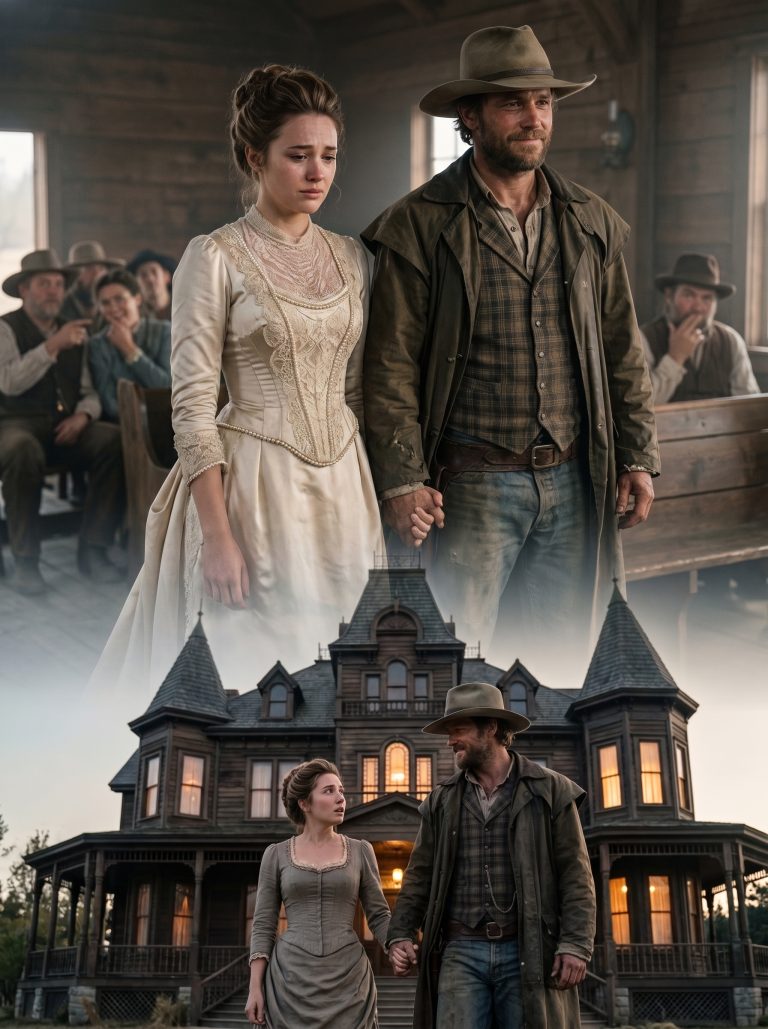
Spring came slow to the valley, the way it always did, but it came. The new cabin rose finished on the ridge above the meadow — a stone foundation, south-facing windows, a porch wide enough for two chairs. Ivy chose to sell the Wren Creek property to a young family just starting out, on the one condition that they preserve the two apple saplings she had planted there years before. Braddock’s name became a byword for shame in three counties. Vane never came back.
On the porch one evening, coffee cooling between them, Garrett asked if she’d help Merrick reorganize the county’s land records — nobody in the territory, he said, understood the weight of a clean deed better than she did.
“You’re asking me to spend my days around paperwork,” Ivy said. “After everything paperwork did to me.”
“I’m asking you to be the reason it never does that to anyone else again.”
She was quiet for a long moment, watching the last light settle gold over land that had once nearly cost her everything, and feeling, at last, entirely at peace.
“Then I accept,” she said. “On one condition.”
“Name it.”
“You let me correct you when you’re wrong. Often. Without complaint.”
Garrett’s rare smile broke free, the one that still startled him every time it arrived. “I was hoping you’d say that.”
Below them, the old trapper’s cabin sat dark and empty in the draw, its chimney cold for the first time in months — not torn down, only retired, kept standing one more season so Ivy could remember exactly where she’d begun again. It had sheltered a stranger with nowhere else to go. It had never been the whole answer. But it had been enough to lead a careful, guarded man down into a hidden fold of land, looking for a trespasser, and send him back up the ridge, quietly, irreversibly, home.
— The End —