“My Children Haven’t Eaten in Five Days,” the Starving Mother Whispered—Then the Lonely Rancher Offered Her Something No One Expected

Part 1
The little girl’s fingers slipped from her mother’s grip, and Elena Marsh watched her daughter go down into the snow.
For one terrible second she only stared, as if staring could undo it.
Rose lay half-swallowed by the drift, her face gray beneath the storm, her lips gone the color of a bruise. Elena crawled to her because standing was no longer a thing her legs remembered how to do. The wind came at her like something with teeth. Snow packed into the seams of her coat. Her hand, numb to the wrist, still gripped the small paring knife she’d carried since Ohio.
“Mama,” Rose breathed. “I can’t feel my feet.”
Something in Elena that the cold hadn’t managed to break, broke then.
“You’re all right,” she said, pulling Rose against her chest. “Mama’s got you.”
Four days without food. Two days on foot since the wagon wheel splintered on buried rock. Seven months running from Nathaniel Cross — her late husband’s business partner, a man who wore grief like a suit he’d had tailored — because Nathaniel did not want Rose. He wanted the silver claim Elena’s husband had left in trust for the child, with Nathaniel named as co-trustee to administer it until Rose came of age. As sole surviving parent, Elena stood as Rose’s natural guardian, and a natural guardian could challenge a trustee’s management or petition to remove him. But if a court found Elena unfit, guardianship of Rose would pass to the next-named party — Nathaniel himself — and a trustee who was also legal guardian answered to no one but a judge he could afford to buy.
So Elena had run. Ohio behind her. Nebraska behind her. Oregon still a lifetime away.
Somewhere around the Nebraska line she had started noticing a rider — never close, never speaking, always a half-mile back at dusk and gone again by morning. She’d told herself it was nerves, the kind that came from looking over her shoulder too long. She had not seen him in nearly two weeks now, and told herself that meant she’d finally lost whoever it was, or that he had never been anything but a shadow her fear had built.
Now Wyoming had gone white and endless, and the storm was closing the last door she had.
Rose coughed, a thin wet sound that scared Elena more than the wind did.
Then, under the wind, she heard hooves. Slow. Deliberate. Coming closer instead of past.
She shoved Rose behind her and rose to her knees, knife low. “If it’s him,” she whispered, though Rose was barely listening anymore, “I’ll fight.”
A shadow separated from the white. Tall, broad through the shoulders, moving with the unhurried care of a man who’d walked through worse storms than this one. He raised both hands before he was close enough to be seen clearly.
“Easy, ma’am. I mean you no harm.”
Not Nathaniel. Older, sun-worn, a wide hat pulled low, ice riming the collar of his coat.
“Then what do you want?” Elena said.
“Found your wagon on the ridge road yesterday. Figured whoever left it might still be out here.” His eyes dropped to Rose. “She alive?”
“Yes.” The knife didn’t waver.
“She won’t stay that way much longer in this.”
“She’s fine.”
The lie came too fast, and his face told her he’d heard a hundred like it. He knelt anyway, slow, non-threatening, and drew something from inside his coat. Not a weapon. A twist of oilcloth.
“Corn dodgers,” he said, unwrapping it. “Hard as stove wood, but it’s food.”
Elena’s stomach convulsed at the sight of it.
“How much do you want,” she said, “for that?”
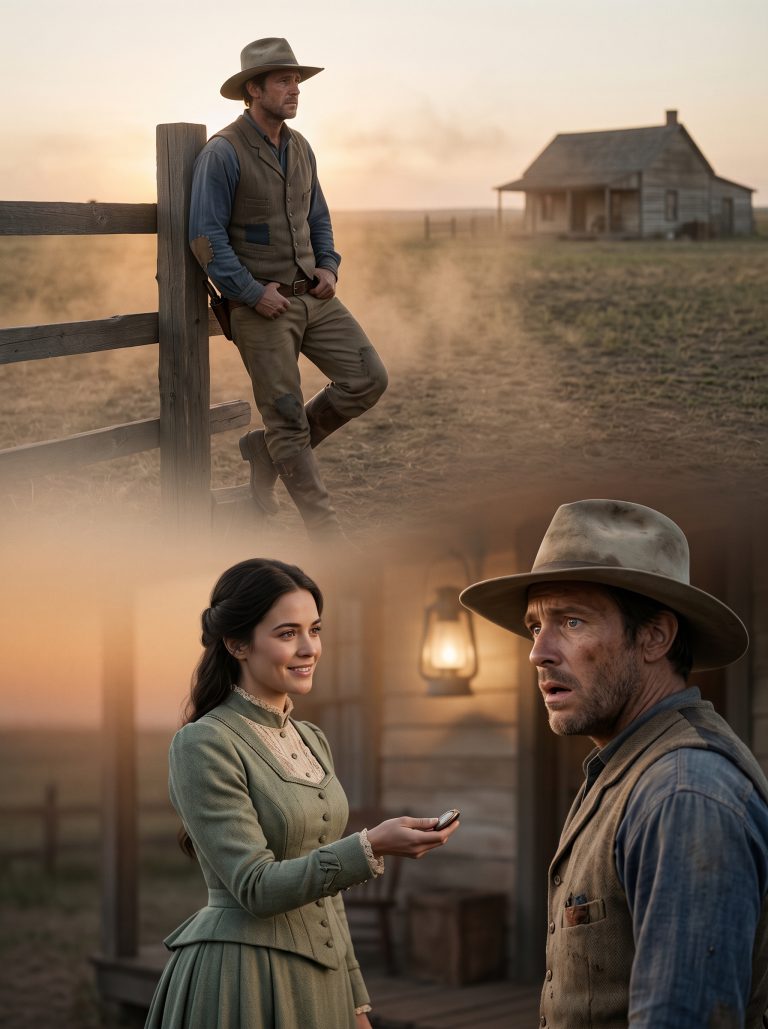
Something crossed his face that looked almost like anger, though not at her. “Nothing. You’re going to die of hunger in front of me, and you’re asking my price. Name’s Caleb Reed. I’ve got a place eight miles north. Walls. A stove. Enough food that two more mouths won’t miss it.”
Rose’s eyes fluttered open at the sound of his voice. “Mama? Is it an angel?”
Elena lowered the knife.
She took the bread instead, breaking a piece for Rose first. Caleb looked away while the child ate, as if hunger deserved privacy, and that was the second thing that made Elena trust him more than she wanted to.
He carried Rose himself, wrapped in his own coat, and walked the horse the whole eight miles rather than ride while a woman and a sick child went on foot. Elena watched his shoulders through the snow and thought: a stranger, a man, a risk — and also, somehow, the only thing standing between her daughter and the ground.
The ranch house appeared out of the white like something she’d invented from exhaustion. Smoke from the chimney. A barn. Warmth made visible.
Inside, heat hit her like an accusation — that she’d let it get this bad, that she’d nearly let Rose die rather than trust anyone. Caleb laid Rose on a narrow bed and stepped back so Elena could reach her first.
“Shirts in that drawer,” he said. “Dry ones. Yours after hers.”
By the time Elena came out in a shirt that fell to her knees, Caleb had coffee going and would not meet her eyes, as if the sight of her in his dead wife’s old room might mean something he wasn’t ready to name.
“I don’t understand you,” Elena said.
“Not much to understand. Saw two people who needed help. Had help to give.”
Later, when Rose was asleep, Elena asked carefully whose room it had been. Caleb was quiet long enough that she thought he wouldn’t answer.
“Margaret,” he said finally. “My wife. Fever took her four winters back — the same kind of sickness that’s sitting in your girl’s chest right now, which is partly why I couldn’t ride past your wagon and pretend I hadn’t seen it. We never had children. She used to say this house had too many empty rooms in it for a place that called itself a home.” He set another log on the fire, not looking at her. “Been keeping her shirts in that drawer four years because I didn’t know what else to do with them. Tonight they finally did something.”
“Everyone wants something.”
“Then,” he said quietly, “you’ve been meeting the wrong people.”
She wanted, more than she’d wanted anything since her husband’s funeral, to believe that. But wanting had gotten her nothing but seven months of running, and she wasn’t sure she remembered how to stop.
Part 2
Caleb rode to town the next morning and came back with tension pulling at his jaw.
“Man got off the stage from Laramie,” he said. “City clothes. Asking after a woman traveling with a sick child. Sheriff Tate didn’t tell him a thing, but a town talks on its own.”
Elena’s coffee cup rattled against the table. “That’s him.”
“There’s a way to make his papers weaker,” Caleb said carefully. “Not disappear him — Wyoming’s not that kind of place. But a married woman settled on land, with a husband’s name behind her, isn’t the same as a widow alone for a judge to call unfit. If you’ll allow it, once we’re married I’d file to legally adopt Rose, too — a proper petition, notice posted, a hearing before a judge like anyone else. Nothing bought, nothing quiet.”
“You don’t know me.”
“I know you carried her eight miles in a blizzard rather than let her go. That tells me plenty.”
Elena did not answer that night, or the next. She watched him instead — how patient he was with Rose over her letters at the kitchen table, how fair he was with the ranch hand who came by about wages, how he never once let a silence between them turn into a demand. On the third evening, Rose asked, unprompted, if they could stay here forever, and something in Elena finally settled around the shape of yes.
“I have conditions,” she told him.
“Name them.”
“My own room until I say otherwise. My name stays my own on anything that’s only mine. And if this doesn’t work the way either of us hopes, you let me go without a fight.”
“Agreed,” Caleb said. “Though I’ll admit I’m hoping it works out better than that.”
They rode to the small church five days later — not at dawn on impulse, but on a morning Pastor Williams had set once Caleb filed his notice of intent, as the law required. No flowers, no music — just the pastor, two neighbors as witnesses, and a plain gold band that had belonged to Margaret.
“It was hers,” he said, sliding it onto Elena’s finger. “She’d have wanted it worn, not kept in a drawer.”
When Rose asked if he was her papa now, Caleb knelt to her height before answering.
“If you’ll have me. Though it’ll take a judge’s signature to make it official — a real hearing, same as your mama and me. Nothing about this family gets done quiet or crooked.”
“I want it more than anything.”
They filed the adoption petition that same week, alongside the marriage record, so both would stand together before whatever came next. Halfway home from town, Sheriff Tate rode up alongside the wagon, hat already off — the way a man takes his hat off before bad news.
“Nathaniel Cross filed an emergency petition this morning,” he said. “Fraud. Kidnapping. Unlawful adoption. He’s got two lawyers from back east and a third man nobody in town seems to know.”
Elena’s newly ringed hand went cold.
“A third man?”
“Quiet fellow. Doesn’t talk much. Watches everything.” Something in that description snagged at her — a shadow that had once kept a half-mile back at dusk and vanished before Nebraska ended. She said nothing about it, not trusting the memory enough yet to give it a name.
Part 3
The hearing was set for two weeks out, and those two weeks felt like living under a blade that hadn’t decided when to fall.
Caleb rode to town daily, meeting with a lawyer named Everett Cole — narrow-faced, patient, sharp as a skinning knife — who asked Elena questions no one had bothered to ask her in seven months. Dates. Bank drafts. The claim’s assay reports. The name of the judge who’d signed the original unfitness order.
“Explain the trust to me plain,” Everett said, “the way your husband set it up.”
“Edward left the claim to Rose outright, but she’s a child, so it needed a trustee to manage it until she’s grown. He named Nathaniel co-trustee alongside me, since Nathaniel had the mining know-how and I didn’t. As long as I’m her guardian, Nathaniel answers to me on how the claim’s run. But guardianship of a minor doesn’t stay with a mother by nature alone — a court can move it, and the papers Nathaniel filed named him as the next guardian in line if I was found unfit. Guardian and trustee both, with no one left to tell him no.”
“So the unfitness ruling was never really about you at all,” Everett said. “It was the key to the strongbox.”
“Yes.”
“Then we don’t just fight the guardianship. We show the court exactly what it was built to unlock, and let the judge draw the line to the claim himself. And for the adoption — Wyoming requires notice to any interested party and a hearing where the court may hear directly from the child if she’s old enough to be heard. That works for us, not against us. Let them see Rose. Let them hear what she says with her own mouth.”
“Your husband’s partner didn’t chase a child across three states for love of her,” Everett added, setting down his pen.
“No,” Elena said. “He chased a silver claim.”
“Then we prove it.”
Neighbors came with pies and spare dresses and casseroles that Rose declared, with the tactlessness of the very young, “not as good as Mama’s.” Elena learned to fire a rifle, badly at first, well enough by the second week that Caleb stopped flinching when she pulled the trigger. In the evenings they sat on the porch under a sky so full of stars it looked spilled, and Elena told him, in pieces, everything the running hadn’t left her time to say out loud.
“I said this was paper,” she told him one night, touching the ring.
“It still can be,” Caleb said, though something in his voice made a liar of him.
“I don’t want it to be,” Elena said, and watched hope do something painful to his face.
The courtroom smelled of dust and ink and old fear. Nathaniel arrived first, boots polished, two lawyers flanking him, and behind them, a third man in a plain gray coat who kept to the back of the room and said nothing at all.
Elena walked in beside Caleb. Not behind him.
Nathaniel’s lawyers called her unstable. A grieving widow who’d stolen her own child rather than accept a rightful guardian’s help.
Then Everett rose, and the room’s temperature seemed to drop by degrees.
He began with the original unfitness order, signed by Judge Absalom Pierce of Cincinnati. Pierce, Everett noted, had been removed from the bench four months prior for accepting payments to steer guardianship rulings — eleven cases currently under review, one of them Elena’s.
Nathaniel’s smile thinned.
Everett produced bank drafts. A ledger showing withdrawals against Rose’s trust that Nathaniel had attempted to authorize before the unfitness order was even filed — proof the theft had come first, and the court order had been bought to cover it.
“Forgeries,” Nathaniel said, half-rising.
“Sit down, Mr. Cross,” the judge said.
And then the quiet man in the gray coat stood.
“Your honor, if the court will allow it — my name is Silas Whitcombe. I was hired by Elena’s late husband’s estate attorney in the weeks before Mr. Marsh’s death, to look into irregularities in the claim’s paperwork. That was some seven months back. Mr. Cross believes I work for him. I do not. I’ve been documenting his dealings since before Mrs. Marsh ever left Ohio — including a stretch on the road behind her wagon, keeping enough distance that I hoped she’d never have to notice me at all.”
The courtroom went very still.
It was, Elena would understand only later, the twist neither she nor Nathaniel had seen coming: her husband, in his last months of failing health, had suspected his partner and quietly hired a man to watch him — a guardian angel neither of them had known was walking the same roads they were, three steps behind, gathering the very evidence that would save them.
Silas laid out dates, letters, a signed confession from a clerk in Pierce’s office. By the time he finished, Nathaniel’s face had gone the color of the snow that had nearly killed Rose.
Then Rose herself was called. Small in the big room, she straightened her shoulders when she found Elena’s eyes.
“Do you see anyone here you’re afraid of?” Everett asked her gently.
Her gaze moved across the room and stopped.
“Him,” she whispered, pointing at Nathaniel. “He yelled at Mama. Real loud. It made her cry after.”
“Do you remember anything else about Uncle Nathaniel, from before you left?”
Rose nodded slowly. “One night I couldn’t sleep. I heard him in the parlor with another man. He kept saying ‘the claim, the claim,’ like it was the only word he knew. And he said Mama wasn’t fit and he’d get the papers signed. I didn’t know what it meant then. I just knew it was bad, because of how quiet Mama went after.”
A gasp moved through the gallery. Nathaniel’s lawyer half-rose to object and thought better of it.
When the judge returned from recess, his voice was grave and final. “Given the evidence before this court regarding the circumstances under which the original order was obtained,” he said, “I am setting that order aside. I find no cause to question Mrs. Reed’s fitness as a mother, and every cause to question the motives behind the petition that claimed otherwise.” He looked to the papers Everett had filed alongside the marriage record. “The marriage stands as lawful. The adoption of the minor child, Rose, by Caleb Reed, is granted and entered into the record — she is his daughter now, same as if born to him. As for the matter of the trust and the claim, I’ll be forwarding what’s been shown here to the district attorney. Mr. Cross would do well to find himself a lawyer of his own before that letter arrives.”
The gavel came down once, and the sound of it seemed to loosen something in Elena’s chest that had been wound tight since Ohio.
Outside, the afternoon sun felt unfamiliar on Elena’s skin — the sun of a day she wasn’t measuring by how far she still had to run.
“It’s over,” Caleb said into her hair.
“We won,” she said, and for the first time in seven months, believed it.
Rose wedged herself between them. “Does this mean we stay forever?”
“Forever,” Caleb said, voice rough. “And always.”
Life did not become easy all at once. Fear has roots, and roots don’t pull free just because the storm has passed. Elena still woke some nights reaching for Rose in the dark. She still counted the flour twice, out of habit, even when the bin was full. But Caleb never once told her to hurry up and heal. He left a lamp burning in the hall. He made coffee at three in the morning without being asked, and sat with her while she drank it.
Spring came. Rose learned to ride the gentlest mare on the place and told anyone who’d listen that her papa said she had “natural horse sense.” Silas Whitcombe, it turned out, had nowhere particular to be, and took up work breaking horses two ranches over — close enough that he came to supper most Sundays, the quiet watcher who’d become, almost without anyone deciding it, part of the family he’d spent seven months protecting from a distance.
One evening, mending a bridle in the last gold light by the barn, Caleb looked up to find Elena crossing the yard toward him with something unguarded on her face he hadn’t seen there before.
“I told you once this was only paper,” she said.
“I remember.”
“I don’t think it ever was. I think I was just too frightened to call it what it already was.”
Caleb set the bridle down slowly, giving her every chance to take the words back. She didn’t.
“I love you,” he said. “I loved you before I had the right to say it. You and Rose both.”
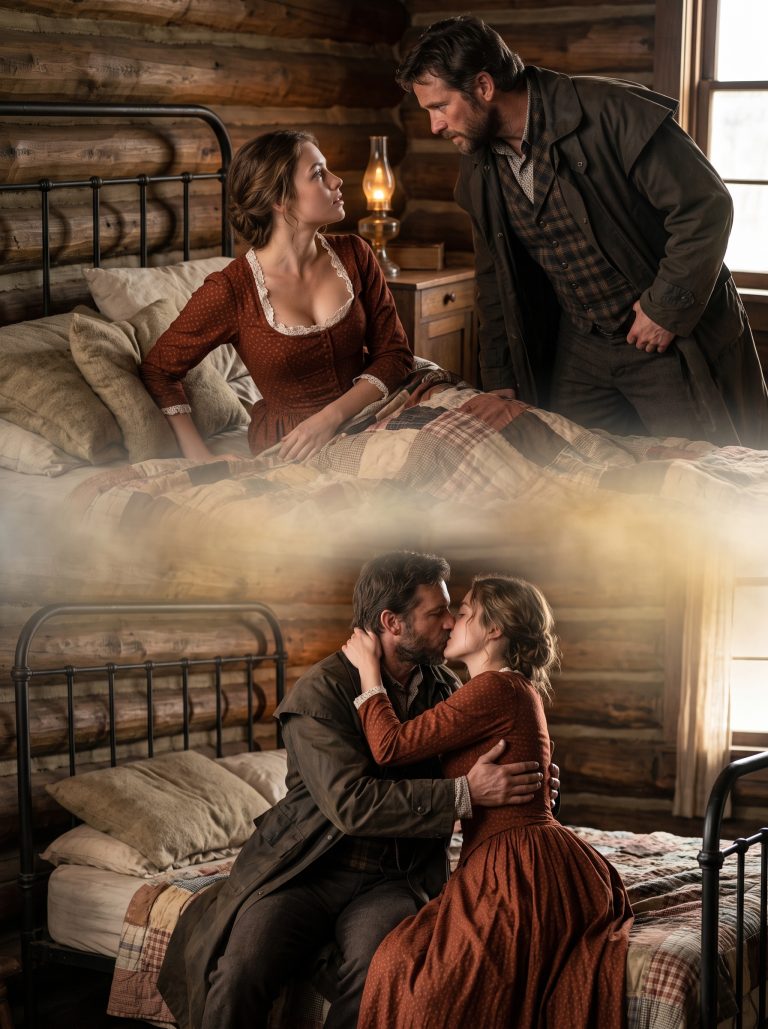
When he kissed her, it wasn’t careful the way it had been on the church steps, asking permission with every inch. This time he simply held her, the way a man holds something he doesn’t intend to put down again.
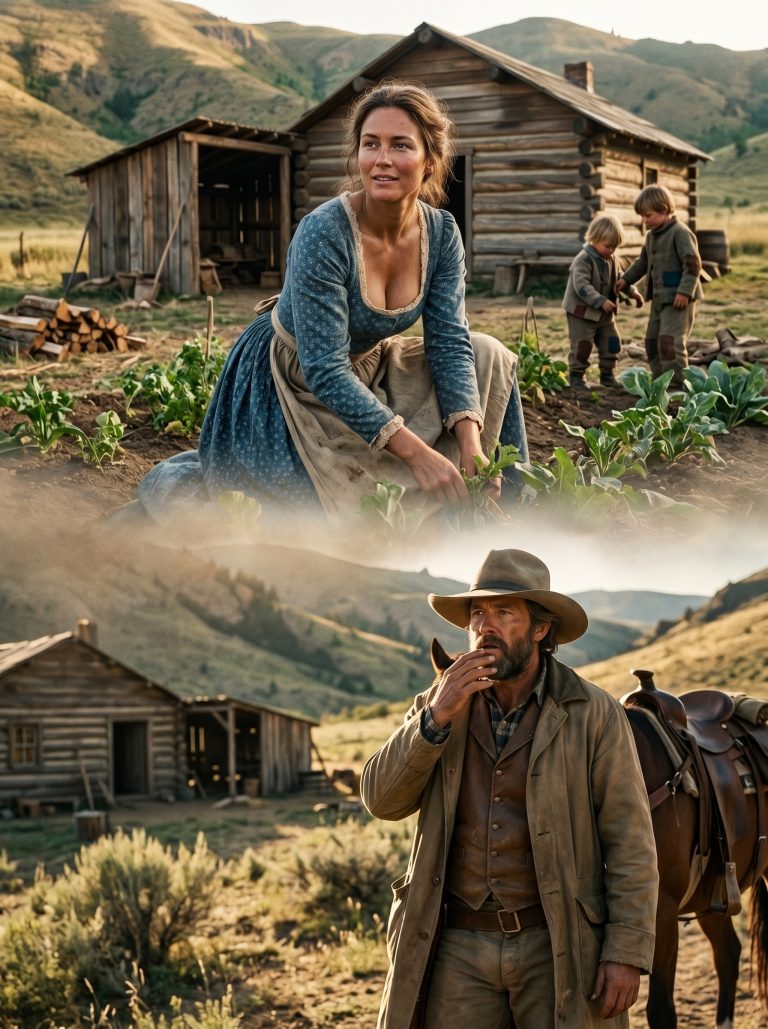
A year on, Elena stood on the porch watching Rose chase chickens across a yard gone green with spring, her daughter’s laugh loud enough to carry all the way to the ridge. Caleb came up behind her, one hand at her waist, and she leaned back into him without having to decide to.
“Storm coming,” he said, nodding at clouds gathering purple over the hills.
Elena smiled.
“Let it come.”
Once, a storm had nearly buried her and her daughter alive. Then hoofbeats had come out of the white — a stranger, a piece of bread, a hand that didn’t ask to be paid for kindness. What she understood now, with her first husband’s ring long put away and Margaret’s ring warm on her finger instead, was this: survival is what gets you through the storm. But it’s the people who kneel down to your level, who wait instead of take, who watch over you even when you don’t know they’re there — those are the ones who teach you how to stop running and finally call a place home.
The End