“They Laughed at the ‘Big Woman With Beggar Hens’—Until the Richest Cowboy Took One Bite and Refused to Walk Away.”

Part 1
Junia Hartwell raised her hand and bought the crate nobody else would touch.
Ezra Vance held it up like a magistrate holding evidence. Seven hens, culled from a dying flock — one blind in the left eye, two with legs bent sideways from a bad hatch, the rest thin and mite-bitten, the kind of birds a decent seller boiled for stock instead of selling at all.
“Sold,” Ezra called, grinning at the crowd gathered in the dust behind Cedar Hollow’s feed store, “to the lady who paid a dollar ten for a funeral.”
The laughter rolled through the yard the way it always did when Ezra started it — obedient, practiced, a little relieved that this time it wasn’t aimed at them. June had heard that laughter her whole life. She was twenty-four, broad-shouldered and broad everywhere else too, and Cedar Hollow had never once let her forget it.
She kept her chin level and did not answer. Answering only fed it.
She had spent her last dollar ten on birds no one wanted because she had watched them shoved to the back of every cage all morning, and something in her had simply refused to let it stand. She stepped forward for the crate, her boot caught a rut, and for one long second it looked as though the birds would spill into the dirt at Ezra’s polished shoes.
She caught them. Arms locked under the crate, breath fast, face burning.
“Careful now,” Ezra said. “Wouldn’t want the ground to give out under you.”
That was when the rider came down off the ridge road.
He didn’t dismount at first. Just sat the big roan gelding at the edge of the yard and watched, and something about his stillness did what nothing else had — it made the laughter falter, then die.
“Mr. Calder,” Ezra said, his voice smoothing over. “Didn’t look for you till the drive.”
Wade Calder didn’t answer him. He was looking at June.
“What’s the joke,” he said. Not a question.
“Just an auction,” Ezra said. “Whole town got a laugh, is all.”
“Forty people laughing at one woman and a box of sick birds.” Wade’s eyes moved slow across the yard, and men who’d been grinning a moment before found reasons to study their boots. “That the kind of morning Cedar Hollow’s proud of?”
He swung down. The crowd parted for him the way it never parted for June.
“Ma’am,” he said, and took off his hat. “Let me carry those.”
“They’re mine. I paid.”
“I ain’t taking them. I’m carrying them. There’s a difference.”
She let him, because her arms were shaking and she was too proud to let the yard see it. He lifted the crate and turned to face the crowd like a man reading a verdict.
“This woman did the only honest thing I’ve seen in this yard all year,” he said. “Y’all laughed at her for it. I heard it from the ridge.”
“She owes half this town,” Ezra said, recovering his footing fast, the way men like him always did. “Rener for her lodging, the mercantile besides. Folks have carried her out of Christian charity and gotten nothing back for their trouble.”
“That true?” Wade asked her. Not over her head — to her.
“I owe Rener four dollars,” June said. “Paying it fifty cents a month. I owe the mercantile nothing. I settled that in March, with washing.” She looked at Ezra. “And I don’t owe charity to a soul in this yard, because not one of you ever gave me any that didn’t come stitched to a sermon.”
Wade counted four silver dollars into Rener’s hand without a word, then turned back to her.
“I’ve got a proposition,” he said. “Hear the whole of it before you tell me no.”
He ran cattle up the mountain — twelve hands, a kitchen gone cold since spring, a garden choked to weeds, a coop standing empty and fox-tight. His last cook had quit in May. He was offering wages, a dry room, and a place for her birds to mend, through the summer drive and not one day longer than she wanted it.
“Why me,” June said. “There’s women in this town who cook fine.”
“Because I watched you catch that crate,” Wade said. “Whole yard waited for you to drop it so they could laugh harder. You didn’t. A person who’ll do that for nine birds that mean nothing to anybody isn’t going to burn my beans.”
Ezra wasn’t finished — he never was. “Ask him why a man with a full ranch’s got no wife,” he called. “Ask him what happened to the last cook. Ask him what happened to the woman before that.”
The yard went still enough to hear the wind.
“My wife,” Wade said, only to June, as though the rest of the yard had stopped existing, “died three winters back. Fever came up the mountain faster than the doctor could. My last cook left because the hands got to whispering the place was cursed. So I’ve been eating ash for two months rather than beg this town for help.”
He turned to Ezra. “That the rest of it you wanted told?”
Nobody answered him.
June had swallowed every cruelty aimed at her that morning without a word. But this one wasn’t aimed at her, and something in her chest came loose.
“I’ll take the work,” she said, loud enough for the whole yard. “You sold these birds laughing because you think broken means worthless, Mr. Vance. You looked at me the same way. I’ve been the culled bird in the corner crate my whole life, and I’ll tell you the one thing I’ve learned about the things nobody wants.” She settled the crate against her hip. “They’re the only things left that still know how to be grateful.”
She turned to Wade. “I’d be obliged for the work, Mr. Calder. And I’ll need that coop, because I don’t intend to lose a single one of these birds.”
Wade put his hat back on, and for the first time in three years, Cedar Hollow saw him almost smile.
Part 2
The mountain road ran four hours of switchbacks, and June rode the buckboard with the crate in her lap the whole way rather than trust it to jostle in the bed. Wade told her the hands wouldn’t be gentle at first — they’d already decided the ranch was cursed, and they’d say things. He could give her a roof and honest wages. He couldn’t give her a world that hadn’t already made up its mind.
“Mr. Calder,” June said, looking down at the birds, “I’ve never once in my life ridden into anything else.”
The ranch came up over the last rise — low house, cold-chimneyed kitchen, a garden gone wild, twelve men drifting out to see what their boss had hauled back from town. She heard the mutters start before she’d even climbed down. She let them land and looked back at every face until the mutters ran dry.
“Name’s Junia Hartwell,” she said. “I’ll be cooking through the drive. I’ll thank you not to mention my size — I’ve heard every version, and none of you is clever enough to find a new one.”
An old hand with a bad leg took his hat off first. “I’m hungry, ma’am. Been hungry since May.”
The kitchen was a grieving man’s kitchen — weevil in the flour, a smokehouse nobody remembered how to run, a garden choked with weeds hiding squash and greens underneath. June looked at the faded curtains, the jars labeled in a dead woman’s careful hand, and understood exactly what she’d walked into and touched nothing of it without asking.
She lit the fire anyway.
By dark she’d fed twelve hands corn cakes, carved ham, and wild greens boiled with molasses, and not one plate came back full. A young hand named Tate, who’d called her a wagon of a woman under his breath at the gate, took one bite and said, “Well, hell,” around a mouthful of corn cake, and didn’t manage anything cleverer for the rest of the meal.
Wade gave her the room that had been meant for his wife’s sewing — dry, real bed, never used. “A woman who can do what you did tonight doesn’t sleep by the fire on my ranch,” he said, and thanked her, at the door, for lighting it.
She carried the hens to the new coop and set them in one by one, feeding the crooked-beaked rooster from her palm in the dark so the others wouldn’t crowd him off his share.
“You’ll heal here,” she told him. “We both will.”
Nine days later she found the first egg, warm, under the blind hen. By the end of the third week there were three a morning, the garden was bearing, and Wade Calder had started sitting at the far end of his own table again, coffee in hand, twice caught almost smiling before he remembered himself.
Part 3
The trouble started with a man named Dorsey, who said something ugly about June’s size through the bunkhouse wall and found his breakfast plate empty the next morning.
“You don’t cook for a man who calls me a sow,” June told him, and when Wade heard why Dorsey was packing his kit before noon, he didn’t ask twice.
“He’ll go to Vance,” June said, watching the man ride down the mountain.
“Likely,” Wade agreed, and that was when he told her the rest of it — that Ezra Vance wasn’t only an auctioneer. He bought every head of cattle within sixty miles because no other buyer stood between the valley and the railhead, and he sat on the bank besides. He’d been circling the Calder ranch for two years, waiting for a bad season to call the note.
“And now he’s got Dorsey singing whatever he’s paid to sing,” June said.
The supply wagon stopped coming eight days after that. Ezra had bought into the mercantile and told the owner no ranch keeping “a woman of low character” would be supplied through his store. It was starvation dressed up as morals, and June recognized the shape of it at once, because cruelty always wore the same three or four coats.
“He’s cut the supply,” Wade said in the yard, hollowed out. “No supply, the men quit. No men, no drive. No drive, no cattle sold — and the bank takes the ranch in fall.”
“He hasn’t cut the land,” June said. “We’ve got a garden coming on heavy, hens laying, a smokehouse I know how to run now, and a creek full of fish. Mr. Vance spent his whole life learning to take. He never once learned to make. A man like that is helpless in front of people who know how to build something out of nothing.”
She sent Wade and Tate down with what little cash they had and they came back with thirty-one of the sorriest culls Ezra had ever been glad to sell off laughing. June sorted the truly sick from the merely neglected and set to work rendering fat, curing salt pork, testing cornmeal until it crackled right — turning the ranch’s kitchen into a small, determined war room.
The valley supper Ezra had organized to shame the Calder name in front of everyone became, instead, the place June meant to answer him.
They came in last, on purpose, and were given the worst table, at the far edge of the yard, exactly as June had wanted — because the wind carried the smell of frying chicken clean across every other table in the churchyard.
Children came first, drawn by the smell. Then a miner, then a widow. June fed them free, saying only there’s plenty, until Ezra climbed onto a chair to remind the valley who was cooking their supper and why they ought to be afraid of her.
“That man’s name is Dorsey,” June said, cutting him off before he’d finished. “Mr. Calder let him go for calling me a sow through a bunkhouse wall. He found you because bitter men always find each other. So let’s not call him a witness, Mr. Vance. Let’s call him what he is.”
She turned to the crowd, picked up a piece of chicken, and ate it slowly in front of every soul who had ever laughed at the way she ate — the one thing she’d spent her whole life making sure nobody watched her do.
“Still standing,” she said. “Who’s hungry?”
It was Eleanor Pike who broke the silence — eighty years old, thirty years cooking for the church, who took one bite, closed her eyes, and said she hadn’t tasted a hand like that since a blizzard winter three decades back, when a young widow named Margaret Hartwell had walked the valley door to door feeding families on nothing but scraps and culls, June’s mother among them, and June had never once been told, because shame doesn’t advertise the good it once did.
The dam broke after that. The whole yard came to eat.
Ezra Vance, watching his crowd walk away from him for the first time in his life, played his last card.
“This is the note on your ranch, Calder,” he said, pulling a folded paper from his coat. “Bought the whole debt off the bank Tuesday last. Every acre, every barn, your wife’s grave included. Thirty days to pay in full, or you’re off my mountain.”
That night, going through the tin box June had finally coaxed open, they found more than receipts.
They found letters.
Sarah — no, Rose Calder’s mother had written to her twice in the last winter of her illness, and tucked behind the second letter, still sealed, was one addressed to Ezra Vance himself, dated the week Rose died. In her own hand, weak and hurried, Rose had begged him — as the only man in the valley who owned a wagon fast enough to reach the doctor in Millrace before the pass snowed shut — to send for help. Ezra had written back four days later, after the pass had already closed, offering his sympathies and, in the same letter, a generous price for the Calder water rights, now that the ranch would surely be needing cash.
He had known the letter would arrive too late to matter for anything but the land.
June read it twice to be sure, then set it down very carefully, because some things were too heavy to hand a man all at once.
“He didn’t just try to take your ranch, Wade,” she said. “He let your wife die waiting on him, and then he wrote you a letter about water rights instead of a doctor.”
Wade didn’t speak for a long time. When he did, his voice had gone somewhere flat and terrible.
“He was in this valley the whole time. He could’ve ridden for the doctor himself.”
“He could have,” June said. “He chose the water rights instead. And I expect that’s the debt Ezra Vance has spent three years trying to bury under a paper one. It’s a great deal easier to be a man who calls in a note than a man who let a woman die for a price.”
They did not go to Wade’s grief with guns. They went to Judge Harlon, who Eleanor Pike’s late husband had once clerked for, together with Rose’s letters, a frightened bank clerk named Amos Tilly who’d been keeping two sets of books under threat for nine years, and Dorsey himself, who came up the mountain hollow-eyed to confess what he’d seen: a lead weight fitted under the cattle scale, and Ezra altering the ledger through his own office window more nights than he could count.
The hearing was held in the church, packed to the doors. Judge Harlon laid the true daybook beside the altered one and read the difference aloud — a four-hundred-dollar debt, paid down for years, inflated on paper to two thousand; a ten-thousand-dollar ranch nearly taken by the stroke of a pen. He read Dorsey’s sworn statement about the scale. And last, because June asked him to, quietly, before the session opened, he read Rose Calder’s letter and Ezra’s reply, side by side, so the valley would understand exactly what kind of man had been sitting in judgment of who deserved to be fed.
Ezra Vance did not have an answer for the ledgers. He had even less of one for the letter.
“I’ll take the books over the man,” Judge Harlon said. “I always have. It’s the whole of my job.” He declared the note void, the foreclosure fraudulent, and ordered a full accounting of fifteen years of altered books — and, separately, referred the matter of the unanswered letter to the county attorney, for whatever the law could still reach after three years.
It ended without a shot fired. It ended with arithmetic, a dead woman’s own careful hand, a frightened clerk’s late courage, and a plate of fried chicken that had made an entire valley brave enough to remember what it already knew.
Wade found June outside the church afterward, in the last of the evening light.
“You gave me back more than the ranch,” he said. “You gave me the truth of it. I don’t know if that’s a gift or a wound yet.”
“Both, probably,” June said. “Most true things are.”
“I don’t want you cooking for me anymore,” he said. “I want to build something with you. Half of everything — the land, the kitchen, your name on the paper next to mine.”
Nobody had ever offered June a future without first asking her to make herself smaller to fit inside it.
“Then we’ll build it,” she said.
They raised a supper house together on the trail road that fall, where drovers and freight wagons passed, a place any hungry soul could sit and eat whether they carried a coin or not. Ranchers Ezra had cheated for fifteen years brought lumber and labor and would not take a cent for it, because feeding June back, they said, was the whole point.
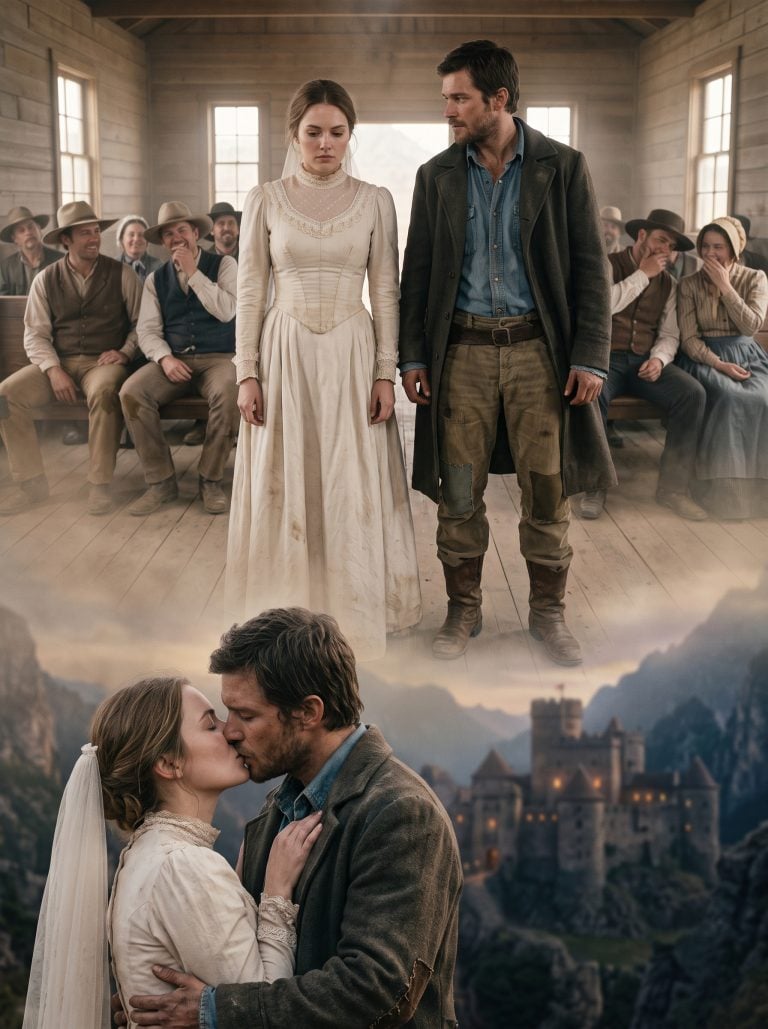
The sign over the door read Hartwell & Calder’s Table — her name first, as Wade had promised — and on the morning it opened, Judge Harlon married them on the porch in front of the whole valley, and Wade Calder kissed his wife in full daylight while every hat in the yard came off and nobody laughed.
Near evening, June saw Ezra Vance standing at the edge of the yard. The county attorney’s inquiry had taken the bank from him and would take a good deal more before it was through; his coat was worn, his face thin, and the hunger in him now was not the kind that earned any sympathy.
She sent him a plate anyway.
Wade watched her do it, troubled. “After what he did,” he said. “After what that letter said.”
“He is a small, hard, hollowed-out man,” June said, “and what he did to Rose is between him and the law now, not me. I spent my whole life standing outside in the cold, watching everyone else be warm. If I ever got let in, I promised myself I wouldn’t be the one who kept somebody else standing out there — not even him. It costs me nothing to feed a man. It would cost me everything to become the kind of person who wouldn’t.”
She did not let him back inside. She fed him at the edge of the light every night for the rest of his diminished days, and in time the valley understood that both the feeding and the distance were the same mercy, offered by a woman who had finally decided her own worth had never once depended on what a crowd was willing to give her.
The Table never had an empty seat again. Children who’d once laughed in that auction yard grew up and brought their own children to eat under a sign that read her name first, and told them, when they asked, about the fat girl who bought the broken chickens, fed a whole valley that had thrown her away, and never once shrank herself to fit anybody’s idea of who she should have been.
THE END