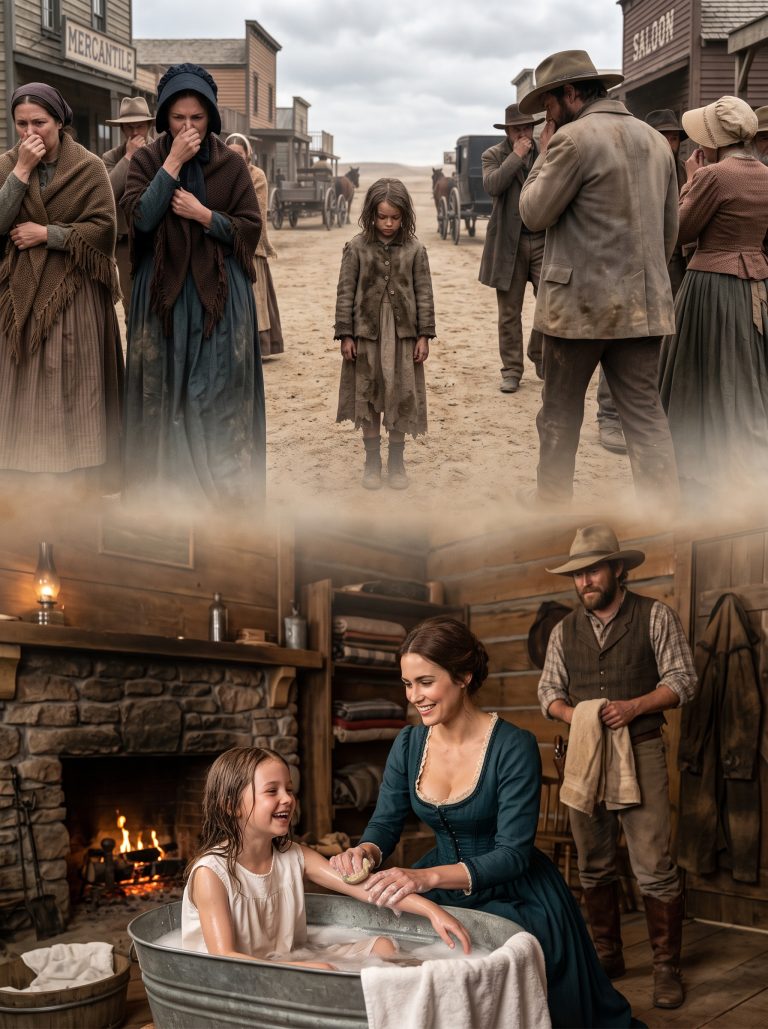
They Thought She Was Just a Virgin Bride From the City… Until They Saw the Bruises She Tried to Hide — What 3 Mountain Men Did Next Shocked Everyone

Part 1
The stage rolled to a stop in front of Larkspur Hollow’s mercantile, and Adelaide Ashcombe stepped down into a town that smelled of pine sap and horse sweat and nothing at all like Chicago.
She was twenty-one years old, and she had spent the last of her mother’s brooch money getting here. Under her traveling coat, a cracked rib from six weeks ago still ached when she breathed too deep. She kept one gloved hand pressed flat against her side, not for balance, but to remind her body to stay quiet.
Three men waited at the edge of the boardwalk.
They were tall and sun-weathered, watching her the way men watch a storm coming — carefully, and without moving toward it. Her fingers found the little folding knife she kept sewn into her cuff.
The oldest of them noticed.
He didn’t reach for anything. He lifted both hands instead, palms out, empty.
“Ma’am,” he said, quiet enough that only she could hear it, “you’re free to get right back on that stage, and not one of us will say a word to stop you.”
Adelaide had spent her whole life learning to fear gentle voices. Her uncle’s had been gentle too, the first time he’d shut the parlor door.
She didn’t get back on the stage. She made herself look at all three of them instead.
The one who’d spoken was near his mid-thirties, dark-haired, a thin scar along his jaw, and eyes the pale gray of creek stone. The second was younger, sandy-haired, with a piece of grass between his teeth and the restless look of a man trying too hard to seem harmless. The third, youngest of the three, said nothing at all. He carried a folded blanket in both hands and watched her with an attention that didn’t ask for anything back.
“Silas Cole,” the eldest said. “This is Finn Doyle, and that’s Micah Vance. We were told to expect a Miss Adelaide Ashcombe.”
“That’s me.”
“There’s been some confusion on our end about who exactly was meant to greet you,” Silas said. “I want you to know that before anything else. There’s a hotel two streets over. Clean room, honest woman running it. I’ll walk you there myself and leave you be till morning, if that’s your preference.”
Preference. Nobody had ever offered her that word before.
She opened her mouth to answer, and the street tipped sideways under her.
Six weeks of bad food and worse sleep, a rib that hadn’t healed right, a fever she’d been refusing to name since Cheyenne — her body simply stopped asking her permission. She felt herself falling and then she wasn’t falling, because Micah Vance had crossed four feet of dust without a sound and caught her before she hit the ground. His hands didn’t grip. They only held, the way a man might hold water he was afraid to spill.
“Easy,” Silas said, close now but still not touching her. “Set her on the bench, Micah. Slow.”
Finn crouched beside her, and for once his mouth wasn’t running. “She’s burning up,” he said. “Silas, she’s burning up.”
“I see it.”
“That ain’t tired. That’s sick.”
“I see it, Finn.”
Adelaide’s eyes fluttered open to three faces at three different distances, none of them too close.
“Do you have somewhere else to go?” Silas asked her.
It was such a small question. It broke something in her anyway. One tear slid sideways into her hair before she could stop it.
“No, sir. I sold everything to get here. There’s no road back.”
Something settled in Silas’s face, like a man setting down a weight he’d already decided to carry. “Then here’s what happens. We take you up to the cabin, because you cannot be sick alone at a hotel. You’ll have your own room. A lock on the door, and you’ll hold the key. Micah sleeps in the loft, farthest away. Finn takes the porch. I take the chair by the fire. There’s one door out, and it’s yours to open or not.”
“Why?” she whispered.
Silas looked at Micah. Something passed between them that didn’t need words.
“Because someone has to,” he said. “And because once, a long time ago, nobody did, for somebody I loved.”
He didn’t explain further. She let them lift her into the wagon anyway. She did not let go of her travel bag, and inside it, wrapped in her mother’s shawl, a cracked leather journal rode against her heart like a second, slower pulse.
The cabin sat low and dark-timbered against a bench of land, smoke curling from its chimney. Her room had white walls, an east-facing window, and a quilt pieced from mismatched scraps that had clearly been sewn by someone who had never sewn a quilt before and had done it anyway. Wildflowers, already wilting, stood in a tin cup on the sill.
Picked for her, though nobody had known her name until that morning.
A note waited on the dresser the next day, in careful, schoolmaster handwriting:
Miss Ashcombe — Tea is mint. Bread is fresh. I will not knock unless you call. One ring of the bell means yes. Two means no. Three means something is wrong. You are safe. — M. Vance
Adelaide read it three times, then held the little bell in both hands like something alive, and for the first time since her father died, she let herself cry loud enough to be heard through the wall — and nobody came to stop her, and nobody came to fix it. Somebody only set the kettle on, so that whenever she was ready, something warm would be waiting.
Part 2
By the second week, Adelaide had mapped the cabin the way a person maps a country they’re deciding whether to trust. She knew which floorboard creaked under Finn’s boot. She knew Silas kept a chipped blue coffee cup in the exact same spot on the mantel every morning. She knew none of them ever crossed the threshold of her room, not even when the door stood open.
Her room was hers. That had never once been a rule in any house she’d lived in.
She learned, too, that Micah had not spoken since before she’d met him — three years, Silas said, though he wrote notes in a careful hand and understood every word spoken to him. “He’s the kindest of us,” Silas told her. “You’ll never need to be afraid of him.”
The bruises faded to the color of weak tea. The fever broke. Adelaide began leaving the cabin — the porch first, then the garden, then the paddock fence, where Silas taught her to hold her palm flat for the gray mare and not flinch at warm breath on her skin. She laughed, once, short and startled, and put a hand over her mouth as if she could catch the sound and put it back.
Then, on a gray Tuesday, a rider came up the road in a city coat.
He was a clerk, hired out of Cheyenne, carrying a letter and a question: had anyone seen a young woman answering to the name Adelaide Ashcombe? A reward was offered, on behalf of her uncle and lawful guardian, Reginald Ashcombe of Chicago.
Silas sent the clerk back down the mountain with the letter unopened and a warning in his pocket. That evening, in the cabin, he opened it in front of her.
The letter claimed Adelaide suffered from hereditary nervous affliction — the same illness, it said, that had taken her mother. It claimed she had, in her grief, administered something to her father in his final illness, believing it medicine. It claimed papers were filed. It offered payment for her return and threatened harboring charges against anyone who sheltered her.
“He’s protecting himself,” Adelaide said, very quietly. “He’s saying I did it, so no one asks what he did.”
“Do you know what he did?” Silas asked.
“I know what my mother believed.” She looked at the bag by her feet. “It’s in the journal. Some of it in pencil. Some of it hidden — she used to write with lemon juice when I was small, like a game. She called it ghost writing. She said some things weren’t safe to write where anyone could see them.”
Silas didn’t reach for the journal. He set his hand open on the table instead, palm up, where she could see it.
“You don’t have to read it tonight. You don’t have to read it ever. But if you decide to, you won’t do it alone.”
Adelaide placed her hand over his — the first time she had touched any of them on purpose — and opened the book.
Part 3
They sat at the pine table for three hours. Adelaide read aloud when she could. When her voice gave out, Silas read for her. Finn kept the lamps trimmed. Micah brought tea, then bread, then tea again, because none of them had thought to eat.
The early pages were her mother’s ordinary hand — recipes, visitors, the day Adelaide took her first steps. Then the entries changed. Smaller writing. Initials instead of names.
R came to dinner again. A is looking thin. R insists on pouring the wine himself, to spare the servants the trouble.
A had a bad night. Vomiting. He says it’s the oysters. He has not had oysters in a month.
R asked me in the garden whether I thought A had made arrangements for Adelaide, in the event. I told him A is in the prime of his life. R smiled and said, of course, of course. One never knows.
Adelaide had to stop there. Finn brought a basin before she asked for one. Micah held her hair back with the practiced gentleness of a man who had done it for someone before, though he never said for whom.
When she could speak again, she asked Silas to hold the last blank pages to the candle flame. Brown letters rose slowly out of nothing, the way they had when she was a child playing games at her mother’s knee, except this time the game was not a game.
Reginald came to me tonight in a state I have never seen him in — not calm, not smiling. He wept, Adelaide, if you can credit it. He said a man named Pruitt has ruined him at cards and holds notes on nearly everything he owns, and that Pruitt has told him there is a way to clear the debt if Augustus should happen to die before the year is out, with the estate settled favorably. Reginald swears he has taken no part in anything. I do not believe him, and yet I do not think he has the stomach to have done this alone. I believe there is a hand behind his hand. I do not know Pruitt’s Christian name. I only know he calls at the house on the first of every month, always after dark, and always leaves with a bottle of Augustus’s good port under his coat, as though it were payment for something.
The room went still.
“Pruitt,” Silas said slowly. “The solicitor’s name, on the letter your uncle sent — it was witnessed by a W. Pruitt.”
Adelaide’s hands went cold. She had assumed, all these months, that the shape of her grief had one face on it — her uncle’s, soft-handed and smiling. It had never once occurred to her that Reginald Ashcombe might have been afraid too, in his own small, cowardly way, of someone worse than himself.
It didn’t make him innocent. It only meant the truth had more rooms in it than she’d known to look for.
Two days later, word came up the mountain with Finn, who’d ridden down for flour and come back pale. Reginald Ashcombe was in Larkspur Hollow himself, registered at the hotel under a false name, traveling with a hired man wearing a badge that didn’t belong to him. And traveling with him — quiet, precise, never at the front of any room — was a narrow gentleman who signed the hotel ledger as W. Pruitt, Attorney.
They did not run. Silas said it plainly: running would only prove every lie Reginald had told about her. Instead, he rode down and asked Mrs. Kessler, who ran the hotel and missed nothing, for the use of the meeting hall. He wrote one letter, addressed to Reginald, laying out what the journal held and what would happen to copies of it if Reginald refused to answer for himself in front of the town.
I will be there, came the reply, unsigned.
The hall was full the next afternoon. Adelaide wore the same navy dress she had arrived in, mended now, the seams let out where the bruises had once been. Reginald sat in the front row, thinner than she remembered, wearing the tired, noble expression of a man performing grief. Beside him sat the false marshal. Two rows back, alone, sat Pruitt — narrow-shouldered, watchful, a man who had clearly spent his whole life being underestimated in rooms and using that against everyone in them.
Silas stood on the floor before the platform, not above anyone, and asked Adelaide to stand.
Reginald rose first, uninvited, and began the speech he’d clearly rehearsed on the long ride west — the sad errand, the hereditary affliction, the grieving niece not in her right mind.
“Stop,” Silas said. One word. Reginald kept talking. Silas said it again, harder, and Reginald sat, jaw working.
Adelaide read the journal herself this time, start to finish, her voice growing steadier with every page, until she reached the candle-lit words about Pruitt. When she read Pruitt’s name aloud in a public hall, something in his posture changed — not fear exactly, but the recalculating stillness of a man watching a door close that he had believed was always open to him.
“That is a private letter,” Pruitt said smoothly, standing at last, “written by a grieving, possibly unstable woman, about a debt her husband misunderstood. I have never met Miss Ashcombe in my life.”
“No,” Adelaide said. “You made sure you never had to. You let my uncle be the hand people saw, so no one would ever look past it to find yours.”
It was Finn, of all people, who’d done the quiet legwork that made the rest of it hold. He’d spent two days riding between Larkspur Hollow and the county seat, tracking down the notary who’d witnessed Reginald’s gambling debts, and had come back with sworn statements that the debts had all, eventually, been bought up — every one of them — by a company registered to no one but Whitmore Pruitt.
A telegraph line ran to Cheyenne. Cheyenne had a line to Chicago. By the time the federal marshals arrived on the four o’clock coach — real ones, this time, with real papers — they came already carrying a wire naming Pruitt as the architect of a scheme to seize the Ashcombe estate through forged debt and a slow, deniable poisoning, with Reginald Ashcombe as his frightened, complicit instrument.
Pruitt did not run. Men like him rarely did; they simply recalculated, all the way to the end, looking for the angle that would let them walk out the door anyway. There wasn’t one. He was taken quietly, the way he had always done everything.
Reginald wept when they took him, and Adelaide found she believed the tears were real, and that they changed nothing at all. He had known. He had been afraid, and weak, and he had let it happen rather than be the one it happened to. Fear did not undo the choosing. She said as much to him, once, in a low voice, before the marshals led him out — not for his sake, but for her own, so the words would exist somewhere outside her own head.
“You could have written to my father. You could have told him. You chose silence because silence was safer for you. I hope it was worth what it cost.”
He had no answer. She did not wait for one.
The trial took the better part of a year, first in the territory and then, by extradition, in Chicago. Adelaide went in her own time, with Silas beside her the whole way east and back. She testified. The journal was entered as evidence, hidden pages and all, read aloud in a courtroom the way it had once been read aloud in a mountain cabin — carefully, and never alone. Pruitt was convicted of fraud and conspiracy to murder. Reginald, for his complicity and silence, was sentenced to a long term at hard labor; he died there, four years in, and Adelaide felt, when the letter came, mostly a kind of tired quiet, the way a house feels after a storm has finally passed rather than after it has been won.
She came home to Larkspur Hollow in the spring.
In the autumn of that same year, in the small white church in town, with Mrs. Kessler weeping happily in the front pew and Finn standing as best man, Adelaide Ashcombe became Adelaide Cole. Micah, who by then had not stopped talking in nearly a year, read a poem he’d written himself, his voice still finding its new shape after three years of silence, and did not falter once.
She kept the journal. She did not burn it, though she’d once thought she might. Instead, years later, she added a page of her own to the back of it, in plain ink, meant to be read by no one in particular and everyone who might someday need it:
If you have come to this house with nowhere else to go, know this: the men here were taught that a woman’s body is hers, her choices are hers, and her story is hers to tell in her own time, to whoever she decides has earned the hearing of it. Fear can look gentle. So can safety. The difference is that safety never asks you to stay quiet about what hurt you. It only asks you to rest, for as long as you need, with the door unlocked from the inside.
She set the journal on the shelf beside the family Bible, where it stayed, for the rest of her life, within easy reach.