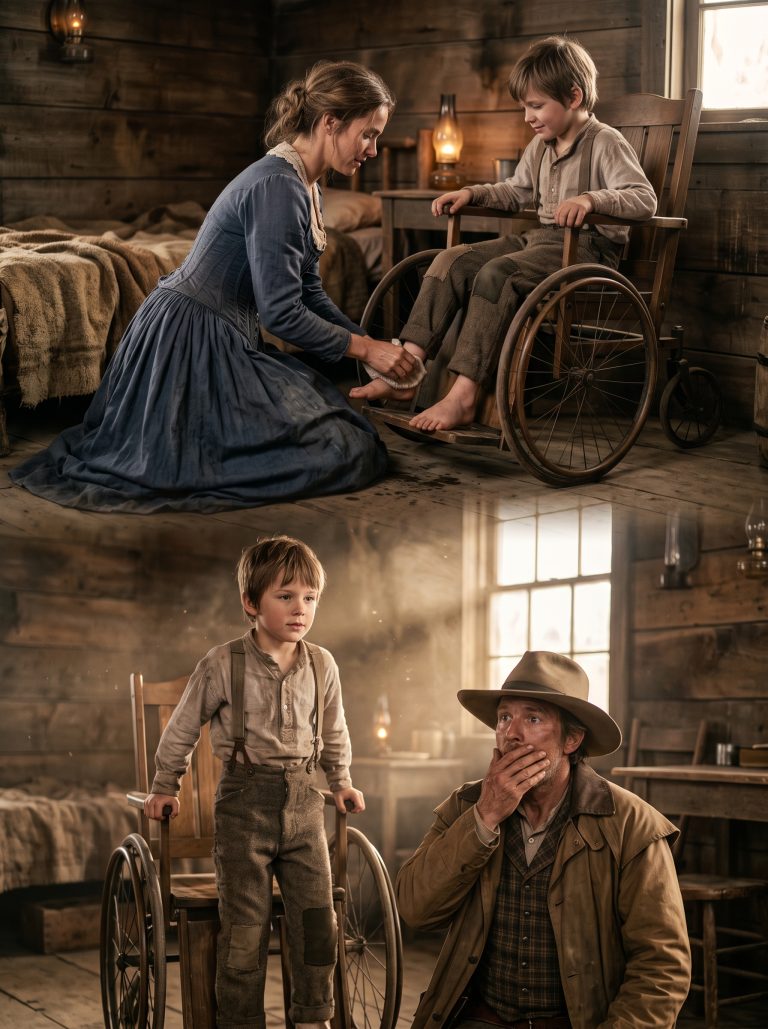
“Would a Husband on Paper Keep Him Off Your Land?”—His Offer Changed Everything

PART 1
Thomas Owens chose Thursday morning on purpose.
He chose the main street, in front of the feed store and the dry goods and the post office, because a woman corrected in public stays corrected. He had the land office paper folded in his coat, and he had his brother’s widow’s whole future folded into his voice when he stopped her wagon in front of half the town.
“The claim is beyond you now,” he said, loud enough for the postmaster to look up from his window. “Five years, proved by two credible witnesses before the register — that’s what the law asks. I can find witnesses enough to swear this ground’s had no man’s plow in it since my brother died. I’m prepared to help you settle the matter cleanly — if you’re reasonable about it.”
Julia’s daughter, Ada, was six, and she gripped the hem of her mother’s coat the way she did when she didn’t understand the words but understood the danger in them. Luke, eight, held the grocery list like it was something solid he could hold onto instead.
Julia didn’t raise her voice. She never did, and that was the thing about her that made men like Thomas underestimate her twice.
“The land is mine,” she said. “And the children’s. I intend to keep it so.”
She said it once. She didn’t repeat herself. Thomas folded his paper back into his coat like a man closing a ledger he still expected to win, and rode out of town. The street rearranged itself the moment his horse turned the corner — the careful shuffle of a crowd pretending it hadn’t been watching a woman get threatened over dry goods and dead men’s land.
Frank Hale saw the whole thing from the boardwalk, a paper sack of hardware fittings in his arm, and he did the one thing that mattered: nothing, until it mattered. He didn’t cross the street while Thomas was still talking. He didn’t put himself between a widow and her brother-in-law, because that ground was hers to hold, not his to borrow. But when Thomas’s horse turned the corner and Julia’s flower sack slipped off the wagon rail, Frank was there before it hit the dirt. He set it back in the wagon bed without a word, touched his hat once, and stepped back like he hadn’t done anything worth thanking him for.
Julia looked at him a moment longer than she needed to. Then she loaded her children and drove the twelve miles home, and that was Thursday.
Friday, Frank came past on his water route — the job that kept him narrow on purpose: a rented room behind the livery, his team boarded below it, two blankets and a trunk, a life built small enough that nothing in it could be taken from him because nothing in it was worth taking. He’d known Julia’s husband the way men out here know each other — by the wave across a fence line, by a borrowed tool that came back before it was asked for twice.
He found her at the north fence, testing posts the wind had loosened, and he didn’t ask permission before he climbed down and started testing them with her. One held. The next held. He looked toward the house, where the curtain wasn’t quite still, meaning the children were watching, meaning she already knew that.
“Would a husband on paper keep him off your land?” he asked.
Julia pulled the wire taut and didn’t answer right away. When she did, her voice was as level as the fence line.
“It would have to be filed quickly.”
Frank nodded, like he’d already worked that much out on the ride over. “His whole case is witnesses. Married, that argument dies before he can raise it. I live here, I work here — I’ll swear to it myself. He’d have nothing left to bring.”
Frank told her exactly what he’d put his name to and exactly what he wouldn’t ask for after. And then he said the part that made her go still, the part that told her he understood precisely what he was offering and precisely what he wasn’t.
“The children stay where their father is buried,” he said. “That’s the shape of it.”
Julia looked down the fence line — a long run of it still needed mending, and the stock had been restless for a week, and Thomas Owens’s voice was still sitting somewhere behind her ears, loud and certain of itself.
“Come to supper,” she said. “We’ll settle the rest after.”
He nodded, and went back to his wagon, and she went back to the fence — and neither one of them, not yet, could have said what they’d just agreed to build.