“After She Whispered ‘Let Me Wash His Foot,’ The Paralyzed Boy Did Something His Father Never Dared To Hope For…”

Part 1
The creek bed was dry, split clay curling up like old paper, gravel showing pale where water used to run. Wren Vaas sat against a cottonwood and ate the last heel of her bread, two days old, hard on one side. She ate it slowly, the way a person eats something when there will not be more.
Somewhere east, past a line of brown hills, was a town called Grovers Creek, and beyond it, a ranch that needed a cook. Wren did not let herself hope about it. Hope was a thing she had stopped spending on anything not yet in front of her.
Before she stood, she noticed the stakes.
They were driven into the dry creek bed at intervals she could not explain — thin wood, red ribbon tied at the top, spaced every twenty paces along the old waterline, running east toward the hills. Survey stakes. She had seen enough of them in three years of drifting to know the shape of men marking land for something. She did not think about it long. Land got marked for all kinds of reasons, and none of them had ever been hers to ask about.
She tightened her boot and started walking.
Her father, Ezekiah Vaas, had been Cherokee, a trader and a quiet healer who never advertised and never promised what he could not deliver. He had owned two hundred acres east of Grovers Creek — good land, with a spring that ran clear through seven months of the year — and he had built a house on it with his own hands. He had taught Wren everything: the ledgers, the trading routes, and the healing work he’d learned from his grandmother. Warm water. Yarrow. Salt. Pressure at the ankle and the arch, patient as prayer.
“The spine can be shocked without being broken,” he told her once, when she was fourteen. “The body forgets how to send the signal. We are not fixing anything. We are reminding. We just keep asking until it remembers.”
He died three winters ago, pneumonia in his chest that would not let go. Within three weeks his brother Cyrus arrived from the Eastern Territory with a county clerk, and within a month Wren was off the land — unmarried, mixed-blood, with no man to speak for her in a county that gave her words no weight. She tried twice to challenge it. Both times she was told to leave before she finished speaking.
So she walked. Laundry for a logging camp. Cooking for a road crew. A hotel that let her go without her last week’s wages. Her body thickened on bad food and cold water; her hands roughened; she kept her hair under a plain cloth and her name behind her teeth, because speaking her name too loudly had only ever brought trouble.
Hadley Ranch sat at the end of a two-mile road, the name cut plain into the gate. Fletcher Hadley opened the door himself — tall, weathered, closed like a man who gave nothing away until he decided to.
“You the woman from town about the cooking?”
“Yes.”
“Can you cook? Laundry too, weekly.”
“I can do that.”
He walked her through the house without much talk — kitchen, lean-to laundry, supply shed — until they stood in the hallway that ran toward the front of the house. At the far end was a closed door. He stopped there and did not raise his voice.
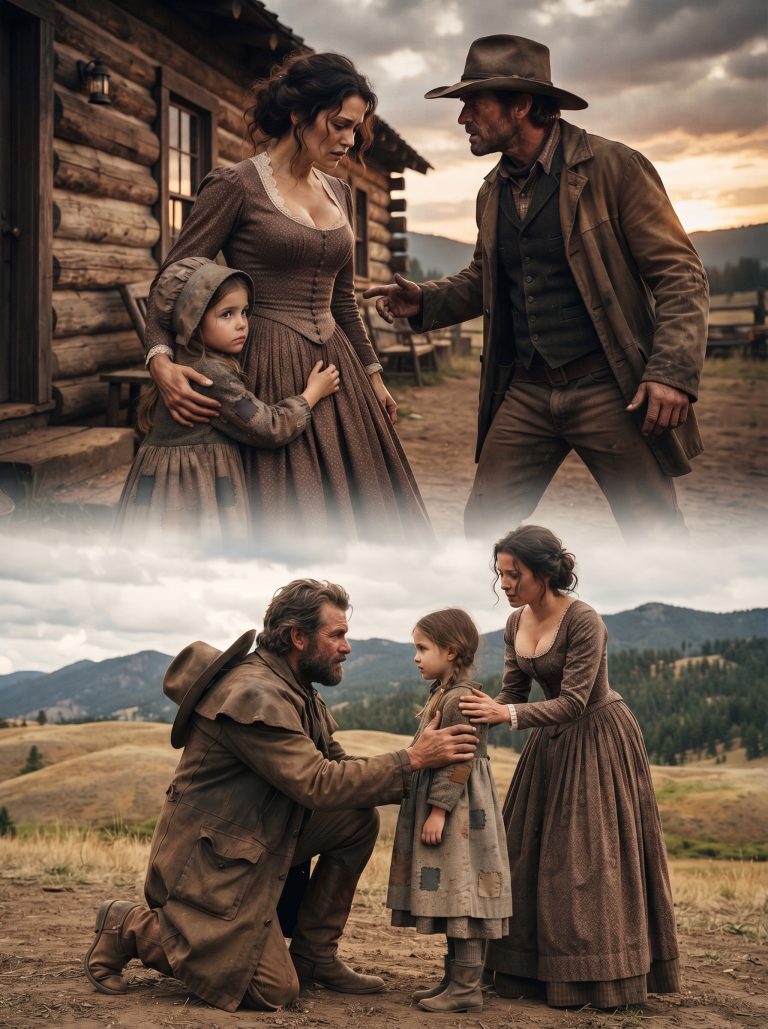
“My boy is at the end of that hall. He is not well, and he does not need anything from strangers. You do not go to that end of the hallway. Not to clean. Not to bring food. Not if you hear something and think you should check.” A pause. “Not even if he calls out.”
Wren looked at the door, then back at him. “All right.”
He nodded once, told her the wage — fair, not generous — and left her to the kitchen.
That night, after the ranch had gone as quiet as it would go, she heard it: a low sound from behind the closed door, rhythmic, private, not crying and not a call for help. She knew that sound. Her father had described it — a paralyzed limb cramping in the dark, the body working against itself while the person could do nothing to relieve it.
She lay still and did not move toward it.
She thought instead of the stakes in the dry creek bed, red ribbon fluttering over cracked clay, and wondered — for no reason she could name yet — whether they had anything to do with why the water hadn’t come this year at all.
Part 2
Two weeks passed. Wren learned the ranch by watching — when Fletcher rode out, when the hands took the wagon, which doors stuck. She cooked, cleaned, did laundry Tuesdays and Fridays. She did not go to the end of the hallway.
Then, in the third week, the door opened a crack.
The house was empty — Fletcher gone to town, Orson and the hands out mending fence. Wren was carrying linens past the junction when she heard it: effort, deliberate, daytime. She turned her head.
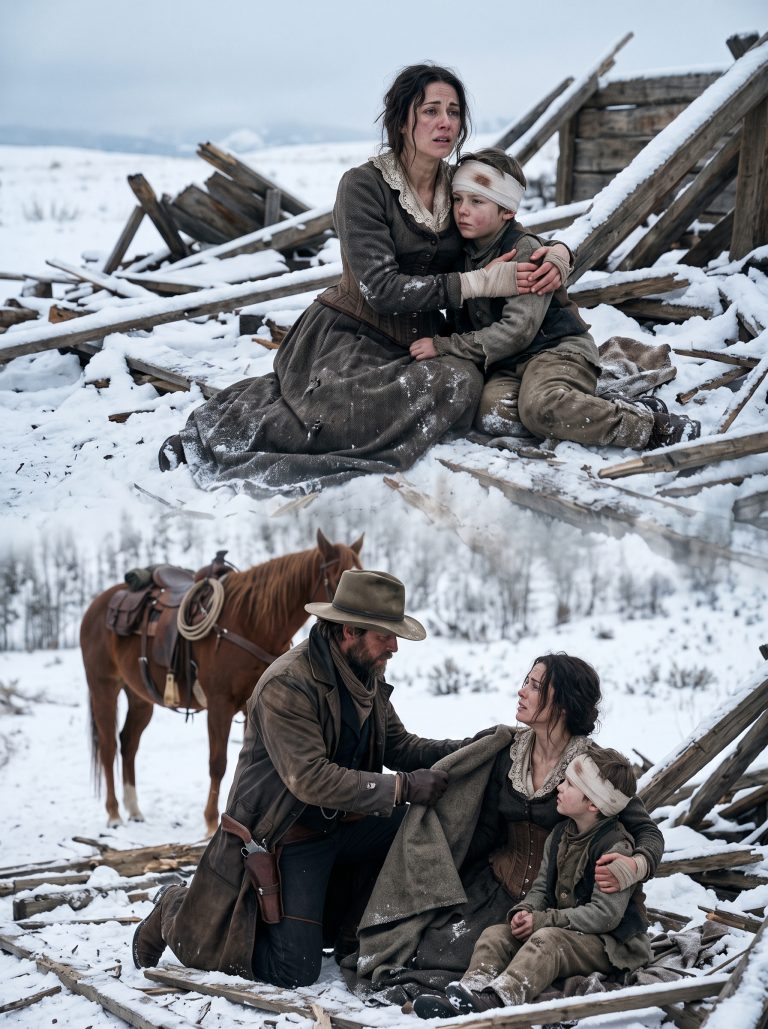
Through the gap she saw a rolling chair, a small hand gripping the armrest until the knuckles whitened, and a bare foot on the footrest, toes curled inward the way a foot curls when no muscle holds it straight.
The boy was trying to lift it.
His arm shook with the effort of forcing something that would not answer. Then he let go, and his head dropped the way a head drops when there is nothing left to push against.
Wren walked back to the kitchen and stood with both hands flat on the worktable.
Her father had turned this exact stillness — a dead sleeping foot, a shocked nerve, not a severed one — into two men walking who should not have walked. Warm water. Yarrow. Salt. Willow bark. Pressure held for ten, released, moved.
She went to the supply shed and found all three. She held the yarrow a long moment.
Then she put it back.
That night she lay awake anyway, thinking of a rash she’d once recognized at a feed store two counties back and said nothing about, because offering knowledge meant offering trust, and trust was not something she assumed anymore. The boy had still had the rash when she left.
There was a difference, she thought, between not being able to do a thing and choosing not to. She had spent three years calling the second the first, because it asked less of her.
She did not know yet which this was.
The question did not get smaller by morning. But when Tuesday came again and the house went quiet, she filled a pot with water and set it on the stove.
Part 3
She started slow, the way her father had taught her — testing the water against her wrist twice before she trusted it. She crumbled yarrow into the pot, added salt, let willow bark soften in a second bowl. When she carried it down the hall, she did not knock softly. She knocked twice, the way a person knocks who intends to be heard.
Gideon was nine, thin-faced, furious in the particular way of a child who has learned that fury changes nothing and uses it anyway. He told her to get out. She righted his tipped chair, turned to leave — and then didn’t.
“When did you last feel anything below your knees?”
“Never. Not since the horse.”
“Your legs aren’t dead,” she said. “They forgot. There’s a difference.”
The sessions ran through October, two or three afternoons a week, always when the ranch emptied. She kept the yarrow in a cloth bag under her cot. The left foot twitched on the second visit — a small involuntary curl, gone in under a second, and real. By the third session, pain came, sharp and sudden up the back of the calf, and Gideon pulled away with a sound that was not fear exactly, but close to it.
Her father had warned her about this. A pathway silent for a long time does not open gently. He’d told her about a freighter who screamed loud enough that a neighbor came to the door with a rifle, thinking someone was being murdered, and who cried on the fifth session because his foot had moved for the first time in four months.
She stopped for two days. Watched Gideon go quiet again at supper, his shoulders curling back into their old shape, the body already starting to forget. On the third morning he opened the door himself, using a rope he’d rigged to the latch. He had decided.
By the fourth week his right foot had begun its own slow twitches. He asked her, once, why her father had died, and she told him plainly, and he told her his mother had died when he was five, and neither of them offered comfort as performance. They only nodded and kept working.
Orson noticed before Fletcher did. He was not a man who reported what he didn’t know, so when he told Fletcher he’d seen the cook woman carrying something toward the boy’s end of the hall — twice, that week — it was only what he’d seen, nothing more. Fletcher came to the kitchen that evening with his face held still and asked her once, plainly, whether she’d been near his son’s room.
“I have been near the hallway.”
“That is not what I asked.”
She said nothing. He gave her until morning.
She thought, lying on her cot, about what she stood to lose — the roof, the wage, the routine — set against the twitch of a foot in warm water and a boy who had rigged a rope to open his own door. She had spent three years choosing the smaller, safer loss. This time she didn’t sleep, and in the gray of first light she went to the kitchen and told him everything: her father, the method, the two men who had walked again, the six sessions already done.
“Who told you that?” Fletcher asked.
“My father. He was a healer.”
“What kind of healer?”
“The kind that was right.”
He told her to stay in the kitchen while he thought on it. That afternoon a buggy came up the road — a physician, Dr. Silas Pemberton, clean coat, polished boots, a leather case, and a folded complaint already signed. Unlicensed practice. A vagrant woman of unknown credentials. Interference with a permanent, medically certified condition. Wren heard the tone shift through the kitchen wall — the complaint given as fact, then something gentler underneath it, about long-term realities and simplifying things, and finally, quietly, about the eastern pasture. The syndicate was still interested. The offer was fair. Given all Fletcher carried, reducing the load might be wise.
Wren stood at the stove with both hands on the counter.
The eastern pasture. Her father’s land — the flat western half and the spring-fed creek — the same acreage Cyrus had walked off with three winters ago. She had grown up looking at that ground from the far side of the valley. She said nothing. The buggy left. Fletcher’s study lamp burned past midnight for three nights running.
On the fourth day, with the house empty again, she went back to Gideon’s room, because stopping now was the one thing her father had warned against. Twenty minutes in, Fletcher came home early and found them.
He didn’t shout. That was worse.
Gideon gripped the armrests of his chair and pushed. His arms shook. He rose — not easily, not without his body grinding against two years of forgetting — and stood. He took a step. The left foot landed flat. A second step, the right ankle stiff, the foot slapping the boards. A third, his knee buckling, Wren’s hand at his elbow steadying him without pulling. A fourth step, and he stood there breathing hard, holding nothing.
Fletcher looked at his son as if the floor had shifted under his boots.
He sent Gideon out to the porch with Orson — the first sun the boy had felt on his face in months — and went to his study. He opened an old walnut cabinet, a trading ledger unopened in years, and turned to entries from the 1850s. His finger stopped on a name: Ezekiah Vaas, Cherokee trader, eastern valley parcel, exchange of forty head, three seasons running.
Folded into the binding was a letter his father had written and never sent. The East parcel will remain under the protection of this agreement so long as a Vaas draws breath. I will not sell what is yours by our handshake, and I expect no Hadley after me to do otherwise.
Fletcher had been living on stolen ground for three years without knowing it. He remembered, too, a broad quiet man with a clay bowl who had once worked warm water into his own sixteen-year-old leg after a fall on the east ridge — a name he’d never asked for and now held in his hand.
He found Wren still standing in the hallway. “Your father treated my leg when I was sixteen,” he said. “I didn’t know his name until now.”
“He never told me about that.”
“No. I don’t suppose he would have.”
For two days he worked at his desk after the house went quiet, and Wren did not ask what he was writing. On the third morning the buggy returned — Pemberton again, and beside him this time, Sheriff Briggs.
Fletcher led them straight down the hall. Gideon was dressed and ready, hair combed, feet on the footrest, calm in a way that took effort to hold. At his father’s word, he gripped the armrests, rose, and walked — four steps out, four steps back, the right foot dragging once and catching itself. Pemberton’s leather case hung forgotten at his side.
“A temporary muscular response,” he said, recovering his voice. “An involuntary spasm of residual—”
“Save it,” Fletcher said, and set three things on the desk: the eastern parcel’s deed, a sealed letter for the county land office, and a sealed letter addressed to Cyrus Vaas. He’d already signed the transfer line. Wren’s name sat there in ink that was not her father’s and not her own.
Pemberton’s composure finally cracked, and what came out of him next was not about medicine at all. “You understand what you’re forfeiting,” he said. “That parcel carries the only live spring feeding this half of the valley. The syndicate has water rights survey stakes in the creek bed already — I assumed you knew.”
The room went still in a different way than before.
Wren thought of the red ribbons she’d seen on her first walk to the ranch, tied to stakes driven into a creek bed that hadn’t run clear in a year. Not idle marking. A survey line, laid weeks before she ever arrived, mapping a diversion that would draw water off her father’s spring before it ever reached the lower valley — starving Grovers Creek dry, then letting the syndicate sell water rights back to every rancher downstream who no longer had a choice. Pemberton’s diagnosis, his complaint, his talk of reducing the load — none of it had been about medicine or even really about Gideon. It had been the softest possible pressure applied to the one man standing between the syndicate and the spring. Cyrus needed Fletcher desperate and willing to sell, and a doctor’s signature made desperation look like prudence.
“You surveyed my father’s spring before you ever examined this boy,” Wren said. It was not a question.
Pemberton did not answer, which was answer enough. Sheriff Briggs, who had come expecting a family dispute over an unlicensed cook, was looking now at something closer to fraud against half the county’s water — and his face changed accordingly.
“I’ll be wanting those survey filings,” Briggs said. “And the syndicate’s paperwork. Today, if you have it on you.”
Pemberton did not have it on him. He left without another word, the buggy rattling back down the road faster than it had come.
The title fight that followed was not fast. Cyrus contested it, as Fletcher had known he would, and the county took its slow months to sort deed from ledger from a letter forty years old. But the water rights complaint moved faster once Briggs’s office got involved, and the stakes came out of the creek bed by the end of that month, pulled up one by one like something finally being told no.
The first snow came light that year, settling on fence posts and vanishing by noon. Two days after it melted, Gideon walked the length of the porch with Wren’s forearm under his palm, careful and deliberate, his left foot stronger than his right, both legs bearing weight for the first time since a horse had thrown him.
At the porch rail he stopped and looked east, to where the parcel lay in the middle distance, fence posts he was too young to have noticed until now.
“Will you still be here when I can run?” he asked.
“Ask me again in spring,” Wren said.
He looked at her the way a child looks at an answer that isn’t yes or no and decides it’s close enough.
Spring came slow to the valley, the way it always had. But it came. The stakes were gone from the creek bed, the survey abandoned along with the syndicate’s claim, and one morning in April the water came down from the eastern spring the way it hadn’t in two years — thin at first, then steady, filling the cracked clay Wren had once sat beside with a heel of hard bread and no hope left to spend.
She stood at the bank with Fletcher, watching it run.
“He’ll run by summer,” Fletcher said.
“Maybe.”
“You think so.”
“I think the body remembers what it’s asked to remember.”
“And people?”
She looked at the water finding its old channel, cutting the same path it must have cut for a hundred years before anyone tried to dam it. “People too,” she said. “But sometimes it takes a spring to remind them where the water was always supposed to go.”
Behind them, up at the house, Gideon’s voice called out — not asking for help this time, just announcing, the way a boy announces something he’s proud of, that he’d made it to the barn and back on his own two feet.
Wren turned toward the sound. The creek kept running behind her, filling the ground it had always belonged to, asking nothing of anyone except to be let alone long enough to remember its own name.
She went inside.
The End