A Lone Cowboy Sheltered a Lost Boy and Two Women—Then Discovered They Were the Richest Family in Town

Part 1
Wyatt Calder had ridden this stretch of prairie for ten years, long enough to know the difference between an ordinary afternoon and one that had gone wrong.
The afternoon sun already leaned west, the wind moving through the grass in long silver waves. His cattle grazed beyond the fence line like dark stones scattered across gold cloth. Everything looked as it should. But the silence sat wrong in his chest, and Wyatt had learned not to argue with that feeling.
Then he saw the wagon.
It leaned half-sunk near the bend of Widow’s Creek, one wheel shattered, canvas torn loose like a bandage ripped from a wound. No horses. No fire. No driver.
He rested a hand near his revolver and rode closer. “Anybody there?”
A small cough answered him.
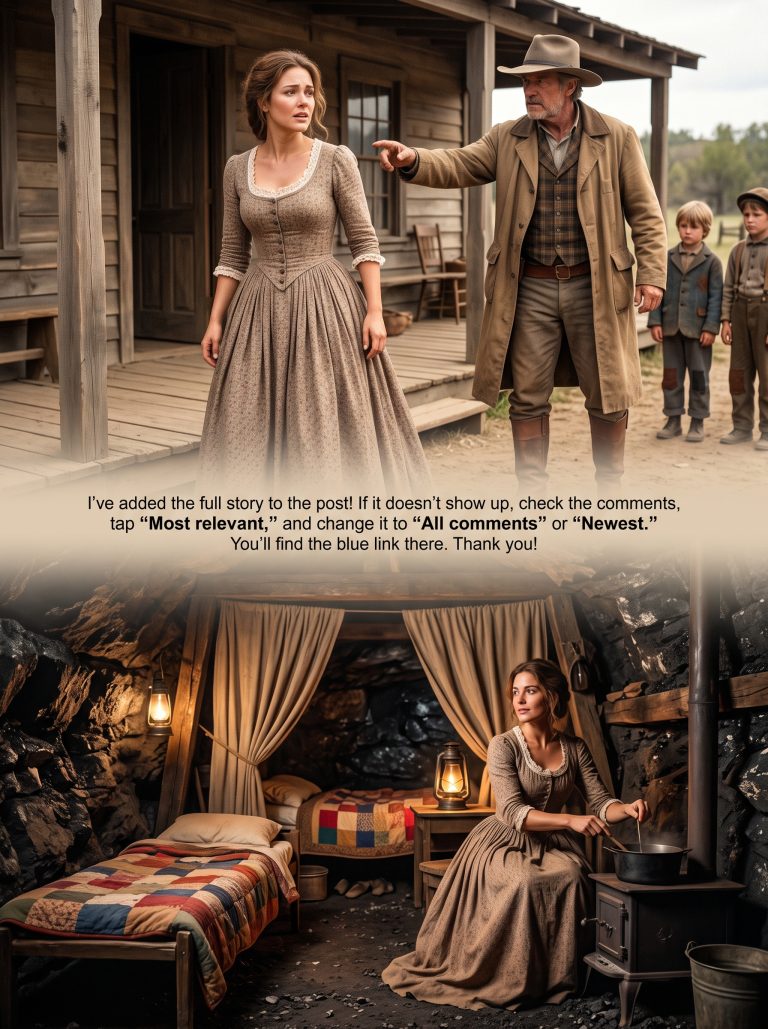
Wyatt swung down and rounded the wagon. A boy sat in the dirt, a thin blanket around his shoulders, his eyes too old for his face. An elderly woman leaned against the broken wheel, gray hair pinned with more dignity than her torn collar deserved. And standing between them and Wyatt, as if she alone could hold back the world, was a young woman in a travel-worn blue dress.
She was lovely in a way that startled him — not soft, not untouched, but proud in the particular way of someone who had decided fear would not be allowed to show.
“Ma’am,” Wyatt said. “You folks need help?”
“Our horses bolted before dawn,” she said. Her voice was educated, careful, strained thin. “We’ve been stranded since first light.”
Wyatt had lived alone long enough to notice details other men overlooked. The grandmother’s coat was fine beneath the dust. The boy’s manners were careful in a way boys’ manners rarely are. The young woman wore no jewelry save a wedding band on a chain, half-hidden at her throat.
“Any men traveling with you?”
Something flickered across her face. “No.”
That single word carried a graveyard behind it.
“My place is over that rise,” Wyatt said. “Water, food, a roof. You’re welcome to it.”
“Why?” she asked, wary as a spooked colt.
“Because you need it.”
“That simple?”
“Best kind of reason there is.”
She studied him a long moment, then extended a hand that trembled only slightly. “Ellen Ford.”
Margaret’s eyes snapped toward her. Wyatt suspected it wasn’t the name she’d been born with — the delivery too quick, the syllables sitting wrong on her tongue — but he only nodded.
“Wyatt Calder.”
“Noah,” the boy whispered.
“Margaret,” the old woman said, then paused half a breath, as if a longer name had risen and been swallowed before it reached her lips. “Margaret will do.”
Wyatt helped Margaret onto his mare first, then Noah in front of her. When he reached for the young woman’s elbow, she stiffened.
“I’ve got you,” he said.
She pulled away a moment later. “I can walk.”
“Didn’t say you couldn’t.”
He walked beside her anyway, shortening his stride twice without mentioning it when her steps grew unsteady. By the time his cabin came into view, sunset had filled the windows with fire, and Noah’s tired face changed at the sight of it.
“Is that yours?” the boy asked.
“Bank lets me pretend,” Wyatt said. Still owed the bank more than half the place was worth, if he was honest about it, but that wasn’t a thing you handed a stranger before supper.
Inside, the woman calling herself Ellen paused at the threshold, taking in the plain room, stone hearth, rifle hooks, a folded quilt, like someone stepping into safety she didn’t trust yet.
They ate in a silence broken only by the fire and Noah’s soft thanks. Margaret’s spoon shook in her hand. Ellen barely touched her plate, though hunger shadowed her eyes.
“You need more than that,” Wyatt said.
“I’m fine.”
“No. You’re proud.”
Her gaze snapped to his, sharp and startled.
“I’ve learned that taking too much from strangers costs more than hunger,” she said quietly.
“Not in this house,” Wyatt answered, and something in his voice made her look at him differently — as if she were recalculating a sum she’d already added twice.
Later, after Noah slept by the fire and Margaret dozed in the chair, Ellen stood at the window, staring east.
“Expecting someone?” Wyatt asked.
“No.”
“Afraid of someone?”
Her reflection closed its eyes. “That isn’t your burden, Mr. Calder.”
“Folks under my roof become my burden.”
“That seems a habit of yours.”
“Looks like arguing’s a habit of yours too.”
For one strange second, something alive passed between them despite the dust and the fear.
Then hoofbeats sounded on the wind.
Ellen went white. Margaret woke with a gasp. Noah sat up, eyes huge.
Wyatt stepped onto the porch and found three riders black against the dying light, one lifting a field glass toward the cabin.
Behind him, Ellen whispered, “God help us.”
Wyatt reached for his rifle.
Part 2
“Cellar’s under the pantry rug,” Wyatt said, not looking away from the ridge. “Take them down and stay quiet.”
“They came for us,” Ellen said. “We won’t hide while you face them alone.”
“You will if that boy matters.”
The words landed like a slap. She knelt, cupped Noah’s face. “Do exactly as Mr. Calder says.”
Noah gripped her wrist. “Aunt Ellen, don’t let them take me.”
Aunt. Not mother. Not even, perhaps, Ellen at all.
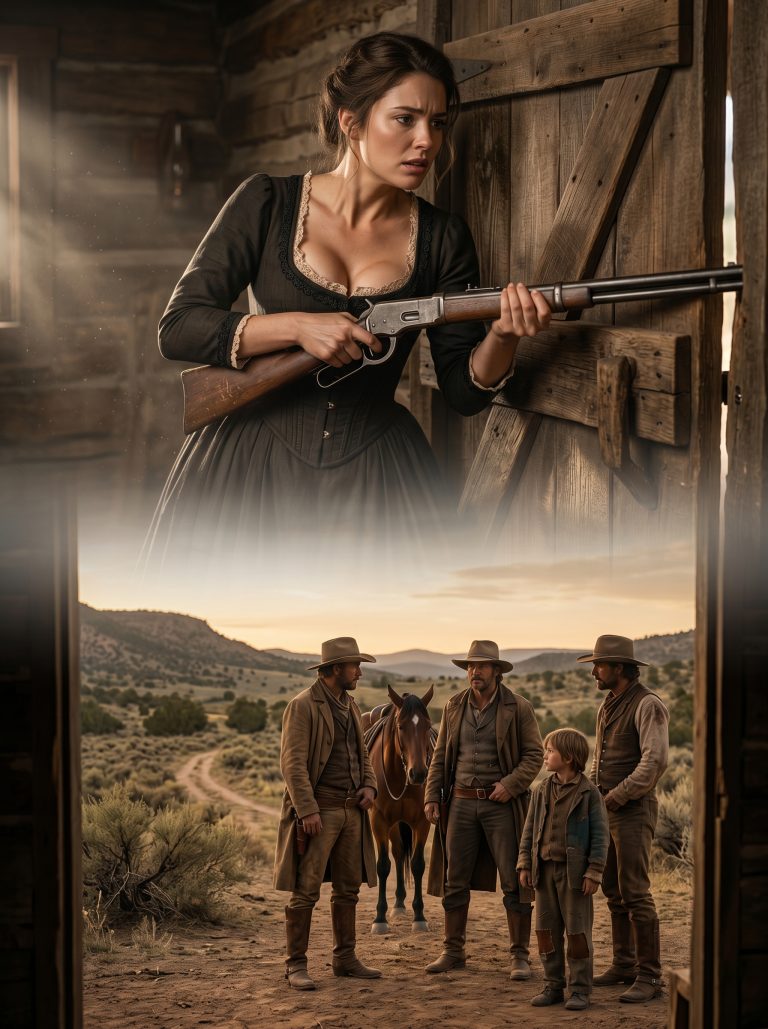
Wyatt heard it. So did Margaret. He said nothing, only sent them below and stepped onto the porch as the riders reined up, dust curling around their horses’ legs. The lead man wore a scar down one cheek and a smile that didn’t reach his eyes.
“Evening,” he called. “Looking for an old woman, a boy, and a widow with a wagon problem. They’re thieves.”
“Seen travelers,” Wyatt said. “Not thieves.”
“Property’s missing. The boy, specifically.”
The yard went dead still.
“Hand him over,” the scarred man said, “and we ride off peaceful.”
“Ride off,” Wyatt answered, “and you’ll leave breathing.”
The youngest rider went for his gun. Wyatt fired first, into the dirt, and the horse reared, scattering them. The scarred man wheeled his mount, hatred burning through his smile.
“You don’t know who you’re sheltering, cowboy. They’re Ashworths, richest bloodline in three counties. And that woman is the last thing standing between Victor Ashworth and a fortune.”
“Victor Ashworth,” the man added before he turned east, “sends his regards. And a promise. He says tell the widow her dead husband would be ashamed of what she’s dragging an innocent man into.”
Ellen, listening from the cellar stair, made a sound like something breaking.
Wyatt didn’t understand it yet. But he filed it away, the way he filed away every crack in a story that didn’t sit flush.
“Storm’s coming, Calder,” the scarred man called back. “We’ll return when thunder covers gunfire.”
When the riders vanished, Ellen’s knees gave. Wyatt caught her before she hit the floor, and for one breath she let herself lean into him.
“I’m sorry,” she whispered. “I should have told you everything.”
“Tell me now,” Wyatt said.
Thunder rolled across the prairie like a warning, and somewhere beneath it, Wyatt Calder felt the first cold certainty that the dead man mentioned outside his door was not as dead as everyone believed.
Part 3
Thunder shook dust from the rafters while Wyatt held her upright, and for a long moment Ellen didn’t seem to remember where she was. Her hands clutched his shirt; her breath came broken, as though she’d been running for miles though she hadn’t moved from the doorway.
“Ellen,” he said.
She flinched at the name. “It isn’t Ellen.”
“I know.”
Shame flooded her face. “Rose. Rose Ashworth. Ellen was my sister’s middle name — the first one that came to my tongue when I needed to disappear.”
“Tell me the rest.”
She drew the ring from beneath her collar — not alone this time, but with a small folded oilskin packet tied beside it. “Noah’s father, Edmund, was my brother-in-law. My sister Louisa married him. When she died last winter, she made me promise to protect Noah from the men smiling around his father’s table. Three weeks ago, Edmund was found dead — thrown from his horse, they said. But Noah saw his uncle Victor standing over the body, taking papers from Edmund’s coat. After the funeral, Victor petitioned the court for guardianship. He said Noah was grieving, confused, unfit to inherit without guidance.”
“And you ran.”
“Because no one believed a frightened boy over a wealthy man.” Rose’s jaw tightened. “Or they believed him and were too afraid of Victor to say so.”
“What about your husband? The rider mentioned him. Called him dead.”
Something closed in her expression, old and unhealed. “Henry Ashworth. Victor’s cousin. Two years ago the bank sent word his skiff had capsized on the Brazos crossing. They never found the body — the current there doesn’t give bodies back. I wore black for a year and told myself grief was a debt I’d finish paying eventually.” She looked down at the ring. “I still don’t know why Victor’s man threw his name at me tonight like a blade.”
Wyatt let the thought settle. A debt collector doesn’t bring up a dead man for spite. He brings him up because he isn’t sure he’s dead either.
Margaret’s voice came from the pantry stair. “Mr. Calder. If you help us, Victor will ruin you. Your land. Your name.”
“Ma’am,” Wyatt said, “men have tried.”
They left within the hour, riding for the old line shack at Cottonbend Draw through a black, lashing rain. Rose’s mare stumbled at the creek crossing; she said nothing, though her face went the color of ash. By the time Wyatt got them inside and lit the lantern, her ankle had swollen badly enough that she couldn’t stand.
He knelt and wrapped it himself, gentler than his hands looked built for.
“You rode on this,” he said.
“I had to.”
“You could’ve told me.”
“And slowed us down?” Her voice cracked. “You had Noah. Margaret could barely sit the saddle. I wasn’t going to become a burden.”
“You are not a burden,” Wyatt said, low and final, and Rose looked away before he could see the tears gathering.
Later, with Noah and Margaret asleep, she handed him the oilskin packet. Inside: a letter in Louisa’s hand, a bank ledger page, a deed transfer with signatures that didn’t square with the dates beside them.
“Witnessed by Judge Prescott,” Wyatt said.
“He’s in Victor’s pocket. So is Sheriff Nolan, who owes Ashworth Bank more than he’ll ever repay.”
“Then we don’t take it to them. Marshal’s due into Redemption Creek for circuit hearings next week.”
“Next week,” Rose whispered. “Victor will find us by morning.”
“Storm hides tracks. Morning sun won’t.” Wyatt was already writing by lantern light — a short note for Jesse Larkin, who’d seen the riders scatter from the cabin and would still be watching the place from the tree line out of pure stubborn loyalty. Ashworth riders hunting a woman and a boy. Send for Marshal Bishop — tell him circuit business can wait, this can’t. We’re making for the freight road to Redemption Creek. He tied it to a spare mount and sent it off into the storm before they rode for the draw. “If Jesse reaches him tonight, Bishop can cut across the flats and beat us to the freight road by morning.”
“And if he doesn’t?”
“Then we ride faster than Victor does.” Wyatt folded the stolen papers back into the oilskin and met her eyes. “Why are you doing this? Truly.”
“You keep asking that like there’s an answer I won’t hate.”
“Maybe you stopped being a stranger when you put yourself between me and that boy.”
“Don’t say things like that.”
“Why?”
“Because I might believe them.”
They set out before dawn under a gray sky, hiding their trail in the draw. By noon they were within ten miles of Redemption Creek when the trap closed. A shot cracked from the ridge, and eight riders appeared where three had been, a tall man at their center, coat dark despite the mud, hat untouched by rain, as easy in the saddle as a man arriving for supper.
Victor Ashworth.
“Enough foolishness,” he called down. “Rose, you’ve embarrassed yourself beyond forgiving.”
“You killed Edmund.”
“My cousin drank too much and rode too hard. Grief has made you hysterical.”
“I saw you,” Noah shouted, small and shaking. “Take Papa’s papers.”
Victor’s pleasant mask thinned. His eyes slid to Wyatt. “Two hundred acres, forty-seven head, an unpaid note at Kessler’s Mercantile, taxes due in October. Do not throw that away for a lying widow.”
“You talk too much for an innocent man,” Wyatt said.
“And you’re exactly what I expected,” Victor answered. “A lonely, prideful cowboy mistaking stubbornness for honor. Come here, Rose. Bring the boy. Bring my mother home, and I’ll forget this rebellion.”
“No,” Rose said.
It was a simple word. It changed everything.
Victor’s face darkened with the first honest emotion she’d ever seen from him. “You are nothing. A dependent widow living on charity my family gave you. Tell me, Calder. Has she promised you money, or only herself?”
Wyatt’s rifle came up, dead steady. “Say one more word about her and you’ll need six men to carry you home.”
Victor smiled thinly and nodded. One of his riders seized Margaret’s reins.
Gunfire broke the wash wide open. Rose spurred forward for Margaret; Wyatt fired twice, not to kill but to break the charge. Then Victor drew on Rose, and Wyatt crossed open ground with no thought but her name, taking the bullet meant for her high across his side as they hit the dirt together.
“Wyatt!” Rose’s scream tore the air.
A voice thundered from the freight road. “Drop your guns!”
Marshal Colt Bishop rode into the wash with six armed men, Sheriff Nolan pale and sick beside him, and Jesse Larkin — who’d ridden through the night to reach him — leading the way. Jesse’s note had found the marshal already camped a day out from Redemption Creek; the moment he’d read the name Ashworth, Bishop had turned his party toward the freight road at first light, gambling that anyone running from Victor would follow the same route Wyatt had. Victor tried to recover his footing with lies about abduction, but Margaret straightened in her saddle, mud-streaked and unbending.
“Silence, Victor,” she said. “I am Margaret Ashworth, mother of Edmund and Victor, and I accuse my son of theft from this estate, unlawful imprisonment, the attempted abduction of Noah Ashworth, and the murder of his brother.”
The wash went silent. Even the marshal looked at her.
Rose, pressing both hands against Wyatt’s wound, fumbled the oilskin free and held it up. “Marshal, the papers.”
Bishop scanned the ledger, the deed, the signatures, and looked at Victor with cold satisfaction. “Judge Prescott’s name is all over this.”
Victor lunged for his fallen pistol. Bishop fired first, striking his hand, and Jesse dragged him from the mud.
“Victor Ashworth,” the marshal said. “You’re under arrest.”
Rose barely heard it. Wyatt’s eyes were closing. “No,” she whispered, bending over him. “You do not get to save me and leave. Do you hear me?”
His lashes lifted with effort. “Bossy.”
“Terribly. So listen.”
Rose did not let go of his hand, not when Jesse brought the wagon around, not when the marshal’s men lifted Wyatt onto the bed of straw, not once for the whole hard ride into town, her free hand pressed against his side the entire way while Jesse drove and the marshal’s men flanked them through the mud.
Dr. Hale, a thin woman with silver spectacles and no patience for panic, cleaned and stitched the long gash the bullet had carved across his side while half of Redemption Creek gathered outside to see the truth ride in ahead of the rumor. Not deep, the doctor said twice. Grazed the ribs and kept going — didn’t lodge. Not fatal if infection stays away. Not safe yet.
For three days Rose barely left his side, and on the third night he woke to find her sitting with her head bowed, one hand near his but not touching it.
“You look worse than me,” he rasped.
“You were shot.”
“Noticed.”
“You might have died.”
“Didn’t.” His gaze softened. “Rose.”
She startled at hearing her own name in his voice, plain and unguarded for the first time. “I lied to you. I dragged you into an Ashworth war. You took a bullet meant for me.”
“I took it because I chose to,” Wyatt said. “Because the moment he aimed at you, every choice became simple.” His thumb moved once over her knuckles, rough and careful. “I don’t have pretty words. But I know what a thing means when I do it.”
“What did it mean?”
“That I couldn’t bear a world that kept Victor Ashworth in it and took you out of it.”
Rose bowed her head, and something in her chest that had been running for two years finally, quietly, stopped.
The hearing convened in the church because half the town had come to hear it. Marshal Bishop kept order and Victor under guard at the back, but the ruling itself belonged to Judge Alden, the circuit judge who’d arrived that morning to hear cases untouched by Prescott’s corruption — a stranger to Redemption Creek, and precisely for that reason, a man both sides had to trust.
A cousin named Leonard rose first to argue for guardianship of “the estate’s financial matters,” until Margaret’s cane struck the floor once and silenced him without a word wasted. She asked the court to name Rose protector before the town, before God, before every Ashworth man who had said Noah’s name and meant money.
Noah stood and spoke for himself. “Uncle Victor said Aunt Rose wanted money, but she sold her wedding brooch to buy us bread. She slept sitting up so she could hear anyone coming.” He looked at Wyatt. “Mr. Calder gave us water before he asked who we were. Papa told me a man’s name doesn’t make him good. What he does makes him good. Mr. Calder is good.”
One by one, townsfolk who had feared Victor’s bank too long to speak found their voices. When the last of them sat down, Judge Alden granted Margaret guardianship of Noah, with Rose named his legal protector until the estate’s affairs could be settled in full — and ordered Victor held for circuit trial.
That should have been the end of it. It was not.
Three weeks later, with Wyatt’s wound healing into a hard red scar and Rose’s visits to the ranch grown into something neither of them named aloud, a letter reached Redemption Creek that undid the quiet they’d built.
It came from a river town two hundred miles south, addressed to Margaret Ashworth in a hand Rose recognized before she’d finished reading the signature.
Henry.
Alive. Not drowned at the Brazos crossing two years ago, but pulled from the current half-dead by a trapper, and — when he learned from a passing rider three days later that Victor was already telling Redemption Creek his cousin had drowned — he had let the lie stand. He’d spent a year piecing together, town by town, ledger by ledger, the proof that Victor had been bleeding the estate dry long before Edmund’s death, proof he’d been too afraid to bring home alone against a man who controlled the sheriff and the judge both. He had been building his own case in the shadows, waiting for enough evidence to bring Victor down without dragging Rose into danger.
He hadn’t known Edmund would die before he finished. He hadn’t known Rose would run.
He was coming home.
Rose read the letter twice at Wyatt’s kitchen table, her hands not shaking exactly, but not steady either. Wyatt watched her from across the room and said nothing, because there was nothing honest to say that wouldn’t sound like a man protecting his own claim.
“You should go to him,” he said finally.
“I don’t know what I owe a man who let me grieve him for a year.”
“That isn’t for me to answer.”
“No,” Rose said. “But it is for you to want an answer to. Don’t pretend otherwise.”
He didn’t. That was the whole of Wyatt Calder — he’d never once pretended.
Henry Ashworth arrived in Redemption Creek two days before Victor’s trial, thinner than the man in Rose’s memory, a scar over one eyebrow and a satchel of evidence that closed the last gaps in the marshal’s case: forged deeds and three years of doctored ledger entries, proof Victor had been bleeding the estate long before Edmund’s death. It was motive enough to finally make sense of what the stable boy had already sworn under oath — that he’d seen Victor’s hands at Edmund’s saddle the morning of the ride that killed him. He testified. He did not ask Rose to return to him. He asked, instead, to see Noah, and spent an afternoon teaching the boy to skip stones on Widow’s Creek, the same creek where Wyatt had found them all.
That evening he found Rose alone on the porch of the Ashworth house.
“I owe you nothing,” she said before he could speak, “and everything, and I don’t know how to hold both.”
“You don’t have to hold either,” Henry said. “I wrote twice, that first year. Neither letter reached you — I know now because I finally traced them, and both had passed through Victor’s hands before they were ever burned. When I understood he controlled every post rider between here and the river towns, I stopped writing. I told myself every letter I sent only pointed him closer to you and Noah, and that silence was the safer cruelty. I still don’t know whether that was the truth, or just the lie a coward tells himself. I’m not here to reclaim a wife. I’m here to finish what I started against my cousin, and to tell you that whatever you’ve built since — you’re allowed to keep it.”
“That’s generous of you to say.”
“It isn’t generosity.” Henry looked out at the dark fields. “It’s the truth I owe you, which is the only thing I have left to give. I saw the way you looked at that rancher in the churchyard. I don’t begrudge it. A man who fakes his own drowning doesn’t get to demand loyalty from the woman he let bury him.”
Rose’s eyes stung. “I’m sorry you were alone.”
“I’m sorry you were, too. Different kind of alone. Go be done with it, Rose.”
Victor’s trial came in October, gold cottonwoods lining the road into town. Henry’s evidence, stacked atop the marshal’s and the stable boy’s testimony and Judge Prescott’s own confession in exchange for mercy, closed every door Victor had left open. He was found guilty on enough charges to ensure Redemption Creek would never again answer to his name. Margaret stood in the courtroom and did not look away from her son as he was led out in irons.
“I buried the son I loved,” she told him, quiet enough that only the front pews heard. “I will not bury the truth for the one I failed.”
Henry left Redemption Creek before the leaves finished turning, bound for a stretch of unclaimed land out past Abilene where a man could start fresh without a dead name trailing him. He wrote once that winter — a short letter, mostly about the weather — and Rose kept it in the same drawer as Louisa’s letter, not from love recovered, but from a debt she no longer needed to be ashamed of owing.
Wyatt never asked what was in it. He’d learned, by then, that some doors a person needs to close themselves.
The cabin changed slowly through that autumn. A second bed appeared for Noah’s Saturday visits. Fresh curtains, sewn by Rose from fabric Margaret called too cheerful and secretly admired, hung in the window. The roof stopped leaking before the rains came. A braided rug lay by the hearth, and the second chair by the fire became Rose’s by unspoken law.
One evening, with the first frost silvering the grass, Wyatt found her near the creek where the broken wagon had once sat, only wheel ruts left now, half-healed by new grass.
“I hated this place at first,” Rose said. “I thought this was where everything ended.”
“I thought the same about my cabin for years,” Wyatt answered. “That nothing would ever begin here again.”
He took a small ring from his coat: gold, simple, a green stone catching the light like prairie grass after rain.
“I asked Margaret first,” he admitted. “She said if I hurt you, she’d buy my mortgage and make me regret being born.”
Rose laughed through sudden tears. “And Noah?”
“Said yes, if he could still come Saturdays and never has to wear a stiff collar to supper.”
“Wise conditions.”
Wyatt’s voice roughened. “I don’t have a grand house or polished manners, and I can’t promise life won’t be hard. But no lie will live between us if I can help it, and no morning will come when you have to earn your place beside me. It’s yours if you want it. I love you — not because I saved you, but because you stood in the worst storm of your life and still protected everyone around you. Marry me.”
“Yes,” Rose said, and meant it the way a person means a thing they’ve finally stopped running from. “Yes, Wyatt Calder.”
They were married in November, frost on the church windows and prairie light spilling gold across the floorboards. Noah guarded the ring in his pocket like a national treasure. Margaret pretended she hadn’t been crying since the first hymn. Dr. Hale sat in the front pew, arms crossed, daring Wyatt’s old wound to act up.
When Rose walked down the aisle, the guarded cowboy in Wyatt vanished, and what was left looked at her the way a man looks at a door finally opening onto a lit room.
That winter was hard, as he’d promised it would be — snow came early, a calf was born weak in a bitter night, and Rose sat wrapped in blankets holding the lantern while Wyatt worked. But the cabin held boots by the door now, and books on the table, and laughter where loneliness had settled too long.
Years later, people in Redemption Creek would tell it as the story of a broken wagon by the creek — the hunted widow, the lost boy, the proud grandmother, and the lone rancher who didn’t know he was sheltering the wealthiest family in the county. They’d talk of Victor’s downfall, of a husband who let himself be buried and came home only to set someone else free, of a boy who told a courtroom that goodness is a thing a man does, not a thing he’s born to.
But Rose knew the truer story. Wyatt’s bravest act had never been the rifle, or the bullet he took, or the men he’d faced down on his own porch.
It had been opening his door to strangers who cost him nothing to turn away.
When people asked him, years on, about the greatest fortune ever to cross his land, Wyatt never mentioned the Ashworth name, the bank, or the cattle contracts that came with it. He’d look toward the cabin where Rose’s voice warmed the rooms and Noah’s laughter carried across the yard, and he’d say the same thing every time.
“Found them stranded by the creek. Thought I was taking them in.”
Then he’d smile.
Folks always said he’d saved them. Wyatt knew better.
“Turns out they were bringing me home.”
— THE END —